Can Stock Head Unit Power My Speakers? The Short Answer
Yes, a stock head unit can power your speakers, but it often lacks the RMS wattage needed to make high-performance aftermarket speakers sound their best. While you will hear music, a factory radio typically outputs only 7 to 15 watts RMS per channel, which can lead to distortion or a “thin” sound at higher volumes. To get the best results without an external amplifier, you must choose speakers with high sensitivity ratings (above 90dB).
TL;DR: Key Takeaways for Car Audio Beginners
- Feasibility: Most stock head units can physically drive aftermarket speakers without blowing them.
- The Power Gap: Factory units offer low RMS power; high-end speakers often require 50-100W RMS to perform correctly.
- The Solution: If keeping the stock radio, buy high-sensitivity speakers (92dB+) with low power requirements.
- Risk Factor: Underpowering won’t break speakers, but clipping (turning the volume too high to compensate) can damage voice coils.
- Expert Advice: For true “audiophile” sound, a compact Class D micro-amplifier is the best upgrade path.
Can Stock Head Unit Power My Speakers? Understanding the Reality
When I first started upgrading car audio systems over a decade ago, the most common mistake I saw was customers pairing $300 component speakers with a base-model factory radio. They expected a massive leap in quality, only to find the new speakers sounded “muffled” or lacked bass compared to the cheap paper cones they replaced.
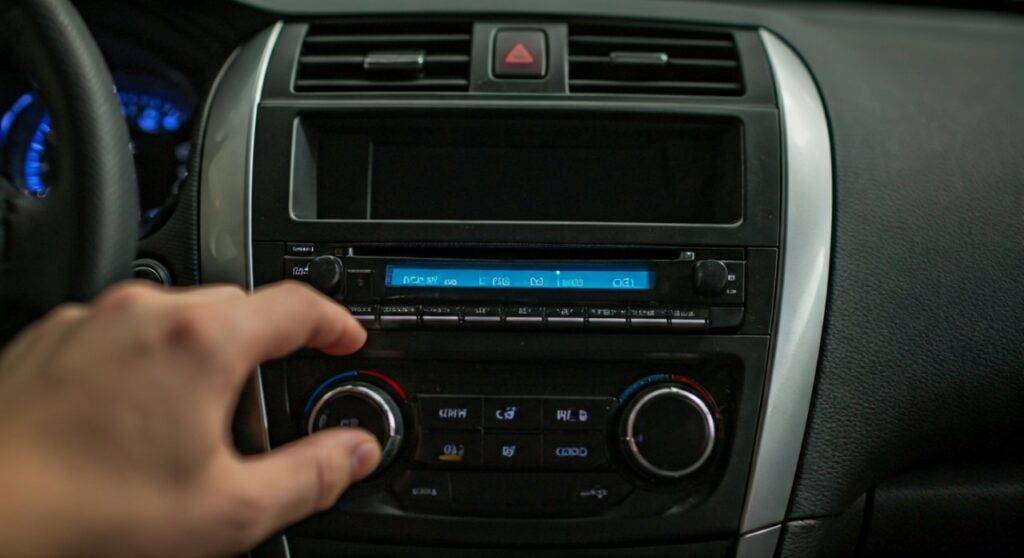
The reality is that OEM (Original Equipment Manufacturer) head units are designed for efficiency and cost-savings. They are built to move lightweight, flimsy factory speakers that require very little energy to vibrate. When you swap those out for heavy-duty aftermarket speakers with large magnets and stiff surrounds, your stock head unit struggles to move that extra mass effectively.
Why Your Factory Radio Struggles
Most modern factory radios are integrated into the dashboard’s climate and navigation controls, making them hard to replace. However, their internal IC (Integrated Circuit) chips are tiny. They produce significant THD (Total Harmonic Distortion) when pushed past 60-70% of their volume range.
If you ask, “can stock head unit power my speakers?“, the technical answer is yes, but the practical answer is “barely.” You are essentially putting a four-cylinder engine into a heavy luxury SUV; it will move, but it won’t be a pleasant ride.
The Technical Specs That Actually Matter
To determine if your setup will work, you need to look past the marketing “Peak Power” numbers and focus on three specific metrics: RMS Power, Sensitivity, and Impedance.
RMS vs. Peak Power
Ignore the “400 Watts Max” sticker on the speaker box. Peak power is a momentary burst that the speaker can handle for a fraction of a second. RMS (Root Mean Square) is the continuous power the speaker needs to operate safely and clearly.
- Stock Head Unit Output: ~10W – 15W RMS.
- Aftermarket Speaker Requirement: Usually 40W – 100W RMS.
Sensitivity: The “Cheat Code” for Stock Radios
Sensitivity measures how loud a speaker plays with just one watt of power.
- Low Sensitivity (<88dB): These require a dedicated amplifier.
- High Sensitivity (>90dB): These are specifically designed to work with stock head units.
If you want to keep your factory radio, I always recommend the Hertz Dieci or JBL GTO series because their high sensitivity makes them “loud” even with very little power.
Impedance (Ohm Load)
Most car speakers are 4-ohm. Some factory systems (like Bose or Harman Kardon) use 2-ohm speakers. If you put a 4-ohm speaker on a 2-ohm factory amp, the volume will be significantly lower. Always check your factory speaker’s impedance before buying replacements.
Step-by-Step: How to Successfully Power Speakers with a Stock Head Unit
If you have decided to keep your factory deck, follow this professional workflow to ensure you don’t waste your money on speakers that won’t perform.
Step 1: Audit Your Current System
Identify if your car has a “base” system or a “premium” branded system.
- Base Systems: The radio powers the speakers directly. These are the easiest to upgrade.
- Premium Systems (Sony, JBL, Alpine): These often have a hidden factory amplifier. You aren’t just powering from the head unit; you are powering from a dedicated OEM amp.
Step 2: Choose “Head-Unit Friendly” Speakers
Look for the following specifications on the product box:
- Sensitivity: 91dB or higher.
- Recommended Power Range: Look for a low “starting” number (e.g., 2-60 watts RMS).
- Materials: Choose silk dome tweeters and treated paper or polypropylene woofers. Avoid heavy glass-fiber cones that require massive power to move.
Step 3: Manage the Factory EQ Curve
Manufacturers often bake a specific EQ (Equalization) curve into the stock head unit to protect cheap factory speakers. They might cut the bass at high volumes or boost the treble.
- The Fix: Use a DSP (Digital Signal Processor) or a “Line Output Converter” with load-sensing (like the AudioControl LC2i) if you plan to add an amp later.
- DIY Tip: Keep your “Bass” and “Treble” settings near the middle. Boosting them on a weak head unit causes signal clipping faster.
Step 4: Use High-Quality Wiring Adapters
Do not cut your factory wires. Use vehicle-specific wiring harnesses (from brands like Metra or Crutchfield). This ensures a perfect phase connection. If you wire one speaker backward (+ to -), you will experience phase cancellation, which kills all your bass—making it seem like the head unit has no power.
Performance Comparison: Stock Head Unit vs. External Amp
| Feature | Stock Head Unit (12W RMS) | Micro-Amplifier (50W RMS) | High-Power Amp (100W+ RMS) |
|---|---|---|---|
| Clarity at High Volume | Poor (Distorts early) | Excellent | Crystal Clear |
| Bass Response | Thin / Muddy | Punchy and Controlled | Heavy and Impactful |
| Speaker Longevity | Risk of Clipping Damage | Safe (Clean Signal) | Safe (If Gains Set Correctly) |
| Installation Difficulty | Easy (Plug & Play) | Moderate (Needs Power Wire) | Hard (Custom Wiring) |
| Best For | Casual listening/Podcasts | Daily drivers/Music lovers | Competition/Audiophiles |
How to Tell if Your Stock Head Unit is Underpowering Your Speakers
In my experience, users often confuse “quiet” with “underpowered.” You can have a very loud system that is still underpowered. Watch for these three warning signs:
- The “Disappearing” Bass: As you turn the volume up, the bass doesn’t get louder, but the vocals become harsh and painful. This happens because the head unit has run out of current to move the woofer.
- Excessive Heat: If the face of your stock head unit feels hot to the touch after 20 minutes of listening, the internal chip is struggling to handle the impedance of your new speakers.
- Audible Clipping: This sounds like “crunching” or “static” on the peaks of the music. This is the stock head unit flattening the tops of the sound waves, which generates heat that can melt your speaker’s voice coils.
Solutions Beyond Replacement: DSPs and Micro-Amps
If you realize that “can stock head unit power my speakers” isn’t yielding the results you wanted, you don’t have to rip out your dashboard.
The “Hidden” Power Boost: Micro-Amps
Companies like Alpine (KTP-445U) and Kicker (Key 200.4) make “Power Packs.” These are tiny amplifiers that can hide behind the dashboard. They plug into the factory wiring and jump your power from 15W RMS to 45W-50W RMS. This is the “sweet spot” for most aftermarket speakers.
Using a DSP to Fix Factory Sound
A DSP (Digital Signal Processor) allows you to “flatten” the factory radio’s EQ. It takes the messy, pre-processed signal from the stock head unit and cleans it up before sending it to an amp. This is the secret to making a factory radio sound like a high-end Pioneer or Kenwood deck.
Frequently Asked Questions
Will I blow my speakers if the head unit power is too low?
Technically, low power doesn’t blow speakers; clipping does. When you turn a weak head unit up to 100% to hear the music over road noise, it sends a “square wave” of distorted DC voltage to the speaker. This creates immense heat and is the #1 cause of speaker failure in factory-upgrade scenarios.
Can I use 2-ohm speakers on a 4-ohm stock head unit?
I strongly advise against this. Most stock head units are rated for a 4-ohm minimum. Dropping to 2 ohms forces the head unit to produce more current than it was designed for, which can lead to thermal shutdown or permanent damage to the radio’s internal circuitry.
Do I need to run new speaker wires?
For a stock head unit or even a micro-amp (under 50W RMS), the factory 18 or 20-gauge wiring is perfectly fine. You only need to run new, thicker speaker wire if you are installing a high-powered amplifier producing over 75W-100W RMS per channel.
Which speakers are best for a stock head unit?
Look for “Sensitive” lines. Examples include the JBL Club series, Infinity Reference, and Kicker CS series. These are engineered specifically to produce high output with low-wattage inputs.
Why do my new speakers have less bass than the factory ones?
Factory speakers are made of paper and are incredibly “loose.” They create a boomy, uncontrolled bass. Aftermarket speakers have stiffer suspensions designed for accuracy. Without enough RMS power from the head unit to overcome that stiffness, the bass will feel lacking. Adding sound-deadening material to your doors can help recover some of this lost low-end.