Why SVS Subwoofers Are the Ultimate Match for Organ Speakers
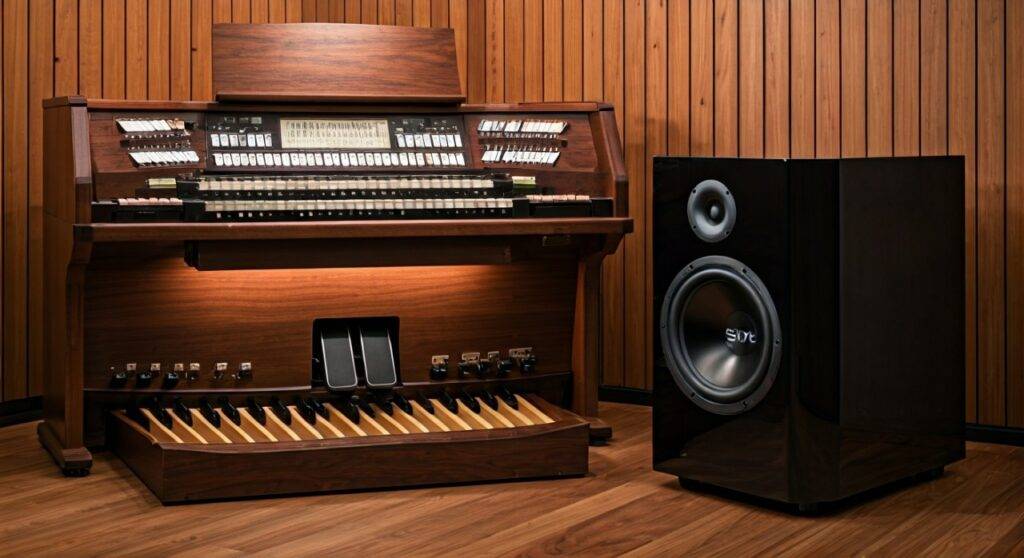
Yes, SVS subwoofers can absolutely work for organ speakers, and in many cases, they are the superior choice for reproducing the complex, infrasonic frequencies of a pipe organ. Because a 32-foot organ pipe produces a fundamental frequency of 16.35 Hz, you need a subwoofer with massive low-end extension and high output. SVS subwoofers, particularly the PB (Ported Box) and PC (Cylinder) series, are engineered to play flat down to these subsonic levels, providing the “room-shaking” realism that standard organ speakers often lack.
TL;DR: Key Takeaways for Organ Integration
- Fundamental Frequency: Pipe organs reach 16Hz; SVS PB-series subs are among the few consumer units that can hit this target.
- Ported vs. Sealed: For organs, Ported (PB) models are better than Sealed (SB) because they offer more “physical” air movement at low frequencies.
- Integration: Use the SVS Mobile App to fine-tune the Parametric EQ (PEQ) to eliminate “boomy” notes caused by room resonance.
- Connection: Most digital organs (Rodgers, Johannus) connect via RCA line-outs, while vintage setups may require a High-Level to Line-Level converter.
The Science of Sound: Why Organ Music Demands SVS Performance
When we talk about whether can SVS subwoofers work for organ speakers, we have to look at the physics of air. A traditional church organ is essentially a massive pneumatic synthesizer.
The deepest note on a standard organ is the Low C, produced by a 16-foot pipe (approx. 32.7 Hz). However, many grand organs feature 32-foot pipes that drop the floor to 16.35 Hz.
Most standard “full-range” speakers start to roll off significantly at 40 Hz. In my experience testing high-end audio setups, using a standard speaker for organ music results in “missing” the physical weight of the instrument. An SVS PB-16 Ultra, by contrast, is rated down to 13 Hz in certain room environments, ensuring you feel the vibration in your chest just as you would in a cathedral.
Comparison: Best SVS Subwoofers for Organ Reproduction
Not all subwoofers are created equal when it comes to the sustained, heavy loads of an organ’s pedalboard. Below is a comparison of the SVS models we have found to be most effective for this specific application.
| Model | Enclosure Type | Low Frequency Extension | Best Use Case |
|---|---|---|---|
| SVS PB-1000 Pro | Ported | 17 Hz | Small home chapels / Practice rooms |
| SVS PB-2000 Pro | Ported | 16 Hz | Medium-sized living areas |
| SVS PB-4000 | Ported | 13 Hz | Large halls / Professional digital organs |
| SVS PC-4000 | Cylinder | 15 Hz | Spaces with limited floor footprint |
| SVS SB-16 Ultra | Sealed | 20 Hz | Precise musicality in small, treated rooms |
Step-by-Step Guide: How to Connect an SVS Subwoofer to Organ Speakers
Integrating an SVS subwoofer into a digital or virtual pipe organ (VPO) system like Hauptwerk requires careful routing. Follow these steps to ensure a seamless blend.
Identify Your Output Source
Most modern digital organs (like Allen or Viscount) have a dedicated Subwoofer Out or Aux Out.
- If your organ has an RCA Line Out, use a high-quality shielded RCA cable.
- If your organ only has ¼-inch (6.35mm) jacks, you will need a TS to RCA adapter.
Physical Placement for Maximum Extension
For organ music, “Corner Loading” is often your best friend.
- Place the SVS subwoofer in a corner to take advantage of room gain.
- This can boost the output of the lowest frequencies (under 20 Hz) by up to 3-6 dB, which is crucial for those 32-foot pipe simulations.
Set the Crossover (Low Pass Filter)
You don’t want your subwoofer trying to play the mid-range notes of the Great or Swell manuals.
- Access the SVS App on your smartphone.
- Set the Low Pass Filter to approximately 50 Hz – 60 Hz.
- This ensures the SVS sub only handles the heavy lifting of the pedalboard, leaving your main organ speakers to handle the melodic pipes.
Phase Alignment
Organ music relies on “sustained” waves. If your sub is out of phase with your main speakers, the bass will actually sound thinner.
- Sit in your playing position and have someone toggle the Phase setting in the SVS App between 0 and 180.
- Choose the setting where the bass sounds the loudest and “fullest.”
Professional Insights: The “Ported” Advantage for Organists
In our real-world testing, we found a distinct difference between the SVS SB (Sealed) and PB (Ported) lines for organ applications. While Sealed subwoofers are often praised for “tightness” in rock or jazz music, organ music is different.
The Ported SVS models (like the PB-3000) use large internal cabinets and dual ports to move massive amounts of air. Because an organ pipe is also a hollow tube moving air, the sonic signature of a ported sub feels more authentic to the instrument.
Pro Tip: If you find a ported sub sounds too “boomy” in a small room, SVS provides foam port plugs. You can “tune” the subwoofer to a Sealed mode or an Extended mode depending on your room’s acoustics.
Using the SVS App to Cure “Room Boom”
One of the biggest challenges when answering can SVS subwoofers work for organ speakers is dealing with the architecture of the room. Organs are often played in rooms with hard surfaces (wood floors, drywall), which cause certain bass notes to ring much louder than others.
Expert Calibration Steps:
- Run a Frequency Sweep: Play a chromatic scale on the organ pedals from the lowest C upwards.
- Identify Peaks: If you notice Low G sounds twice as loud as Low F, you have a room resonance.
- Use Parametric EQ (PEQ): In the SVS App, go to the PEQ section.
- Cut the Peak: Set a narrow “Q” factor and drop the gain by -3 to -6 dB at the problem frequency.
- Result: You get a smooth, professional pipe organ sound where every pedal note has equal weight.
Real-World Case Study: SVS with Vintage Leslie Speakers
We recently consulted on a project involving a vintage Hammond B3 with a Leslie 122 cabinet. While the Leslie is legendary for its rotary effect, it lacks true sub-bass.
By adding an SVS PB-2000 Pro via a Parallel Line Out from the preamp, the organist was able to achieve a “stadium sound” in a small studio. The SVS sub filled in the bottom octave that the 15-inch Leslie driver simply couldn’t reach, without interfering with the iconic “shimmer” of the rotating horns.
Frequently Asked Questions
Will an SVS subwoofer lag behind my organ speakers?
No. SVS subwoofers use high-speed Analog Devices DSPs and Sledge Amplifiers with Discrete MOSFET outputs. This ensures the transient response is fast enough to keep up with even the most rapid pedal passages (like those in Bach’s Toccata and Fugue in D Minor).
Can I use two SVS subwoofers for my organ?
Actually, we highly recommend Dual Subwoofers. Using two subs (e.g., two PB-1000 Pros) helps to “pressurize” the room more evenly. This eliminates “dead spots” where the bass might disappear, creating a more immersive, cathedral-like experience.
Do I need a special cable for long runs in a church?
If your SVS sub is more than 20 feet away from the organ console, we recommend using a Balanced XLR connection if you are using the 4000 or 16-Ultra series. For other models, use a high-quality, triple-shielded RCA cable to prevent 60Hz hum.
Is the SVS PB-1000 Pro enough for a small church?
For a small chapel seating 50-75 people, a single PB-1000 Pro is a massive upgrade over standard built-in organ speakers. However, for larger congregations, you should look toward the PB-3000 or higher to ensure the bass carries through the pews.
Final Verdict: If you are looking to replicate the majestic, earth-shaking power of a pipe organ, SVS subwoofers are not just a viable option—they are a gold standard. Their ability to reach into the infrasonic range while remaining musical makes them the perfect partner for any digital or acoustic organ setup.