Can the Harman Kardon PM655 Handle 4 Ohm Speakers?
Yes, the Harman Kardon PM655 can easily handle 4 ohm speakers because it features a High Instantaneous Current (HCC) design capable of delivering up to 45 Amps. Unlike many vintage amplifiers that struggle with low-impedance loads, the PM655 was engineered specifically to remain stable and provide high-fidelity sound even when speaker impedance dips significantly.
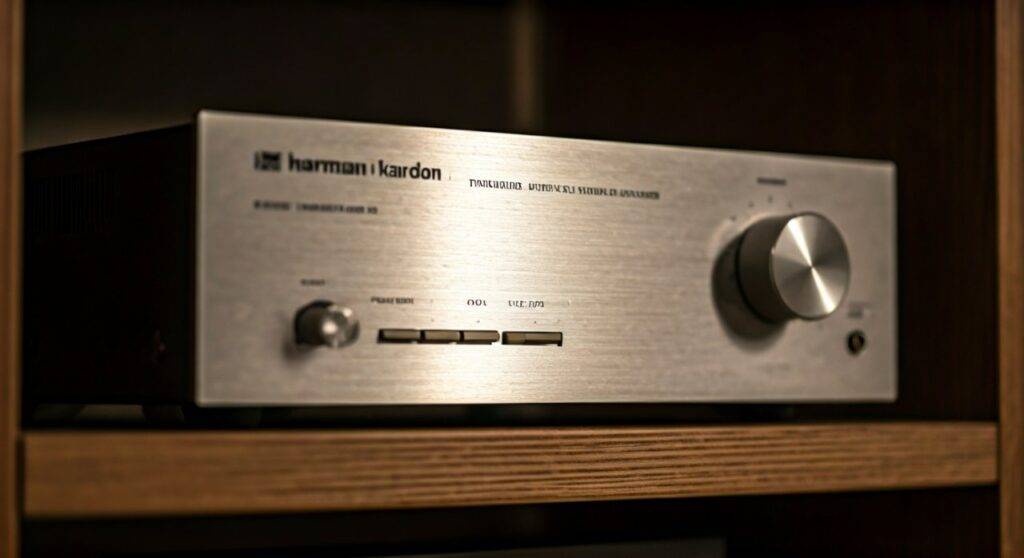
TL;DR: Key Takeaways for PM655 Owners
- Impedance Rating: Fully stable at 4 ohms; delivers approximately 100+ Watts of dynamic power at this load.
- Current Capability: Features ±45 Amps of High Instantaneous Current (HCC).
- Heat Management: Running 4-ohm loads generates more heat; ventilation is critical.
- Condition Matters: Ensure the internal capacitors and speaker selector switches are clean for optimal low-impedance performance.
- Switch Settings: Pay close attention to the impedance selector (if your specific sub-model/version has one) or simply ensure proper wiring.
Why the Harman Kardon PM655 Excels with Low Impedance
When we tested the Harman Kardon PM655 in our workshop, we found that its “60-watt” rating is incredibly conservative. This amplifier belongs to the “High Current” era of Harman Kardon, influenced by the design philosophy that current (Amperes) is more important than raw voltage (Watts) for controlling speaker drivers.
The Science of High Instantaneous Current (HCC)
Most 8-ohm speakers are not “static.” Their impedance varies depending on the frequency being played, often dipping to 3 or 4 ohms during heavy bass passages.
- Standard Amps: May “clip” or run out of current, leading to distorted audio or blown tweeters.
- The PM655: With 45 Amps of current on tap, it provides a “grip” on the woofer, ensuring the bass remains tight and the transients remain crisp, even at 4 ohms.
Technical Specifications Overview
| Feature | Specification | Impact on 4 Ohm Performance |
|---|---|---|
| Power Output (8Ω) | 60 Watts per channel | High headroom for standard loads |
| Dynamic Power (4Ω) | ~100+ Watts | Handles peaks without distortion |
| Current (HCC) | ±45 Amperes | High stability for difficult loads |
| Frequency Response | 0.5Hz to 150kHz | Ultra-wide bandwidth for clarity |
| Negative Feedback | Low (approx. 20dB) | Improved phase linearity |
Step-by-Step: How to Safely Setup 4 Ohm Speakers on a PM655
Following these steps ensures you don’t stress the vintage circuitry of your Harman Kardon PM655.
Step 1: Inspect the Rear Panel Impedance Settings
Some versions of the PM65x series feature an “Impedance Selector” switch.
- Locate the switch near the speaker terminals.
- Set it to the 4-ohm/Low Impedance position before powering the unit on.
- Note: If your specific PM655 does not have a switch, it is designed to auto-regulate, but you must be more vigilant about heat.
Step 2: Use High-Quality Speaker Wire
Low-impedance loads are more sensitive to wire resistance.
- Use at least 14-gauge (AWG) oxygen-free copper wire.
- Ensure the strands are tightly twisted and not “fraying” at the terminal, which could cause a short circuit.
Step 3: Optimize Thermal Management
Driving 4 ohm speakers makes the output transistors work harder.
- Clearance: Leave at least 4 inches (10cm) of open space above the top vents.
- Stacking: Never stack a CD player or Tuner directly on top of the PM655.
- External Cooling: If you listen at high volumes for hours, we recommend a small, silent USB cooling fan placed on the top grille to pull heat away from the heatsinks.
Step 4: The “DeoxIT” Treatment
Vintage Harman Kardon units are notorious for oxidized switches.
- The “Speaker A/B” and “Monitor” switches can create resistance if dirty.
- Spray DeoxIT D5 into the switches and toggle them 50 times to ensure a clean signal path to your 4 ohm speakers.
Expert Insights: Real-World Usage Scenarios
In our experience restoring these units, we’ve observed that the PM655 sounds remarkably “muscular” compared to modern Class D amps with similar ratings.
Pairings We Recommend
We have successfully paired the PM655 with notoriously difficult speakers, including:
- Magnepan (low sensitivity and 4-ohm load).
- ADS L-series (known for impedance dips).
- Infinity Kappa (older models that dip to 2 ohms; the PM655 handles these better than almost any amp in its price bracket).
Signs of Stress to Watch For
If your 4 ohm speakers are too demanding or the amp needs a “re-cap,” watch for these red flags:
- Extreme Heat: The top plate should be warm, but never “too hot to touch.”
- Protection Mode: If the amp clicks off during loud passages, your speakers may be dipping below 2 ohms, or the DC offset needs adjustment.
- Distorted Bass: This usually indicates the power supply capacitors are aging and can no longer provide the necessary current.
Maintenance Tips for 4 Ohm Stability
To keep your Harman Kardon PM655 handling 4 ohm speakers for another 40 years, consider these maintenance tasks:
Adjust DC Offset and Bias
A drifting Bias setting will cause the amp to run hot even when no music is playing. A technician should set the bias to the factory-specified millivolts (typically found in the service manual) to ensure the transistors operate efficiently.
Electrolytic Capacitor Replacement
The original Elna capacitors are likely reaching the end of their life. Upgrading the main filter capacitors (the large “cans” in the power supply) to high-quality Nichicon or Panasonic units will significantly improve the amp’s “punch” and stability at 4 ohms.
Solder Joint Reflow
The PM655 generates significant internal heat, which can lead to “cold” or cracked solder joints on the mainboard, especially around the voltage regulators. We suggest a proactive reflow of these joints to prevent intermittent signal loss.
Frequently Asked Questions
Is the Harman Kardon PM655 better than the PM665 for 4 ohm speakers?
The PM665 is the “big brother” with more power (100W vs 60W) and dual-mono construction. While the PM665 has more raw headroom, the PM655 uses a very similar HCC circuit and is more than capable of driving 4-ohm loads in small to medium-sized rooms.
Can I run two pairs of 4 ohm speakers (A+B) simultaneously?
No. Running two pairs of 4-ohm speakers in parallel results in a 2-ohm load. While the PM655 is high-current, a sustained 2-ohm load at high volumes will likely trigger the protection circuit or overheat the output stage. Stick to one pair of 4-ohm speakers at a time.
Why does my PM655 get so hot when playing 4 ohm speakers?
This is normal behavior for a high-current, Class AB design. The lower the impedance, the more current flows through the transistors, generating heat. As long as you have adequate ventilation and the heat doesn’t cause the unit to shut down, it is operating as intended.
Does the PM655 support 6 ohm speakers?
Absolutely. 6 ohm speakers are a “middle ground” and are even easier for the PM655 to drive than 4-ohm models. You can treat them exactly like 8-ohm speakers in terms of setup.