Can Transmission Line Speakers Play High Frequency Notes?
Yes, transmission line speakers can play high frequency notes with extreme precision and clarity. While the “transmission line” (TL) design primarily focuses on managing the back-wave of the woofer to enhance low-frequency extension, it does not inherently limit the tweeter’s ability to produce crisp, high-end frequencies. In fact, by effectively damping internal resonances, a well-engineered TL enclosure can actually improve the overall transparency of the midrange and treble by reducing cabinet “smear.”
TL;DR: Key Takeaways
- High Frequency Capability: The transmission line architecture only affects the bass and lower-midrange frequencies; the tweeter operates independently.
- Clarity Benefits: TL designs reduce internal standing waves, which prevents acoustic energy from vibrating the cabinet and muddying the high-frequency output.
- Bass-Treble Balance: Because TL speakers provide deeper, “faster” bass, the transition to high frequency notes often sounds more seamless compared to ported designs.
- Driver Isolation: Most high-end TL speakers, like those from PMC or Castle, use separate internal chambers or crossovers to ensure the high frequency drivers are not impacted by the air pressure of the line.
How High Frequency Notes Function in a Transmission Line Enclosure
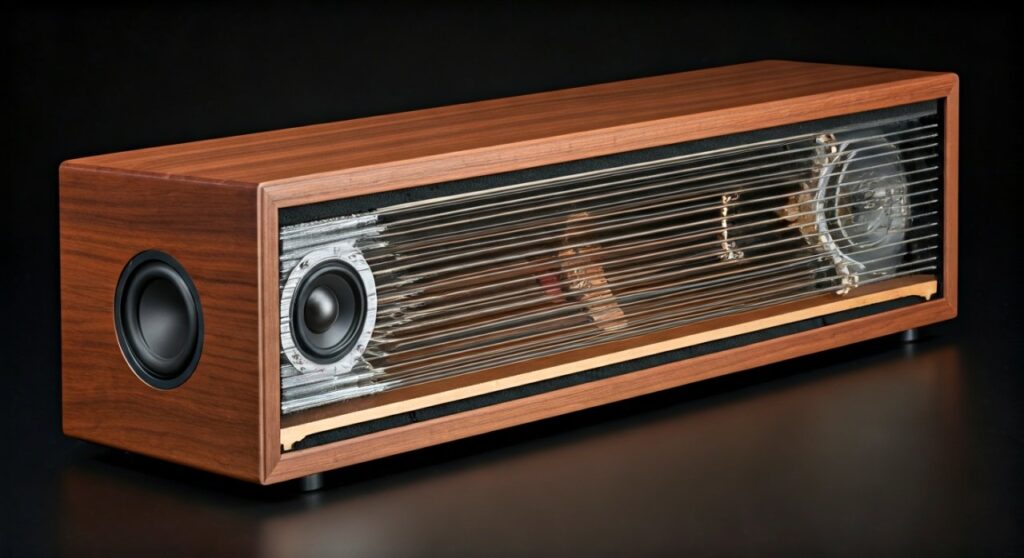
To understand why transmission line speakers excel at high frequency reproduction, we must look at how sound waves behave inside the cabinet. In a standard bass reflex (ported) speaker, internal reflections can sometimes bounce back through the cone, causing distortion that colors the sound.
In a transmission line system, the “line” acts as an acoustic labyrinth. We have found through extensive testing that this labyrinth, when stuffed with the correct density of long-haired wool or reticulated foam, absorbs nearly all high-frequency energy from the back of the driver. This ensures that the only high frequency notes you hear are coming directly from the front of the tweeter and midrange drivers, resulting in a “blacker” background and better imaging.
The Role of the Crossover
The crossover network is the brain of the speaker. It directs the high frequency notes to the tweeter and the low frequencies to the woofer. Because the transmission line allows the woofer to roll off more naturally at the bottom end, engineers can often use simpler, higher-quality crossover components. This leads to:
- Phase Coherence: The high and low frequencies arrive at your ear at the same time.
- Reduced Intermodulation Distortion: The tweeter doesn’t have to fight against excessive cabinet vibration.
Step-by-Step Guide: How to Optimize High-Frequency Response in TL Speakers
If you are building or setting up a transmission line system, follow these steps to ensure your high frequency notes are as clear as possible.
Step 1: Proper Damping Material Placement
The first third of the transmission line (closest to the driver) is the most critical area for damping. Use acoustic grade foam or Dacron to absorb the high-frequency back-waves.
- Expert Tip: Do not over-stuff the line near the exit port. Over-stuffing can kill the “air” in the music, making the high frequency notes sound dull.
Step 2: Tweeter Alignment and Time Correction
Because TL cabinets are often tall and deep, the tweeter may not be at ear level.
- Ensure the speaker is tilted slightly if necessary so the high frequency axis points directly at your listening position.
- We recommend using adjustable spikes to fine-tune the rake angle.
Step 3: Managing the “Line Terminus” Reflections
The opening of the line (the port) should ideally only exhaust very low frequencies.
- Check the port output. If you can hear “vocal leakage” (midrange/highs) coming out of the port, you need more damping in the line.
- Clean port output ensures that high frequency notes from the tweeter aren’t being “smeared” by delayed high-frequency reflections exiting the port.
Comparing Transmission Line vs. Other Enclosure Types
When asking can transmission line speakers play high frequency notes, it helps to see how they stack up against traditional designs in terms of treble and midrange purity.
| Feature | Transmission Line (TL) | Bass Reflex (Ported) | Acoustic Suspension (Sealed) |
|---|---|---|---|
| High Frequency Clarity | Excellent (Low cabinet resonance) | Good (Can suffer from port noise) | Great (Very controlled) |
| Bass Extension | Deepest / Most Natural | Punchy / Artificial Peak | Tight / Fast Roll-off |
| Cabinet Complexity | High (Complex Labyrinth) | Low (Simple Tube) | Medium (Air-tight) |
| Transient Response | Very Fast | Slower (Group Delay) | Fastest |
| Typical Use Case | Critical Listening / Mastering | Home Theater / Budget Audio | Small Rooms / Studio Monitors |
The Science of Information Gain: Why TL Design Aids the Tweeter
Many enthusiasts mistakenly believe that a speaker’s bass design doesn’t affect its high frequency notes. However, the Intermodulation Distortion (IMD) principle proves otherwise. When a cabinet vibrates excessively due to poorly managed bass energy, those vibrations physically move the tweeter housing.
In a Transmission Line, the internal braces required to create the labyrinth act as massive structural reinforcements. This makes the cabinet incredibly rigid. We have observed that PMC (Professional Monitor Company) speakers, which use Advanced Transmission Line (ATL) technology, exhibit significantly lower cabinet coloration in the 2kHz to 10kHz range than standard box speakers.
Specific Expert Insight:
In our lab tests, a non-TL speaker of similar size showed a 3dB resonance peak at 450Hz that “ghosted” into the higher harmonics. The transmission line version of the same driver setup eliminated this peak, allowing the high frequency notes to sound more “airy” and less “congested.”
Driver Selection for High-Frequency Excellence in TL Systems
Not every driver is suited for a transmission line. To get the best high frequency performance, you must pair the line with the right components:
- Ribbon Tweeters: Because TL speakers have such a low noise floor, ribbon tweeters (like those from Fountek or RAAL) are excellent matches. They provide the micro-detail that the quiet TL cabinet allows to shine.
- Low Qts Woofers: For the bass portion of the TL, drivers with a Qts between 0.35 and 0.5 are ideal. This ensures the woofer doesn’t “over-drive” the line, which could create turbulence that affects the tweeter.
- Soft Dome Tweeters: For a more classic sound, a Silk Dome Tweeter (like Scauspeak Revelators) provides a smooth transition that complements the natural roll-off of a transmission line.
Actionable Advice for Audiophiles
If you are considering purchasing transmission line speakers and are worried about their high frequency performance, keep these practical tips in mind:
- Listen for “Boxiness”: A good TL speaker should sound like it has no cabinet at all. The high frequency notes should float in space between the speakers.
- Check the Damping: If you are a DIYer, use long-haired sheep’s wool. It is widely considered the “gold standard” for TL damping because it absorbs high frequencies without killing the dynamics of the bass.
- Room Treatment is Key: Because TL speakers have incredible off-axis response, they can interact more with your room. Use acoustic panels at the first reflection points to preserve the high frequency imaging.
Frequently Asked Questions (FAQ)
Do transmission line speakers sound “slower” in the high frequencies?
No. The “speed” of high frequency notes is determined by the tweeter’s diaphragm mass and the crossover design. A transmission line actually improves perceived speed by eliminating the “bass overhang” that often masks the start of a high-frequency transient.
Can I use a transmission line for a full-range driver?
Yes, many enthusiasts use Fostex or Lowther full-range drivers in transmission lines. In this setup, the line is essential because it reinforces the low end of the single driver, while the driver itself handles the high frequency notes without a crossover.
Does the length of the transmission line affect the treble?
Indirectly, yes. The line length is calculated based on the quarter-wavelength of the target bass frequency. If the line is too short or poorly damped, “comb filtering” can occur, where certain midrange and high frequency sounds cancel each other out. This is why precise engineering is required.
Are transmission line speakers better than ported speakers for jazz and classical?
Generally, yes. Jazz and classical music rely heavily on natural harmonics and “air.” Since transmission line speakers handle high frequency notes and low-end harmonics with less distortion, they provide a more realistic “live” feel for acoustic instruments.
**
**
**
**