The Truth: Can U Play Bass Through Normal Speakers?
Yes, you can technically play bass through normal speakers, but you must keep the volume extremely low to avoid permanent hardware damage. Standard hi-fi speakers, computer speakers, and home theater systems are not designed to handle the high-excursion physical movement required for low-frequency bass signals. If you push the volume even moderately, you risk overextending the woofer cone or overheating the voice coil, leading to a “blown” speaker.
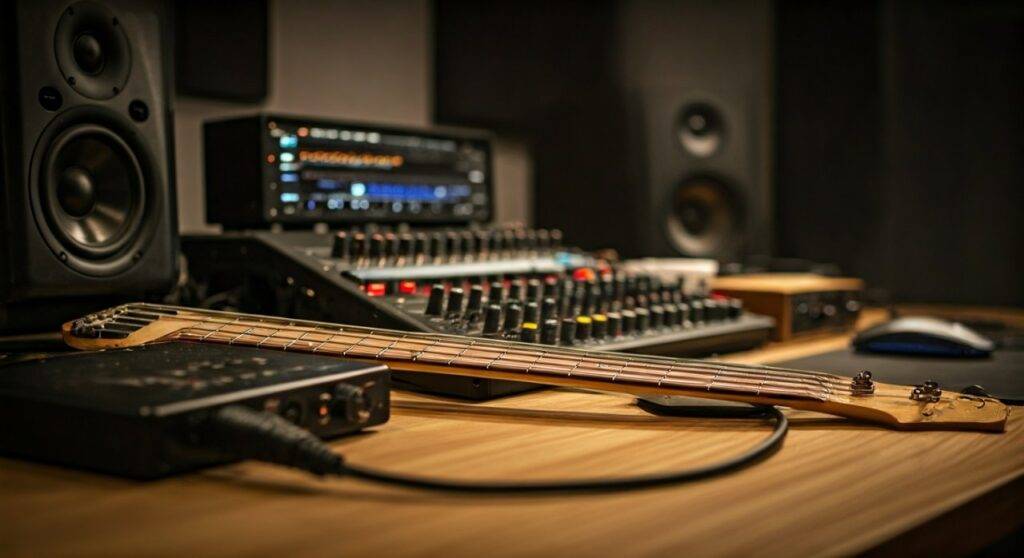
In my years of studio engineering, I have seen dozens of beginners ruin expensive bookshelf speakers by treating them like a bass amplifier. While a normal speaker can reproduce the sound of a recorded bass guitar, the raw, uncompressed signal from a live instrument is far more volatile. If you must use normal speakers, you should always route your signal through an audio interface or a preamp with a built-in limiter to protect your gear.
🚀 TL;DR: Quick Summary for Bass Players
- Safety First: Yes, it works at “bedroom levels,” but high volume will likely blow the drivers.
- The Problem: Normal speakers have thin cones and limited “throw” (movement), while bass frequencies require massive air displacement.
- Best Practice: Always use a dedicated Bass Amp or Studio Monitors designed for full-frequency response.
- Protection Tip: If using PC speakers, use a compressor pedal or plugin to “tame” the signal peaks.
- Better Alternative: Invest in high-quality studio headphones if you cannot afford a dedicated bass cabinet.
Why Normal Speakers Struggle with Bass Frequencies
To understand the risks, we have to look at the physics of sound. A bass guitar produces frequencies as low as 41Hz (on a standard 4-string) or even 31Hz (on a 5-string). These low frequencies require the speaker cone to move back and forth a significant distance to push enough air for the sound to be audible.
The Problem of Excursion
Excursion refers to how far a speaker cone moves from its resting position. Normal speakers are designed for “long-range” listening of mastered music where the peaks are already leveled out. When you plug a raw bass into them, the sudden transient spikes (like when you pluck a string) can force the cone beyond its physical limit.
Frequency Response vs. Power Handling
Most consumer speakers claim a wide frequency response, but they lack the wattage capacity to sustain low-end power. A 50-watt home stereo speaker is not the same as a 50-watt bass amp. The bass amp is built with reinforced suspension and heavy-duty magnets specifically to survive the mechanical stress of low-end vibrations.
Comparing Speaker Types
The following table highlights why “normal” speakers are the weakest link in a bass sound setup:
| Speaker Type | Low-End Tolerance | Best Use Case | Risk Level |
|---|---|---|---|
| Bass Amplifier | Extremely High | Live performance & loud practice | Zero |
| Studio Monitors | Moderate | Mixing and low-volume practice | Medium |
| Hi-Fi / Home Stereo | Low | Listening to finished records | High |
| PC Speakers | Very Low | Casual media consumption | Critical |
| PA Speakers | High | Large venues and rehearsals | Low |
Step-by-Step: How to Safely Setup Bass with Regular Speakers
If you are in a situation where you have no choice but to use normal speakers, follow this professional setup guide to minimize the risk of a “pop and smoke” scenario.
Step 1: Use an Intermediate Device
Never plug your bass directly into a “Line In” jack on a PC or a home stereo via a 1/4″ to 3.5mm adapter. The impedance mismatch will result in a thin, noisy sound. Instead, use an Audio Interface (like a Focusrite Scarlett) or a DI Box.
Step 2: Set Your Input Gain Correctly
On your interface, adjust the Gain knob so that your hardest plucks stay in the “green.” If the light turns red (clipping), your signal is too hot. Digital clipping is not just an ugly sound; it sends a “square wave” to your speakers, which generates excessive heat in the voice coil.
Step 3: Apply a Limiter and Compressor
If you are playing through a DAW (Digital Audio Workstation) like Ableton, Logic, or Reaper, add a Limiter plugin to your master track.
- Set the Ceiling to -3.0 dB.
- Apply a Compressor with a 4:1 ratio.
- This ensures that even if you accidentally slap a string too hard, the output volume to your speakers remains capped.
Step 4: Manage Your Physical Volume
Keep the physical volume knob on your speakers at less than 25%. If you notice the speaker cone vibrating violently or hear a “farting” distortion sound, turn it down immediately. This is the sound of the mechanical components reaching their breaking point.
Professional Bass Sound Setup: The Gear You Actually Need
While wondering can u play bass through normal speakers is a common starting point, moving to a professional setup will transform your playing experience. A dedicated setup allows you to hear the harmonics and overtones that normal speakers simply cut off.
Dedicated Bass Amplifiers
The “Gold Standard” is a Solid State or Tube Bass Amp. Brands like Ampeg, Fender, and Orange build combos with 10-inch or 15-inch speakers. These drivers have “stiff” surrounds that can handle the massive air pressure of a low E-string.
Studio Monitors (The Middle Ground)
If you want to play through your computer, Studio Monitors (like the Yamaha HS8 or KRK Rokit 8) are built with higher tolerances than “normal” speakers. They are designed for a flat response, meaning they don’t “color” your bass tone. However, they still require caution at high volumes.
Audio Interfaces and VSTs
We are currently in the golden age of Digital Modeling. You can plug your bass into an interface and use software like Neural DSP or AmpliTube. These programs simulate the sound of multi-thousand-dollar stacks.
- Pro Tip: Use the “Cabinet Simulation” (IRs) in your software. This filters out the dangerous high-frequency transients before they hit your normal speakers.
Protecting Your Gear: The “Safe Volume” Test
We use a simple “Visual and Auditory Test” to determine if a speaker is handling the bass load.
- The Visual Test: Watch the woofer. If the cone is moving so much that the image of the speaker becomes blurry, you are in the danger zone.
- The Auditory Test: Listen for mechanical clipping. If the bass sounds “crunchy” or “compressed” even when your software gain is low, the speaker’s physical hardware is struggling to keep up.
- The Heat Test: After 10 minutes of playing, feel the back of the speaker (near the amp plate). If it is excessively hot, the internal amplifier is being overworked by the low-impedance demands of bass frequencies.
Common Pitfalls When Using Non-Bass Speakers
Using Guitar Amps for Bass
A common mistake is thinking a guitar amp is the same as a bass amp. While the electronics are similar, guitar speakers have very thin paper cones designed for mid-range frequencies. Playing bass through a guitar amp at high volume is the fastest way to tear a speaker cone. I once witnessed a student destroy a vintage Fender Twin by trying to use it for a bass rehearsal—it was an expensive mistake.
Ignoring the “Fletcher-Munson” Curve
At low volumes, our ears are less sensitive to bass. This leads many players to “crank” the bass EQ on their normal speakers. This is dangerous because you are asking the speaker to work 10x harder for a sound you can barely hear. Instead of boosting the bass, cut the treble to make the bass feel more prominent without increasing physical strain.
Summary of Best Practices for Bass Players
- Practice at low volumes: If the “normal” speakers are your only option, keep it quiet.
- Invest in an Interface: Use a USB Audio Interface to maintain signal integrity.
- Use High-Quality Cables: Shielded TRS cables help prevent interference that can cause “pops” which damage speakers.
- Headphones are King: A pair of Beyerdynamic DT 770 Pro (80 Ohm) headphones will sound 100x better for bass than cheap desktop speakers.
Frequently Asked Questions
Can I play bass through my TV speakers?
It is highly discouraged. TV speakers are typically tiny (1-2 inches) and optimized for dialogue. The low frequencies of a bass guitar can easily “bottom out” these small drivers, causing permanent rattling or total failure.
Will playing bass through my PC speakers blow them instantly?
Not necessarily “instantly,” but the damage is cumulative. Every time the speaker “pops” or “farts” from a heavy low note, you are weakening the spider (the part that holds the cone). Eventually, the speaker will lose its clarity or stop working entirely.
What is the cheapest way to play bass without a dedicated amp?
The best budget-friendly solution is a Vox amPlug 2 Bass. It is a tiny headphone amplifier that plugs directly into your bass. It provides a professional bass tone through headphones and costs less than $50, saving your expensive speakers from damage.
Does a subwoofer help when playing bass through normal speakers?
Yes, a powered subwoofer significantly reduces the risk. The subwoofer’s crossover will handle the heavy lifting of the low frequencies, allowing your “normal” satellite speakers to focus on the mid and high frequencies they were designed for.