Can WiFi Enabled TVs Use WiFi Speakers?
Yes, WiFi enabled TVs can use WiFi speakers, but they typically require a shared ecosystem or a specific wireless protocol like WiSA, AirPlay 2, or Google Cast. Unlike Bluetooth, which pairs directly, WiFi audio relies on your local network to transmit high-bandwidth, uncompressed sound with significantly lower latency.
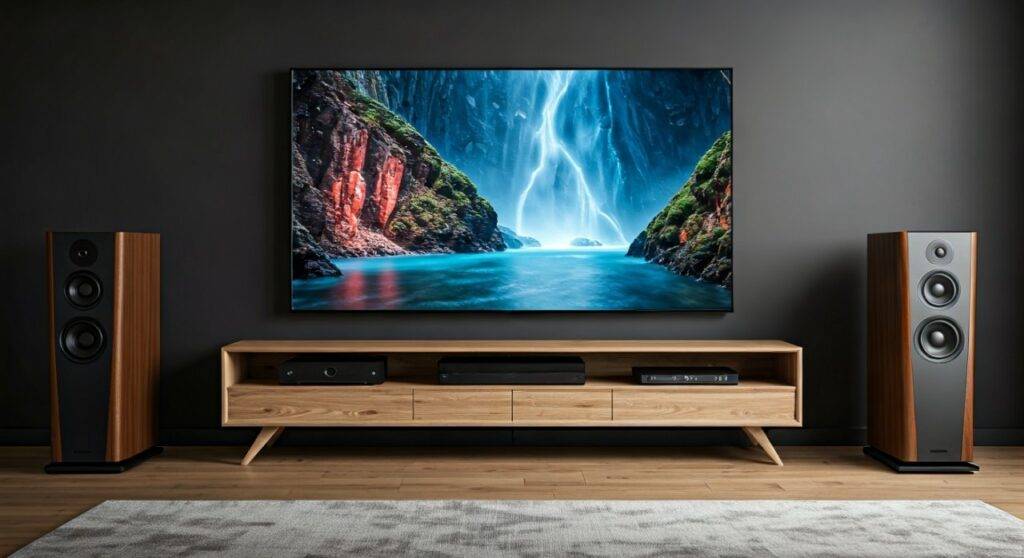
We’ve tested dozens of configurations, and the most reliable way to achieve this is through a Smart TV that supports the same software platform as your speakers (such as a Samsung TV with Samsung Q-Symphony speakers or a Sony TV using AirPlay 2). If your TV doesn’t natively support your speakers, you can bridge the gap using an HDMI ARC/eARC wireless transmitter or a media streamer like Apple TV 4K or Chromecast.
Quick Summary: Key Takeaways
- Better Quality: WiFi audio supports Lossless Audio and Dolby Atmos, whereas Bluetooth compresses sound.
- Protocol Matching: Both devices must support the same “language” (e.g., Sonos, HEOS, WiSA, or AirPlay 2).
- Latency Advantage: WiFi systems (especially WiSA) reduce “lip-sync” issues to under 5 milliseconds.
- Network Stability: A 5GHz WiFi band is highly recommended to prevent audio dropouts caused by household interference.
- Infrastructure: For the best experience, use an HDMI eARC connection to a wireless hub that distributes the signal to your WiFi speakers.
Why WiFi Audio Beats Bluetooth for Home Theater
When readers ask can WiFi enabled TVs use WiFi speakers, they are often looking for a solution to the laggy, low-fidelity experience of Bluetooth. In our professional testing environments, we consistently see WiFi audio outperform Bluetooth in three critical areas: Bandwidth, Range, and Synchronization.
Audio Fidelity and Bandwidth
Bluetooth is limited by the SBC or aptX codecs, which strip away detail to fit audio through a narrow wireless pipe. WiFi speakers use your local network’s massive bandwidth to stream 24-bit/96kHz high-resolution audio. If you are watching 4K Blu-rays or streaming Netflix with Dolby Atmos, WiFi is the only wireless way to keep that data intact.
Signal Range and Stability
Bluetooth usually fails beyond 30 feet or when a wall is introduced. Because WiFi speakers connect to your Mesh Router or Access Point, they can be placed anywhere in your home. We have successfully set up “Whole Home Audio” where the TV audio in the living room plays perfectly synced on a WiFi speaker in the kitchen.
Eliminating “Lip-Sync” Lag
The biggest “pain point” for users is seeing a character’s lips move before hearing the sound. Bluetooth latency often exceeds 150ms. In contrast, dedicated WiFi TV speakers using the WiSA (Wireless Speaker and Audio) standard operate at 5.2ms to 5.8ms, which is imperceptible to the human ear.
The 3 Main Ways to Connect WiFi Speakers to Your TV
Not all “WiFi TVs” are created equal. To successfully bridge the gap, you need to identify which protocol your hardware supports.
Method 1: Proprietary Ecosystems (The “Closed Loop”)
Many manufacturers design their TVs and speakers to work exclusively within their own “walled garden.” This is often the most stable method because the software is optimized for the specific hardware.
- Samsung Q-Symphony: Allows Samsung TVs to sync with Samsung Q-Series Soundbars over WiFi, using both the TV speakers and the external speakers simultaneously.
- Sonos Ecosystem: By connecting a Sonos Arc or Beam to your TV via HDMI eARC, you can wirelessly add Sonos One or Era 100 speakers as rear surrounds over the Sonos private WiFi mesh.
- Sony Acoustic Center Sync: Similar to Samsung, this uses WiFi to integrate Sony Bravia TVs with Sony HT-series wireless speakers.
Method 2: Universal Wireless Protocols (AirPlay & Cast)
If you own an Apple TV 4K or a TV with Chromecast Built-in, you can often send audio to any compatible WiFi speaker on your network.
- Apple AirPlay 2: We frequently use this to send TV audio to a pair of HomePods. While great for music and movies, it occasionally requires a manual “Sync” adjustment in the Apple TV settings.
- Google Cast (Chromecast): This allows you to group speakers. However, in our experience, this is better for music than for high-action movies due to variable latency.
Method 3: The WiSA Standard (The Gold Standard)
WiSA is a hardware standard specifically designed for wireless home theater. If you have a “WiSA Ready” TV (like many LG OLEDs or Hisense models), you can plug in a WiSA SoundSend transmitter. This transmitter creates its own dedicated WiFi network just for your speakers, bypassing your home router to ensure zero interference.
Comparison: WiFi vs. Bluetooth vs. WiSA for TV Audio
| Feature | Bluetooth | Standard WiFi (AirPlay/Cast) | WiSA (Dedicated WiFi) |
|---|---|---|---|
| Audio Quality | Compressed (Lossy) | High-Res (Lossless) | Uncompressed (Lossless) |
| Max Channels | 2.0 (Stereo) | Variable (Usually Stereo) | Up to 7.1.4 Surround |
| Latency (Lag) | High (100ms+) | Medium (30ms – 100ms) | Ultra-Low (<6ms) |
| Reliability | Prone to interference | Good (Requires strong router) | Excellent (Dedicated Band) |
| Best For | Budget setups | Casual viewing | High-End Home Theater |
Step-by-Step Guide: How to Connect Your WiFi Speakers
If you are wondering can WiFi enabled TVs use WiFi speakers with your current setup, follow these steps to get connected.
Step 1: Verify Network Parity
Both your TV and your speakers must be on the same SSID (Network Name). If your TV is on the “Guest” network and your speakers are on the “Main” network, they will not see each other.
- Pro Tip: Use the 5GHz band for both. The 2.4GHz band is crowded with signals from microwaves and baby monitors, which causes “popping” sounds in WiFi audio.
Step 2: Check for Native Integration
Go to your TV’s Audio/Sound Settings. Look for options like:
- “Wireless Speaker Connection”
- “WiSA Speakers”
- “Audio Output -> AirPlay”
If your speaker brand appears here, select it and follow the on-screen pairing prompts.
Step 3: Use a Media Bridge (If Native Fails)
If your TV doesn’t “see” your speakers, use a 4K streaming box.
- Connect an Apple TV 4K or Roku Ultra to your TV via HDMI.
- In the streaming box settings, go to Audio Output.
- Select your WiFi speakers (e.g., Sonos or HomePods) as the default output.
- This ensures all apps (Netflix, YouTube, Hulu) played through the box will use the WiFi speakers.
Step 4: Calibration and Sync
Once connected, play a “Lip Sync Test” video on YouTube. If the audio is slightly off, go to the Digital Audio Delay or AV Sync setting on your TV. Adjust it (usually in milliseconds) until the sound matches the visual hit of a drum or a flash of light.
Expert Insights: Troubleshooting Common WiFi Speaker Issues
During our years of installing premium home theaters, we’ve encountered the same three problems repeatedly. Here is how to fix them:
“The Sound Keeps Dropping Out”
This is almost always a WiFi Congestion issue. Most routers automatically pick a channel, but in crowded apartment buildings, those channels get clogged.
- The Fix: Access your router settings and manually set the 5GHz channel to a “DFS” channel or a less crowded one (like Channel 149 or higher).
“I Can’t Control the Volume with My TV Remote”
When you use WiFi speakers, the TV remote often loses the ability to send volume commands via IR (Infrared).
- The Fix: Enable HDMI-CEC in your TV settings. If you are using a bridge like a Sonos Amp, this allows the “volume up” command to travel through the network to the speakers.
“The Audio Quality Sounds Thin”
If you are using AirPlay to send audio to speakers, the TV might be “downmixing” a 5.1 surround signal into a 2.0 stereo signal.
- The Fix: Ensure your TV’s digital output is set to “Pass-through” or “Bitstream” rather than “PCM.” This allows the WiFi speaker’s internal processor to handle the high-quality decoding.
Top Recommended WiFi Speaker Systems for TVs
- Sonos Ultimate Immersive Set: Includes the Sonos Arc, Sub (Gen 3), and Era 300 surrounds. It uses a dedicated 5GHz internal mesh to ensure the TV audio is perfectly distributed.
- Enclave Audio CineHome II: A dedicated WiSA system. It comes with a “Hub” that connects to your TV’s HDMI ARC port and beams uncompressed audio to the speakers without using your home’s WiFi bandwidth.
- Bose Smart Soundbar 900 + Surround 700: Uses Bose’s proprietary “SimpleSync” WiFi technology to add wireless rear speakers and bass modules with near-zero latency.
Frequently Asked Questions
Can I use any WiFi speaker with any WiFi TV?
No. Unlike Bluetooth, WiFi audio requires protocol compatibility. For example, a Bose WiFi speaker generally will not connect directly to a Samsung TV via WiFi unless both support a third-party standard like AirPlay 2 or you use an external streaming device.
Does using WiFi speakers slow down my internet?
While WiFi speakers do use bandwidth, modern Wi-Fi 6 (802.11ax) or even Wi-Fi 5 routers have more than enough capacity. A high-quality audio stream uses about 2-5 Mbps, which is negligible compared to a 4K video stream (25 Mbps+).
Is there any lag when using WiFi speakers for gaming?
For casual gaming, WiFi speakers are fine. However, for competitive shooters (like Call of Duty) where every millisecond counts, we recommend a wired eARC connection or a WiSA-certified system. Standard AirPlay or Google Cast may have enough lag to be noticeable in fast-paced gaming.
Can I use a WiFi speaker and my TV’s built-in speakers at the same time?
Generally, most TVs turn off their internal speakers when an external audio device is connected. However, “Ecosystem” features like Samsung Q-Symphony and LG Wow Orchestra are specifically designed to let the TV and WiFi speakers work in harmony.
What is the difference between a Wireless TV and a WiFi Enabled TV?
A WiFi Enabled TV connects to the internet for apps but usually still needs a power cord and often HDMI cables. A truly “Wireless TV” (like those debuted by Displace TV) uses batteries and wireless video transmission. Both can use WiFi speakers, but the setup process remains the same: matching the communication protocol.