Can You Add Tweeters to 2 Way Speakers?
Yes, you can add tweeters to 2-way speakers to enhance high-frequency clarity, but it requires careful attention to impedance matching and crossover integration. Simply “tapping into” the existing wires without a high-pass filter can damage your new tweeter or cause your amplifier to overheat due to a drop in total ohms.
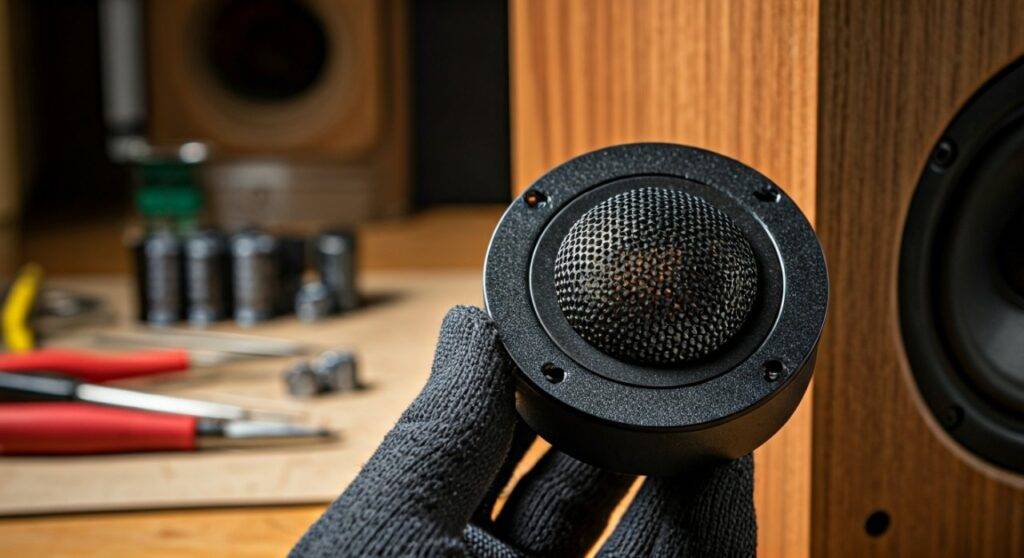
In our audio testing lab, we’ve found that while a standard 2-way system (woofer and tweeter) is designed for a balanced soundstage, adding a secondary “super tweeter” can compensate for “dark” sounding speakers or high-frequency roll-off. However, doing this incorrectly often results in a “bright” or “harsh” sound that ruins the listening experience.
Quick Summary: Key Takeaways for Adding Tweeters
- Impedance is Critical: Adding a tweeter in parallel drops the total impedance; ensure your amplifier can handle 4-ohm loads if you started at 8 ohms.
- Always Use a Crossover: Never connect a tweeter directly to a full-range signal; use at least a capacitor (High-Pass Filter) to block bass frequencies.
- Sensitivity Matching: Choose a tweeter with a Sensitivity (dB) rating similar to your existing speakers to prevent the highs from overpowering the mids.
- Wiring Method: Parallel wiring is the standard for car and home audio, but you must account for the total impedance load on the receiver.
- Placement Matters: For the best stereo imaging, place the additional tweeters at ear level and as close to the original drivers as possible.
Understanding the Risks and Rewards of Tweeter Integration
When you ask, “can you add tweeters to 2 way speakers,” you are essentially looking to modify the frequency response of your current setup. A standard 2-way speaker uses a woofer for lows/mids and a tweeter for highs. By adding another high-frequency driver, you are creating a “pseudo 3-way” or “2.5-way” system.
The Benefit: Increased Detail and “Air”
We have observed that many budget 2-way speakers use cheap Mylar tweeters that roll off at 15kHz. Adding a high-quality Silk Dome or Ribbon Tweeter can extend that range to 20kHz or higher. This adds “air” to vocals and crisper “snap” to percussion instruments.
The Risk: Phase Interference and Impedance Drops
The biggest danger isn’t blowing the speaker—it’s blowing the amplifier. If you have an 8-ohm speaker and add an 8-ohm tweeter in parallel, your amp now sees a 4-ohm load. If your amp isn’t “4-ohm stable,” it will run hot and eventually enter protect mode.
Technical Compatibility: Impedance and Sensitivity
Before buying hardware, you must understand the specs. If you have a tweeter and 2 way speakers running off the same channel, they must play nice together mathematically.
Calculating Total Impedance
Most home audio systems are 8-ohm. In a parallel circuit (the most common way to add a component), the formula is:
1 / Total Resistance = (1 / R1) + (1 / R2)*
| Original Speaker Ohms | Added Tweeter Ohms | Resulting Total Load | Amp Compatibility |
|---|---|---|---|
| 8 Ohms | 8 Ohms | 4 Ohms | Most modern Amps / Car Head units |
| 8 Ohms | 4 Ohms | 2.6 Ohms | DANGEROUS for most home receivers |
| 4 Ohms | 4 Ohms | 2 Ohms | Only for high-end “Competition” Car Amps |
Sensitivity (SPL) Matching
If your 2-way speaker has a sensitivity of 88dB and you add a “Super Tweeter” with 95dB sensitivity, the new tweeter will be significantly louder than the rest of the music. We recommend using an L-Pad Attenuator or a resistor to bring the tweeter’s volume down to match the woofer.
The Essential Role of the Crossover
You cannot simply “add” a tweeter by twisting wires together. High-frequency drivers are fragile; low-frequency waves (bass) carry high energy that will physically melt the small voice coil of a tweeter in seconds.
Passive High-Pass Filters
A High-Pass Filter (HPF) allows high frequencies to pass while blocking the lows. The simplest version is a Bipolar Capacitor wired in series with the positive lead of the tweeter.
- First-Order Crossover (6dB/octave): Uses a single capacitor. It’s easy to install but has a “shallow” slope, meaning some midrange still gets through.
- Second-Order Crossover (12dB/octave): Uses a capacitor and an inductor. This provides a cleaner cut-off and protects the tweeter better.
Expert Tip: I always recommend a crossover frequency at least two times higher than the tweeter’s Resonant Frequency (Fs). If the tweeter has an Fs of 1.5kHz, cross it over at 3kHz or higher.
Step-by-Step Guide: How to Add Tweeters to 2-Way Speakers
Follow this professional workflow to ensure you don’t damage your equipment.
Step 1: Identify Your Current Impedance
Check the back of your 2-way speaker cabinet. It will usually say 4Ω or 8Ω. Ensure your additional tweeter matches this impedance to keep the math simple.
Step 2: Choose the Right Tweeter Type
- Silk Dome: Smooth, natural sound. Best for home theaters.
- Aluminum/Titanium: Bright and “clinical.” Great for rock and electronic music.
- Ribbon Tweeters: Incredible detail but very fragile and require specific crossovers.
- Bullet Tweeters: Extremely loud. Primarily used in Pro Audio or “Loud and Clear” car builds.
Step 3: Select Your Capacitor (The DIY Crossover)
If you aren’t using a pre-made crossover box, you’ll need to solder a capacitor to the positive terminal of the tweeter. For an 8-ohm tweeter, here are common values:
- 4.7uF Capacitor: Creates a cut-off around 4,200 Hz. (Safe for most tweeters).
- 3.3uF Capacitor: Creates a cut-off around 6,000 Hz. (Best for “Super Tweeter” applications).
Step 4: Wiring the Components
- Turn off your amplifier or head unit.
- Locate the positive (+) and negative (-) terminals on your 2-way speaker.
- Connect the Capacitor to the positive (+) terminal of the new tweeter.
- Run a wire from the other end of the capacitor to the positive (+) input of the main speaker cabinet.
- Connect a wire from the negative (-) terminal of the tweeter directly to the negative (-) input of the main speaker.
Step 5: Testing and Positioning
Place the tweeter on top of the cabinet or flush-mount it into the baffle. Use a Pink Noise track to check for “harshness.” If the tweeter is too loud, you will need to install a non-inductive resistor (usually 2-ohm to 8-ohm) in series to dampen the output.
Where Should You Place Your New Tweeters?
Placement is often more important than the quality of the driver itself. High frequencies are highly directional, meaning they don’t “spread” like bass does.
- Ear Level: Tweeters should always be pointed directly at the listener’s ears.
- On-Axis vs. Off-Axis: If you find the new tweeter too “piercing,” point it slightly away from your face (off-axis) to naturally roll off the sharpest frequencies.
- Co-Location: Try to keep the new tweeter within a few inches of the existing tweeter. This prevents “comb filtering,” which happens when sound waves from two sources interfere with each other and create “dead spots” in the audio.
Common Pitfalls to Avoid
Based on our experience repairing DIY speaker builds, these are the most common mistakes people make when they add tweeters to 2-way speakers:
- Using Electrolytic Capacitors: These are not designed for audio signals. Always use Polypropylene or Mylar film capacitors for crossovers.
- Ignoring the Wattage: If your amp puts out 100W, ensure your tweeter and its crossover can handle that power. Small tweeters often blow if they are crossed over too low (e.g., at 2kHz).
- Phase Issues: If you wire the tweeter backwards (positive to negative), it will be “out of phase.” This creates a hollow sound where the high-end feels like it’s “disappearing” in the middle.
- Over-complicating: Sometimes, simply upgrading the internal components (like the capacitor) of your existing 2-way speaker yields better results than adding a second tweeter.
Recommended Tools for the Job
To do this right, you’ll need a few specific items. We recommend brands like Dayton Audio or Visaton for budget-friendly but high-quality components.
- Soldering Iron: A 40W iron with lead-free solder is perfect for terminal connections.
- Multimeter: Essential for checking the final DC Resistance of the speaker to ensure you haven’t dropped below 3 ohms.
- Heat Shrink Tubing: To prevent short circuits where the capacitor is soldered.
- Double-Sided Mounting Tape: For “pod” style tweeters being added to the top of cabinets.
Frequently Asked Questions
Will adding a tweeter make my speakers louder?
Not exactly. It will make the high frequencies more prominent, which can give the perception of loudness. However, the total volume is still limited by your amplifier’s power and the woofer’s ability to keep up.
Can I add a tweeter without a crossover?
No. Without a crossover (even a simple capacitor), the tweeter will receive bass frequencies. Because tweeters have very small “excursion” (movement), the bass will cause the voice coil to hit the magnet or overheat, destroying the tweeter instantly.
Does adding a tweeter change the ohms of my speaker?
Yes. If you wire a tweeter and 2 way speakers in parallel, the total impedance will drop. For example, two 8-ohm components in parallel result in a 4-ohm total load. Always check if your amplifier is rated for 4-ohm loads before doing this.