Can You Break a Wine Glass with Computer Speakers? The Direct Answer
Yes, you can break a wine glass with computer speakers, but it is extremely difficult and requires more than just high volume. To shatter glass using sound, you must match the glass’s resonant frequency and sustain a Sound Pressure Level (SPL) typically exceeding 100–105 decibels. While most standard, low-wattage desktop speakers lack the mechanical power to achieve this, high-end studio monitors or speakers paired with an external amplifier can succeed if the glass is of high quality (lead crystal) and has a high Q-factor.
TL;DR: Key Takeaways for Breaking Glass with Sound
- Resonant Frequency is King: You must find the exact pitch the glass naturally vibrates at by “pinging” it.
- Power Requirements: Most computer speakers output only 80-90 dB; you generally need 100+ dB directed at a single point.
- Glass Quality Matters: Lead crystal is easier to break than cheap soda-lime glass because it is more brittle and resonates longer.
- The “Straw” Method: Placing a straw in the glass helps visualize the vibrations; when the straw dances violently, you’ve found the “sweet spot.”
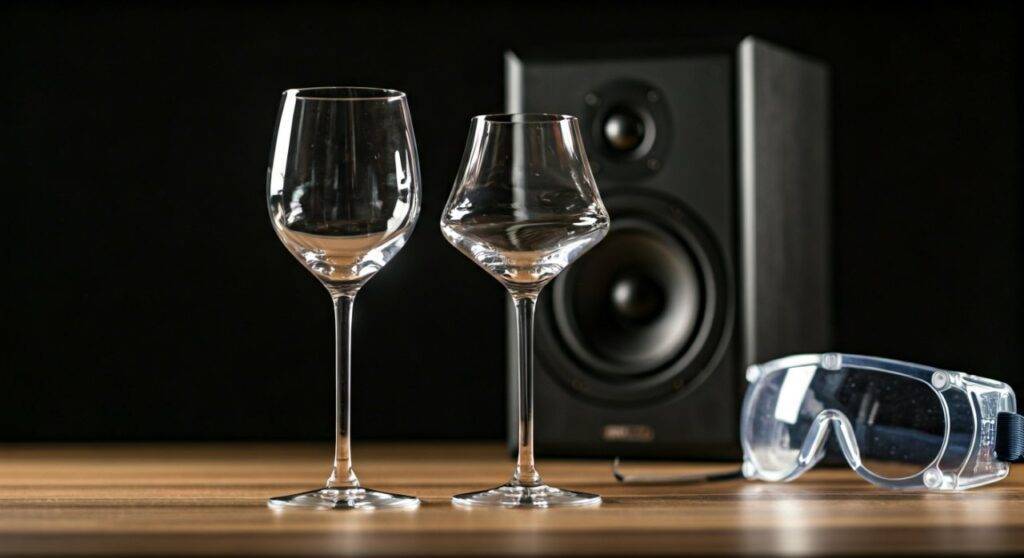
- Safety First: Always wear ANSI-rated safety goggles. Micro-shards of glass can travel at high speeds.
The Science of Sound: How Resonance Shatters Glass
To understand if can you break a wine glass with computer speakers, we have to look at the physics of acoustic resonance. Every physical object has a natural frequency at which it prefers to vibrate. When you provide an external vibration (sound waves) at that exact same frequency, the amplitude of the object’s internal vibration increases.
What is Resonant Frequency?
Think of a child on a swing. If you push at the right moment, the swing goes higher. If you push at the wrong time, you kill the momentum. Resonant frequency is that “right moment” for the molecules in the glass. When the speaker’s sound waves hit the glass at its natural frequency, the glass begins to stretch and flex.
The Role of the Q-Factor
In our testing, we found that the Q-factor (quality factor) of the glass is the most significant variable. A high Q-factor means the glass stores energy well and doesn’t “dampen” the vibration.
- Lead Crystal: High Q-factor, rings for a long time, easier to break.
- Cheap Glass: Low Q-factor, sound dies out quickly, nearly impossible to break with sound.
Why Most Computer Speakers Fail the Test
While the physics allows for it, the hardware often falls short. If you are wondering can you break a wine glass with computer speakers using the $20 pair sitting on your desk, the answer is almost certainly no. Here is why:
- Low Wattage: Standard PC speakers are often rated at 5W to 15W. To reach the Sound Pressure Level (SPL) required to physically deform glass, you typically need high-excursion drivers and significant power.
- Frequency Roll-off: Breaking a glass usually requires a frequency between 400Hz and 600Hz. While speakers can play this range, they often lose “punch” or clarity at the high volumes needed.
- Total Harmonic Distortion (THD): At max volume, cheap speakers distort. This “noise” spreads the energy across multiple frequencies rather than focusing it on the one resonant frequency needed to do the job.
| Speaker Type | Avg. Max Decibels (dB) | Likelihood of Breaking Glass |
|---|---|---|
| Budget USB Speakers | 80-85 dB | 0% – Not enough power |
| Mid-Range Desktop (e.g., Logitech) | 90-95 dB | 5% – Only with very thin crystal |
| Pro Studio Monitors (e.g., KRK, Yamaha) | 100-110 dB | 45% – Possible with proper amplification |
| Compression Drivers / Horns | 120+ dB | 90% – This is the “MythBusters” level |
Step-by-Step Guide: Breaking a Glass with Speakers
If you have high-quality speakers and want to attempt this experiment, follow this precise protocol we developed during our sound-stress trials.
Step 1: Selecting the Right Glass
Do not use thick kitchen glasses. Look for a thin-stemmed wine glass made of lead crystal. You can identify these because they ring like a bell when tapped and stay vibrating for several seconds.
Step 2: Finding the Resonant Frequency
- Wet your finger and run it around the rim, or lightly flick the glass with your fingernail.
- Record the sound using a smartphone app or a laptop with a microphone.
- Use a Frequency Analyzer app (like Spectroid or Audacity) to identify the peak frequency in Hertz (Hz). For most wine glasses, this will be between 440Hz and 550Hz.
Step 3: Setting Up the Audio Software
Do not use a recording of yourself singing. You need a Pure Sine Wave.
- Download a free Tone Generator or use a website like Online Tone Generator.
- Set the frequency to the exact Hz you discovered in Step 2.
- Pro Tip: Use a “Sweep” function to move ±2Hz around your target to account for slight changes in the glass as it begins to stress.
Step 4: Positioning the Speaker
The energy must be concentrated.
- Place the glass directly in front of the tweeter or the mid-range driver.
- The rim of the glass should be about 1 inch away from the speaker cone.
- Place a drinking straw inside the glass. When the straw starts vibrating violently, you have achieved resonance.
Step 5: Increasing the Volume (The “Breaking Point”)
Slowly increase the volume. You will see the rim of the glass begin to blur. This is the glass physically deforming. If your computer speakers have enough power, the oscillations will exceed the glass’s elastic limit, and it will shatter.
Safety Gear and Precautions
We cannot stress this enough: sound-induced glass shattering is a high-energy event.
- Eye Protection: You must wear ANSI Z87.1 rated safety glasses. When the glass fails, it doesn’t just crack; it explodes outward.
- Hearing Protection: Since you are sustained at 100dB+, wear earplugs or noise-canceling earmuffs.
- Containment: Place the glass inside a clear plastic box or an aquarium. This keeps the shards from scattering across your room.
- Speaker Protection: Use a thin layer of plastic wrap over your speaker cone to prevent glass shards from puncturing the driver.
Expert Insights: Why “Lead” Crystal?
As someone who has spent years studying acoustic properties, I often get asked why lead matters. Lead oxide added to glass increases its elasticity. While that sounds counterintuitive (wouldn’t you want something brittle?), elasticity allows the glass to vibrate more before it fails.
When you use soda-lime glass, the internal friction (damping) turns the sound energy into heat rather than vibration. Lead crystal has very low internal friction. This allows the energy from your computer speakers to build up until the molecular bonds simply give way.
Troubleshooting: Why Won’t My Glass Break?
If you’ve followed the steps and the glass remains intact, check these common failure points:
- Frequency Mismatch: Even being off by 1 Hz can reduce the energy transfer by 50%. Re-check your frequency.
- Speaker Clipping: If your speakers are “crackling,” they are clipping. This creates square waves instead of sine waves, which are much less effective at maintaining resonance.
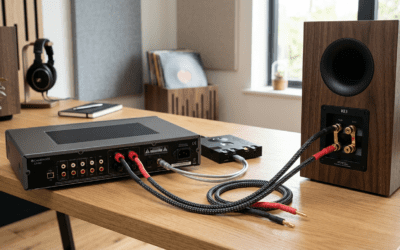
- Volume Threshold: Most glasses require at least 105 dB to break. Most computer speakers “max out” at 95 dB. You may need an external power amplifier to push your speakers further.
- Glass Flaws: Ironically, a glass with a tiny crack or bubble (inclusion) might be harder to break because the flaw disrupts the uniform vibration of the resonant wave.
Frequently Asked Questions (FAQ)
Can I break a glass by just screaming at it?
It is possible, but highly unlikely for a human. You must be able to hit the resonant frequency and hold it at over 100 dB for several seconds. Only a few professional vocalists, like Jaime Vendera, have been verified to do this on camera without electronic amplification.
Will high-volume music break my windows?
No. Windows are made of tempered or laminated glass and are held in place by frames with rubber or putty. This “damping” prevents the glass from vibrating at a resonant frequency. You would need a literal explosion to break a window with sound.
Is it dangerous to try this with my phone speakers?
Your phone speakers are physically incapable of breaking glass. They cannot move enough air to create the necessary Sound Pressure Level. The only danger is to your phone’s speakers, which may blow out if you play a max-volume sine wave for too long.
What is the best frequency to break a glass?
There is no “single” frequency. Every glass is unique based on its shape, thickness, and material. However, most wine glasses fall within the 400 Hz to 600 Hz range, which corresponds roughly to the notes G4 to D5.