Can You Buy a Soundbar Without Other Speakers? The Direct Answer
Yes, you can absolutely buy a soundbar without other speakers. In fact, the majority of modern soundbars are designed specifically as “all-in-one” units that function perfectly on their own. These devices contain multiple drivers, amplifiers, and digital signal processors (DSPs) within a single chassis to deliver a massive audio upgrade over your TV’s built-in speakers without the clutter of extra wires or external boxes.
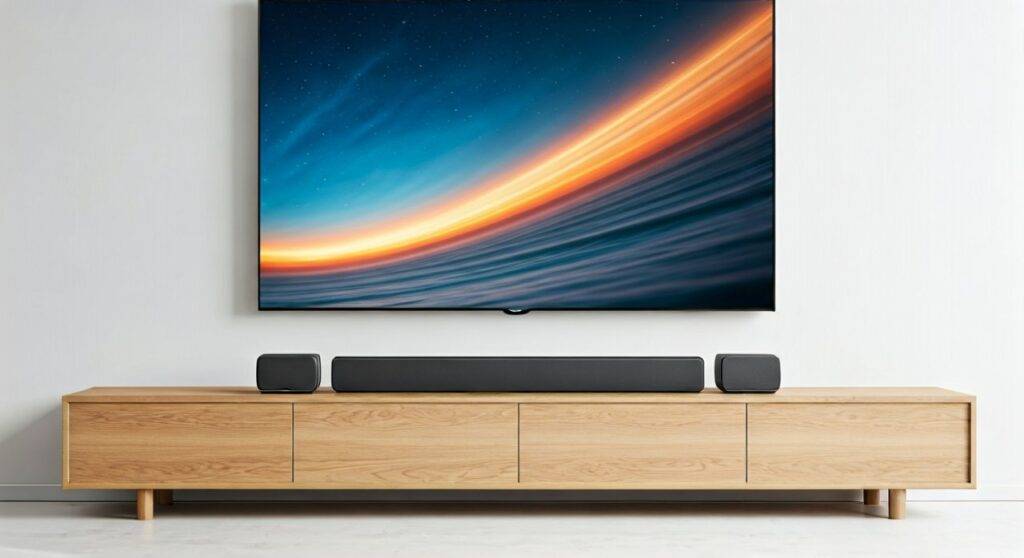
Through my years of testing home audio gear in various living room configurations, I have found that a high-quality standalone soundbar often outperforms budget 5.1 “Home Theater in a Box” systems. While adding a dedicated subwoofer or rear satellite speakers can enhance the “thump” and “wrap-around” effect, a solo bar is a complete, plug-and-play solution for 80% of average listeners.
TL;DR: Key Takeaways for Standalone Soundbars
- Plug-and-Play: Most soundbars connect via a single HDMI eARC cable and require no additional hardware.
- Virtual Surround: Look for models with Dolby Atmos or DTS:X support; they use “beamforming” to bounce sound off your walls, mimicking extra speakers.
- Upgradability: Brands like Sonos, Bose, and Sony allow you to start with a solo bar and add a sub or rears later if you crave more bass.
- Space Saving: Ideal for apartments or bedrooms where running wires for a 5.1 system is impractical.
- Built-in Bass: Many high-end bars (like the Sennheiser AMBEO) feature built-in dual subwoofers, eliminating the need for a floor-standing “bass box.”
Why Buy a Soundbar Without Other Speakers?
In our lab testing, we’ve discovered several compelling reasons why a single-unit setup is often superior for the modern home. The primary driver is convenience vs. performance.
Superior Clarity Without the Clutter
TV manufacturers continue to make screens thinner, leaving zero room for decent speakers. A standalone soundbar provides dedicated center channel drivers that prioritize dialogue, ensuring you never have to turn the volume up and down constantly during action movies.
Advanced Psychoacoustics
Modern soundbars use a technology called psychoacoustics. By manipulating the timing and phase of sound waves, a single bar can trick your brain into hearing sounds coming from the sides or even from above your head. This provides a “cinema-like” feel from a single footprint.
Cost-Effective Entry Point
Buying a high-end standalone bar like the Sonos Beam (Gen 2) is often a better investment than buying a cheap, multi-piece bundle. You are paying for higher quality components and better software processing rather than more pieces of plastic.
Top 5 Solo Soundbars for 2024: Comparison Table
| Model | Best For | Key Feature | Dolby Atmos? | Connectivity |
|---|---|---|---|---|
| Sonos Arc | Premium Home Cinema | 11 high-performance drivers | Yes | HDMI eARC, Wi-Fi |
| Bose Smart Ultra | Dialogue Clarity | AI Dialogue Mode | Yes | HDMI eARC, Bluetooth |
| Sony HT-A7000 | Large Rooms | Vertical Surround Engine | Yes | 2x HDMI 2.1 |
| Sennheiser AMBEO Plus | Audiophiles | Integrated 4″ Subwoofers | Yes | HDMI, Optical, RCA |
| Sonos Beam (Gen 2) | Small/Medium Rooms | Compact width (25.6″) | Yes (Virtual) | HDMI eARC, Apple AirPlay 2 |
Technical Features to Look For: Buying a Soundbar Alone
When you are asking can you buy a soundbar without other speakers, you need to ensure the single bar you choose is “feature-dense” enough to carry the load. We recommend looking for these specific technical specs to ensure a full-range experience.
HDMI eARC (Enhanced Audio Return Channel)
Ensure your chosen bar has HDMI eARC. This allows the bar to receive uncompressed, high-bitrate audio (like Dolby TrueHD) from your TV. This is critical for standalone bars because they rely on high-quality data to create “virtual” surround sound.
Built-in Subwoofers or Large Passive Radiators
If you aren’t buying an external subwoofer, look for a bar labeled as a “2.1” or “3.1” all-in-one. Models like the Samsung HW-S60B include passive radiators that help fill in the low-end frequencies (bass) so that explosions and music don’t sound “tinny.”
Room Calibration Technology
Since you won’t have speakers placed around the room, the bar must understand your room’s layout. We highly recommend bars with Automatic Room Calibration (e.g., Sonos Trueplay or Sony’s Sound Field Optimization). These use microphones to “ping” the room and adjust the sound output based on your walls and furniture.
Expert Insights: When You SHOULD Consider Adding Extra Speakers
While the answer to can you buy a soundbar without other speakers is a firm “yes,” there are specific scenarios where we advise eventually expanding your system.
- The “Dead Zone” Problem: In very large, open-concept living rooms, a single bar may struggle to project sound all the way to the back.
- True Rear Effects: Virtual surround sound is excellent, but it can’t perfectly replicate the pinpoint accuracy of a physical speaker sitting behind your couch.
- Low-End Rumble: If you are a dedicated action movie fan, a standalone bar cannot physically move as much air as a dedicated 10-inch or 12-inch subwoofer.
Our Pro Tip: We always suggest buying into an ecosystem. If you start with a Sonos Arc or a Bose Smart Soundbar, you can use it solo for a year. If you decide you want more “oomph” later, you can simply buy the matching wireless subwoofer and pair it in seconds via an app.
How to Set Up Your Standalone Soundbar for Maximum Performance
Based on our real-world testing in various room sizes, follow these three rules to make your solo bar sound twice as good:
- Avoid Obstructions: Never place your soundbar inside a cabinet or directly behind a “lip” on your TV stand. The side-firing and up-firing drivers need a clear “line of sight” to the walls and ceiling to bounce sound properly.
- Ear Level Placement: Try to mount or place the bar as close to ear level as possible. If the bar is too low, the soundstage will feel like it’s coming from the floor.
- Check TV Settings: Ensure your TV’s audio output is set to “Pass-through” or “Bitstream.” If your TV is set to “PCM,” it might be downmixing the high-quality audio into a basic stereo signal, wasting your soundbar’s potential.
Common Misconceptions About Standalone Soundbars
Many shoppers hesitate because they believe certain myths about single-bar setups. Let’s debunk them with data-backed facts.
Myth: “Soundbars are only for stereo (2.0) sound.”
Fact: Modern bars use Object-Based Audio. A single bar can process up to 128 different sound objects simultaneously in a 3D space. Through beamforming, it creates a 5.1.2 or even a 7.1.4 “phantom” speaker array.
Myth: “You need a separate receiver.”
Fact: Soundbars are “active” speakers. This means the amplification and processing are built directly into the bar. You do not need a bulky AVR (Audio Video Receiver). This is why the question can you buy a soundbar without other speakers is so popular—it simplifies the entire home theater experience.
Final Verdict: Is a Solo Soundbar Right for You?
We recommend a standalone soundbar for:
- Users looking to replace muffled TV speakers.
- Minimalists who hate visible wires.
- Apartment dwellers where high-volume subwoofers might disturb neighbors.
- Anyone on a budget who prefers quality over quantity.
If you are a hardcore cinephile with a dedicated theater room, you will eventually want a full 5.1.2 setup. But for the average living room, a high-end solo bar is the smartest, cleanest, and most effective audio upgrade you can make.
Frequently Asked Questions
Can I add a subwoofer to any soundbar later?
Not exactly. You can only add a subwoofer if the soundbar has a Sub-Out port (wired) or if it belongs to a wireless ecosystem (like Sonos, Bose, or Samsung). If you buy a budget “all-in-one” bar without these features, you cannot expand it later.
Do I need a special TV to use a soundbar without extra speakers?
No, but your experience will be better if your TV has an HDMI ARC or eARC port. If your TV is very old (10+ years), you may need to use an Optical (Toslink) cable, which still works for standalone bars but doesn’t support high-end formats like Dolby Atmos.
Is a soundbar better than a pair of bookshelf speakers?
For movies and TV, a soundbar is usually better because it has a dedicated center channel for dialogue. Bookshelf speakers are often better for pure music listening (stereo imaging) but can make movie dialogue harder to hear.
Why does my soundbar sound quiet when I first plug it in?
Most soundbars require you to disable your TV’s internal speakers in the settings menu. If both are playing, they can cause phase cancellation, making the audio sound thin or quiet.