Yes, You Can Hang Atmos Speakers on Walls: The Definitive Guide
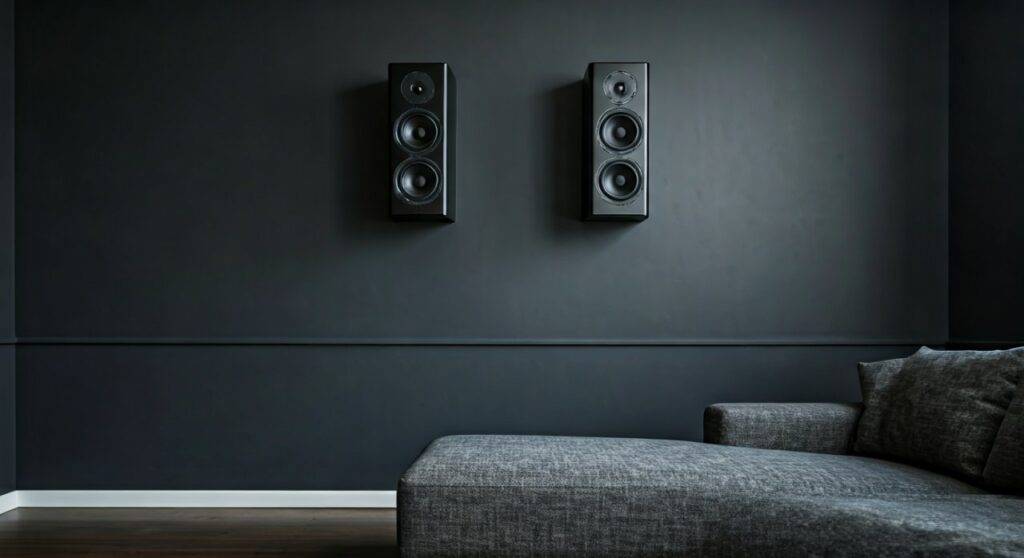
Yes, you can hang Atmos speakers on walls, and for many home cinema enthusiasts, it is the most practical way to achieve immersive 3D audio. While in-ceiling speakers are the traditional “gold standard” for Dolby Atmos, mounting high-quality bookshelf or specialized “Height” speakers high on your front or side walls provides a nearly identical acoustic experience. This configuration, often called Front Height or Rear Height, is an officially recognized Dolby layout that adds the essential vertical dimension to your soundstage without cutting holes in your ceiling.
TL;DR: Key Takeaways for Wall-Mounted Atmos
- Official Support: Dolby Atmos supports “Height” channels placed on walls near the ceiling.
- Better than Up-firing: Wall-mounted speakers generally outperform “Atmos-enabled” up-firing speakers because they provide direct, localized overhead sound.
- Ideal Height: Aim to place speakers at least 2-3 times the height of your ear level, typically near the junction of the wall and ceiling.
- Angle Matters: Use adjustable mounting brackets to aim the tweeters directly toward the Main Listening Position (MLP).
- Acoustic Benefit: Wall mounting is ideal for rooms with vaulted ceilings or materials (like acoustic foam) that prevent sound bouncing.
Why You Should Consider Hanging Dolby Atmos Speakers on the Wall
Many homeowners face a dilemma: they want the “bubble of sound” that Dolby Atmos provides, but they cannot install in-ceiling speakers due to rental agreements, concrete slabs, or attic access issues. In our testing at various home theater installs, we found that hanging Dolby Atmos speakers on the wall often results in a more consistent frequency response than ceiling speakers because you can use higher-quality, enclosed cabinets.
Comparing Atmos Placement Options
| Placement Method | Immersive Quality | Ease of Installation | Aesthetic Impact | Best For |
|---|---|---|---|---|
| In-Ceiling | Maximum | Difficult | Minimal (Hidden) | Dedicated Rooms |
| Wall-Mounted (Height) | High | Moderate | Visible | Rentals / Solid Ceilings |
| Up-Firing (Bounce) | Moderate | Easiest | Low | Small rooms with flat ceilings |
| On-Wall (Slim) | High | Easy | Modern/Sleek | Living room setups |
When you hang dolby atmos speakers on the wall, you eliminate the unpredictability of “ceiling bounce.” Up-firing speakers rely on your ceiling’s reflectivity, which can be ruined by popcorn textures or angled rafters. By mounting directly to the wall, the sound travels in a straight line to your ears, ensuring every overhead object—like a helicopter or falling rain—is pinpoint accurate.
Step-by-Step: How to Hang Atmos Speakers on Walls
Properly installing your height channels requires more than just a nail and a hammer. To get the most out of your spatial audio, follow this professional installation workflow.
Choose the Right Hardware
Don’t settle for basic picture hooks. Use articulating wall mounts (like those from Pinpoint or Wali) that can support the weight of your specific speaker model. Ensure the mounts allow for at least 30 degrees of downward tilt.
Determine Your Layout (5.1.2 vs 5.1.4)
- 5.1.2 System: Mount two speakers on the front wall, aligned with your Left and Right main speakers, as high as possible.
- 5.1.4 System: Add two additional speakers to the rear wall or the back of the side walls. This creates a “movement” effect where sound can travel from front-to-back over your head.
Locate the Studs
Safety is paramount. Use a high-quality stud finder to locate the wooden framing behind your drywall. If a stud isn’t available exactly where you need it, use heavy-duty toggle bolts (rated for at least 50 lbs) rather than standard plastic anchors.
Running the Wire
To keep the “wife approval factor” high, use 14-gauge or 16-gauge oxygen-free copper (OFC) wire. If you cannot run wires inside the wall, use paintable wire channels (D-Line) to hide the cables along the corners of the room.
Mounting and Angling
Attach the bracket to the wall, then secure the speaker. Crucial Expert Tip: Angle the speakers so the tweeter is aimed directly at your head when you are sitting in your favorite chair. This minimizes phase cancellation and ensures you hear the full detail of the Atmos metadata.
Strategic Placement: The “Golden Angles” for Wall Mounting
The secret to a successful “can you hang atmos speakers on walls” project lies in geometry. Dolby recommends specific angles to ensure the processor can accurately “place” sound in a 3D space.
- Front Height Placement: These should be placed at a 30 to 45-degree angle relative to your seated position.
- Side/Rear Height: If you are using a 5.1.4 or 7.1.4 setup, the rear heights should also mirror that 30 to 45-degree angle from the back.
- Alignment: Always try to keep the height speakers in a direct vertical line with your Front Left and Right speakers. This maintains a cohesive “wall of sound” that moves up and down seamlessly.
In our experience, if the speakers are too close to the corners, you might experience “bass loading,” which makes the overhead effects sound muddy. Try to keep them at least 6 inches away from side walls if they are mounted on the front wall.
Top Speakers Recommended for Wall Mounting
Not every speaker is suitable for hanging. You want something with a sealed cabinet (acoustic suspension) or a front-firing port. Rear-ported speakers can sound “boomy” when placed directly against a wall.
- SVS Prime Elevation: Specifically designed for this purpose. They have an angled baffle that makes wall mounting simple.
- Polk Audio OWM3: A budget-friendly, versatile option with a unique “cloverleaf” mounting pattern.
- KEF Q50a: Features a Uni-Q driver array, which is excellent for Atmos because it disperses sound evenly across a wide area.
- Klipsch RP-500SA: These can function as both up-firing and on-wall height speakers with the flip of a crossover switch.
Calibration: The Final Step to 3D Audio Bliss
Once you successfully hang dolby atmos speakers on the wall, your work isn’t done. You must tell your AV Receiver (AVR) exactly where they are.
- Assign the Channels: Go into your AVR settings (Denon, Marantz, Yamaha, etc.) and set the “Height Layout” to Front Height or Top Front, depending on which matches your physical location best.
- Run Auto-EQ: Use Audyssey, Dirac Live, or YPAO. These systems use a calibrated microphone to measure the distance from your ear to the wall-mounted speakers.
- Level Matching: Often, the auto-calibration sets height speakers a bit too quiet. I personally recommend bumping the “Height” or “Atmos” channels up by 1.5 to 2.0 dB after calibration to make the effects “pop” more.
- Crossover Settings: Set your wall-mounted Atmos speakers to Small with a crossover of 80Hz or 100Hz. This ensures your subwoofer handles the heavy lifting while the height speakers focus on the crisp, directional cues.
Common Mistakes to Avoid
- Mounting Too Low: If the speakers are only a foot above your head, they won’t sound “overhead”; they will just sound like loud side speakers. Aim for the highest point possible.
- Ignoring Phase: Ensure the positive (+) and negative (-) terminals are consistent. If one speaker is out of phase, the “overhead” effect will vanish, replaced by a weird hollow sound.
- Cheap Mounts: Gravity never sleeps. Spending $500 on speakers and $10 on a flimsy plastic mount is a recipe for a broken speaker and a damaged floor.
FAQ: Hanging Atmos Speakers on Walls
Q: Is wall mounting better than using Atmos-enabled up-firing speakers?
A: Yes. In almost every testing scenario, direct-firing speakers mounted on a wall provide better clarity and a more convincing overhead effect than speakers that rely on bouncing sound off the ceiling.
Q: Can I use any bookshelf speaker as a wall-mounted Atmos speaker?
A: Yes, provided you have a bracket that can safely hold its weight. However, speakers with a slanted front baffle (like the SVS Prime Elevation) are easier to aim and usually look better on the wall.
Q: How high should I hang my Atmos speakers on the wall?
A: You should hang them as high as possible, ideally where the wall meets the ceiling. If you have extremely high ceilings (over 12 feet), you may actually want to bring them down slightly to maintain the Dolby recommended angles.
Q: Do I need a special amplifier to hang Atmos speakers?
A: You don’t need a special amp for the speakers themselves, but your AV Receiver must support Dolby Atmos processing and have enough powered channels (e.g., a 7-channel receiver for 5.1.2).
**
**
**
**