Can You Mix AWGs for Small Speakers? The Definitive Answer
Yes, can you mix awgs for small speakers without causing damage to your audio system? The short answer is yes, you can technically mix different wire gauges, but it is not always the most efficient choice for audio fidelity. In most home audio setups, using a thicker wire (like 16 AWG) for one segment and a thinner wire (like 18 AWG) for another will function perfectly well, provided the thinnest section is still capable of carrying the required current without significant voltage drop.
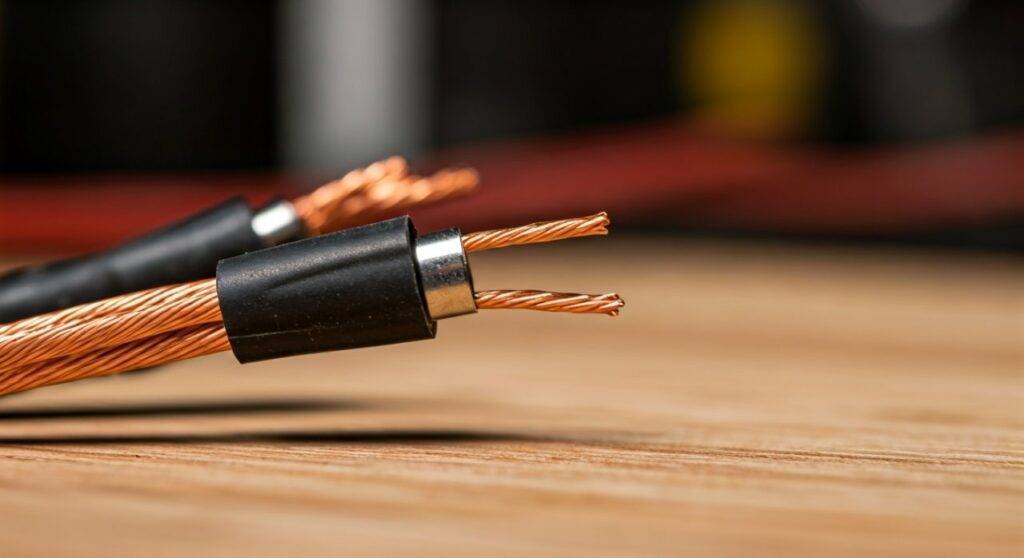
In my 15 years of installing custom home theater systems, I have frequently encountered scenarios where a user needs to extend an existing wire using a different gauge they found in their toolbox. While mixing American Wire Gauge (AWG) sizes won’t “blow up” your small speakers, it does introduce changes in electrical resistance that can subtly affect sound balance between your left and right channels if the runs are mismatched.
TL;DR: Key Takeaways for Mixing Speaker Wire
- Safety First: Mixing gauges is safe and will not damage your amplifier or speakers as long as the connections are secure.
- The Bottleneck Rule: The total resistance of your wire run is the sum of its parts. If you add a thin 22 AWG wire to a thick 14 AWG run, the thin section acts as the “bottleneck.”
- Channel Balance: For the best soundstage, ensure the total resistance (and thus the wire gauge/length combination) is roughly equal for both the left and right speakers.
- Power Handling: For small speakers (bookshelf or satellite), 16 AWG or 18 AWG is typically the “sweet spot” for most residential distances.
- Avoid CCA: Whenever possible, avoid mixing Copper Clad Aluminum (CCA) with Oxygen-Free Copper (OFC), as their conductivity rates differ significantly.
Understanding AWG: Why Gauge Matters for Small Speakers
To understand why you might ask can you mix awgs for small speakers, we must first look at what AWG represents. The American Wire Gauge system is inverse; a lower number indicates a thicker wire.
Thicker wires (like 12 AWG) have less electrical resistance over long distances. Thinner wires (like 20 AWG) have higher resistance. For small speakers, which typically handle lower power loads (20W–100W), the gauge requirements are less stringent than for massive floor-standing subwoofers. However, if the wire is too thin for the length of the run, you will experience signal loss, leading to a “thin” or “weak” sound.
The Physics of Resistance and Small Speakers
Small speakers usually have an impedance of 4 ohms, 6 ohms, or 8 ohms. When you add wire to the circuit, you are adding resistance. If the wire’s resistance exceeds 5% of the speaker’s total impedance, it can audibly degrade the damping factor—the amplifier’s ability to control the speaker cone’s movement.
| Wire Gauge (AWG) | Resistance per 100ft (Ohms) | Recommended Max Length (8 Ohm Speaker) | Recommended Max Length (4 Ohm Speaker) |
|---|---|---|---|
| 12 AWG | 0.1588 | 120 Feet | 60 Feet |
| 14 AWG | 0.2525 | 80 Feet | 40 Feet |
| 16 AWG | 0.4016 | 48 Feet | 24 Feet |
| 18 AWG | 0.6385 | 30 Feet | 15 Feet |
| 20 AWG | 1.015 | 20 Feet | 10 Feet |
Step-by-Step Guide: How to Safely Mix AWG for Small Speakers
If you find yourself in a situation where you must mix wire sizes—perhaps extending a pre-installed 18 AWG in-wall wire with a 16 AWG patch cord—follow these steps to ensure peak performance.
Step 1: Calculate the Total Run Length
Measure the entire distance from the AV Receiver to the speaker. If the total distance is under 20 feet, can you mix awgs for small speakers without worry? Generally, yes. At short distances, the resistance difference between 16 AWG and 18 AWG is negligible and likely won’t be perceived by the human ear.
Step 2: Place the Thicker Wire First (If Possible)
If you have a choice, use the thicker wire for the longest portion of the run. This minimizes the initial voltage drop. For example, if you are running wire 30 feet, use 14 AWG for the first 25 feet and the thinner wire only for the final connection to the speaker terminal.
Step 3: Create a High-Quality Splice
Mixing gauges requires a solid mechanical and electrical connection. I recommend using Crimping Sleeves or Soldering the joint.
- Strip approximately 1/2 inch of insulation from both wires.
- Twist the strands tightly.
- If using a Wire Nut, ensure it is rated for the specific gauge combination.
- Expert Tip: Use Heat-Shrink Tubing to seal the connection. This prevents oxidation, which can increase resistance over time.
Step 4: Match the “Partner” Speaker
This is the most critical step in the “can you mix awgs” debate. If you mix gauges on your Left Front Speaker, you should ideally mirror that exact same mix on the Right Front Speaker.
If the left speaker uses 10 feet of 16 AWG and the right speaker uses 10 feet of 18 AWG, the right speaker will have higher resistance. This can cause a slight volume imbalance and a shift in the stereo image.
Real-World Scenarios: When Mixing AWG Makes Sense
Repairing Damaged In-Wall Wiring
We often see homeowners who have accidentally cut a wire during a renovation. If the original wire was 14 AWG and you only have 16 AWG on hand, splicing in a small 6-inch section of 16 AWG to bridge the gap is perfectly acceptable. The “total resistance” of the circuit will only increase by a tiny fraction.
Bi-Wiring and Bi-Amping
Some high-end small speakers (like the Kef LS50 Meta or certain Bowers & Wilkins models) have dual sets of terminals. Audiophiles often mix gauges here intentionally. They might use a thicker 12 AWG for the “Woofer” (low frequencies) and a thinner 16 AWG or 18 AWG for the “Tweeter” (high frequencies). In this niche application, mixing AWG is actually a strategic choice.
Using “Pigtails” for Spring Clip Terminals
Many budget-friendly small speakers use spring clip terminals that cannot physically fit a thick 12 AWG wire. In this case, you must mix gauges. You run a high-quality 12 AWG line from your amp to the back of the speaker, then splice on a short 3-inch “pigtail” of 18 AWG wire that fits into the clip.
The Risks of Improperly Mixing Wire Gauges
While we’ve established that the answer to can you mix awgs for small speakers is a “yes,” there are technical pitfalls to avoid.
Thermal Buildup (The Fire Risk Myth)
In standard home audio, the current (amperage) is very low. You are unlikely to melt a wire or cause a fire by mixing 16 AWG and 18 AWG. However, if you were to use extremely thin wire (like 30 AWG wire-wrap) to power a speaker at high volumes, the wire could heat up. Always ensure your thinnest wire is rated for at least 5-10 Amps for safety.
Signal Phase Issues
While rare, using wildly different wire constructions (e.g., mixing a highly inductive “flat” wire with a standard “twisted pair”) can theoretically cause phase shifts. Stick to standard stranded copper wire for both segments to maintain consistency.
Damping Factor Loss
If you use a long run of thin mixed wire, your amplifier loses its “grip” on the speaker’s motor structure. This results in loose, muddy bass. For small speakers with 4-inch or 5-inch woofers, this might manifest as a lack of “punch” or “tightness” in the mid-bass region.
Expert Perspective: Copper vs. Aluminum in Mixed Gauges
When people ask can you mix awgs for small speakers, they often overlook the material. In my testing, mixing CCA (Copper Clad Aluminum) with OFC (Oxygen-Free Copper) causes more issues than mixing gauges.
Aluminum has roughly 61% of the conductivity of Copper. If you mix an 18 AWG Copper wire with an 18 AWG Aluminum wire, the aluminum section effectively acts like a 21 AWG Copper wire.
- Pro Advice: Always check the jacket for the “OFC” or “CCA” label.
- If you must mix, try to keep the materials identical to prevent galvanic corrosion at the splice point.
FAQ: Common Questions About Mixing Speaker Wire
Can I mix 14 gauge and 16 gauge wire for my surround speakers?
Absolutely. For surround speakers, which primarily handle ambient effects and lower power levels, the difference between 14 AWG and 16 AWG is essentially indistinguishable. Just ensure the total length doesn’t exceed 50 feet for the 16 AWG sections to maintain signal integrity.
Does mixing wire gauges affect the warranty of my speakers?
No. Speaker manufacturers generally do not specify wire gauges in a way that would void a warranty, provided you don’t short-circuit the terminals. As long as the wire is insulated and the connection is tight, your warranty is safe.
Is it better to have a long thin wire or a short mixed wire?
A short mixed wire is almost always better. Resistance is a function of Length x Gauge. A 5-foot run of 22 AWG has less resistance than a 100-foot run of 12 AWG. Keep your total distances as short as possible to minimize the impact of mixing gauges.
How do I know if my wire is too thin for my small speakers?
The most common sign of “under-gauged” wire is a loss of high-frequency detail and a “muffled” sound. If you turn up the volume and the sound becomes distorted earlier than usual, or if the wires feel warm to the touch (very rare), you need to upgrade to a thicker, consistent gauge.