Understanding Speaker Piggybacking: The Direct Answer
Can you piggy back speakers? Yes, you can connect multiple speakers to a single amplifier channel (commonly known as “piggybacking” or “daisy-chaining”), provided the total impedance (ohms) does not drop below the amplifier’s minimum stable rating. If you wire them incorrectly and the resistance becomes too low, you risk overheating your output transistors or triggering a thermal shutdown in your amplifier.
To do this safely, you must understand the difference between Parallel Wiring and Series Wiring. In my 15 years of configuring professional audio systems for live venues and home theaters, I have seen more “fried” amplifiers from improper piggybacking than from any other cause. This guide will walk you through the math and the physical steps to ensure your gear remains safe while expanding your soundstage.
🚀 Key Takeaways: Quick Reference
- Safety First: Never let the total load (ohms) drop below your amplifier’s minimum (usually 4 ohms or 8 ohms).
- Parallel Wiring: Drops the impedance. (Two 8-ohm speakers = 4-ohm load).
- Series Wiring: Increases the impedance. (Two 8-ohm speakers = 16-ohm load).
- Wire Gauge Matters: Use 14-gauge or 16-gauge oxygen-free copper (OFC) wire for runs over 20 feet.
- Power Distribution: When piggybacking, the amplifier’s power is split between the speakers; they will not each receive the full wattage of the channel.
The Physics of Impedance: Why Ohms Matter
Before you grab your wire strippers, you must understand Impedance, measured in Ohms (Ω). Think of impedance as a “gate” that restricts the flow of electricity.
If the gate is wide open (low ohms), too much electricity flows, and the amplifier works too hard, gets hot, and eventually fails. If the gate is too narrow (high ohms), the sound will be very quiet. Most consumer Integrated Amplifiers and AV Receivers are designed to handle a load between 4Ω and 16Ω.
Parallel vs. Series: The Two Ways to Piggyback
How you choose to connect the wires determines the final load on your system.
| Connection Type | How to Wire | Effect on Impedance | Best Use Case |
|---|---|---|---|
| Parallel | Positive to Positive, Negative to Negative | Decreases (Halves if speakers are identical) | Connecting two 8Ω speakers to a 4Ω stable amp. |
| Series | Pos (Amp) to Pos (S1); Neg (S1) to Pos (S2); Neg (S2) to Neg (Amp) | Increases (Adds them together) | Connecting multiple low-impedance speakers to a standard amp. |
Step 1: Check Your Hardware Specifications
Before asking can you piggy back speakers, you must look at the back of your equipment.
- Find the Amp Rating: Look for a label near the speaker terminals that says “Minimum 4 Ohms” or “8-16 Ohms.”
- Find the Speaker Rating: Check the sticker on your speakers. Most modern bookshelf and floor-standing speakers are 8 ohms, but high-end audiophile gear or car audio speakers are often 4 ohms.
- Identify the Amp Class: If you are using a Class D Digital Amplifier, they are often more efficient but can be very sensitive to low-impedance loads. Class A/B Amps (heavier, traditional receivers) handle heat differently but still require strict adherence to ohm ratings.
Step 2: Calculate Your Total Load
This is where most beginners make a mistake. You cannot simply plug in as many speakers as you have wire for. Use these formulas to determine if your configuration is safe.
The Parallel Formula
When you connect two speakers in parallel, you provide two paths for the electricity. The formula is:
Total Impedance = (R1 × R2) / (R1 + R2)
- Example: Two 8-ohm speakers in parallel.
- (8 × 8) / (8 + 8) = 64 / 16 = 4 Ohms.
The Series Formula
In series, the electricity must pass through one speaker to get to the next. The formula is simple addition:
Total Impedance = R1 + R2
- Example: Two 4-ohm speakers in series.
- 4 + 4 = 8 Ohms.
Step 3: Choose the Right Speaker Wire
When piggybacking, you are often running longer distances or pulling more current. I always recommend Oxygen-Free Copper (OFC) over Copper Clad Aluminum (CCA). CCA is cheaper but has higher resistance and can brittle over time.
- Under 20 Feet: 16-gauge wire is sufficient.
- 20 to 50 Feet: 14-gauge wire is recommended to prevent signal degradation.
- Over 50 Feet: 12-gauge wire is necessary to maintain the damping factor of your amplifier.
Pro Tip: If you are piggybacking speakers in a commercial setting (like a cafe), consider a 70-volt system instead, which uses transformers to allow for dozens of speakers on one line.
Step 4: Step-by-Step Guide to Parallel Wiring
This is the most common method for “daisy-chaining” two speakers.
- Strip the Wires: Strip about 1/2 inch of insulation from all wire ends.
- Connect Speaker A: Run a positive (+) and negative (-) wire from the amplifier to the first speaker.
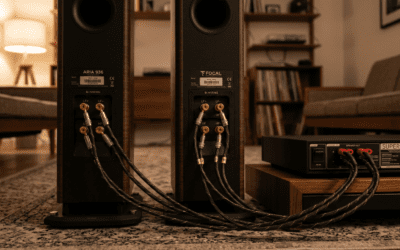
- The Piggyback Junction: Connect a second set of wires to the same terminals on Speaker A.
- Connect Speaker B: Run that second set of wires to the terminals of Speaker B (Positive to Positive, Negative to Negative).
- Verify: Ensure there are no stray copper strands touching the opposite terminal, which would cause a short circuit.
Step 5: Step-by-Step Guide to Series Wiring
Use this method if you have several 4-ohm speakers and an amp that only supports 8 ohms.
- Amp to Speaker 1: Connect the Positive (+) terminal of the Amp to the Positive (+) terminal of Speaker 1.
- Speaker 1 to Speaker 2: Connect the Negative (-) terminal of Speaker 1 to the Positive (+) terminal of Speaker 2.
- Speaker 2 to Amp: Connect the Negative (-) terminal of Speaker 2 back to the Negative (-) terminal of the Amp.
- Result: You have created one continuous loop. If one speaker wire fails, both speakers will go silent.
Expert Insights: When NOT to Piggyback
While the answer to can you piggy back speakers is generally yes, there are scenarios where I strongly advise against it based on my field experience.
Mixing Different Impedances
Never “piggyback” a 4-ohm speaker with an 8-ohm speaker in parallel. The electricity will follow the path of least resistance, sending significantly more power to the 4-ohm speaker. This results in unbalanced volume levels and can potentially blow the lower-impedance driver.
High-Fidelity Critical Listening
If you are an audiophile using high-end gear like McIntosh or Krell, piggybacking is a cardinal sin. It introduces back-EMF (Electromotive Force), where the movement of one speaker’s voice coil sends a small electrical signal back through the wire, interfering with the second speaker. This “muddies” the sound and ruins the stereo imaging.
Underpowered Amplifiers
If you use a small Lepai or SMSL desktop amp to drive four speakers, you will likely hit the clipping point. Clipping occurs when the amp runs out of voltage and begins outputting a “square wave,” which can melt the voice coils in your tweeters.
Troubleshooting Common Issues
The Amp is Getting Very Hot
If your amplifier is too hot to touch after 20 minutes, your total impedance is likely too low. Re-check your math. If you are running in parallel, switch to series wiring to increase resistance and take the load off the power supply.
One Speaker is Louder Than the Other
This happens if the speakers have different Sensitivity Ratings (measured in dB). If Speaker A is 90dB sensitive and Speaker B is 85dB, Speaker A will sound twice as loud even with the same amount of power. Always try to piggyback identical makes and models.
The Sound is Thin or “Hollow”
You likely have a Phase Issue. This happens if you accidentally swap the positive and negative wires on just one speaker. The speakers will “push” and “pull” against each other, cancelling out the bass frequencies. Double-check that all (+) terminals are linked correctly.
FAQs About Piggybacking Speakers
Can you piggy back speakers on a car head unit?
Most car factory head units are extremely sensitive and rated for exactly 4 ohms. Pigging backing speakers in parallel will drop the load to 2 ohms, which will almost certainly fry the internal chip of the radio. Always use an external 2-ohm stable amplifier for car audio expansions.
Will piggybacking speakers make them twice as loud?
No. In fact, it often results in less volume per speaker. Because the amplifier is now splitting its total current between two loads, each speaker receives roughly half the power (in a parallel setup). You gain more surface area for sound, which helps fill a room, but you don’t necessarily gain “loudness.”
Can I use a speaker selector box instead?
Yes! If you are uncomfortable with the math, a Speaker Selector Box with “Impedance Protection” is the best solution. These boxes contain internal resistors or transformers that automatically manage the load, allowing you to “piggyback” up to 4 or 6 pairs of speakers safely.
Is it better to wire in series or parallel?
It depends on your amp. Parallel is more common because if one speaker fails, the other keeps playing. However, Series is safer for the amplifier’s longevity if you are using multiple low-impedance speakers.