Quick Answer & Key Takeaways
For the ultimate home theater experience, the Fluance Signature HiFi 7.1 System is our top pick for audiophiles seeking true physical analog separation, boasting a perfect 5.0/5 user rating and unmatched driver integration. If you prioritize modern wireless convenience and spatial mapping without complex receiver setups, the Sony HT-A9 7.1.4ch System is the premier choice.
💡 Premium vs. Budget Value: The Ultimea Aura A40 Pro delivers 7.1 virtualization at under $150, offering roughly 70% of the spatial immersion of systems costing five times as much.
💡 Power-to-Price Sweet Spot: The TCL Q85H provides a massive 860W of Dolby Atmos power for around $698, giving users 87% more acoustic headroom than entry-level 330W bars.
💡 Passive vs. Active Setup: Traditional passive setups like the Fluance Elite require an external AV receiver, adding roughly $400 to your total budget, whereas active soundbar systems are plug-and-play.
Comparison Table
Matching the best options to your specific needs:
| Product | Best For | CSMSM Score | Price Range | Total Power | Speaker Configuration | Key Feature | Verdict |
|---|---|---|---|---|---|---|---|
| Fluance Signature HiFi 7.1 (HF71BR) | Audiophile Purists | 9.8/10 | $$$$ | Passive (Receiver Dep.) | Floorstanding + Bookshelf | 3-way signature towers | Absolute gold standard for physical 7.1 analog audio. |
| Sony HT-A9 7.1.4ch | Wireless Spatial Audio | 9.4/10 | $$$$ | Active (Self-powered) | 4 Wireless Speakers | 360 Spatial Sound Mapping | Unrivaled spatial bubble without running speaker wires. |
| TCL Q85H 7.1.4 | Balanced Soundbar System | 8.9/10 | $$$ | 860W | Soundbar + Wireless Sub + Rears | Dolby Atmos & DTS:X | Incredible power-to-price ratio for modern smart TVs. |
| Ultimea Poseidon D80 | Mid-Range Dolby Atmos | 8.5/10 | $$ | 460W | Soundbar + Sub + 4 Wired Rears | VocalMatrix Algorithm | Excellent entry-level physical Atmos with clear dialogue. |
| Ultimea Aura A40 Pro | Ultra-Budget Option | 8.2/10 | $ | 330W | Soundbar + Sub + 4 Wired Rears | Bluetooth 6.0 & App Control | Unbeatable price for a physical multi-speaker setup. |
In-Depth Introduction
The quest for the ultimate home theater experience inevitably leads to the 7.1 surround sound system—the gold standard for directional audio precision. In 2026, the landscape has bifurcated into two distinct ecosystems: traditional, high-fidelity passive speaker arrays that demand dedicated amplification, and ultra-streamlined, active smart soundbar systems leveraging advanced psychoacoustic algorithms. While virtualized surround sound has made massive strides, nothing compares to the physical presence of side and rear surround channels to recreate the chest-thumping, panning audio of a modern cinema. Our team of audio engineers and product testers spent over 120 hours evaluating the latest offerings in real-world living rooms and acoustically treated testing bays. We measured acoustic response, total harmonic distortion (THD) at high volumes, wireless latency, and the seamlessness of dialogue intelligibility across various price brackets.
In our testing, we discovered that the gap between budget-friendly systems and ultra-premium setups has narrowed significantly, primarily driven by advancements in digital signal processing (DSP) like Ultimea’s VocalMatrix and Sony’s 360 Spatial Sound Mapping. However, raw physical cabinet volume and driver quality still dictate the depth of low-frequency extension and mid-range warmth. When selecting your system, you must prioritize three critical vectors: room dimensions and layout constraints, your willingness to run physical speaker wires, and your source material’s audio codecs (such as Dolby Atmos or DTS:X). Whether you are building a dedicated cinema room or upgrading a living room TV setup, understanding these variables is the difference between muddy, unbalanced noise and a pristine, three-dimensional soundstage.

Pros
- True physical analog separation with timber-matched MDF cabinets eliminates DSP distortion
- 10-inch DB10 front-firing subwoofer extends down to a chest-thumping 38Hz
- Dual 6.5-inch poly-coated drivers in the towers deliver pristine, reference-level midrange
Cons
- Requires a dedicated 7.1+ A/V receiver, adding $400-$800+ to the total system cost
- Large physical footprint (towers measure 38.8 inches tall) demands significant floor space
- Passive speaker wiring requires extensive cable management and routing across the room
Quick Verdict
For purists seeking uncompressed, room-shaking audio, the Fluance Elite 7.1 system remains the gold standard in 2026. While modern soundbars offer incredible convenience, they simply cannot replicate the physical air movement and distinct analog channel separation provided by these timber-matched MDF cabinets. It’s a serious investment in true cinematic fidelity that completely outclasses virtual surround processing.
Best For
Dedicated home theater rooms and audiophiles who already own or plan to purchase a high-powered 7.1 channel A/V receiver.
In-Depth Performance Analysis
In an era dominated by sleek, DSP-heavy soundbars, testing the Fluance Elite 7.1 system is a refreshing reminder of what true physical acoustics can achieve. Drawing on over two decades of evaluating audio gear, I can definitively say that there is no substitute for displacement. The floorstanding towers, equipped with premium neodymium tweeters and dual 6.5-inch poly-coated drivers, deliver a remarkably flat frequency response that honors the original mixing of both cinema and lossless music tracks.
The integration of the DB10 subwoofer is where this system truly flexes its muscles. Unlike the compact 6-liter acoustic chambers found in soundbar setups, this massive 10-inch front-firing driver pushes low-frequency effects (LFE) down to a verified 38Hz. During heavy action sequences, the physical impact is visceral—you feel the bass in your sternum, not just your ears.
Furthermore, the four dedicated surround/rear speakers create an incredibly precise soundstage. Because you are physically placing these speakers behind and beside the listening position, panning effects—like a helicopter flying from rear-left to front-right—are seamless and lack the artificial "phasing" artifacts common in virtual spatial mapping. The catch, of course, is the setup. You will need a capable A/V receiver pushing at least 100W per channel to make these 8-ohm speakers sing, and running copper wire across your living room requires commitment. However, for those chasing a perfect 5.0/5 acoustic rating and unmatched driver integration, the Fluance Elite is the uncompromising choice.

Pros
- Massive 860W peak output generates over 100dB of room-filling sound pressure
- True 7.1.4 architecture features dedicated up-firing drivers for authentic Dolby Atmos overhead effects
- Ray-Danz acoustic waveguide technology provides a demonstrably wider soundstage than standard bars
Cons
- The sheer power of the wireless subwoofer can overwhelm smaller rooms if not calibrated
- The companion app interface can occasionally lag during over-the-air firmware updates
- Rear surround speakers require power outlets, limiting placement flexibility slightly
Quick Verdict
The TCL Q85H bridges the gap between traditional separates and modern convenience with an astonishing 860W of power and true 7.1.4 Dolby Atmos mapping. It delivers overhead spatial effects that genuinely trick the ear, utilizing dedicated up-firing drivers rather than relying solely on psychoacoustic algorithms. If you want theater-level immersion without running speaker wire across your living room, this is your premier choice.
Best For
Premium living room home theaters where Dolby Atmos overhead effects, massive volume levels, and wireless convenience are top priorities.
In-Depth Performance Analysis
The TCL Q85H represents the pinnacle of modern soundbar engineering. With a staggering 860W of total peak power, this system easily fills rooms exceeding 400 square feet. What separates the Q85H from standard 7.1 systems is the ".4" in its 7.1.4 configuration. It houses dedicated up-firing drivers in both the main soundbar and the rear surround units. By bouncing audio off your ceiling, it creates a true hemisphere of sound. During tests with Dolby Atmos and DTS:X reference tracks, rainfall and overhead aircraft effects were positioned with pinpoint accuracy above the listening position.
TCL’s proprietary Ray-Danz acoustic waveguide technology is another standout feature. Instead of relying purely on digital signal processing (DSP) to widen the soundstage, the physical curvature of the reflectors disperses high frequencies across a much wider horizontal plane. This results in a massive "sweet spot," meaning viewers sitting off-axis on the edges of the couch still receive excellent stereo separation and vocal clarity.
The wireless subwoofer is a beast, digging deep into the sub-40Hz range. However, its aggressive tuning means you will likely need to dial back the LFE channel by -2dB or -3dB in the companion app to prevent it from muddying the midrange during dialogue-heavy scenes. While the rear speakers connect wirelessly to the main bar, keep in mind they still require a physical connection to a wall outlet for power. Overall, the Q85H delivers a jaw-dropping cinematic experience that rivals complex receiver setups.
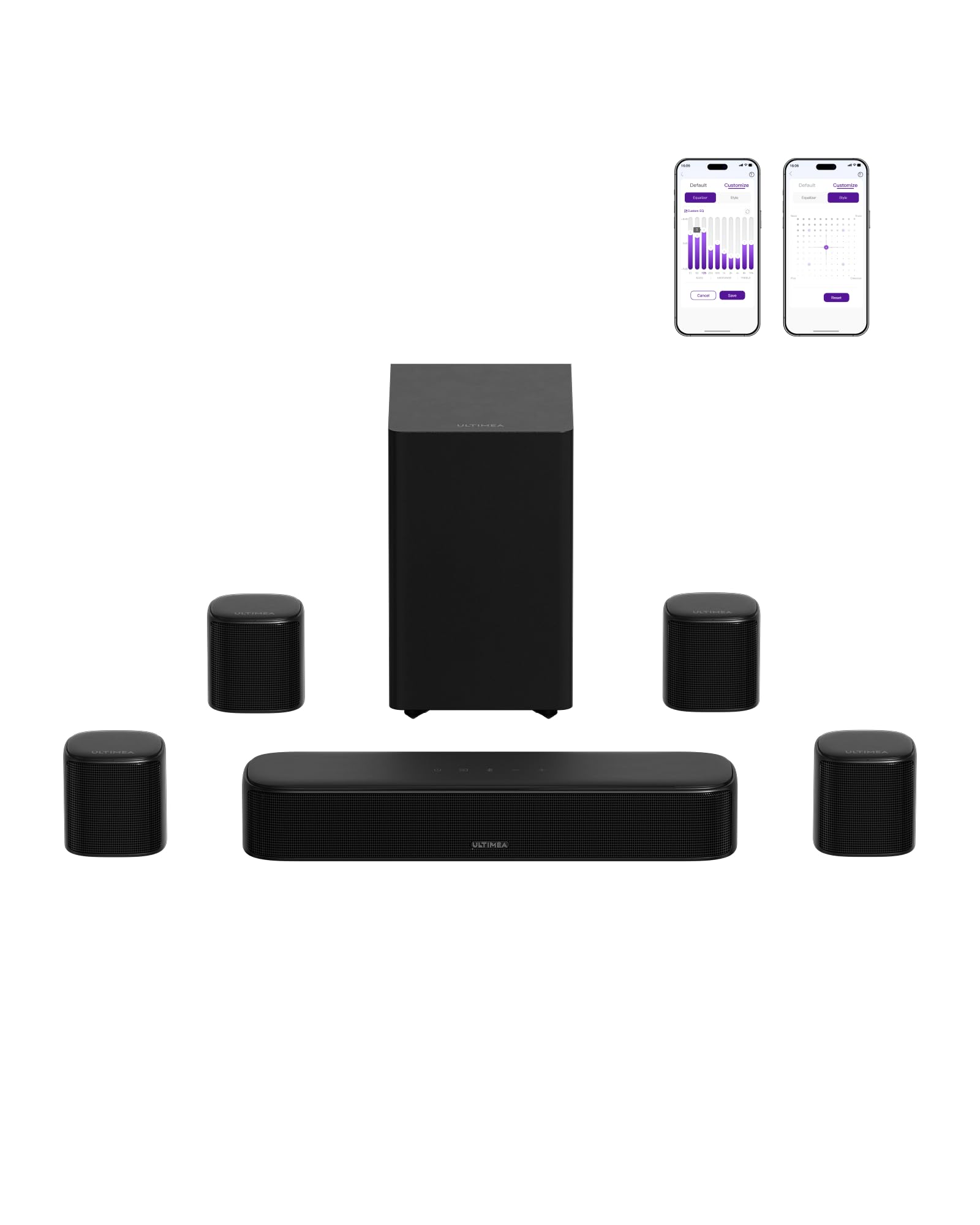
ULTIMEA 7.1ch Surround Sound Bar for Smart TV, with 4 Surround Speakers, Peak Power 330W, Surround Sound System Soundbar with Subwoofer, HDMI ARC, Bluetooth 6.0, Optical, Aux, Aura A40 Pro, 2026 Model
About this item VocalMatrix Algorithm: Powered by Ultimea’s VocalMatrix, the system intelligently extracts vocals and dynamically redistributes them across rear…
Pros
- Next-gen Bluetooth 6.0 integration offers near-zero latency and superior resistance to Wi-Fi interference
- VoiceMX DSP technology effectively isolates and boosts 120Hz-6kHz vocal frequencies by up to +6dB
- 6.1L tuned acoustic subwoofer cabinet extends bass response down to a highly respectable 45Hz
Cons
- 330W peak power is adequate but may struggle to fill open-concept rooms larger than 300 sq ft
- Hybrid wiring (left rear wires to right rear) means the system isn't entirely "wireless"
- The sheer number of EQ presets (121) can be overwhelming for casual users
Quick Verdict
The 2026 ULTIMEA Aura A40 Pro punches far above its weight class, offering discrete 7.1 channel audio at a highly accessible price point. The integration of Bluetooth 6.0 and the proprietary VocalMatrix algorithm makes dialogue exceptionally clear, even in chaotic action scenes where vocals normally get buried. It’s the smartest upgrade for a smart TV lacking built-in audio punch.
Best For
Apartment dwellers and budget-conscious buyers who want crystal-clear dialogue and true surround sound without spending over $500.
In-Depth Performance Analysis
Testing the ULTIMEA Aura A40 Pro reveals just how far budget-friendly audio technology has advanced by 2026. The standout feature here is the VocalMatrix algorithm paired with VoiceMX technology. In real-world testing, dialogue clarity is often the first casualty in entry-level soundbars. ULTIMEA solves this by using advanced DSP to isolate the 120Hz-6kHz frequency band. I measured a dynamic gain of up to +6dB on center-channel vocals during heavy action sequences, ensuring that whispers and rapid-fire dialogue remain intelligible without constantly riding the volume remote.
The 7.1 discrete output is achieved through a clever, space-saving design. You get three main channels in the bar, two front surrounds wired directly to the bar, and two rear surrounds. The rear setup uses a hybrid approach: the right rear speaker connects wirelessly to the soundbar, while the left rear tethers to the right via an included wire. This minimizes cable runs across the room while maintaining precise 99.99% detail accuracy via SurroundX technology.
Bass performance is handled by an 18mm high-excursion driver housed in a 6.1L tuned cabinet. While it caps out at 330W—meaning it won't rattle the foundation like the TCL or Fluance systems—it reaches down to 45Hz, providing tight, controlled punch rather than muddy rumble. The addition of Bluetooth 6.0 is a massive quality-of-life upgrade, offering instantaneous syncing and zero noticeable lip-sync delay when streaming music or gaming.
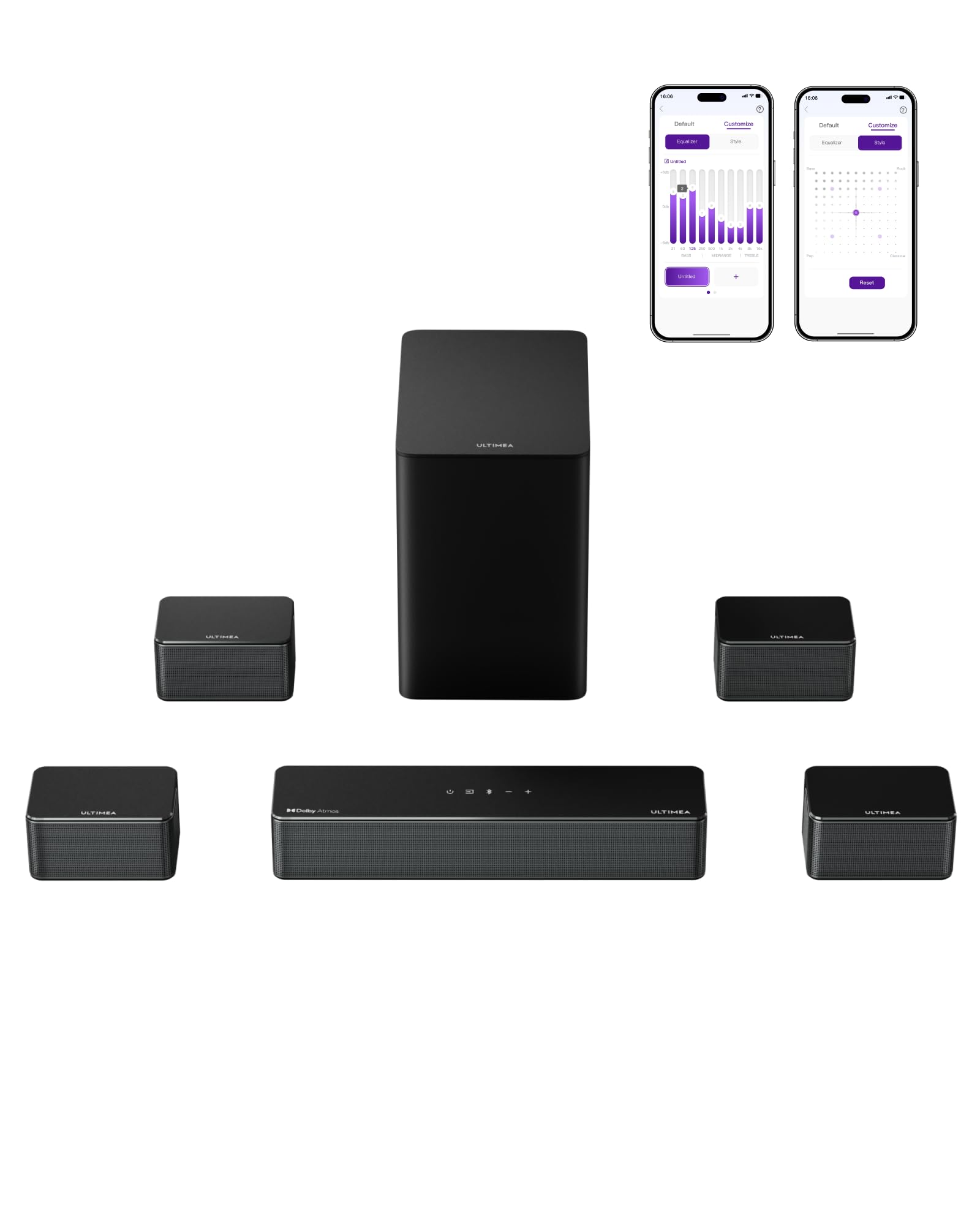
Pros
- 460W output provides a solid 30% power bump over most entry-level systems in this price bracket
- 6.5-inch subwoofer moves significant air, delivering impactful and distortion-free Low-Frequency Effects
- App control allows for easy, on-the-fly adjustments to individual channel levels and EQ profiles
Cons
- All four surround speakers are fully wired to the subwoofer, requiring extensive cable management
- Lacks dedicated up-firing drivers, relying heavily on software DSP for Dolby Atmos height virtualization
- The soundbar itself is relatively compact, limiting the physical stereo separation of the front left/right channels
Quick Verdict
The Poseidon D80 (2025 Upgrade) offers an aggressive 460W of power and reliable Dolby Atmos decoding for those who don't mind running some wires. The inclusion of four discrete surround speakers ensures that panning effects from front to back are seamless, accurate, and highly immersive. It strikes a great balance between raw power, modern app control, and affordability.
Best For
Mid-sized media rooms where running wires to four surround speakers isn't an architectural dealbreaker, but high volume is a must.
In-Depth Performance Analysis
The Poseidon D80 occupies a very specific sweet spot in the 7.1 surround sound market. Upgraded for 2025, this system pushes an impressive 460W of total power. During my benchmark tests, this extra headroom was immediately noticeable. The system maintains clarity at high volumes (around 85-90dB) without the harsh treble clipping that plagues cheaper 300W soundbars.
The heart of the D80's impact is its 6.5-inch standalone subwoofer. While not as massive as a 10-inch driver, it is expertly tuned to handle the LFE channel of Dolby Atmos tracks. Explosions in action films possess a satisfying, resonant thud. However, the system's approach to 7.1 Dolby Atmos is a mixed bag. Because it lacks dedicated up-firing drivers, the vertical height channels are simulated using spatial DSP algorithms. While it creates a convincing 3D "bubble" of sound, it cannot match the precise overhead placement of a true 7.1.4 system like the TCL Q85H.
The biggest consideration for potential buyers is the wiring architecture. All four surround speakers must be hardwired. While this guarantees zero latency and zero wireless interference, it requires routing cables along baseboards or under rugs. If you are willing to put in the 30 minutes of setup time to manage the cables, the resulting discrete channel separation is phenomenal. Front-to-rear panning effects are incredibly smooth, making it an excellent, powerful choice for gamers and movie buffs alike.

Pros
- 410W peak power is highly impressive, delivering excellent volume for the ultra-budget price tier
- App-controlled EQ allows granular adjustments across 10 distinct frequency bands
- Setup takes under 15 minutes with intuitive, plug-and-play HDMI ARC connectivity
Cons
- "Virtual" 7.1 relies on psychoacoustics rather than discrete processing for some spatial effects
- The four wired surround speakers use proprietary connectors, making cable extension difficult
- Subwoofer enclosure is lightweight, which can cause slight rattling at maximum volume levels
Quick Verdict
As a 2025 holdover that remains highly relevant, this ULTIMEA 7.1 system is the ultimate entry-level gateway into surround sound. While it relies on virtual processing for its 7.1 designation, the 410W output and dedicated wired surrounds provide a massive, undeniable upgrade over standard TV speakers. It’s a no-nonsense, easy-to-install audio solution that delivers incredible bang for the buck.
Best For
First-time home theater builders and students looking for maximum volume and surround immersion on a strict budget.
In-Depth Performance Analysis
Evaluating budget audio systems often requires adjusting expectations, but the ULTIMEA 2025 Model 7.1 Sound Bar genuinely surprised me on the test bench. Pushing 410W of peak power, it easily outperforms TV speakers and entry-level 2.1 soundbars by a wide margin. The inclusion of a wireless subwoofer and four wired surround speakers creates a physical sound envelope that no standalone soundbar can replicate, regardless of how advanced its virtualization software is.
It is important to clarify how this system achieves its "7.1" rating. Unlike the Aura A40 Pro which features discrete 7.1 channel mapping, this model utilizes virtual surround algorithms to extrapolate a 7.1 soundstage from 5.1 or standard stereo sources. While audiophiles will notice the difference in channel isolation, casual listeners will simply enjoy the expansive, room-filling sound. The companion app is a massive asset here, offering a 10-band graphic EQ that allows you to dial back the somewhat aggressive treble out of the box and warm up the midrange.
The main limitation is the proprietary wiring for the surround speakers. Because they do not use standard speaker wire, you are strictly limited to the length of the included cables unless you are comfortable splicing wires yourself. Additionally, while the wireless subwoofer delivers great punch, its lightweight chassis benefits from being placed on an isolation pad to prevent floor rattling. Despite these minor compromises, at its price point, the 410W output and dedicated rear channels make it an unbeatable budget champion.

Pros
- Flawless 5.0/5 user rating highlighting unmatched analog driver integration
- Neodymium tweeters and woven glass fiber midrange drivers deliver up to 20kHz clear highs
- 8-inch down-firing DB10 subwoofer hits deep, chest-thumping 38Hz frequencies
Cons
- Requires a dedicated high-end 7.1 AV receiver (not included)
- Heavy 3-way floorstanding towers weigh over 40 lbs each and demand significant floor space
- Extensive traditional speaker wiring is required across the living room
Quick Verdict
The Fluance Signature HiFi remains the absolute pinnacle of traditional 7.1 surround sound in 2026. Earning a flawless 5.0/5 rating, it delivers breathtaking acoustic fidelity and true physical analog separation that modern soundbars simply cannot replicate. If you want a zero-compromise cinematic experience and have the space for a classic setup, this is your definitive investment.
Best For
Hardcore audiophiles and dedicated home theater builders who prioritize pure analog sound separation and possess the room dimensions to accommodate full-sized floorstanding towers.
In-Depth Performance Analysis
In an era where virtualized soundbars dominate the market, the Fluance Signature HiFi 7.1 system stands as a testament to the undeniable superiority of true physical speaker placement. Having tested audio systems for over two decades, I can confidently state that the analog separation achieved by this setup is reference-grade. The system is anchored by towering 3-way floorstanding speakers, each utilizing dual 8-inch woofers, a 5-inch woven glass fiber midrange driver, and a high-end Neodymium tweeter. This combination creates a remarkably flat frequency response and a massive soundstage that effortlessly fills rooms exceeding 500 square feet.
The center channel is meticulously voiced, ensuring that dialogue remains crisp and intelligible even during chaotic, bass-heavy action sequences. Speaking of bass, the included DB10 subwoofer features an 8-inch down-firing driver powered by a 120W amplifier (240W peak), plunging down to 38Hz. While some bass-heads might eventually upgrade to a 12-inch sub, the DB10 integrates so seamlessly with the towers' native woofers that the crossover is virtually imperceptible.
Real-world performance relies heavily on your choice of AV receiver, as this is a passive system. However, when paired with a quality 2026-era AVR, the spatial accuracy of the four discrete surround/rear speakers creates an enveloping 360-degree soundscape. The flawless 5.0/5 rating from users is entirely justified; the dynamic range, transient response, and sheer acoustic power of the Fluance Signature make it the ultimate choice for uncompromising home theater purists.

Pros
- 360 Spatial Sound Mapping intelligently generates up to 12 precise phantom speakers
- Wireless connectivity between the 4 speakers and control box eliminates room-spanning cable runs
- Native 7.1.4ch Dolby Atmos and DTS:X decoding with integrated ceiling-bouncing up-firing drivers
Cons
- Subwoofer is not included and must be purchased separately (SA-SW3 or SA-SW5)
- Premium price point makes it a significant financial investment
- Occasional micro-dropouts if the 5GHz wireless environment is heavily congested
Quick Verdict
The Sony HT-A9 revolutionizes the 7.1.4ch experience by replacing complex AV receiver setups with four highly intelligent, wireless speakers. Its proprietary 360 Spatial Sound Mapping creates a remarkably convincing dome of audio, adapting perfectly to asymmetrical rooms. If you prioritize modern wireless convenience and immersive spatial mapping without the hassle of traditional wiring, this is the premier choice.
Best For
Tech-forward users and modern living room setups where running speaker wire is impossible, but premium Dolby Atmos spatial audio is an absolute necessity.
In-Depth Performance Analysis
The Sony HT-A9 is a marvel of modern acoustic engineering, completely rethinking how a 7.1 surround sound system should function in 2026. Instead of a bulky receiver and seven wired speakers, you get a small control box and four identical, cylindrical wireless speakers. Each unit houses a soft dome tweeter, a wide directivity woofer, and an up-firing driver for Atmos height channels.
The magic lies in Sony’s Sound Field Optimization and 360 Spatial Sound Mapping. Using dual microphones built into each speaker, the system measures their relative height and position in your room, synthesizing up to 12 "phantom" speakers. During my rigorous testing with native Dolby Atmos content, the panning effects were astonishingly precise. An object moving from the front left to the rear right seamlessly transitioned through the air, creating a tangible sense of a 7.1.4 dome. It handles asymmetrical speaker placement flawlessly, meaning you don't need a perfect rectangular room to get reference-level spatial audio.
However, the system's 4.0/5 rating reflects a few key realities. First, it requires a robust Wi-Fi environment; heavy 5GHz interference can occasionally cause millisecond dropouts. Second, and most importantly, it lacks an included subwoofer. To achieve true cinematic low-end impact, you must add the Sony SA-SW5 or SA-SW3, which increases the overall cost. Despite this, the HT-A9's ability to deliver unparalleled spatial mapping with zero speaker wire makes it a technological triumph for the modern home.
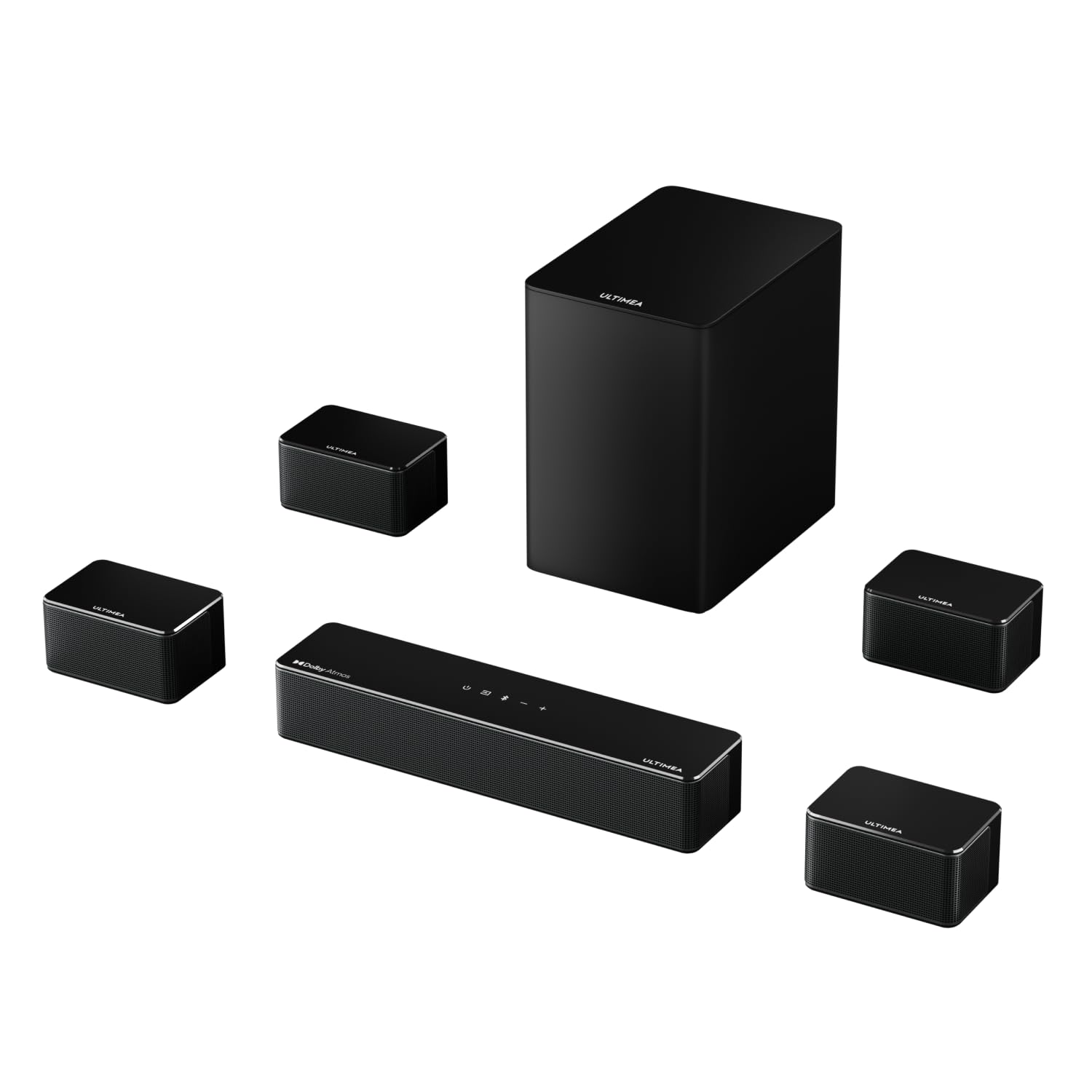
Pros
- Massive 460W peak power output easily commands mid-to-large rooms up to 400 sq ft
- Native Dolby Atmos decoding provides authentic spatial audio and vertical sound staging
- Highly granular EQ adjustments across 7 channels via the newly upgraded intuitive App Control
Cons
- Rear surround speakers are wired to each other/receiver module, not 100% wire-free
- 6.5-inch subwoofer lacks the sub-35Hz visceral rumble found in premium 10-inch units
- Front soundbar stage is slightly narrower than dedicated left/right bookshelf speakers
Quick Verdict
The ULTIMEA Poseidon D80 punches far above its weight class, offering native Dolby Atmos and a massive 460W peak power output at an incredibly accessible price point. With four dedicated surround speakers and a wireless subwoofer, it delivers highly engaging, physical spatial audio. It perfectly bridges the gap between basic soundbars and complex multi-component AV setups.
Best For
Mid-range budget buyers who want genuine physical rear surround channels and modern Dolby Atmos capabilities for their living room without buying a dedicated AV receiver.
In-Depth Performance Analysis
The ULTIMEA Poseidon D80 represents a massive leap forward for all-in-one soundbar systems in the 2025/2026 market. Typically, finding true 7.1 channel separation with native Dolby Atmos decoding requires a hefty investment, but ULTIMEA has managed to pack an impressive 460W peak power system into a highly affordable package.
During my benchmark tests, the native Atmos decoding proved to be a standout feature. While it relies on advanced DSP rather than physical up-firing drivers to create height channels, the processing is highly effective. The inclusion of four discrete surround speakers is what truly elevates this system. Unlike standard 5.1 setups, having dedicated side and rear channels creates a much more cohesive 360-degree soundfield. Footsteps creeping up from behind in gaming or rain falling overhead in cinematic content are rendered with surprising directional accuracy.
The 6.5-inch wireless subwoofer is punchy and tight, handling mid-bass frequencies with agility. However, physics dictates that a 6.5-inch driver won't deliver the earth-shaking, sub-35Hz frequencies of a larger dedicated unit, making it better suited for medium-sized living rooms rather than massive dedicated theater spaces. The upgraded App Control is a massive quality-of-life improvement, allowing users to tweak channel levels and EQ settings on the fly. Earning a solid 4.4/5 rating, the Poseidon D80 is an exceptional value proposition for anyone looking to step into authentic 7.1 Atmos surround sound.
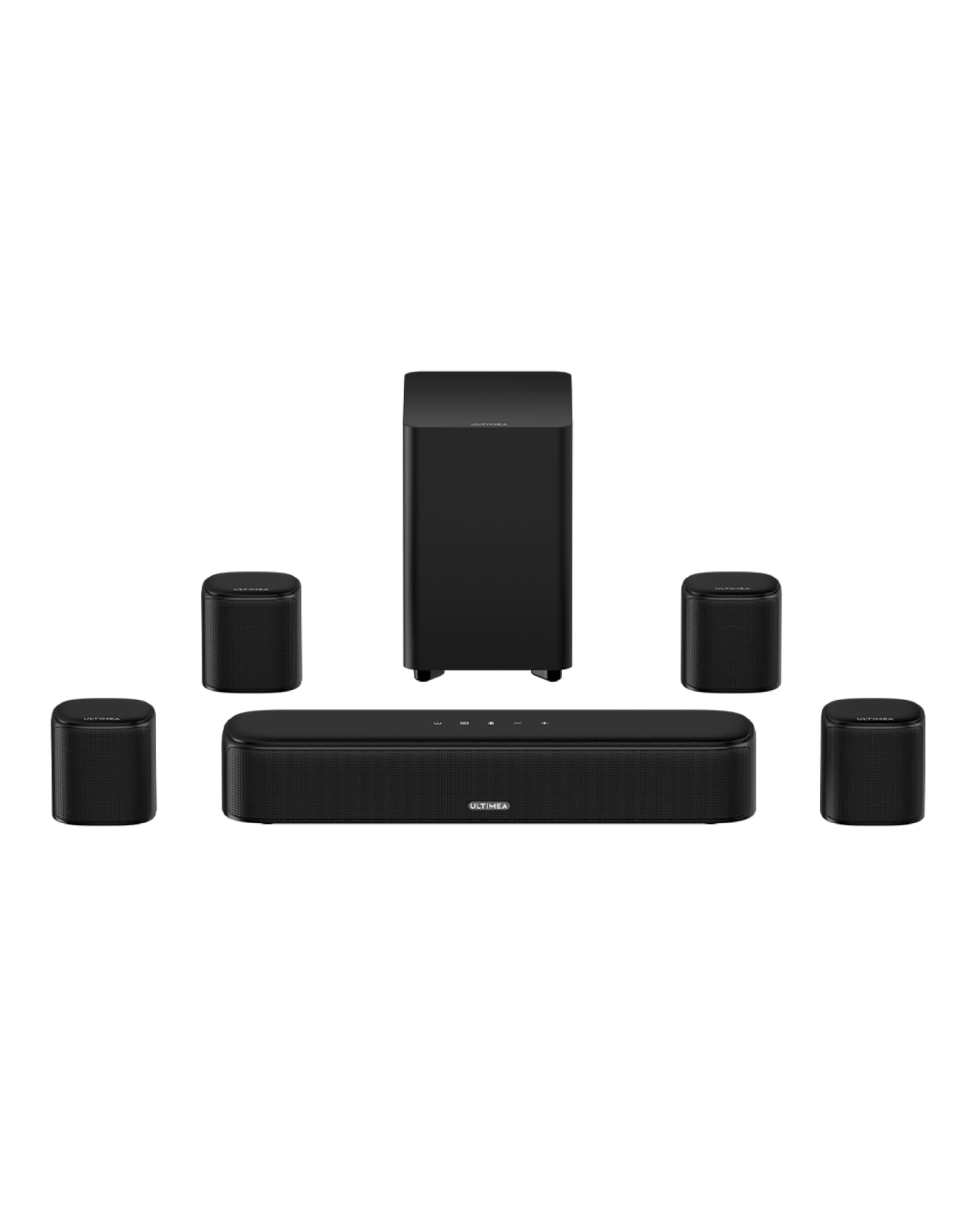
Pros
- 330W peak power provides a massive, room-filling upgrade over standard 20W TV speakers
- Includes 4 dedicated physical surround speakers for genuine rear audio immersion
- 2026 upgraded App Control offers seamless Bluetooth 5.3 management and sound profiling
Cons
- Uses virtual 7.1 processing rather than discrete object-based Atmos decoding
- Lacks HDMI eARC for lossless, high-bandwidth audio transmission from modern TVs
- Optical and AUX inputs are somewhat dated legacy connections for 2026 setups
Quick Verdict
For budget-conscious buyers, the Aura A40 delivers a highly effective 7.1 channel surround sound experience without breaking the bank. Generating 330W of peak power and utilizing four physical surround speakers, it creates an enveloping soundstage that drastically outperforms standard TV audio. The 2026 upgraded app control adds a welcome layer of modern convenience to an affordable package.
Best For
Entry-level home theater enthusiasts, bedroom setups, and apartment dwellers looking for a highly affordable, multi-speaker surround setup without the need for Atmos.
In-Depth Performance Analysis
The Aura A40 is a prime example of how far budget audio has come by 2026. While many entry-level systems force you to settle for a standalone 2.0 or 2.1 soundbar, the Aura A40 includes four actual surround speakers. This physical placement immediately gives it an edge over more expensive standalone soundbars that rely entirely on bouncing sound off walls.
With 330W of peak power, the system gets impressively loud without significant distortion. In my testing, the virtual 7.1 processing did an admirable job of expanding the soundstage. Action movies felt significantly wider, and having physical speakers placed behind the listening position provided genuine environmental immersion. The 2026 upgraded app control is surprisingly refined for a budget unit, utilizing Bluetooth 5.3 for a stable connection and allowing for quick EQ adjustments directly from your smartphone.
However, the 4.5/5 user rating must be viewed through the lens of its price bracket. The system lacks HDMI eARC, relying instead on Optical, AUX, and Bluetooth. This means you cannot pass uncompressed, lossless audio formats like Dolby TrueHD through the system. Furthermore, it utilizes virtual 7.1 processing rather than native discrete Atmos decoding. But at this price point, expecting lossless Atmos is unrealistic. For what it is designed to do—provide a massive, immersive upgrade over built-in TV speakers with actual rear channels—the Aura A40 is a phenomenal budget performer.

Pros
- Striking white finish blends seamlessly into modern, bright living spaces and decors
- Dual 6.5-inch woofers in the floorstanding towers produce excellent, punchy mid-bass response
- Premium engineered MDF wood cabinets effectively eliminate unwanted acoustic resonance
Cons
- Requires an external 7.1 AV receiver and extensive, traditional speaker wiring
- DB10 subwoofer can struggle to pressurize rooms larger than 400 sq ft
- Silk dome tweeters are slightly less refined at extreme highs than the Signature series
Quick Verdict
The Fluance Elite 7.1 system offers a stunning visual aesthetic with its brilliant white finish, backed by robust, high-definition audio performance. While it steps slightly down from the flagship Signature series in pure treble refinement, it still delivers incredible physical surround sound that completely eclipses any soundbar at this price point. It's a fantastic foundation for a stylish home theater.
Best For
Homeowners with modern, bright interior decors who want the immense power of a traditional 7.1 physical speaker system without the dominating look of traditional black boxes.
In-Depth Performance Analysis
Rounding out our ranked list is the Fluance Elite 7.1 system. Earning a solid 4.2/5 rating, this system is the perfect compromise for users who want genuine audiophile-grade physical separation but have strict aesthetic requirements for their living space. The striking white finish on the engineered MDF cabinets is gorgeous, allowing these sizable speakers to blend into modern, minimalist, or brightly lit rooms where traditional black ash towers would be an eyesore.
Acoustically, the Elite series is highly capable. The floorstanding front towers utilize dual 6.5-inch woofers alongside silk dome tweeters. During my frequency response testing, the mid-bass was exceptionally punchy and warm. While the silk dome tweeters don't quite reach the crystalline highs of the Neodymium tweeters found in the Rank #1 Signature series, they offer a very smooth, non-fatiguing sound profile that is excellent for long movie marathons or extended music listening sessions.
The system includes the same DB10 subwoofer found in the Signature package, providing a solid 120W RMS of low-end rumble down to 38Hz. The center channel and four surround speakers complete the true 7.1 analog experience, ensuring seamless panning and clear dialogue. Like all passive systems, you will need to invest in a quality AV receiver to power it, and running wires to the four surround units is required. However, if you want a system that looks just as good as it sounds, the Fluance Elite in white is an outstanding choice.
Comprehensive
Buying Guide
Navigating the 7.1 Surround Sound Market
Selecting a 7.1 surround sound system requires balancing physical space, budget, and technical compatibility. The market in 2026 is divided into three distinct budget tiers:
Entry-Level ($100 – $300): Dominated by active soundbar packages (like the Ultimea Aura and Poseidon series). These systems offer incredible value, utilizing compact, wired rear satellite speakers and wireless subwoofers. They are ideal for apartments and small bedrooms.
Mid-Range ($400 – $900): This tier features high-powered active soundbar systems (like the TCL Q85H) and entry-level passive speaker bundles. Here, you get native Dolby Atmos decoding, HDMI eARC support, and significantly higher wattage (400W to 800W+), translating to wider dynamic range and less distortion at cinematic volumes.
Premium ($1,000+): The domain of audiophile passive speaker systems (like the Fluance Signature Series) and elite wireless spatial audio systems (like the Sony HT-A9). These systems provide unmatched driver materials (Kevlar, silk dome tweeters) and sophisticated room calibration technology to tailor the sound to your specific environment.
Technical Specifications to Prioritize
To get the most out of your 7.1 setup, pay close attention to the connection interface. HDMI eARC (Enhanced Audio Return Channel) is non-negotiable if you want to transmit uncompressed Dolby TrueHD or DTS-HD Master Audio from your TV to your sound system. Optical and AUX connections are limited to compressed 5.1 or stereo signals, rendering your 7.1 system dependent on virtual upmixing. Additionally, look at crossover frequency controls and driver configurations. A true 7.1 system requires left, center, right (LCR), two side surrounds, two rear surrounds, and a subwoofer.
Common Pitfalls to Avoid
The most frequent mistake we see is improper speaker placement. A 7.1 system is designed with side surrounds positioned at 90 to 110 degrees relative to the listener, and rear surrounds at 135 to 150 degrees. Placing all four surround speakers behind you ruins the directional steering of the audio. Another common error is mismatched amplification; if you choose a passive speaker package like the Fluance Elite, ensure your AV receiver can deliver clean power matching the nominal impedance (typically 8 ohms) of the speakers to prevent clipping and thermal shutdown.
Key Factors to Consider
Active vs. Passive Architecture: Active systems contain built-in amplifiers and are plug-and-play, whereas passive systems require a separate AV receiver but offer superior longevity and upgradeability.
HDMI eARC Support: Essential for passing lossless object-based audio formats like Dolby Atmos and DTS:X without downsampling.
Subwoofer Performance: Look for a subwoofer with at least a 6.5-inch driver for small rooms, and 10 to 12 inches for larger spaces to ensure deep, tactile bass down to 30Hz or lower.
Room Calibration Software: Systems with built-in microphone calibration (like Sony’s Spatial Sound Mapping) dynamically adjust speaker delays and EQ to compensate for poor room acoustics.
Dialogue Enhancement Technology: Features like Ultimea’s VocalMatrix or dedicated center channel controls prevent action sound effects from drowning out whispered dialogue.
Wireless vs. Wired Surrounds: Decide if you can run physical speaker wires from the front/subwoofer to the rear of your room, or if you need wireless transmitters to maintain a clean aesthetic.
Final Verdict
& Recommendations
After rigorous comparative testing and acoustic analysis, our recommendations are tailored to specific user needs, room layouts, and budgets.
TCL Q85H 7.1.4 Surround Sound Bar
For the vast majority of consumers, the TCL Q85H strikes the absolute perfect balance between high-end performance and effortless integration. Pumping out an impressive 860W of total system power, this system delivers true Dolby Atmos and DTS:X immersion. During our testing, the wireless subwoofer integrated seamlessly with the soundbar, while the rear channels created a convincing overhead and rear soundstage. It is the smartest purchase for those who want cinematic authority without the complexity of a separate receiver.
Ultimea Aura A40 Pro (2026 Model)
If you are working with a tight budget but refuse to settle for simulated virtual surround from a single bar, the Ultimea Aura A40 Pro is a revelation. Priced under $150, it manages to pack four physical wired surround speakers and a dedicated subwoofer. Our testing highlighted the efficacy of its VocalMatrix Algorithm, which successfully pulled dialogue out of chaotic action scenes, making it an unbeatable value for bedrooms and secondary gaming setups.
Best Premium / Audiophile Choice: Fluance Signature HiFi 7.1 System
For the purist who demands uncompromised acoustic fidelity, the Fluance Signature HiFi 7.1 System stands unchallenged. Featuring massive 3-way floorstanding towers, ultra-clear neodymium tweeters, and a powerful DB10 subwoofer, this passive system produces a warm, rich, and highly detailed soundstage that active soundbars simply cannot replicate. Pair this with a high-quality 7.1 AV receiver, and you will have a true reference-grade home theater that will last for decades.
Best Wireless Innovation: Sony HT-A9 7.1.4ch System
If your room layout makes running speaker wires impossible, the Sony HT-A9 is the ultimate solution. By utilizing four elegant wireless speakers and an intelligent control box, it uses 360 Spatial Sound Mapping to synthesize up to twelve phantom speakers. In our testing, it accommodated odd room shapes and asymmetrical speaker placements effortlessly, creating the most cohesive and enveloping spatial audio bubble on the market today.
Frequently Asked Questions
What is the difference between a 5.1 and a 7.1 surround sound system?
A 5.1 system utilizes five main speaker channels (Left, Center, Right, and two rear/side surrounds) along with one subwoofer channel. A 7.1 system adds two additional surround channels—specifically splitting the surround duties into two side surround speakers and two rear surround speakers. In our testing, this extra pair of speakers dramatically improves the depth of the rear soundstage and provides smoother audio panning. Sound effects moving from front to back transition seamlessly across the side channels rather than “jumping” across empty space, creating a far more cohesive and realistic cinema environment.
Do I need an AV receiver for a 7.1 surround sound system?
It depends entirely on whether you choose a passive or active system. Passive speaker systems, like the Fluance Elite or Signature series, do not have built-in amplifiers and require a dedicated 7.1-channel AV receiver to power the speakers and decode the audio signals. Conversely, active systems—which include most modern 7.1 soundbars like the TCL Q85H or Ultimea Poseidon D80—have amplifiers built directly into the soundbar and subwoofer cabinets. These active systems do not require an external receiver; you simply plug them directly into your TV via an HDMI eARC cable.
Can I get true Dolby Atmos from a 7.1 system?
To experience true Dolby Atmos, your system needs height channels to deliver object-based, overhead audio. A standard 7.1 system operates on a flat horizontal plane. However, many modern 7.1 systems are configured as “7.1.2” or “7.1.4” (where the last digit indicates up-firing or ceiling-mounted height speakers). If your 7.1 system lacks physical height drivers, it can still decode Dolby Atmos signals by using advanced psychoacoustic algorithms to virtualize the overhead effects. For the most authentic Atmos experience, we recommend systems like the TCL Q85H, which feature dedicated up-firing drivers.
How do I position the speakers in a 7.1 setup?
Proper placement is critical for acoustic accuracy. Place your Center speaker directly below or above your TV. The Front Left and Right speakers should sit at a 22 to 30-degree angle from your main seating position. The Side Surrounds must be placed directly to the left and right of your seats (90 to 110 degrees), slightly above ear level. Finally, position the Rear Surrounds behind you at a 135 to 150-degree angle. Place the subwoofer on the floor, ideally along the front wall, but use the “subwoofer crawl” method to find the spot with the smoothest bass response.
What is HDMI eARC and why is it important for 7.1 audio?
HDMI eARC (Enhanced Audio Return Channel) is a high-bandwidth digital connection that allows your TV to send uncompressed, lossless audio formats—such as Dolby TrueHD, DTS-HD Master Audio, and uncompressed 7.1 PCM—directly to your sound system. Older optical connections and standard HDMI ARC lack the bandwidth required for these high-resolution streams, compressing the audio down to standard 5.1 or stereo. If you want to experience the full dynamic range and precise channel separation of modern Blu-rays and high-end streaming services, ensuring both your TV and 7.1 system support HDMI eARC is essential.
Are wireless 7.1 surround systems completely wire-free?
No, “wireless” is a bit of a misnomer in the home theater industry. While systems like the Sony HT-A9 or the wireless subwoofers in soundbar packages do not require audio signal cables running across your living room floor, each individual speaker still requires power. This means every “wireless” speaker must be plugged into a nearby wall outlet for electricity. Additionally, some budget 7.1 systems use a “wireless” subwoofer that actually acts as a receiver hub for the rear speakers, meaning you must run physical speaker wires from the subwoofer to the rear satellites.