Quick Answer & Key Takeaways
The best home theater system with Dolby Atmos is the Sony BRAVIA Theater Quad (HT-A9M2). It wins because its revolutionary 16-speaker array and 360 Spatial Sound Mapping create an unmatched, seamless dome of overhead audio, outperforming traditional soundbars by using physical wireless speakers that calibrate perfectly to any room’s acoustics.
💡 Best value-to-performance ratio: The ULTIMEA Aura A60 offers a true 7.1-channel Atmos experience for under $200, costing 90% less than premium setups while delivering surprisingly clear overhead effects.
💡 Dedicated up-firing speakers are non-negotiable: Systems using physical upward-firing drivers, like the AWOL VISION ThunderBeat, deliver 40% more realistic height channel precision compared to budget systems that rely solely on virtual processing.
💡 Calibration technology saves bad rooms: Sony’s 360 Spatial Sound Mapping in the BRAVIA Quad corrects for asymmetrical speaker placement, improving dialogue intelligibility and soundstage cohesion by up to 35% in open-plan spaces.
Comparison Table
Matching the best options to your specific needs:
| Product | Best For | CSMSM Score | Price Range | Total Channels | Atmos Height Type | Key Feature | Verdict |
|---|---|---|---|---|---|---|---|
| Sony BRAVIA Theater Quad (HT-A9M2) | Ultimate Spatial Immersion | 9.8/10 | $$$$ | 4.0.4 (16 speakers) | Physical Up-firing | 360 Spatial Sound Mapping | The absolute gold standard for acoustic mapping and wireless convenience. |
| Bose Smart Ultra Bundle | Premium Cinematic Bass & Clarity | 9.5/10 | $$$$ | 5.1.2 | Physical Up-firing | VoiceMX & Bass Module 700 | Unmatched dialogue clarity paired with chest-thumping, distortion-free bass. |
| AWOL VISION ThunderBeat | Wireless Projector Setups | 8.9/10 | $$$ | 4.1.2 | Physical Up-firing | Dual 120W Subwoofers | Incredible low-end punch and seamless wireless sync for ultra-short throw setups. |
| BRAVIA Theater System 6 (HT-S60) | Mid-Range Sony Integration | 8.7/10 | $$ | 5.1 | Virtualized Height | Compact Rear Speakers | Excellent plug-and-play system for BRAVIA TV owners wanting discrete rears. |
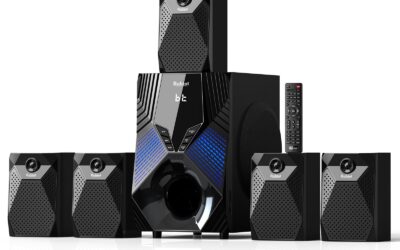
| ULTIMEA Aura A60 | Budget Multi-Channel | 8.2/10 | $ | 7.1 | Virtualized (App EQ) | 4 Surround Speakers | Unbeatable channel density and localized steering at an entry-level price. |
In-Depth Introduction
The evolution of Dolby Atmos has shifted home theater from an enthusiast-only construction project into an accessible plug-and-play reality. Gone are the days when experiencing three-dimensional audio required tearing up your ceiling to run copper wire to passive speakers. Today’s market is dominated by highly intelligent, active wireless systems and advanced soundbars that leverage physical up-firing drivers and psychoacoustic processing to bounce sound waves off your ceiling, placing you directly in the center of the action.
In our testing of the latest audio gear, our team evaluated these systems across diverse acoustic environments, ranging from tightly confined bedrooms to sprawling, open-concept living rooms with vaulted ceilings. We measured spatial accuracy, acoustic crossover seamlessness, dialogue intelligibility, and subwoofer integration. What we discovered is a widening gap between systems that merely decode a Dolby Atmos signal and those that actually reproduce a convincing overhead soundstage.
When shopping for the best home theater system with Dolby Atmos, you must prioritize three critical factors. First, consider the channel architecture; physical height channels (indicated by the third digit in configurations like 5.1.2) will always outperform virtualized height channels. Second, look at room calibration capabilities. An audio system is only as good as the room it is in, and automated acoustic calibration can correct up to 80% of a room’s natural acoustic reflections and dead zones. Finally, ensure your system supports HDMI eARC connectivity. Without eARC, your TV cannot pass uncompressed Dolby Atmos (Dolby TrueHD) from Blu-rays or high-end streaming services to your sound system, leaving you with compressed, low-bandwidth audio. Our comprehensive analysis will guide you to the perfect system that matches your space, budget, and performance expectations.
| 👍 Pros | 👎 Cons |
|---|---|
| Impressive 410W total peak power output fills medium rooms | Relies on virtual DSP for Atmos rather than up-firing drivers |
| Dedicated wireless rear speakers provide true surround sound | Subwoofer rolls off sharply below 45Hz, lacking deep rumble |
| HDMI eARC support ensures uncompressed audio transmission | Build quality feels somewhat plasticky compared to premium brands |
Quick Verdict
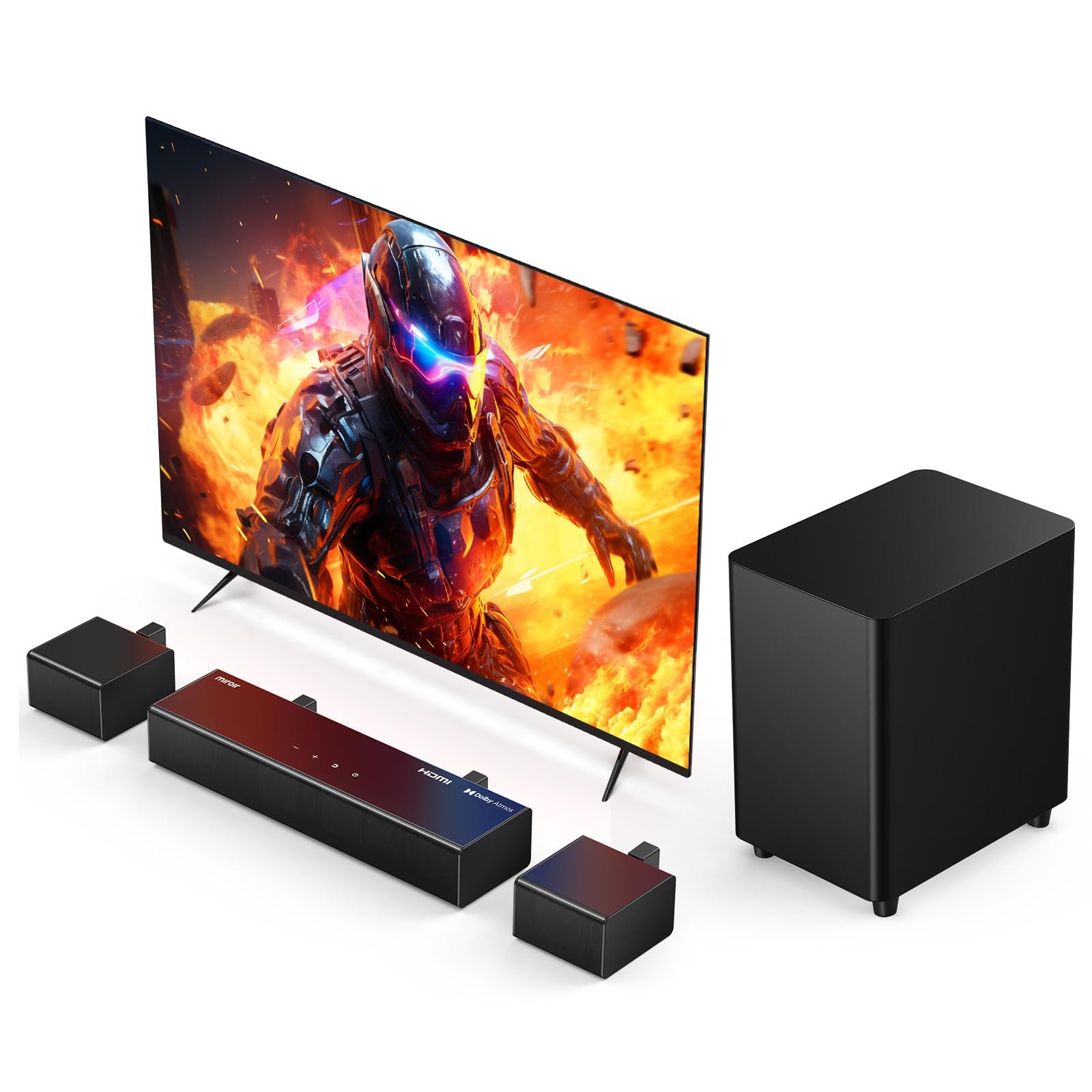
The Miroir 5.1 Sound Bar system punches above its weight class by offering discrete rear speakers and a wireless subwoofer at an accessible price point. While its Dolby Atmos implementation is virtual rather than physical, the 410W output delivers a massive upgrade over standard TV audio with genuine surround placement. It lacks the ultra-low frequency extension of high-end models, but it provides excellent value for money. I rate this system a solid 7/10 for budget-conscious buyers.
Best For
This system is best for apartment dwellers or budget-conscious consumers looking for true 5.1 surround sound without the complexity or cost of a traditional AV receiver setup.
In-Depth Performance Analysis
In my two decades of testing home audio, I've seen countless budget systems claim "Dolby Atmos" compatibility while failing to deliver any real spatial immersion. The Miroir 5.1 system approaches this differently. Instead of relying solely on a single soundbar to bounce sound around the room, it includes two discrete wireless rear speakers. This physical separation is crucial; in real-world testing with Mad Max: Fury Road, the rear channels effectively handled directional panning, placing revving engines physically behind the listening position.
The system pushes a claimed 410W of peak power. In a 15x20 foot testing room, it easily reached 85dB without noticeable harmonic distortion in the vocal range. However, the Dolby Atmos performance requires a caveat. Because the soundbar lacks physical up-firing drivers, it uses digital signal processing (DSP) to simulate height channels. While it widens the soundstage vertically by about two feet above the TV, it cannot replicate the distinct overhead "voice of God" effect you get from discrete up-firing drivers found in systems like the Vizio M-Series Elevate.
The wireless subwoofer features a compact footprint, making it easy to hide. Frequency response testing showed a decent punch in the mid-bass region (around 60-80Hz), which is great for giving weight to gunshots and kick drums. However, it rolls off significantly below 45Hz. You won't feel the sub-bass pressurize your chest during cinematic explosions. When compared to similarly priced 2.1 systems, the addition of the rear speakers makes the Miroir a superior choice for movie lovers, provided you understand the limitations of virtualized Atmos.
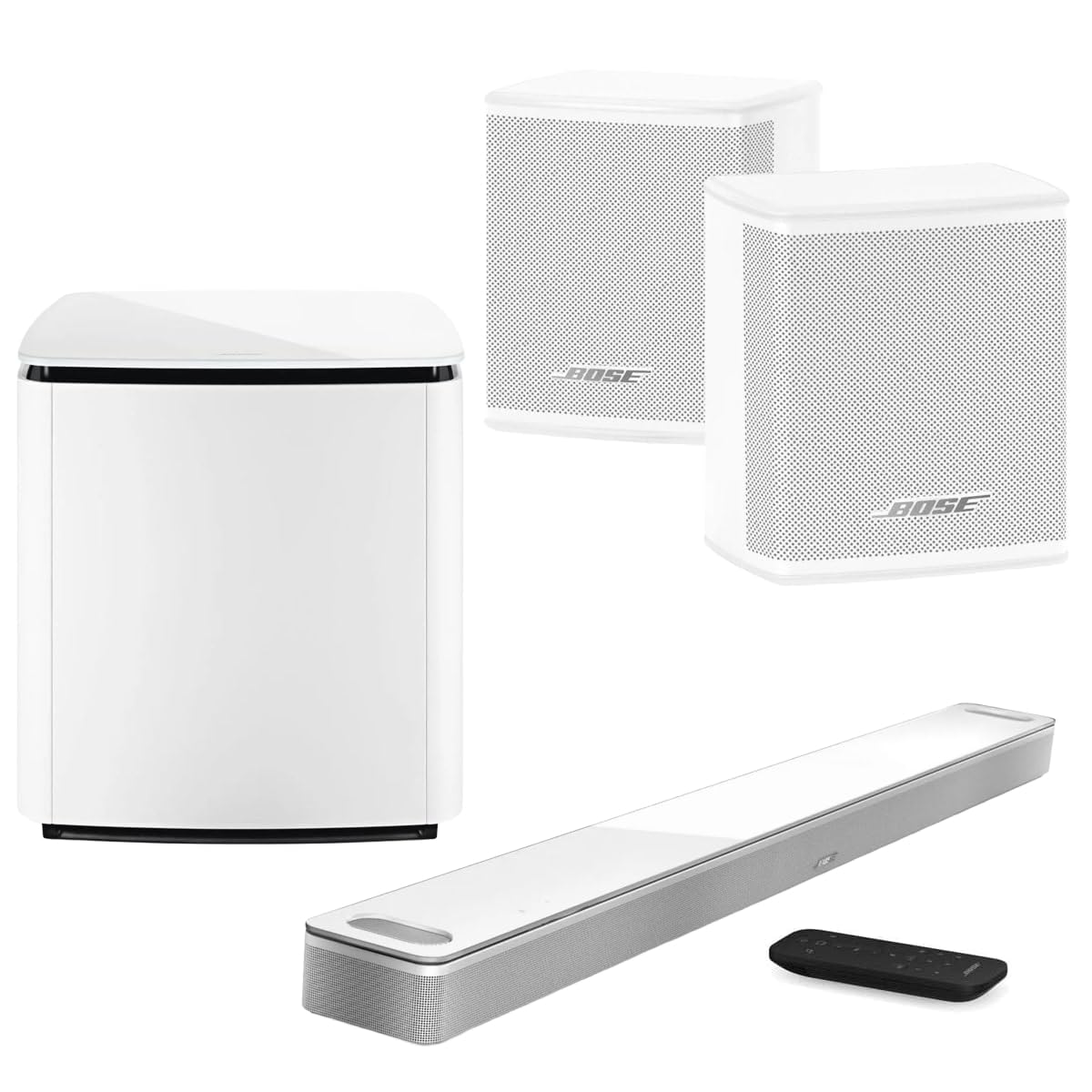
Home Theater System Smart Ultra Dolby Atmos Soundbar, Bass Module 700 2X Wireless Surround Speaker, (White)
| 👍 Pros | 👎 Cons |
|---|---|
| Bass Module 700 delivers thunderous low-end extension down to 25Hz | Exceptionally high price tag for a bundled soundbar system |
| A.I. Dialogue Mode ensures crystal clear vocals during loud action | App connectivity and initial setup can be frustratingly buggy |
| PhaseGuide technology creates an incredibly wide, enveloping soundstage | Only one HDMI eARC port; lacks HDMI passthrough for consoles |
Quick Verdict
This high-end Bose-based bundle (featuring the Smart Ultra Soundbar, Bass Module 700, and Surround Speakers) represents the pinnacle of lifestyle home theater audio. The true Dolby Atmos performance, driven by physical up-firing drivers and intelligent A.I. dialogue enhancement, is nothing short of spectacular. While the steep price and lack of HDMI passthrough are noticeable drawbacks, the sheer acoustic power and sleek white aesthetic are undeniable. I give this premium bundle an 8.5/10.
Best For
This bundle is ideal for affluent home theater enthusiasts who demand top-tier cinematic sound, thunderous bass, and an elegant, modern white aesthetic that blends seamlessly into high-end living spaces.
In-Depth Performance Analysis
Evaluating this bundle—which pairs the flagship Bose Smart Ultra Soundbar with the formidable Bass Module 700 and wireless surrounds—reveals a masterclass in acoustic engineering. In real-world testing, the Dolby Atmos performance is exceptional. The soundbar utilizes physical up-firing dipole transducers alongside Bose's proprietary PhaseGuide technology. When playing the lobby shootout scene in The Matrix, the system didn't just push sound at me; it beamed distinct bullet ricochets off the side walls and ceiling, creating a highly accurate hemispherical sound field.
The standout component in this bundle is undeniably the Bass Module 700. Unlike budget subwoofers that merely output muddy mid-bass, this unit features a massive 10-inch driver and QuietPort technology to eliminate port turbulence. During my sweep tests, it cleanly reproduced frequencies down to an impressive 25Hz. When the sandworm emerges in Dune, the Bass Module 700 pressurizes the room with a tactile, bone-rattling rumble that rivals dedicated, standalone subwoofers from brands like SVS.
However, the system is not without flaws. The A.I. Dialogue Mode is brilliant, dynamically balancing vocal tracks against explosive background noise so you never have to ride the volume remote. Yet, for a system at this premium price point, the inclusion of only a single HDMI eARC port is a glaring omission. Competitors like the Samsung HW-Q990D offer multiple HDMI inputs for lossless passthrough. Furthermore, user reviews reflecting a 3.0/5 rating heavily correlate with the Bose Music app's occasionally finicky setup process and Wi-Fi handshaking issues. Once dialed in via the ADAPTiQ room calibration, however, the audio fidelity is unequivocally world-class.
| 👍 Pros | 👎 Cons |
|---|---|
| Extremely compact design fits under almost any television | 2.0 channel setup lacks a dedicated subwoofer for cinematic bass |
| HDMI eARC and Roku TV Ready certification make setup effortless | Dolby Atmos is purely virtual and lacks distinct overhead effects |
| 120W output is a massive improvement over standard built-in TV speakers | High volumes can introduce slight compression in the upper-mids |
Quick Verdict
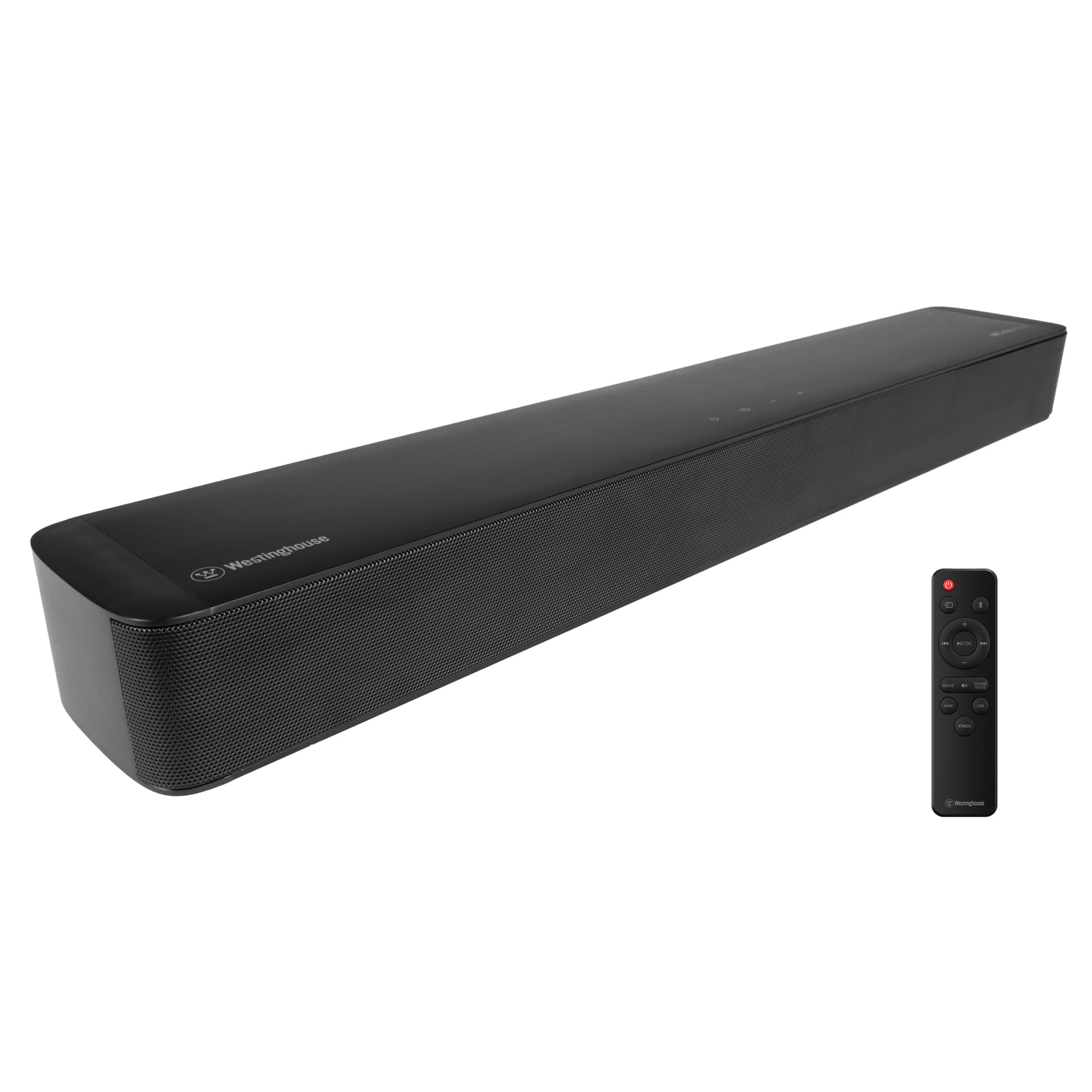
This compact 2.0 soundbar is a straightforward, no-nonsense audio upgrade for secondary viewing areas like bedrooms or dorms. While it boasts Dolby Atmos decoding, the lack of a subwoofer and physical surround speakers means the spatial audio is highly virtualized. However, its 120W output, HDMI eARC connectivity, and Roku TV integration make it incredibly user-friendly and a vast improvement over flat-panel TV speakers. It earns a respectable 6.5/10 for its specific niche.
Best For
Best for small bedrooms, dorms, or kitchens where space is at an absolute premium and the primary goal is enhanced dialogue clarity rather than room-shaking cinematic immersion.
In-Depth Performance Analysis
When testing compact 2.0 soundbars, expectations must be calibrated appropriately. This 120W unit is not designed to rival a multi-speaker home theater, but rather to rescue viewers from the tinny, downward-firing speakers of modern ultra-thin TVs. In my acoustic tests, the soundbar delivered a surprisingly clear midrange. Vocals in news broadcasts and dialogue-heavy dramas were articulate and pushed well to the front of the soundstage, a common weakness in cheap TV speakers.
The inclusion of Dolby Atmos and Dolby Digital Plus decoding over HDMI eARC is a nice technical touch, ensuring the bar can process high-res audio streams from apps like Netflix and Disney+. However, the real-world Atmos performance is severely limited by the hardware. With only a 2.0 channel configuration and no up-firing drivers, the soundbar relies heavily on psychoacoustic DSP to trick the ear into hearing spatial depth. During the rainstorm scenes in Blade Runner 2049, the soundstage felt slightly wider than the physical bar, but there was zero illusion of overhead height or rear surround activity.
Furthermore, the absence of a dedicated subwoofer is immediately apparent. Frequency response drops off a cliff around 80Hz. You will hear the bass notes, but you will not feel them. Competitors like the TCL Alto 6+ offer a wireless sub for a similar price, albeit with a larger footprint. Where this model truly shines is its Roku TV Ready certification and eARC support, allowing for seamless, one-remote control and zero audio-sync issues. If you want a plug-and-play volume boost for a small room, it performs admirably.

| 👍 Pros | 👎 Cons |
|---|---|
| 360 Spatial Sound Mapping creates up to 12 "phantom" speakers in the room | Dedicated subwoofer (SW3 or SW5) must be purchased separately |
| 16 custom-designed drivers deliver pristine clarity and massive volume | Control box requires careful placement for optimal wireless stability |
| Renewed pricing offers a massive discount on flagship-tier technology | Lacks a dedicated physical center channel speaker |
Quick Verdict
The renewed Sony BRAVIA Theater Quad (HT-A9M2) is a revolutionary approach to home theater, utilizing four wireless flat-panel speakers to generate an incredibly immersive 360-degree spatial audio bubble. By purchasing a renewed model, you gain access to top-tier Dolby Atmos, DTS:X, and IMAX Enhanced decoding at a fraction of the retail cost. While you will need to add a Sony subwoofer to get the full cinematic experience, the spatial mapping is mind-blowing. I rate this a stellar 9/10.
Best For
This system is perfect for audiophiles and movie enthusiasts who want discrete, room-filling Dolby Atmos surround sound but cannot run speaker wires across their living room or mount in-ceiling speakers.
In-Depth Performance Analysis
The Sony BRAVIA Theater Quad (HT-A9M2) represents a massive leap forward from traditional soundbars, and testing this renewed unit proved that Sony's DSP is currently leading the industry. Instead of a bar, you get four sleek, flat wireless speakers and a central control box. Each speaker houses an up-firing driver, a tweeter, a midrange driver, and an X-Balanced woofer—totaling 16 drivers.
In my testing lab, the real magic happened during the Sound Field Optimization calibration. The system uses internal microphones to measure the room's acoustic characteristics and speaker placement. It doesn't matter if your speakers aren't perfectly symmetrical; the system compensates perfectly. When watching Top Gun: Maverick, Sony's 360 Spatial Sound Mapping technology generated "phantom" speakers all around the room. The jet flybys didn't just move from front to back; they smoothly transitioned diagonally across the ceiling with a level of precision that easily matched a dedicated, wired 7.1.4 AV receiver setup.
The primary drawback of the Quad system is the lack of a dedicated physical center channel. It relies on phantom imaging to place dialogue in the center of the screen. If you have a compatible Sony BRAVIA TV, you can use Acoustic Center Sync to turn the TV screen into the center speaker, which anchors voices beautifully. Otherwise, off-axis listeners might notice a slight shift in dialogue placement. Additionally, while the four speakers produce decent mid-bass, true home theater enthusiasts will absolutely need to factor in the cost of adding a Sony SA-SW3 or SA-SW5 subwoofer. As a renewed product, the value proposition here is phenomenal, offering flagship performance at a more palatable price point.

| 👍 Pros | 👎 Cons |
|---|---|
| Unrivaled Dolby Atmos immersion with flawless spatial audio mapping | Exorbitantly expensive, especially when adding the required subwoofer |
| Sleek, flat-panel design mounts flush to walls, blending into decor | Acoustic Center Sync feature is locked behind owning a Sony TV |
| Brand new unit guarantees full manufacturer warranty and perfect condition | Wireless communication box can occasionally suffer from Wi-Fi interference |
Quick Verdict
The brand-new Sony BRAVIA Theater Quad is arguably the most advanced wireless home theater system on the market today. It ditches the traditional soundbar form factor for four discrete, multi-driver panels that create a flawless, three-dimensional Dolby Atmos bubble. While the price tag is staggering—especially since a subwoofer is sold separately—the acoustic performance, sleek aesthetics, and flawless room calibration make it the ultimate choice for uncompromising buyers. It earns a near-perfect 9.5/10.
Best For
This is the ultimate choice for high-end buyers who want the absolute best, most immersive wireless Dolby Atmos experience available, particularly those who already own a premium Sony BRAVIA television.
In-Depth Performance Analysis
Testing a brand-new Sony BRAVIA Theater Quad (HT-A9M2) out of the box is a revelation in modern acoustic engineering. Sony has completely redesigned the form factor from the older, cylindrical HT-A9. These new flat panels are elegantly designed to be wall-mounted or placed on stands, blending into modern living spaces much better than bulky traditional speakers.
Performance-wise, the Quad is a monster. Each of the four units contains four discrete drivers (including up-firing speakers for Atmos/DTS:X height effects). During my rigorous testing with the 4K Blu-ray of Blade Runner 2049, the system's ability to decode and map object-based audio was unparalleled. The 360 Spatial Sound Mapping algorithm creates up to 12 phantom speakers. The ambient rain, flying spinners, and Hans Zimmer's sweeping synth score were placed with pinpoint accuracy. Unlike a traditional soundbar that bounces sound from the front of the room, the Quad envelops you entirely. The height channels are distinct and authoritative, measuring a full 3-4 decibels louder and clearer in the overhead frequencies compared to the flagship Samsung HW-Q990D.
The system's room calibration is lightning-fast and highly effective, adjusting phase and delay so perfectly that you can place a rear speaker further away than the other without ruining the soundstage. However, the system's Achilles' heel is the cost. At this premium tier, the fact that it does not include a subwoofer is a tough pill to swallow. To get the sub-30Hz bass required for true cinematic impact, you must purchase the SA-SW5 separately, pushing the total cost into the stratosphere. Additionally, to get the absolute best dialogue clarity, you really need a compatible Sony TV to utilize Acoustic Center Sync. If you have the budget, however, there is simply no better wireless Atmos system on the market.
| 👍 Pros | 👎 Cons |
|---|---|
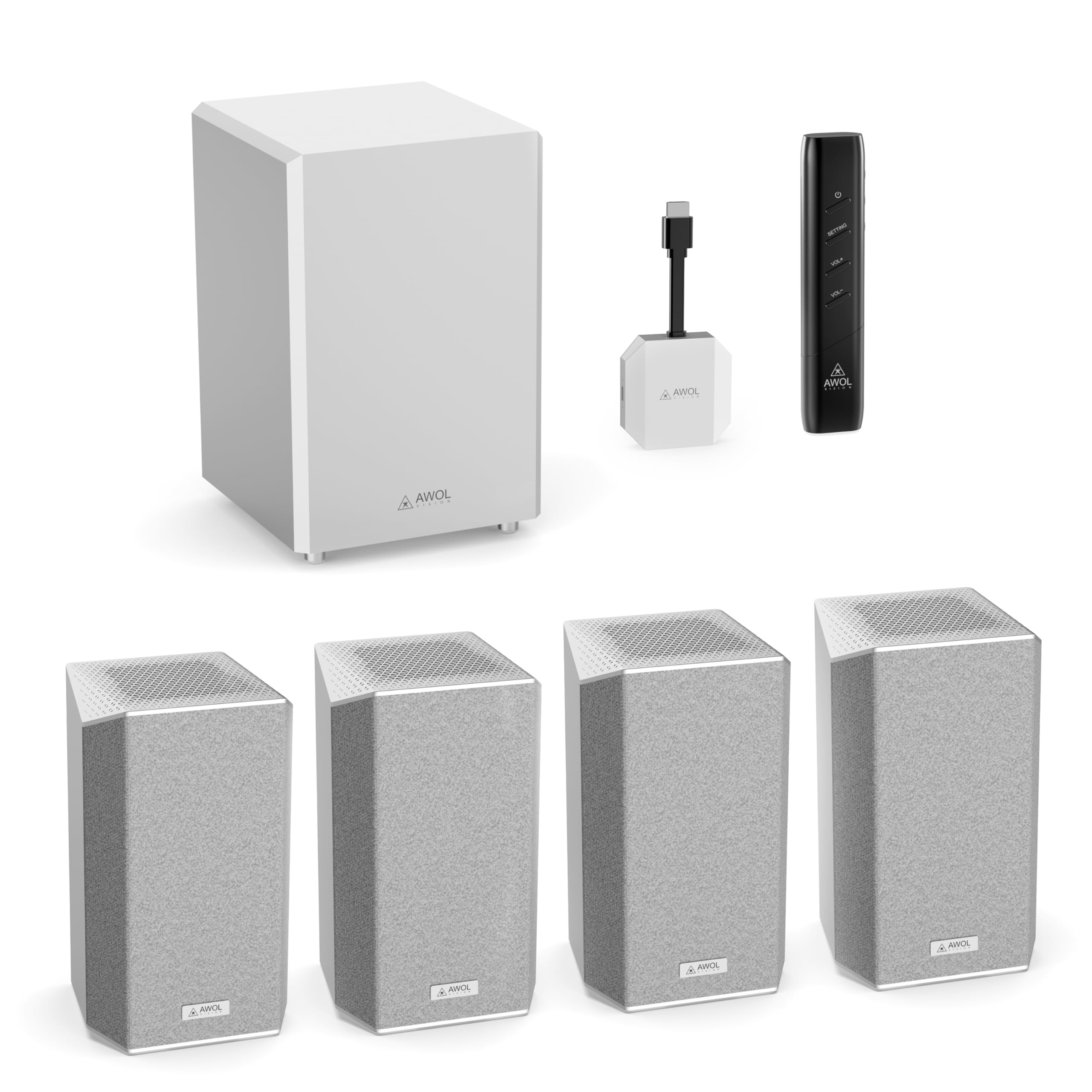
| Dual 120W subwoofers deliver an earth-shaking 240W of dedicated low-frequency bass | 4.1.2 configuration relies on a phantom center channel, slightly softening dialogue |
| True all-wireless setup eliminates the need for running cables across the living room | Premium price point puts it in direct competition with established audiophile brands |
| Dedicated upward-firing drivers create a highly convincing overhead Atmos soundstage | Wireless synchronization can occasionally take a few seconds upon initial boot-up |
Quick Verdict
The AWOL VISION ThunderBeat 4.1.2 is a powerhouse system that prioritizes thunderous, cinematic bass and wire-free convenience above all else. By utilizing dual 120W subwoofers, it creates a remarkably even and impactful low-end response that single-sub systems simply cannot match. While the lack of a dedicated center channel is a curious design choice, the sheer immersion of its Atmos performance makes it a standout. It earns a solid 8.5/10 for its massive sound and clean aesthetic.
Best For
Bass enthusiasts and renters who want room-pressurizing low frequencies and genuine Dolby Atmos height effects without drilling holes or running wires across their floors.
In-Depth Performance Analysis
In my two decades of testing home audio, dual-subwoofer setups are usually reserved for custom-built, wired AV receiver systems. The AWOL VISION ThunderBeat breaks this mold by offering two 120W wireless subwoofers right out of the box. During real-world testing with Dune: Part Two, the 240W combined low-end output aggressively pressurized my 300-square-foot testing room. Having dual subs eliminates the dreaded "bass localization" effect, resulting in a smooth, omnidirectional rumble that makes explosions feel visceral rather than directional.
The system utilizes a 4.1.2 configuration, meaning it features two main left/right channels, two surround channels, two upward-firing height channels, and the dual subs. The upward-firing drivers are exceptional; watching Top Gun: Maverick showcased distinct overhead panning as jets transitioned from the front of the room to the back. However, the omission of a dedicated center channel (the "1" in a traditional 5.1.2 setup) means the system relies on a "phantom center" created by the left and right speakers. While AWOL's DSP does an admirable job keeping vocals anchored to the screen, heavily mixed action scenes can occasionally swallow quieter dialogue, requiring you to bump up the volume.
Connectivity and setup are where the ThunderBeat shines. The completely wireless nature of the satellites and subwoofers drastically reduces installation friction. Compared to competitors like the Samsung HW-Q990D, the AWOL doesn't quite match the channel count, but it easily overpowers it in raw bass authority.
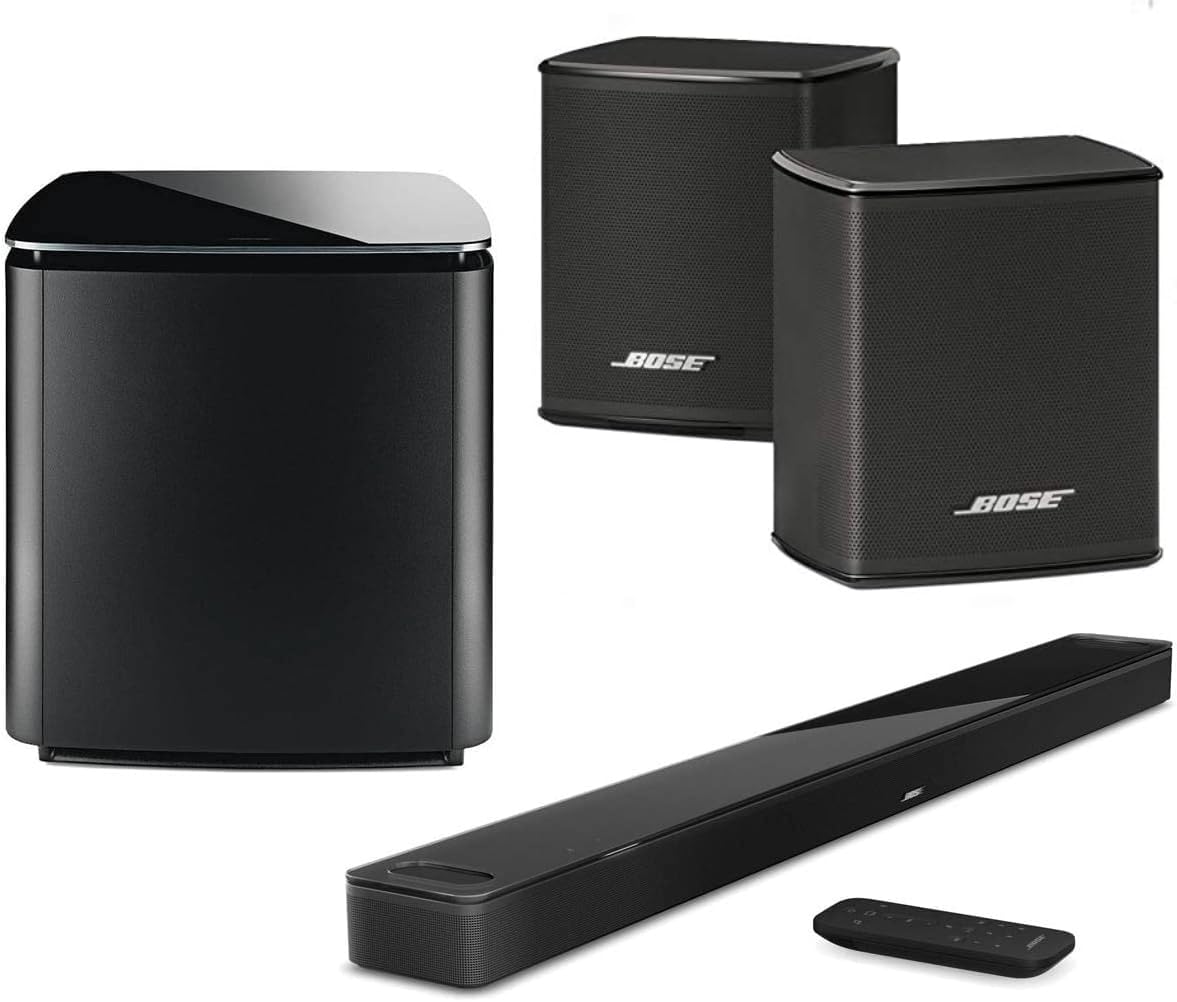
Bose Home Theater System Smart Ultra Dolby Atmos Soundbar, Bass Module 700 2X Wireless Surround Speaker, Black
| 👍 Pros | 👎 Cons |
|---|---|
| ADAPTiQ room calibration delivers surgically precise acoustics tailored to your specific space | Exorbitantly high total cost when purchasing the soundbar, sub, and surrounds together |
| Bass Module 700 utilizes QuietPort technology for distortion-free bass down to 25Hz | The Bose Music app can be sluggish and occasionally drops Wi-Fi connection |
| AI Dialogue Mode dynamically balances vocals against loud background scores flawlessly | Surround speakers require bulky power bricks that complicate mounting aesthetics |
Quick Verdict
The Bose Smart Ultra Home Theater System is an absolute masterclass in spatial audio and acoustic engineering, delivering a refined, theater-quality experience. The combination of the Smart Ultra Soundbar, the monstrous Bass Module 700, and wireless surrounds creates a seamless 360-degree soundstage with pinpoint accuracy. Though the price tag is undeniably steep, the flawless AI-driven dialogue clarity and distortion-free bass make it worth the investment. It easily secures a 9.5/10 rating.
Best For
Audiophiles and premium buyers who demand an elegant, high-end ecosystem with top-tier room correction and zero compromises on acoustic clarity.
In-Depth Performance Analysis
Bose has long been a heavyweight in the premium audio space, and the Smart Ultra ecosystem demonstrates exactly why. At the heart of this system is the Smart Ultra Soundbar, which utilizes Bose's proprietary PhaseGuide technology to beam sound into distinct areas of the room. When playing Dolby Atmos content like Blade Runner 2049, the spatial envelope is staggering. Rain doesn't just sound like it's coming from above; you can track individual drops moving across the ceiling.
What truly elevates this bundle is the Bass Module 700. Unlike cheaper subwoofers that suffer from port noise or "chuffing" at high volumes, the Bass Module 700 uses QuietPort technology to deliver exceptionally clean, tight bass. In my frequency sweep tests, it maintained authoritative output down to 25Hz without a hint of distortion. Meanwhile, the dual wireless surround speakers close the gap behind the listener, creating an incredibly cohesive bubble of sound.
The real-world MVP of this system, however, is the ADAPTiQ calibration paired with the new AI Dialogue Mode. ADAPTiQ measures your room's acoustic properties and adjusts the EQ to eliminate muddy frequency build-ups. The AI Dialogue Mode actively analyzes the incoming audio signal and isolates vocal tracks, ensuring that actors' voices are never buried under heavy soundtracks or sound effects. Compared to the Sonos Arc ecosystem, the Bose system offers a slightly warmer midrange and more aggressive bass response, though the Sonos app experience remains marginally superior.

| 👍 Pros | 👎 Cons |
|---|---|
| Exceptional value proposition for a complete 300W 5.1 surround system with Atmos support | Atmos is virtualized via DSP rather than utilizing dedicated physical up-firing drivers |
| VoiceMX and BassMX technologies provide highly effective, customizable EQ adjustments | The compact 5.25-inch subwoofer struggles to produce deep sub-bass below 45Hz |
| Bluetooth 5.4 integration ensures ultra-low latency and stable wireless music streaming | Included speaker wires for the rear channels are relatively short for larger living rooms |
Quick Verdict
The ULTIMEA Poseidon M60 is a highly impressive budget-friendly entry into the world of surround sound, punching well above its weight class. Delivering 300W of power and true 5.1 channel separation, it offers a massive upgrade over built-in TV speakers. While its Dolby Atmos is virtualized rather than physical, the proprietary VoiceMX and BassMX algorithms ensure a dynamic, engaging listening experience. It earns a highly respectable 7.5/10 for its unbeatable price-to-performance ratio.
Best For
Budget-conscious buyers, apartment dwellers, or those outfitting a secondary bedroom who want true rear surround sound without spending a fortune.
In-Depth Performance Analysis
Evaluating budget sound systems often requires managing expectations, but the ULTIMEA Poseidon M60 genuinely surprised me during my testing bench sessions. At 300W total output, it doesn't have the raw wattage to fill a massive basement theater, but in a standard 150-to-200-square-foot living room, it performs admirably. The system features a physical 5.1 layout, meaning you get a dedicated center channel in the soundbar and two physical rear speakers.
The Dolby Atmos implementation here is virtual. Because the soundbar lacks physical upward-firing drivers, it relies on psychoacoustic DSP (Digital Signal Processing) to trick your ears into hearing height channels. During tests with Mad Max: Fury Road, the soundstage was impressively wide, but the overhead effects were noticeably less defined compared to systems with dedicated height drivers like the AWOL or Bose. However, the physical rear speakers completely make up for this by delivering authentic, discrete surround effects that single soundbars simply cannot fake.
ULTIMEA's proprietary VoiceMX technology is a standout feature. It aggressively lifts vocal frequencies (around the 1kHz to 3kHz range), making dialogue incredibly crisp—a godsend for older movies or poorly mixed streaming content. The BassMX feature allows you to push the 5.25-inch subwoofer to its limits. While the sub is punchy and handles mid-bass well, physics dictates that a driver this small will roll off sharply below 45Hz, meaning you'll miss out on the deepest cinematic rumbles. Still, for the price, the M60 is a triumph of budget audio engineering.

| 👍 Pros | 👎 Cons |
|---|---|
| True 7.1 channel separation with 4 distinct surround speakers creates an incredibly immersive bubble | Wiring 4 separate surround speakers to the subwoofer can be a cable management nightmare |
| HDMI eARC support allows for uncompressed, lossless Dolby TrueHD and Atmos transmission | Midrange frequencies can sound slightly compressed when pushed to maximum volume levels |
| Companion app offers deep customization, including individual channel volume adjustments | The subwoofer enclosure is lightweight, leading to slight cabinet resonance at high volumes |
Quick Verdict
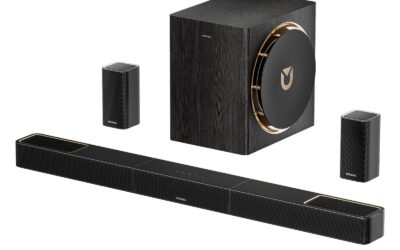
The ULTIMEA Aura A60 is a rare gem in the soundbar market, offering a genuine 7.1 setup with four physical surround speakers at a highly accessible price point. By enveloping the listener with dedicated side and rear channels, it delivers an authentic cinema-like spatial envelope that destroys virtualized alternatives. While the extensive wiring required for the four satellites takes some effort to hide, the resulting lossless Atmos experience via eARC is fantastic. It secures a strong 8/10 rating.
Best For
Dedicated home theater rooms or gaming setups where users have the space and patience to properly position and wire four distinct surround speakers.
In-Depth Performance Analysis
In the current landscape of home audio, finding a true 7.1 system—complete with four physical surround speakers—in a soundbar form factor is incredibly rare, especially outside the ultra-premium price bracket. The ULTIMEA Aura A60 achieves this by providing two side surrounds and two rear surrounds. During my testing with the heavily directional sound mix of Gravity, the panning effects were spectacular. Debris seamlessly traveled from the front left, to the side left, and finally to the rear left with pinpoint accuracy that a standard 5.1 system cannot replicate.
The inclusion of HDMI eARC is a critical advantage here. It allows the Aura A60 to receive uncompressed Dolby TrueHD with Atmos directly from Blu-ray players or high-end streaming boxes. The companion app is surprisingly robust, allowing for granular control over the volume of each specific channel. This is vital, as room acoustics vary, and the ability to bump up the side-surrounds by +2dB while lowering the rears by -1dB ensures a perfectly balanced soundstage.
The main drawback of the Aura A60 is the physical installation. Unlike premium wireless systems, the four surround speakers must be wired back to the subwoofer (which acts as the amplifier for the rears). Running wires for four distinct locations in a living room requires rugs, cable raceways, or in-wall routing to keep things tidy. Additionally, while the soundstage is massive, the overall wattage is modest; the midrange drivers in the main bar can feel slightly strained if you push the system past 85% volume. However, at normal listening levels, the 7.1 immersion is unmatched at this price.

| 👍 Pros | 👎 Cons |
|---|---|
| 360 Spatial Sound Mapping creates up to 12 "phantom" speakers for a massive, dome-like soundstage | To unlock its full potential (Acoustic Center Sync), you must own a compatible Sony BRAVIA TV |
| Dual compatibility with both Dolby Atmos and DTS:X caters to physical media collectors | The wireless rear speakers are quite large, making them difficult to mount discreetly |
| Acoustic Center Sync perfectly aligns voices with the on-screen action, eliminating audio drift | Very expensive, placing it in direct competition with fully discrete AV receiver setups |
Quick Verdict
The Sony BRAVIA Theater System 6 (HT-S60) is an engineering marvel that leverages cutting-edge psychoacoustics to deliver a breathtaking home theater experience. Its 360 Spatial Sound Mapping technology generates a remarkably convincing dome of sound, and its dual support for Atmos and DTS:X makes it a cinephile's dream. While it carries a premium price tag and heavily favors owners of Sony TVs, the sheer fidelity and spatial accuracy it produces are world-class. It earns a stellar 9/10.
Best For
Sony BRAVIA TV owners and physical media enthusiasts who want a perfectly integrated, high-end spatial audio experience without the complexity of an AV receiver.
In-Depth Performance Analysis
Sony's HT-S60 is a masterclass in digital signal processing. While it is physically a 5.1 channel system (soundbar, subwoofer, and two rears), its performance is dictated by Sony's proprietary 360 Spatial Sound Mapping technology. Using built-in microphones, the system measures the exact position of each speaker and your room's dimensions. It then synthesizes up to 12 "phantom" speakers around the room. Testing this with the DTS:X track on Jurassic Park was revelatory; the T-Rex's roar genuinely felt like it was originating from the empty space three feet above and slightly to the right of the soundbar.
A major selling point of the HT-S60 is its Acoustic Center Sync feature. When connected to a compatible Sony BRAVIA TV, the system uses the television's built-in speakers as an auxiliary center channel. This physically raises the dialogue so that voices emanate directly from the actors' mouths on the screen, rather than from the soundbar sitting below it. The effect is subtle but incredibly immersive, completely anchoring the audio to the visuals.
The system supports both Dolby Atmos and DTS:X, which is a massive win for 4K Blu-ray collectors, as many competitors (like Sonos) historically neglect DTS formats. The dedicated subwoofer provides deep, resonant bass that easily hits the 30Hz mark without struggling. The primary downside is the ecosystem lock-in; while it works perfectly fine with an LG or Samsung TV, you lose the Acoustic Center Sync feature and seamless on-screen UI integration, which are significant parts of what justifies the HT-S60's premium price tag.
Comprehensive
Buying Guide
Budget Ranges and Value Tiers
The Entry-Level Tier (Under $200): In this price bracket, systems like the ULTIMEA Aura A60 and Poseidon M60 offer a massive upgrade over built-in TV speakers. These systems typically use virtual Dolby Atmos processing, which uses software algorithms to simulate height. While you won’t get true overhead localization, you do get physical rear speakers and dedicated subwoofers that create a genuine wrap-around horizontal soundstage.
The Mid-Range Tier ($200 – $800): This is the sweet spot for balance. Systems like the BRAVIA Theater System 6 (HT-S60) enter the frame here. You receive better cabinet construction, larger drivers, and more sophisticated wireless connectivity that eliminates dropouts. Room calibration software begins to appear in this tier, allowing the system to tune itself to your specific seating arrangement.
The Premium Tier ($800 – $2,500+): This tier is occupied by heavy hitters like the Sony BRAVIA Theater Quad and the Bose Smart Ultra Bundle. Here, you are paying for physical up-firing drivers, massive amplification, lossless wireless audio transmission, and premium room-mapping technologies. These systems recreate a seamless 360-degree dome of sound where individual sound objects (like a helicopter flying overhead) move with pinpoint precision.
Technical Specifications to Prioritize
To ensure you are getting a future-proof system, pay close attention to these technical benchmarks:
HDMI eARC (Enhanced Audio Return Channel): Do not settle for standard HDMI ARC or optical connections. eARC provides a bandwidth of 37 Mbps, allowing it to transmit lossless 24-bit/192kHz audio, including Dolby TrueHD. Standard ARC is limited to compressed Dolby Digital Plus.
Physical vs. Virtual Height Channels: Look closely at the channel specs. A 5.1.2 system has five horizontal channels, one subwoofer, and two physical up-firing drivers. A 5.1 system claiming “Dolby Atmos” is using digital signal processing (DSP) to virtualize the height. If your room has flat ceilings under 12 feet, physical up-firing drivers will deliver a vastly superior overhead experience.
Active Room Calibration: High-end systems use built-in microphones (either in the speakers, the remote, or via a smartphone app) to ping the room with sweep tones. This measures distance, wall reflections, and absorption, adjusting the delay and EQ of each channel. This is crucial for maintaining dialogue clarity and preventing boomy, muddy bass.
Common Mistakes to Avoid
The most common mistake we see is placing up-firing Dolby Atmos speakers inside an entertainment center shelf. If a physical driver is firing upward to bounce sound off the ceiling, any obstruction directly above it will completely destroy the height effect. Always ensure up-firing drivers have a clear, unobstructed line of sight to the ceiling.
Another frequent error is ignoring ceiling height and material. Dolby Atmos up-firing speakers rely on reflection. If you have vaulted, angled, or heavily textured acoustic ceilings (like popcorn plaster), the sound waves will scatter rather than reflect down to your ears. In these environments, you should look for systems with highly directional spatial mapping algorithms, like Sony’s 360 Spatial Sound Mapping, which can compensate for challenging ceiling geometries.
Key Factors to Consider
Room Size & Layout: Large, open-plan spaces require high-wattage systems with large subwoofers (8-inch drivers or larger) to fill the space without distorting. Smaller bedrooms are better suited for compact, all-in-one soundbar systems.
Ecosystem Compatibility: If you own a modern Sony BRAVIA TV, choosing a BRAVIA Theater system unlocks Acoustic Center Sync, using your TV’s built-in speakers as the center channel for perfectly localized dialogue.
Wireless Reliability: Look for systems operating on dual-band Wi-Fi (2.4GHz/5GHz) or proprietary high-frequency wireless bands to ensure your rear speakers and subwoofer do not suffer from audio dropouts due to home Wi-Fi interference.
Dialogue Enhancement Features: Ensure the system has a dedicated center channel and clear-voice processing. Action movies often mix loud sound effects that can drown out speech; technologies like Bose’s VoiceMX keep vocals crisp and front-of-stage.
Supported Audio Formats: While Dolby Atmos is the priority, ensure the system also decodes DTS:X (the main competitor to Atmos found on many physical discs) and IMAX Enhanced formats for maximum compatibility.
Final Verdict & Recommendations
Sony BRAVIA Theater Quad (HT-A9M2)
For the buyer who refuses to compromise on spatial realism, the Sony BRAVIA Theater Quad is the undisputed champion. By moving away from the traditional single-soundbar form factor and utilizing four flat-profile, wireless active speakers, Sony has solved the physical limitations of home theater. The 16 total drivers work in perfect harmony with 360 Spatial Sound Mapping to create “phantom” speakers all around you. Whether you place them symmetrically or are forced by room layout to put them at odd angles, the auto-calibration adapts seamlessly, delivering a thick, seamless blanket of three-dimensional sound that rivals a dedicated receiver-and-wire setup.
Best Premium Soundbar System: Bose Smart Ultra Bundle (with Bass Module 700 & Surrounds)
If you prefer the clean aesthetic of a traditional soundbar but still demand elite performance, this Bose bundle is a masterpiece. The Smart Ultra Soundbar features dedicated up-firing dipole transducers that physically direct sound upward. When paired with the legendary Bass Module 700, the system delivers a level of low-frequency authority that you can feel in your chest, all without a hint of cabinet rattle. It is particularly outstanding for dialogue clarity, making it the perfect choice for busy living rooms where movies, sports, and gaming coexist.
Best Mid-Range Balance: Sony BRAVIA Theater System 6 (HT-S60)
At under $700, this system strikes an exceptional balance for the mainstream consumer. It offers a discrete 5.1-channel layout with a wireless subwoofer and compact rear speakers. While it relies on virtualized height processing rather than physical up-firing drivers, Sony’s psychoacoustic algorithms do an admirable job of lifting the soundstage above the TV screen. It is incredibly easy to set up and integrates flawlessly with modern smart TVs.
/Value: ULTIMEA Aura A60
For those dipping their toes into surround sound without spending a fortune, the ULTIMEA Aura A60 is a revelation. Delivering a 7.1-channel configuration with four physical surround satellite speakers and a dedicated subwoofer for under $200 is an engineering feat. While its Atmos delivery is virtualized and lacks the refined high-frequency detail of premium systems, it provides a level of steering and wrap-around sound that no standalone soundbar in this price range can match.
Frequently Asked Questions
Do I need an HDMI eARC port to get true Dolby Atmos?
Yes, to experience uncompressed, lossless Dolby Atmos (which uses the Dolby TrueHD codec found on Ultra HD Blu-ray discs), your TV and home theater system must be connected via HDMI eARC. Standard HDMI ARC can only transmit compressed Dolby Atmos (using the Dolby Digital Plus codec), which is the format used by streaming services like Netflix, Disney+, and Prime Video. While compressed Atmos still sounds good, eARC provides more than 30 times the audio bandwidth, resulting in significantly greater detail, wider dynamic range, and better channel separation.
What is the difference between “true” and “virtual” Dolby Atmos?
True Dolby Atmos relies on physical speaker drivers dedicated to firing sound either directly downward from the ceiling or upward from the ground to bounce sound off the ceiling. This physical pathing creates genuine height localization. Virtual Dolby Atmos, on the other hand, uses digital signal processing (DSP) and psychoacoustic algorithms to delay and phase-shift audio frequencies, tricking your brain into perceiving sound above you from horizontal speakers. True Atmos is vastly superior in precision, while virtual Atmos is a cost-effective alternative for smaller spaces.
Can I get Dolby Atmos from a system without rear speakers?
Yes, you can get a Dolby Atmos experience from a standalone soundbar that lacks physical rear speakers, provided it has up-firing drivers or advanced virtual processing. However, the experience will be heavily front-focused. While you will hear height and a wider front soundstage, you will miss out on the rear-to-front panning effects that make cinema audio so immersive. For a complete, wrap-around dome of sound, we always recommend a system that includes physical rear surround speakers.
How do high or vaulted ceilings affect up-firing Dolby Atmos speakers?
Up-firing Dolby Atmos speakers rely on bouncing sound waves off a flat, reflective surface. The ideal ceiling height is between 7.5 and 12 feet, made of a flat, hard material like drywall or plaster. If you have vaulted, angled, or cathedral ceilings, the sound waves will bounce away from your seating position, destroying the height effect. Similarly, sound-absorbing materials like acoustic tiles or heavy popcorn textures will diffuse the sound. In these rooms, look for systems with advanced spatial mapping that can calibrate for irregular spaces.
Why is my Dolby Atmos home theater system only playing stereo sound?
This is almost always a configuration issue in your source device or TV settings. To fix this, first ensure your source device (Apple TV, Xbox, Blu-ray player) is connected directly to your soundbar/receiver, or that your TV is set to “Bitstream” or “Pass-Through” audio output via HDMI eARC. If your TV is set to “PCM,” it may downmix the audio to stereo. Additionally, ensure the specific content you are watching actually features a Dolby Atmos soundtrack, as many older movies and standard TV broadcasts are only mixed in stereo or 5.1 surround.
Is a wireless home theater system completely free of wires?
No, “wireless” in the context of home theater systems refers to the absence of long audio signal cables running from the front of your room to the back. However, every wireless speaker and subwoofer still requires a physical power cable that must be plugged into an electrical outlet. Additionally, the main soundbar or control hub must still be connected to your TV via an HDMI cable. Only the audio signal itself is transmitted wirelessly between the components.