Are Stock Car Speakers Good? The Honest Truth About Factory Audio
Are stock car speakers good? Generally, the answer is no; most factory speakers are designed for cost-efficiency and durability rather than high-fidelity sound. While they function well for talk radio or casual listening, they lack the dynamic range, clarity, and bass response found in even entry-level aftermarket upgrades.
🚀 TL;DR: Key Takeaways for Fast Readers
- Material Quality: Stock speakers typically use paper cones and small magnets, leading to distorted sound at high volumes.
- Audio Fidelity: Factory systems often lack dedicated tweeters, resulting in a “muddy” sound where instruments blend together.
- Power Handling: Most stock units are rated for very low RMS power, meaning they can’t handle the output of a high-quality amplifier.
- The Exception: “Premium” factory systems (like Bose, Harman Kardon, or Bang & Olufsen) are better but still often outperformed by mid-range aftermarket components.
- The Verdict: If you value instrument separation and deep bass, stock speakers will almost always disappoint you.
Understanding Why Factory Speakers Often Underperform
In our years of testing and replacing factory audio systems, we have found that car manufacturers prioritize three things: weight, space, and bottom-line cost.
Most standard vehicles use speakers made of treated paper and foam surrounds. While these materials are lightweight and cheap, they degrade quickly when exposed to the extreme temperature fluctuations and humidity found inside a car door.
In contrast, aftermarket speakers use materials like polypropylene, mica, or Kevlar. These materials are stiffer and respond more accurately to electrical signals, resulting in much lower Total Harmonic Distortion (THD).
The Problem with “Whizzer Cones”
Many stock speakers are “full-range” drivers that use a whizzer cone—a small paper cone attached to the center of the main woofer.
This is a budget-friendly way to simulate high frequencies. However, it lacks the precision of a dedicated silk-dome tweeter. This is why your favorite songs might sound “flat” or “veiled” in a stock setup.
Comparison Table: Stock vs. Aftermarket Speakers
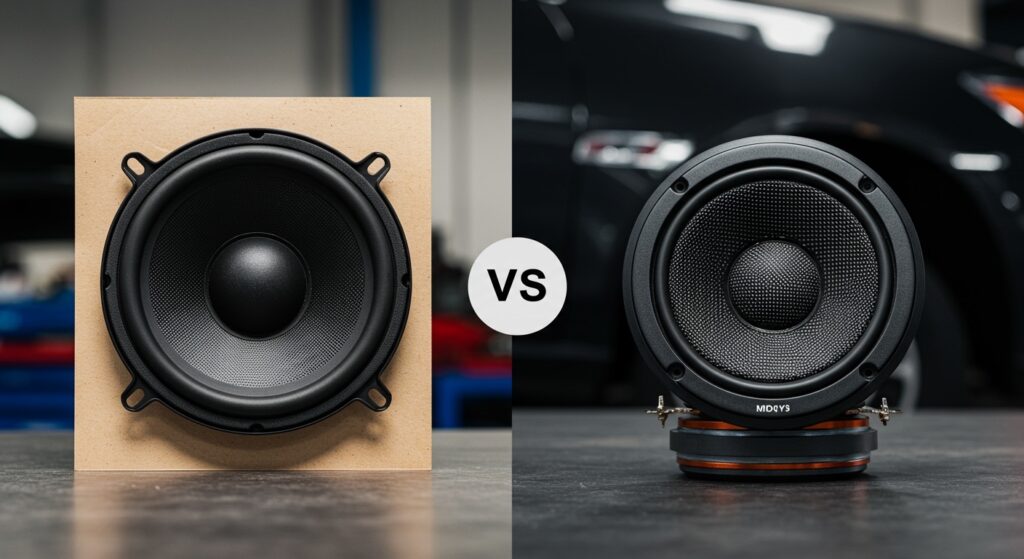
| Feature | Stock Factory Speakers | Aftermarket Upgrades |
|---|---|---|
| Cone Material | Pressed Paper / Cardboard | Polypropylene, Silk, Carbon Fiber |
| Surround Material | Foam or Paper | Synthetic Rubber (Santoprene) |
| Magnet Size | Small Ferrite (often 1-2 oz) | Large Ferrite or Neodymium |
| High Frequency | Whizzer Cone (Internal) | Dedicated Tweeter (Coaxial or Component) |
| Longevity | 3–5 years before degradation | 10+ years |
| Power Handling | 5–15 Watts RMS | 30–100+ Watts RMS |
When Are Stock Car Speakers Good Enough?
We often tell our clients that “good” is subjective. If you primarily listen to podcasts, audiobooks, or news, you may find that your stock speakers are perfectly adequate.
Casual Listeners
If you rarely turn the volume above 30% and don’t care about feeling the kick drum in your chest, the factory setup is designed for you. It is tuned to be “safe” and mid-heavy, which is ideal for human speech.
Premium OEM Systems
Vehicles equipped with “Premium” audio packages from brands like Burmester or Revel are a different story. These systems use digital signal processing (DSP) to compensate for the car’s interior acoustics.
While still technically “stock,” these systems are often good enough to satisfy 90% of listeners. However, replacing them is significantly more difficult due to proprietary wiring and impedance matching.
Signs You Need to Replace Your Stock Speakers
If you are wondering if your system is underperforming, look for these specific red flags we frequently encounter during audio audits:
- Distortion at High Volume: If the music “crackles” or sounds fuzzy when you turn it up, the voice coil is likely struggling.
- Muffled Vocals: If the singer sounds like they are behind a thick curtain, your high-frequency response is dead.
- Lack of “Punch”: If the bass sounds like a hollow “thud” rather than a sharp, rhythmic hit.
- Imbalance: If one side of the car sounds noticeably quieter or duller than the other.
- Physical Rattling: This often indicates that the foam surround has dry-rotted and detached from the cone.
Step-by-Step: How to Test Your Current Sound Quality
Before spending money on upgrades, we recommend performing this “Critical Listening Test” to see where your factory speakers are failing.
Step 1: Use a High-Quality Source
Do not use FM radio or a standard YouTube video. Connect via USB or Apple CarPlay/Android Auto and use a lossless service like Tidal or Apple Music.
Step 2: Flatten Your EQ
Go into your head unit settings and set Bass, Treble, and Midrange to “0” or “Flat.” Disable any “Loudness” or “Surround” enhancements.
Step 3: Listen for Imaging
Sit in the driver’s seat. Can you “place” the singer in the center of the dashboard? With stock speakers, the sound usually feels like it’s coming directly from your feet (where the door speakers are located).
Step 4: Check the Low-End
Slowly increase the volume. At what point does the bass start to sound “bloated” or cause the door panel to vibrate uncontrollably? In most stock systems, this happens around 50-60% volume.
The Upgrade Path: How to Fix Bad Stock Audio
If you’ve decided that your stock car speakers are not good, don’t just buy the first pair you see online. Follow this proven hierarchy of upgrades we use in professional shops:
Phase 1: The “Simple Swap” (Coaxial Speakers)
Replace your factory door speakers with 2-way coaxial speakers. These have a built-in tweeter. This is the most cost-effective way to immediately improve clarity and brightness.
Phase 2: Adding Sound Deadening
Before installing new speakers, apply butyl-based sound dampening sheets (like Dynamat or Hushmat) to the inner door skin. This stops the metal from vibrating and makes your “okay” speakers sound “great” by creating a sealed acoustic chamber.
Phase 3: The Component Move
If your car has factory tweeter locations in the pillars or dash, buy a component speaker set. This separates the woofer and the tweeter, raising the soundstage to ear level.
Phase 4: Adding an Amplifier
New speakers often have lower sensitivity than stock ones. They require more “juice” to move the stiffer materials. Adding a small 4-channel amplifier will provide the headroom needed for crystal-clear peaks.
Technical Deep Dive: Why “Sensitivity” Matters
When asking are stock car speakers good, you have to look at Sensitivity (dB).
Factory speakers are “High Sensitivity” (usually 90dB+). This is because they have to run on the tiny 10-15 watt output of a factory radio.
When you switch to high-end aftermarket speakers, they often have lower sensitivity. If you don’t add an amplifier, they might actually sound quieter than your stock speakers, even if the quality is better. Always match your speakers to your power source.
Frequently Asked Questions
Will new speakers make my bass louder?
Not necessarily. While aftermarket speakers provide cleaner bass, they are often smaller and stiffer than factory paper cones. To get “loud” bass, you usually need a powered subwoofer.
Can I replace my speakers but keep the factory radio?
Yes! This is very common. Look for speakers with high sensitivity ratings (above 90dB) so the factory radio can still drive them efficiently.
Is it hard to install car speakers myself?
For most vehicles, it is a 2/10 difficulty level. You will generally need a screwdriver, a panel removal tool, and “plug-and-play” wiring harnesses to avoid cutting factory wires.
Why do my new speakers sound worse than stock?
This usually happens due to polarity issues (wiring the + and – backwards) or because the new speakers are “underpowered” and require an external amplifier to reach their potential.
How much should I spend on new speakers?
A budget of $100–$200 for a pair of front speakers is the “sweet spot” where you see the most significant jump in quality over stock equipment.
**
**
**
**