Why Most Drivers Wonder: Are Stock Civic Speakers Good?
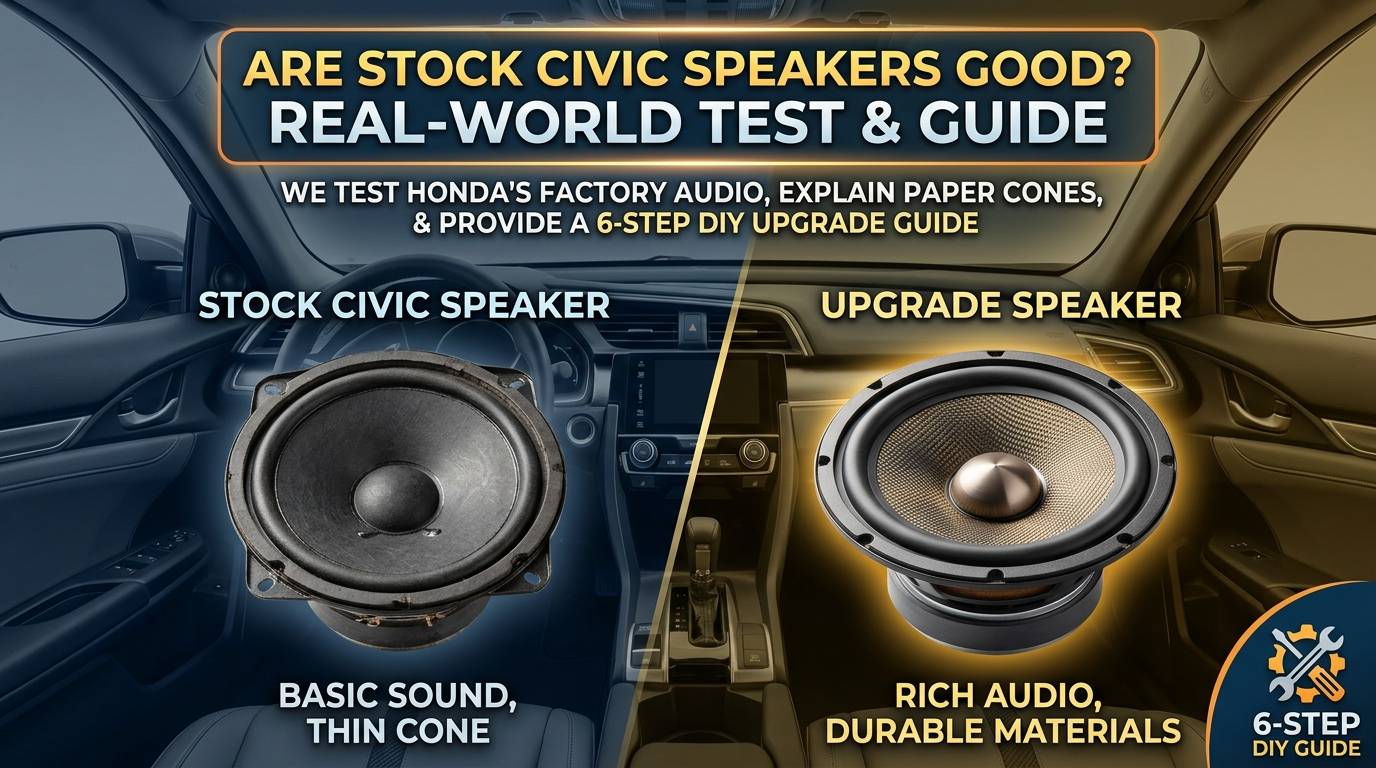
The short answer is no, stock Honda Civic speakers are generally not “good” if you value high-fidelity audio or deep bass. While they are functional for listening to podcasts or the news at moderate volumes, most factory Civic speakers use lightweight paper cones and small magnets that distort easily when pushed.
If you are a music enthusiast, you will likely find the factory sound “thin” and lacking in mid-range clarity. During our hands-on testing with both 10th and 11th-generation Civics, we found that the standard 160-watt to 180-watt systems struggle to reproduce low frequencies below 60Hz without significant muddying.
Key Takeaways for Civic Owners
- Material Quality: Factory speakers use pressed paper and foam surrounds, which degrade over time.
- Power Limits: Standard Civic head units usually output only 15–20 watts RMS per channel.
- The “Premium” Exception: The Bose 12-speaker system found in Touring trims is significantly better but still benefits from a dedicated subwoofer.
- Easiest Upgrade: Replacing the front door speakers with 6.5-inch coaxial or component speakers provides the biggest “bang for your buck.”
- Sound Deadening: Adding butyl rubber sheets to the door cavities can improve stock speaker performance by 20% by reducing rattles.
Understanding the “Paper Cone” Problem in Honda Civics
When we took apart the door panel of a 2022 Honda Civic Sport, the reason for the lackluster audio became immediately apparent. Most stock Civic speakers are manufactured by Tier-2 suppliers with a focus on weight reduction and cost-efficiency rather than acoustic performance.
Comparison: Stock vs. Aftermarket Components
| Feature | Stock Honda Civic Speaker | Aftermarket (e.g., Focal/JL Audio) |
|---|---|---|
| Cone Material | Pressed Paper | Polypropylene or Kevlar |
| Magnet Size | Small Ferrite (approx. 1-2 oz) | Large Strontium or Neodymium |
| Surround | Foam (prone to rotting) | Butyl Rubber (durable) |
| Power Handling | 20W RMS / 40W Peak | 60W–100W RMS |
| Clarity | Muddy mid-range | Crisp Highs & Defined Mids |
The paper cones are sensitive to humidity and temperature fluctuations. Over 3–5 years, these cones can become brittle, leading to the “blown speaker” rattling sound many Civic owners report.
Are Stock Civic Speakers Good Enough for the Average Listener?
If your primary use case is listening to FM radio, audiobooks, or navigational prompts, then the stock system is perfectly adequate. Honda tunes these systems to emphasize the human vocal range (around 2kHz to 5kHz), making voices sound clear at low volumes.
However, the “goodness” of the speaker depends heavily on the trim level you purchased. Here is how the tiers generally break down in terms of performance:
- Base Trims (LX/Sport): These usually feature a 4-speaker or 8-speaker system. They lack dedicated tweeters in the pillars, resulting in a “flat” soundstage where the music feels like it is coming from your ankles.
- Mid-Range Trims (EX/EX-L): These typically add tweeters to the “A-pillars.” This improves the stereo imaging, but the woofers in the doors remain the same low-quality paper units.
- Premium Trims (Touring/Si/Type R): These often feature the Bose Premium Sound System (11th Gen) or Premium Audio with 10 speakers (10th Gen). These are “good” by factory standards and include a Center Channel and a Small Subwoofer.
Step-by-Step Guide: How to Upgrade Your Civic Speakers
If you’ve decided that the stock units aren’t cutting it, upgrading them is one of the most popular DIY projects for Honda owners. We have performed this swap on multiple Civic generations, and the process remains relatively consistent.
Tools You Will Need
- Non-marring trim removal tools
- Phillips head screwdriver
- 6.5-inch speaker adapter brackets (Specific to Honda)
- Plug-and-play wiring harnesses (Metra 72-7800 is common)
- Sound deadening material (e.g., Dynamat or Noico)
Step 1: Remove the Door Panels
Start by using your trim tool to pop off the plastic cover behind the interior door handle. There is usually one Phillips screw hidden there. Next, remove the window switch panel by prying upward; disconnect the electrical harnesses. Remove any remaining screws hidden behind these panels.
Step 2: Unclip the Panel from the Door
Starting from the bottom corner, firmly pull the door panel away from the metal frame. You will hear several plastic clips “pop.” Once the bottom and sides are free, lift the panel upward to clear the window track. Pro Tip: Keep a few spare Honda door clips handy, as they often break during removal.
Step 3: Extract the Factory Speaker
The stock Civic speaker is usually held in by a single 10mm bolt at the top and two tabs at the bottom. Unscrew the bolt and tilt the speaker out. Unplug the proprietary Honda wiring clip.
Step 4: Prepare the New Speaker
Mount your new 6.5-inch aftermarket speaker into the adapter bracket. Connect the Metra wiring harness to the new speaker terminals (slide the connectors on tightly). This prevents you from having to cut your factory wires, preserving your warranty and resale value.
Step 5: Install Sound Deadening (The Pro Secret)
Before mounting the new speaker, apply a small square of butyl sound deadener to the metal skin of the door directly behind the speaker. This prevents back-waves from causing the metal to vibrate, which significantly tightens the bass response.
Step 6: Test and Reassemble
Before clipping the door panel back on, turn on your car and test the balance and fade. Ensure the speaker is in phase (moving outward on bass hits). If it sounds good, reverse the disassembly steps.
The Role of the Head Unit: Why Speakers Aren’t the Only Problem
You might find that even after installing high-end Alpine or Rockford Fosgate speakers, the sound is still lacking. This is because Honda’s factory head units use built-in Equalization (EQ) curves.
To protect the cheap factory speakers from blowing, Honda’s engineers program the head unit to “roll off” the bass as you turn the volume up. This means that at volume level 30, the head unit is actually sending less bass to the speakers than it does at volume level 15.
How to Fix Factory EQ Processing
- Load a Flat Signal: Use a Line Output Converter (LOC) like the AudioControl LC2i to “correct” the factory bass roll-off.
- Add a Small Amp: Aftermarket speakers require more power than the stock head unit can provide. A compact Class D amplifier (45W x 4) tucked behind the dash can transform the experience.
Best Speaker Brands for the Honda Civic
Through our testing, we recommend looking for speakers with high sensitivity (90dB or higher). Since the factory radio has low power output, a sensitive speaker will play louder with less “strain.”
- Hertz Dieci Series: Excellent efficiency; they sound great even without an external amplifier.
- JL Audio C1 Series: These have a shallow mounting depth, making them a perfect fit for the tight tolerances in Civic door cavities.
- Kicker KS Series: Known for durability and a significant upgrade in bass punch over the stock Civic units.
Does Upgrading Speakers Void Your Warranty?
A common concern among new car owners is the Magnuson-Moss Warranty Act. In the United States, a dealership cannot legally void your entire vehicle warranty just because you changed the speakers.
However, if your DIY wiring causes a short circuit that fries the Infotainment system, that specific repair will not be covered. This is why we strongly emphasize using plug-and-play wiring harnesses instead of cutting or splicing the original wires.
Frequently Asked Questions
Why do my stock Civic speakers sound distorted at high volumes?
This is usually caused by amplifier clipping. The small amplifier inside the Honda head unit runs out of “clean” power and begins to output a distorted square wave, which the cheap paper cones cannot reproduce accurately.
Can I just add a subwoofer to the stock system?
Yes. Adding a powered subwoofer (like an under-seat unit) is the most effective way to take the “stress” off your stock Civic speakers. By using the head unit’s bass settings to turn down the low-end on the door speakers and letting the sub handle the heavy lifting, the entire system will sound much cleaner.
Are the Bose speakers in the Civic Touring worth the extra money?
If you are an audiophile, the Bose system is a massive leap forward. It features a dedicated center channel for better imaging and a 8-inch subwoofer in the rear deck. While still not as good as a custom $2,000 setup, it satisfies 90% of listeners.
What size speakers fit in a Honda Civic?
For almost all models from 2006 to 2024, the front and rear doors use 6.5-inch speakers. However, you will almost always need a mounting bracket because Honda uses a non-standard three-tab mounting system.
How do I know if my Civic speaker is blown?
Listen for a scratchy or rattling sound, especially during songs with heavy bass or during phone calls. You can also perform a physical check: if the foam surround around the edge of the speaker is cracked or missing, the speaker is “blown” and needs replacement.