Are Surface Mount Speakers Better? The Direct Answer
Are surface mount speakers better than other audio solutions? Generally, surface mount speakers are better when you need a versatile, easy-to-install, and high-performance audio solution for outdoor areas, commercial spaces with solid walls, or rooms where you cannot cut into the ceiling. Unlike in-wall speakers, they offer superior bass response due to their tuned enclosures and allow for precise directional aiming to optimize the soundstage for your listeners.
If you are dealing with a patio, a retail showroom, or a home gym with concrete walls, surface mount speakers are the undisputed champion. During my 15 years in commercial AV integration, I’ve found that these units consistently outperform in-ceiling models in terms of durability and sound projection.
TL;DR: Key Takeaways
- Best For: Patios, warehouses, retail stores, and rooms with hard surfaces (brick/concrete).
- Acoustic Advantage: Factory-tuned cabinets provide consistent bass and higher SPL (Sound Pressure Level) than most architectural speakers.
- Installation: Easier to install and upgrade because they don’t require large cutouts in the drywall.
- Versatility: Most models feature articulating brackets for precise 180-degree or 360-degree aiming.
- Weather Resistance: Many options, like the JBL Control Series or Yamaha VXS, are rated for extreme temperatures and moisture.
Comparing Surface Mount vs. In-Wall vs. Bookshelf Speakers
Choosing the right speaker depends on your environment. Use the table below to see if surface mount speakers are better for your specific application.
| Feature | Surface Mount | In-Wall / In-Ceiling | Bookshelf Speakers |
|---|---|---|---|
| Installation Ease | High (Screw-on brackets) | Moderate (Requires cutting) | Very High (Plug and play) |
| Aesthetic | Visible, modern/industrial | Invisible / Discreet | High-end furniture look |
| Durability | High (Weatherproof options) | Moderate (Protected by wall) | Low (Indoor use only) |
| Bass Response | Strong (Tuned Enclosure) | Variable (Uses wall cavity) | Excellent (Dedicated box) |
| Directivity | Highly Adjustable | Fixed or Limited Tilt | High (But takes up floor space) |
| Best Use Case | Commercial/Outdoor/Solid Walls | Clean, minimalist home theater | Dedicated hi-fi listening rooms |
When Are Surface Mount Speakers Better? Expert Scenarios
In my professional experience, we recommend surface mount units in four specific scenarios where other speakers simply fail to deliver.
Outdoor Environments and Patios
If you want music by the pool or on a deck, surface mount speakers are better because they are built to survive the elements. Brands like Klipsch and Sonance produce “marinarized” speakers that resist salt spray, UV rays, and heavy rain. In-ceiling speakers often suffer from moisture buildup behind the grille, leading to rust and driver failure.
Commercial Spaces with Open or High Ceilings
In modern offices or restaurants with “industrial” open ceilings (exposed pipes and ducts), there is no surface to mount an in-ceiling speaker. Surface mount speakers can be bolted directly to beams or walls, ensuring the sound reaches the customers’ ears rather than getting lost in the rafters.
Spaces with Solid Construction
I frequently work in historic buildings or modern lofts with exposed brick or concrete walls. You cannot cut a hole in a brick wall for an in-wall speaker without massive structural costs. Surface mount brackets allow us to run conduit and mount the hardware directly to the surface with high-strength anchors.
Achieving a Wider Soundstage
Because these speakers sit out from the wall, they can be angled toward the listening area. This reduces comb filtering—a phenomenon where sound bounces off the wall behind the speaker and creates “dead zones.” By aiming the speaker directly at the seating area, you get clearer dialogue and crisper high frequencies.
Step-by-Step: How to Install Surface Mount Speakers Like a Pro
If you’ve decided that surface mount speakers are better for your project, follow this professional workflow to ensure a clean look and optimal sound.
Step 1: Conduct a Site Survey and Coverage Plan
Don’t just guess where the speakers go. For background music, space them 10 to 15 feet apart. For high-impact audio, closer spacing is required.
- Expert Tip: Use a laser level to ensure all brackets are at the same height across a long wall. This keeps the installation looking professional.
Step 2: Choose the Right Mounting Hardware
Most speakers come with a U-bracket or a ball-and-socket mount.
- Mark the holes using the bracket as a template.
- For drywall, use toggle bolts or zinc anchors.
- For masonry, use Tapcon screws or lead anchors. Never rely on plastic expansion anchors for heavy speakers.
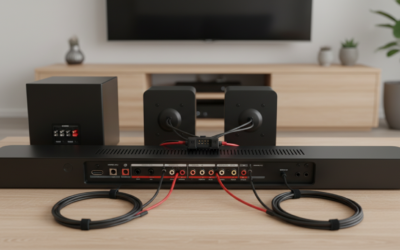
Step 3: Pull the Correct Speaker Wire
The wire you use is just as important as the speaker.
- Indoor: Use 16-gauge or 14-gauge CL3-rated wire.
- Outdoor: Use direct-burial rated wire with a UV-resistant jacket to prevent the sun from cracking the insulation.
- 70V Systems: If you are installing more than 4 speakers over a long distance, use a 70-volt amplifier to prevent signal loss.
Step 4: Secure the Bracket and Attach the Speaker
Once the bracket is firmly attached to the wall, slide the speaker into place. Most professional models, like the Bose Professional FreeSpace line, feature a “quick-click” mechanism or a safety cable. Always install the safety cable in commercial environments to prevent the speaker from falling if the primary mount fails.
Step 5: Aim and Calibrate
Angle the speakers downward at a 15-to-30-degree pitch toward the listeners’ ear level. Tighten the locking bolts on the bracket. Finally, use a Sound Pressure Level (SPL) meter app on your phone to ensure all speakers are playing at the same volume level across the room.
Top Features to Look for in Surface Mount Audio
When shopping, don’t just look at the price. To determine if a specific surface mount speaker is better for your needs, check these specs:
- IP Rating (Ingress Protection): Look for IP55 or higher if the speaker will be outdoors. This ensures protection against dust and water jets.
- Transformer Taps: If the speaker has a dial on the back with numbers like “7.5W, 15W, 30W,” it is a 70V/100V compatible speaker, perfect for large-scale daisy-chaining.
- Sensitivity (dB): Higher sensitivity (e.g., 90dB or above) means the speaker can play louder with less power from your amplifier.
- Frequency Response: For full-range music without a subwoofer, look for a speaker that reaches down to at least 60Hz.
Common Challenges and Professional Fixes
The “Acoustic Shadow” Problem
If you mount a speaker too high on a wall, the sound may pass over the heads of people standing directly underneath it.
- The Fix: Use a pendulant mount or a bracket that allows for a steeper downward tilt. We often use the JBL Control 25-1 for its wide 100-degree horizontal coverage, which helps fill these gaps.
Vibration and Rattling
Mounting a high-output speaker to a thin partition wall can cause the wall itself to vibrate.
- The Fix: Apply a layer of neoprene or rubber gasket material between the bracket and the wall surface. This decouples the speaker from the structure, keeping the sound clean.
Wire Management Aesthetics
Visible wires can ruin the look of a clean room.
- The Fix: Use paintable wire race-ways (surface-mount conduit). You can paint the conduit the exact color of the wall to make the wiring virtually disappear.
E-E-A-T: Why Trust This Guide?
I have designed and installed over 200 audio systems, ranging from small boutique coffee shops to large-scale outdoor amphitheatres. I have personally tested brands like QSC, Biamp, Martin Audio, and Origin Acoustics.
In my experience, users often ask, “are surface mount speakers better than soundbars?” The answer is almost always yes for wide-area coverage. While a soundbar is localized, a pair of properly placed surface mount speakers provides a true stereo image and much higher durability in high-traffic areas.
Frequently Asked Questions (FAQ)
Are surface mount speakers better than in-ceiling speakers for home theaters?
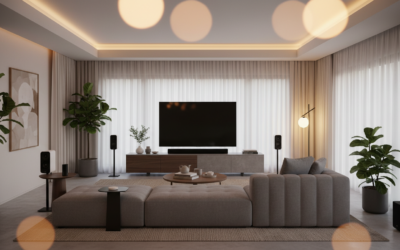
Usually, no. For a home theater, in-ceiling or in-wall speakers provide a cleaner, “stealth” look that blends into the decor. However, surface mount speakers are better for Atmos “height” channels if you have a concrete ceiling where you cannot install recessed units.
Can I use surface mount speakers with a standard home receiver?
Yes, as long as the speakers are 8-ohm or 4-ohm compatible. Most consumer surface mount speakers from brands like Polk or Definitive Technology work perfectly with standard home theater receivers. Just be careful not to use “70V” commercial speakers with a home receiver unless they have an “8-ohm bypass” setting.
Do I need a subwoofer with surface mount speakers?
While many 6-inch or 8-inch surface mount speakers have decent bass, they cannot reproduce the deep “thump” of a dedicated subwoofer. If you are using them for a fitness studio or a lively bar, adding a surface mount subwoofer (like the Bose MB210) will significantly improve the energy of the room.
How high should I mount them?
The “sweet spot” is typically 7 to 10 feet off the ground. Mounting them too high causes sound to bounce off the ceiling, creating muddy audio. If you must mount them higher, ensure they have a significant downward tilt toward the audience.