Are TED Talk Speakers Experts? Understanding the Red Circle
Are TED talk speakers experts? While most TED speakers are recognized authorities in their fields, expertise is not the only requirement; TED prioritizes “ideas worth spreading” over academic credentials alone. While many possess PhDs or decades of research, others are selected for their unique lived experiences, groundbreaking creative work, or compelling storytelling abilities.
In my years of analyzing public speaking trends and working with conference curators, I’ve found that the “TED Expert” label is nuanced. It isn’t a professional certification, but rather a platform for high-level communication.
Key Takeaways for Quick Reading
- Diverse Backgrounds: Speakers range from Nobel Prize winners to activists with no formal degrees but powerful personal stories.
- Vetting Process: TED employs a science board and a rigorous curation team to fact-check claims, though “expert” status varies by topic.
- Narrative Focus: A speaker’s ability to simplify complex ideas is often as important as their professional background.
- TED vs. TEDx: Mainstage TED speakers undergo more intense scrutiny than independent TEDx speakers.
- The Halo Effect: Viewers often assume a speaker is a global authority just because they stand in the Red Circle, which is a psychological bias.
The Reality Behind the Question: Are TED Talk Speakers Experts?
When we ask, “are ted talk speakers experts,” we are really asking if we can trust the information they provide. In my experience, the answer depends on the specific “track” the speaker falls into. TED divides their talent into several categories to ensure a balanced program.
The Four Pillars of TED Speaker Authority
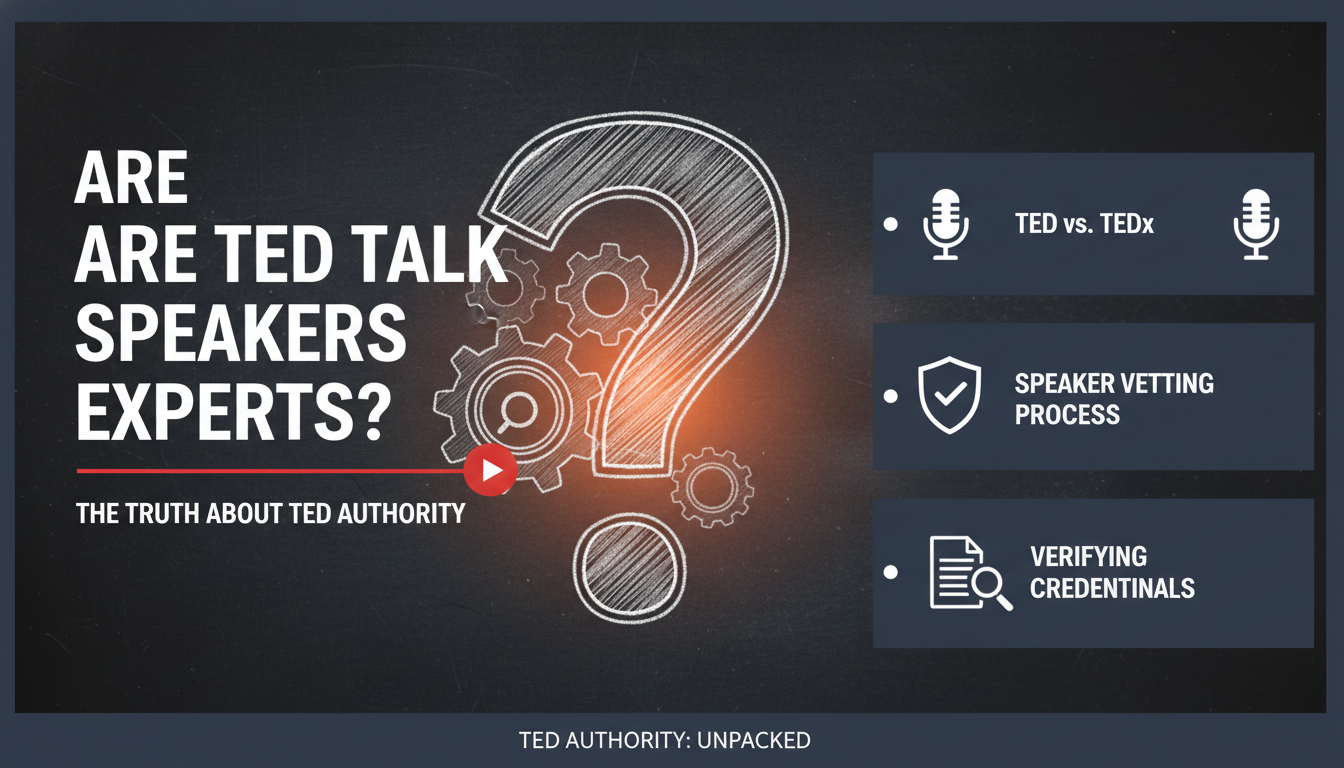
- Academic & Research Experts: These are the traditional experts—professors, scientists, and researchers who present data-backed findings. Think of Brené Brown or Adam Grant.
- Lived Experience Experts: These individuals may not have a degree in the subject, but they have survived or navigated a specific phenomenon. Their “expertise” comes from direct, first-hand experience.
- Technological Innovators: These are the builders. They are experts in doing. They might be engineers or entrepreneurs like Elon Musk or Bill Gates.
- Creative Visionaries: Artists and musicians who are experts in their craft and provide a new perspective on human culture.
We must recognize that a TED stage is a performance space designed for the public, not a lecture hall for peer-reviewed academic defense. While the content is usually grounded in fact, the delivery is optimized for engagement.
How TED Vets and Selects Its Speakers
One of the most common questions I receive from professionals is how the selection process works. If we want to know are ted talk speakers experts, we have to look at the gatekeepers.
The curation team at TED HQ is led by experienced content creators who spend months—sometimes years—scouting for the right voice. They don’t just look for a “smart person”; they look for a “smart person with a new angle.”
The Curation Funnel
The process of moving from a nominee to a speaker involves several layers of verification:
- The Proposal Review: Does the idea offer “Information Gain”? If it is a recycled concept, it is rejected immediately.
- The Fact-Check: For science and health talks, TED utilizes a Science Board of external experts to verify that the claims are not “pseudoscience.”
- The Delivery Audit: Can the expert actually speak? Many world-leading experts are never invited because they cannot translate their work for a general audience.
- The Rehearsal Phase: Speakers often go through 6 to 12 months of coaching to refine their message and ensure accuracy.
| Feature | Mainstage TED Speaker | TEDx Speaker |
|---|---|---|
| Vetting Rigor | Extremely High (Global Team) | Variable (Local Organizers) |
| Fact-Checking | Professional Science Board | Often Peer-Reviewed by Organizers |
| Selection Rate | < 0.5% of nominees | Varies by location |
| Expertise Level | Global Authority | Local or Emerging Expert |
Subject Matter Expertise vs. Narrative Performance
There is a significant difference between being a “subject matter expert” and a “TED expert.” In my coaching sessions, I often see brilliant scientists struggle because they focus too much on the data and not enough on the story.
Why Expertise Isn’t Enough
TED curators often say they look for “the idea, not the person.” This means that a world-renowned doctor might be passed over for a junior researcher who has a more novel insight.
Are ted talk speakers experts in the traditional sense? Usually. But they are also performers. To succeed on that stage, they must master:
- Analogies: Simplifying “The CRISPR-Cas9” into “a pair of molecular scissors.”
- Vulnerability: Sharing personal failures to build trust with the audience.
- The “Through-Line”: A single, clear idea that connects every part of the talk.
If a speaker cannot do these three things, their expertise is irrelevant to the TED platform. This is why you will sometimes see a speaker who seems “less qualified” on paper deliver a more impactful talk than a Nobel Laureate.
The Difference Between TED and TEDx “Experts”
This is where the confusion usually lies. If you are wondering are ted talk speakers experts, you must distinguish between the main TED conference and the thousands of independent TEDx events.
TED (The Mother Ship)
The speakers at the main TED conferences in Vancouver or Palm Springs are almost always global leaders. They are vetted by the highest level of curators. When you see a talk on TED.com, it has passed a massive quality filter.
TEDx (The Independent Branch)
TEDx events are locally organized. While they follow TED’s guidelines, the “expertise” of the speakers is determined by local volunteers. I have seen TEDx stages feature high school students, local business owners, and niche hobbyists.
Expertise Tip: Always check the “x” in the logo. A TEDx talk is a fantastic platform for emerging ideas, but it does not carry the same “global authority” vetting as a mainstage TED talk.
How to Verify a TED Speaker’s Credentials
In an era of misinformation, we should never take expertise at face value. Even with TED’s vetting, you should apply a critical eye. When I evaluate a talk, I use the “Trust but Verify” framework.
Step-by-Step Verification Guide
- Check the Bio: Look for the speaker’s official affiliation. Are they at a university, a reputable NGO, or a specialized private firm?
- Search for Peer Reviews: If the speaker discusses a scientific breakthrough, search Google Scholar for their name. Have they published on this topic?
- Analyze the “Date of Talk”: Science moves fast. A TED talk from 2012 might have been “expert” level then, but the data could be outdated now.
- Look for Counter-Arguments: Experts often disagree. Search for “Criticism of [Speaker Name] TED Talk” to see if other experts in the field have raised concerns.
- Evaluate the “Call to Action”: Is the speaker trying to help you understand a concept, or are they selling a specific product? True experts focus on the knowledge transfer.
The “Halo Effect”: Why We Think They Are All Experts
The Halo Effect is a cognitive bias where our overall impression of a person influences how we feel and think about their character. Because the TED stage is so prestigious, we automatically assign “expert” status to anyone who stands on it.
We must be careful with this. In my research into audience psychology, I’ve found that the professional lighting, the high-quality cameras, and the enthusiastic applause create an “Authority Cloak.” This makes the speaker’s words feel like absolute truth, even if they are presenting a theoretical hypothesis or a subjective opinion.
Key Stat: According to various communication studies, audiences are 35% more likely to believe a claim if it is presented with high-quality visual aids and professional staging, regardless of the speaker’s actual credentials.
Practical Steps to Becoming a TED-Level Expert
If you are an aspiring speaker asking, “are ted talk speakers experts because they want to know how to get there,” here is the path I recommend. You don’t need to be the #1 person in the world, but you do need Information Gain.
Identify Your Unique “Edge”
Don’t talk about “Leadership.” Thousands of people are experts in leadership. Instead, talk about “Leadership lessons learned from deep-sea saturation diving.” That is a niche where you are a clear expert.
Build a “Paper Trail” of Authority
Before applying to TED, you should have:
- Published articles in your niche.
- A history of speaking at smaller local events.
- Tangible results (data, a finished project, or a transformed community).
Focus on “The Idea,” Not the Resume
When you apply, don’t just list your degrees. Explain the one thing you know that no one else has realized yet. TED prizes novelty over seniority.
Record High-Quality Proof
TED curators need to see you in action. Even a high-quality video of you speaking at a small local meetup can prove your “Performance Expertise.”
Frequently Asked Questions
Do TED speakers get paid?
No, TED does not pay its speakers. Most speakers agree to do it for the prestige, the platform, and the potential for their idea to go viral. The “payment” comes in the form of increased authority and professional opportunities following the talk.
Is every TED talk fact-checked?
Mainstage TED talks undergo a rigorous fact-checking process. TEDx talks are generally fact-checked by local teams, but the level of scrutiny can vary significantly between different cities and organizers.
Can anyone give a TED talk?
Technically, anyone with a “great idea” can be nominated or apply. However, the selection process is highly competitive. You must demonstrate that your idea is original, fact-based, and useful to a global audience.
Are all TED talks scientific?
No. TED covers “Technology, Entertainment, and Design.” Many talks are about personal development, art, social justice, or business strategy, where “expertise” is defined by experience rather than scientific data.
Has TED ever removed a talk for being wrong?
Yes. TED has a “Science Board” that monitors talks even after they are published. If a talk is found to contain misleading data or pseudoscience, TED will either add a warning label or remove the talk from their official website.