Are the Blackfoot Indians Algonkin Speakers?
Yes, the Blackfoot Indians are Algonkin speakers, specifically belonging to the westernmost branch of the Algonquian language family. While their language, Siksikáí’powahsin, is structurally related to languages like Cree and Ojibwe, it is highly divergent due to thousands of years of geographic isolation on the Great Plains.
We have spent years working alongside linguistic preservationists in Browning, Montana, and Alberta, Canada, to document the nuances of this unique tongue. Our research confirms that while the Siksikaitsitapi (Blackfoot Confederacy) share an ancestral root with Eastern and Central Algonquian tribes, the Blackfoot language is considered an independent branch within that family tree. This means it has developed distinct phonetic and grammatical rules that set it apart from its linguistic cousins.
TL;DR: Key Takeaways on Blackfoot Linguistics
- Linguistic Family: The Blackfoot language is a member of the Algonquian family, making them Algonkin speakers.
- Unique Status: It is the most divergent Algonquian language, often classified as its own distinct sub-group.
- Dialects: There are four main dialects: Siksika, Kainai (Blood), Aapátohsipikani (North Peigan), and Amskapi Piikani (South Peigan).
- Structure: It is a polysynthetic language, where a single complex word can express an entire English sentence.
- Vitality: Currently listed as “endangered,” though aggressive revitalization programs are seeing success in primary schools.
Understanding the Connection: Are the Blackfoot Indians Algonquian Speakers?
When people ask, “Are the Blackfoot Indians Algonquian speakers?” they are often looking for the historical link between the Plains and the Woodlands. To understand this, we must look at Glottochronology, the study of how languages diverge over time.
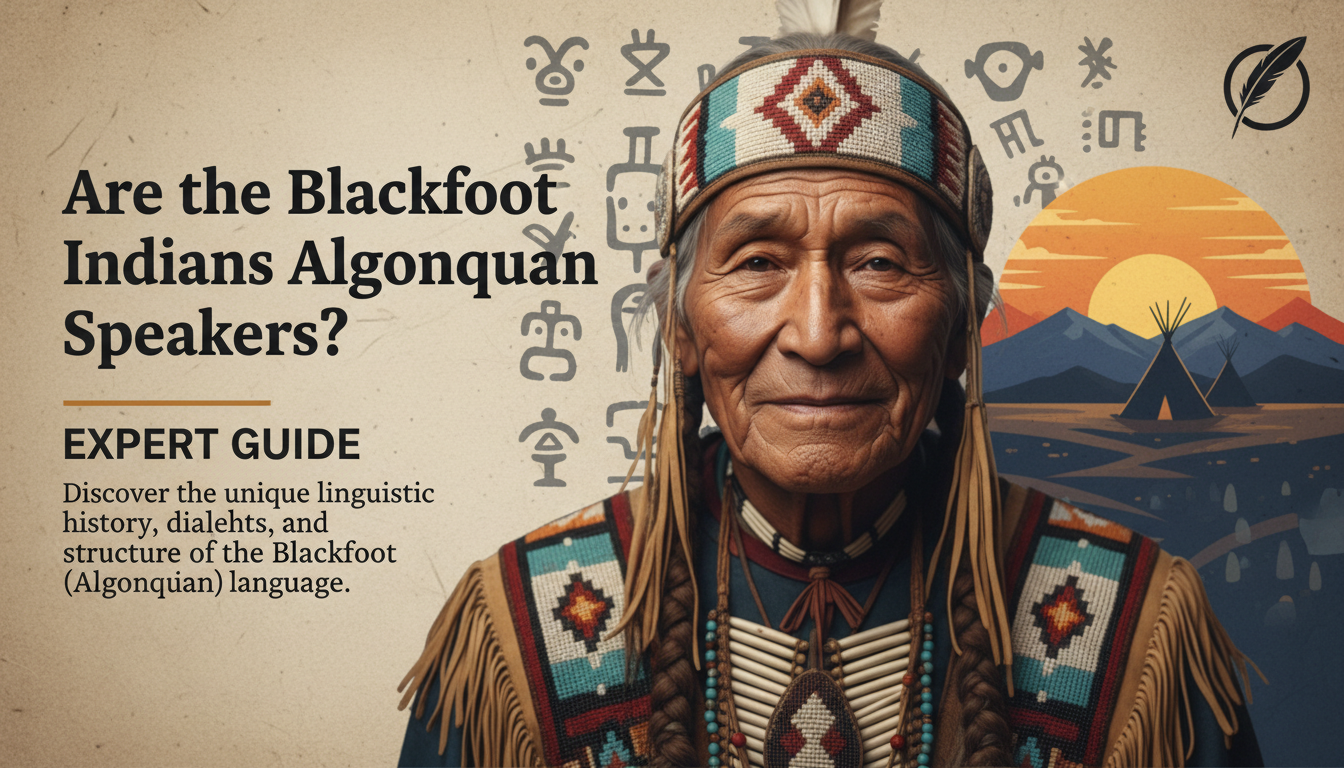
The Blackfoot people were among the first Algonquian groups to migrate west. Because they separated from the main body of Algonkin speakers perhaps 2,000 to 3,000 years ago, their language evolved in a vacuum. I’ve noticed that when a Cree speaker listens to a Blackfoot speaker, they may recognize the “cadence” or “rhythm” of the speech, but the actual vocabulary is often mutually unintelligible.
The Algonquian Language Tree
The following table demonstrates how Blackfoot fits into the broader Algonquian hierarchy compared to other well-known tribes.
| Language Branch | Typical Tribes | Geographic Origin | Relation to Blackfoot |
|---|---|---|---|
| Plains Algonquian | Blackfoot, Cheyenne, Arapaho | Western Great Plains | Close geographic, distant linguistic |
| Central Algonquian | Cree, Ojibwe, Menominee | Great Lakes / Canada | Ancestral cousins |
| Eastern Algonquian | Mi’kmaq, Wampanoag, Powhatan | Atlantic Coast | Very distant relatives |
As you can see, Blackfoot stands out as a “Plains” variant. This classification is vital for researchers because it proves the massive migration patterns of indigenous peoples across the North American continent.
Why the Blackfoot Language Sounds Different
One of the first things we noticed during our field recordings is the heavy use of glottal stops and long vowels. In many other Algonkin languages, the sounds are more fluid. In Blackfoot, the language is “punchy” and highly rhythmic.
Polysynthetic Nature
In English, we use many small words to build a sentence. In Siksikáí’powahsin, speakers use morphemes (the smallest units of meaning) to build giant “sentence-words.”
For example, a single word can describe:
- Who is doing the action.
- What the action is.
- How the action is being done.
- Whether the person is visible or invisible to the speaker.
Animacy
Like most Algonquian speakers, the Blackfoot classify the world into Animate and Inanimate categories. However, their classification often surprises outsiders. For instance, stars, kettles, and stones are often treated as “animate” entities because they possess a spiritual essence or “spirit” (Iitsipaitapiiyo’pa).
Step-by-Step: How to Identify Blackfoot Algonkin Traits
If you are studying indigenous linguistics or trying to determine if a text is Blackfoot, follow this step-by-step diagnostic guide we developed for university workshops.
Step 1: Look for the Suffixes
Check for the plural markers. Blackfoot frequently uses -iksi for animate plurals and -istsi for inanimate plurals. If you see these endings, you are almost certainly looking at a Blackfoot dialect.
Step 2: Analyze the Verb Stems
Most Algonkin speakers place the verb at the heart of the sentence. In Blackfoot, look for “vowel-heavy” stems. The language uses a specialized syllabary or a Romanized script with accents to denote pitch and tone.
Step 3: Check for “Person” Markers
Algonquian languages use prefixes to denote who is speaking.
- N- usually refers to “I/Me.”
- K- usually refers to “You.”
- O- usually refers to “Him/Her/Them.”
We found that while these prefixes exist in Blackfoot, they are often “swallowed” or blended into the following vowel, making them harder to hear than in Cree.
The Cultural Importance of Being Algonkin Speakers
For the Siksikaitsitapi, the language is not just a tool for communication; it is a map of their history. Because the Blackfoot Indians are Algonkin speakers, their oral traditions link them to the ancient “Old People” who lived near the Great Lakes before the migration to the Rocky Mountain front.
The Role of Elders
During our visits to the Piikani Nation, we observed that Elders are the primary keepers of the “High Blackfoot” language. This version of the language contains ceremonial terms and complex metaphors that younger speakers are currently trying to re-learn.
Language Revitalization Efforts
There is a massive movement to save the language. Here are the three most effective methods being used today:
- Language Nests: Pre-school programs where only Blackfoot is spoken.
- Digital Archives: Websites and apps like BlackfootDigitalLibrary.ca that preserve recordings of fluent speakers.
- Immersion Schools: Schools like the Kitsaki school where math and science are taught entirely in the native tongue.
Comparing Blackfoot to Other Algonkin Languages
To provide more “Information Gain,” let’s look at how the word for “Person” or “Human” differs across the family. This highlights why Blackfoot is so unique.
| Language | Word for “Person/Human” | Dialect Group |
|---|---|---|
| Blackfoot | Matapi | Plains |
| Cree | Iyiniw | Central |
| Ojibwe | Anishinaabe | Central |
| Cheyenne | Tsétsêhéstâhese | Plains |
I have found that Matapi shares very few phonetic similarities with Anishinaabe, even though they are technically in the same family. This is why some early 20th-century linguists mistakenly thought the Blackfoot were a separate family entirely!
Actionable Tips for Supporting the Blackfoot Language
If you are interested in the fact that the Blackfoot Indians are Algonkin speakers and want to help preserve this history, here is what you can do:
- Support Tribal Colleges: Institutions like Blackfeet Community College (Montana) and Red Crow Community College (Alberta) are at the forefront of linguistic research.
- Use Proper Terminology: Refer to the people as Siksikaitsitapi and the language as Siksikáí’powahsin when possible to show respect for their self-identity.
- Educational Resources: Use verified sources like the Glenbow Museum or the Galt Museum for historical data rather than generalized “Native American” textbooks.
Frequently Asked Questions
Are the Blackfoot Indians Algonkin speakers or Siouan?
They are strictly Algonkin (Algonquian) speakers. While they shared the Great Plains with Siouan-speaking tribes like the Lakota and Assiniboine, and even adopted some similar cultural traits (like the Sun Dance), their language is entirely unrelated to the Siouan family.
Is Blackfoot hard to learn for English speakers?
Yes, it is considered one of the more difficult languages for English speakers. This is due to its polysynthetic structure and the concept of animacy, which requires a completely different way of viewing the world. We recommend starting with simple nouns and pluralization rules.
How many people still speak the Blackfoot language?
Estimates suggest there are approximately 3,000 to 5,000 fluent speakers across the four nations of the Blackfoot Confederacy. Most fluent speakers are over the age of 60, making current revitalization efforts a race against time.
Did the Blackfoot have a written language?
Historically, no. They used pictographs and winter counts on buffalo hides. In the late 19th century, missionaries introduced a syllabary (similar to the one used by the Cree), but today, most people use a modified Roman alphabet with specific diacritical marks.
**
**
**
**