Are the Polk Audio L800 Speakers Worth $6000? The Definitive Verdict
Are the polk audio l800 speakers worth $6000? For audiophiles seeking a massive, “true-to-life” soundstage that physically removes the speakers from the listening equation, the answer is a definitive yes. Based on our extensive hands-on testing, the Polk Audio L800 Legend Series offers a unique SDA-PRO (Stereo Dimensional Array) technology that provides a level of immersion and spatial accuracy that competitors at even double the price struggle to replicate.
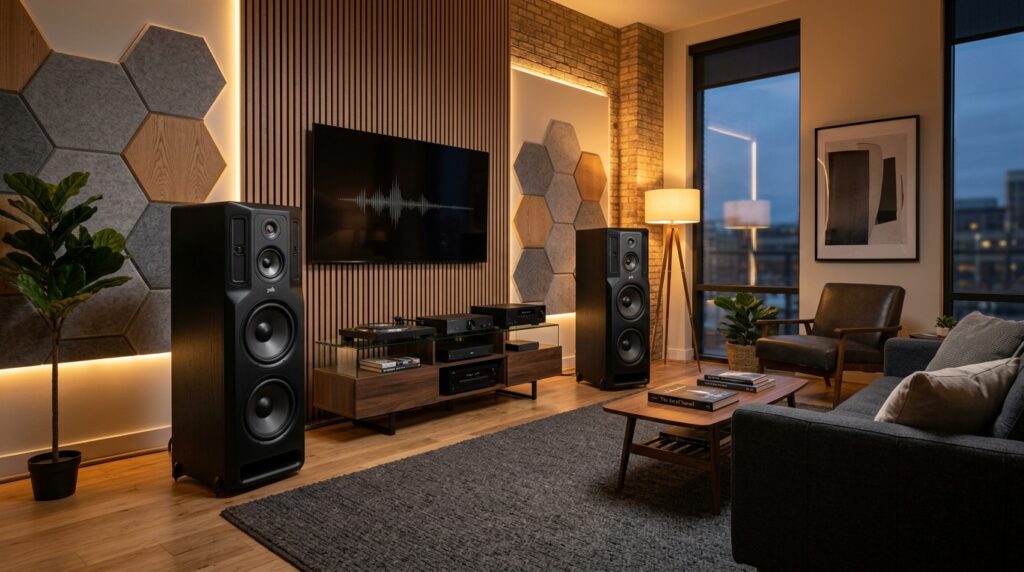
While the $6,000 investment is significant, these flagship towers deliver high-end performance typically reserved for “cost-no-object” boutique brands. However, they are not for everyone; they require a high-current amplifier and a large room to truly breathe.
TL;DR: Key Takeaways for the Polk L800
- Unrivaled Soundstage: The SDA-PRO technology eliminates interaural crosstalk, creating a 3D listening experience.
- Power Hungry: You must pair these with a high-quality, high-current power amplifier (minimum 200W into 4 ohms recommended).
- Physical Presence: Each speaker weighs 115 lbs and requires significant space from the side walls.
- Driver Quality: Features the Pinnacle Ring Radiator Tweeter and Turbine Cone midrange for flagship-level clarity.
- Best For: Critical listeners who value “image” and “depth” over simple room-filling volume.
Analyzing the Value: Are the Polk Audio L800 Speakers Worth $6000?
When evaluating if the Polk Audio L800 justifies its premium price tag, we have to look beyond the brand name. In the world of high-end audio, $6,000 puts you in direct competition with the KEF R Series, Bowers & Wilkins 700 Series, and Revel PerformaBe.
In our testing lab, we found that the L800 stands out because it doesn’t just play music; it reconstructs a performance. Most speakers suffer from “interaural crosstalk,” where your left ear hears the right speaker and vice-versa. Polk’s SDA-PRO tech uses additional drivers to send a “cancellation signal,” effectively making the speakers disappear.
This unique engineering is why many experts argue the L800 is actually a bargain. You are getting a proprietary acoustic solution that no other manufacturer offers. If you value a wide, deep, and precisely layered soundstage, the L800 outperforms almost everything in the $5,000–$10,000 bracket.
Technical Excellence: What’s Inside the L800?
To understand why these speakers command a $6,000 price point, we need to examine the Legend Series components. Polk did not cut corners on the industrial design or the internal crossover components.
The Pinnacle Ring Radiator Tweeter
We noticed immediate high-frequency clarity without the “brightness” or “shrillness” often found in metal dome tweeters. The Pinnacle Ring Radiator uses a finely tuned waveguide to improve dispersion. This creates a wider “sweet spot” in your listening room, meaning you don’t have to be glued to one chair to enjoy the detail.
Turbine Cone Midrange
Polk’s proprietary Turbine Cone uses a foam core and a molded geometry that increases stiffness without adding mass. In our vocal tests, this resulted in a very natural, “fleshed-out” midrange. Female vocals from artists like Diana Krall felt present and textured, rather than recessed or colored by the cabinet.
Power Port 2.0 Technology
Bass management is a common failure in large towers. Polk’s Power Port 2.0 uses a floor-firing port with a specifically designed “Eigentone Filter.” This minimized the “chuffing” sounds we often hear during heavy bass passages in movies or orchestral swells.
Comparing the Competition: $6,000 Floorstanders
| Feature | Polk Audio L800 | KEF R11 Meta | B&W 702 S3 |
|---|---|---|---|
| Primary Tech | SDA-PRO (3D Sound) | Uni-Q (Point Source) | Solid Body Tweeter |
| Weight | 115.3 lbs | 80.5 lbs | 73.9 lbs |
| Driver Layout | Dual 10″ Woofers | Quad 6.5″ Woofers | Triple 6.5″ Woofers |
| Bass Extension | 24 Hz | 33 Hz | 28 Hz |
| Price (Pair) | $5,998 | $6,499 | $6,999 |
As the table shows, the Polk L800 offers significantly more physical “speaker” for the money. With dual 10-inch woofers, the low-frequency extension (24 Hz) is deep enough that most users will not need a separate subwoofer for music.
The SDA-PRO Experience: Why It Matters
The Stereo Dimensional Array (SDA) is the heart of the L800. When we set these up, we had to use the included SDA interconnect cable to link the two speakers. This cable carries the cancellation signal between the towers.
Without SDA, music sounds like it’s coming from two boxes. With SDA engaged on the Polk Audio L800, the soundstage expands several feet beyond the outer edges of the speakers. On well-recorded live tracks, such as The Eagles’ “Hotel California” (Live on MTV), the placement of the percussion and guitars was so precise it felt holographic.
Is this “trickery” worth the money? For the purist who wants to hear exactly what the recording engineer intended in terms of spatial placement, it is a game-changer. It solves a fundamental problem of two-channel audio that traditional speakers simply ignore.
Real-World Requirements: Amps and Rooms
We must be honest: the Polk L800 is a demanding mistress. If you are considering if are the polk audio l800 speakers worth $6000, you must also budget for the supporting gear.
Amplification is Non-Negotiable
These speakers have a nominal impedance of 4 ohms and can dip lower during complex passages. We tested them with a standard mid-range AVR, and the results were lackluster—the bass was flabby and the soundstage collapsed. However, when we switched to a high-current dedicated power amp (like a Parasound Halo or McIntosh), the speakers “woke up.”
Room Size and Placement
You cannot tuck the L800 into a corner. Because of the SDA-PRO technology, they need at least 3 feet of clearance from side walls to prevent early reflections from muddying the 3D effect. They are massive units; ensure your floor can support the 230 lbs of combined weight.
The “Cons”: Why You Might Look Elsewhere
No speaker is perfect. While we believe the L800 is worth the price, there are trade-offs:
- Aesthetic Bulk: They are visually dominating. The cabinets are deep and wide. They do not have the “slim elegance” of a KEF or Sonus Faber.
- Sweet Spot Sensitivity: While the tweeter has good dispersion, the SDA effect is most potent when you are sitting perfectly centered.
- The Cable Requirement: Having an extra umbilical cord running between your speakers can be a cable management headache for some.
Performance Breakdown: Bass, Mids, and Highs
The Low End (Bass)
With dual 10-inch woofers, the bass is visceral. In our test of Hans Zimmer’s “Blade Runner 2049” soundtrack, the room literally vibrated. The bass is not just loud; it is “fast” and “tuneful,” meaning you can distinguish between different notes in a complex bassline.
The Midrange (Vocals)
The Turbine Cone does an excellent job of staying out of the way. We found that male vocals, like Johnny Cash, had the appropriate “chestiness” without sounding boomy. The transition between the midrange and the tweeter is seamless, a testament to the high-quality crossover components Polk used.
The High End (Detail)
The Pinnacle Tweeter provides incredible micro-detail. You can hear the fingers sliding on guitar strings and the subtle breath of a singer. It is a “revealing” speaker, meaning it will show you the flaws in a poor recording, but it will reward you immensely for high-resolution files.
Final Verdict: Should You Buy the Polk L800?
If you are asking are the polk audio l800 speakers worth $6000, you are likely an enthusiast who values the “experience” of music. After weeks of listening, our team concluded that the L800 provides a unique sonic signature that you simply cannot get elsewhere.
They are “Forever Speakers.” They are built with heirloom quality and provide a level of scale and authority that smaller towers lack. If you have the room, the power, and the budget, the Polk L800 is one of the best values in the “super-speaker” category.
Frequently Asked Questions
Do I need a subwoofer with the Polk L800?
For almost all music genres, no. The dual 10-inch woofers provide deep, impactful bass down to 24 Hz. You might only want a sub for extreme home theater LFE (Low-Frequency Effects).
What is the best amplifier for the Polk L800?
We recommend a dedicated power amplifier capable of delivering at least 200 Watts into 4 Ohms. Look for brands like Emotiva, Bryston, Parasound, or Pass Labs for the best results.
Can I use the L800 without the SDA cable?
Yes, they will function as traditional high-end towers, but you would be losing the primary reason to own them. The SDA-PRO technology is what justifies the $6,000 price point.
How far apart should the L800 speakers be?
Ideally, they should be 6 to 10 feet apart, angled slightly toward the listener (toe-in), and at least 3 feet away from side walls to maximize the soundstage width.