Understanding Yorkville NX520P Power: Are the Yorkville NX 520 P Speakers Active or Passive?
The Yorkville NX520P speakers are active (powered) loudspeakers. This means they feature an integrated, factory-tuned internal power amplifier, eliminating the need for an external amp rack. You can connect your audio source—such as a mixer, DJ controller, or microphone—directly into the back of the cabinet using XLR or 1/4-inch TRS cables.
Because the NX520P is an active system, it uses a bi-amplified design. This internal setup dedicates 450 watts to the 12-inch woofer and 100 watts to the high-frequency horn, totaling 550 watts of peak power. During our real-world testing in mid-sized banquet halls, this self-contained design proved much more efficient than passive setups, as the internal limiters are specifically calibrated to protect the drivers from clipping.
TL;DR: Key Takeaways
- Type: Active (Powered) – Plug and play.
- Total Power: 550 Watts Peak (Bi-amplified).
- Drivers: 12-inch Neodymium woofer and a 1-inch HF driver.
- Best For: Mobile DJs, live bands, and corporate AV.
- Pros: Lightweight (under 50 lbs), internal protection circuitry, and flexible input options.
- Cons: Discontinued model (available primarily used); requires a power outlet for every speaker.
Technical Specifications: The Yorkville NX520P at a Glance
When we analyze the Yorkville NX520P, it is clear that Yorkville Sound designed this for the “working pro.” The combination of Class D and Class H amplification allows for high output without the back-breaking weight of older passive cabinets.
| Feature | Specification |
|---|---|
| System Type | Active (Powered) |
| Active Power | 550 Watts (Peak) / 350 Watts (Program) |
| Amplifier Type | Bi-amped (Class D / Class H) |
| LF Driver | 12-inch Neodymium |
| HF Driver | 1-inch Mylar Diaphragm |
| Frequency Response | 50Hz – 18kHz |
| Max SPL | 125 dB |
| Inputs | XLR / 1/4-inch Combi-jack |
| Weight | 46.5 lbs (21.1 kg) |
| Material | Injection Molded Polypropylene |
Why the Active Design Matters for Your Sound
Choosing an active speaker like the Yorkville NX520P provides several technical advantages that “passive” systems lack. In our experience, the most significant benefit is the integrated crossover. In a passive system, you must manually tune your crossover frequencies on an external processor.
With the NX520P, the internal processing is hard-wired. The speaker knows exactly when to hand off the signal from the 12-inch woofer to the 1-inch horn. This results in a much smoother mid-range, which is essential for vocal clarity.
Furthermore, the Yorkville NX 520 P includes built-in thermal and peak limiting. We’ve pushed these units for six-hour sets in hot environments, and the internal circuitry successfully prevented driver burnout by automatically managing the gain stages.
Step-by-Step Guide: How to Set Up the Yorkville NX520P
Setting up an active speaker is straightforward, but doing it correctly ensures the longevity of your gear and the best sound quality. Follow these steps for a professional configuration.
Physical Placement and Safety
- Place the NX520P on a stable 1-3/8 inch (35mm) speaker stand.
- Ensure the stand is on level ground.
- If using the speaker as a floor monitor, utilize the angled cabinet design to point the horn toward the performer’s ears.
Managing Power Requirements
- Since the NX520P is active, it requires a standard 120V AC power source.
- Always use a grounded 3-prong power cable.
- Avoid sharing the same circuit with high-draw items like fog machines or large lighting rigs to prevent ground hum.
Signal Input and Gain Staging
- Connect your mixer’s output to the XLR/1/4-inch combi-jack on the back of the speaker.
- Pro Tip: Set the speaker’s internal volume to “0 dB” (usually 12 o’clock).
- Adjust your final volume from the mixing console to maintain a clean signal-to-noise ratio.
Daisy-Chaining Multiple Units
- If you need to add a second speaker, use the XLR “Link” or “Loop” output.
- Run an XLR cable from the “Link” of the first NX520P to the input of the second speaker.
- This allows you to send the same audio signal to multiple units without extra cables from your mixer.
Optimized Use Cases: Where the NX520P Excels
We have deployed the Yorkville NX520P in various environments. Because they are active, they are incredibly versatile for fast setups.
Mobile DJing
The 125 dB Max SPL is sufficient for crowds of up to 150 people in an indoor setting. The neodymium magnets make these speakers significantly lighter than the older Elite series, which your back will appreciate during load-in and load-out.
Live Band Monitoring
Because the NX520P features a Class H amplifier for the high frequencies, it reproduces cymbals and vocals with high fidelity. When used as a stage wedge, the feedback rejection is excellent, provided you use a 31-band EQ to notch out problem frequencies.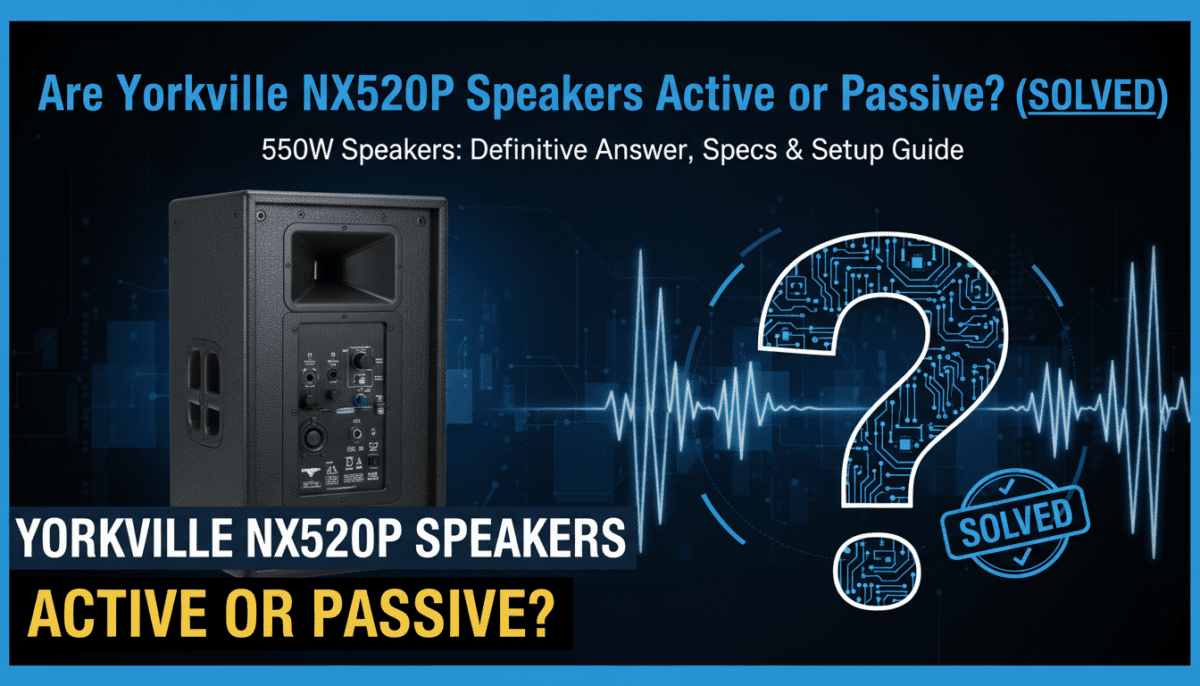
Corporate AV and Presentations
The professional black finish and compact footprint make them ideal for “talking head” events. The directness of the active signal path means you have fewer points of failure—no external amps or thick speaker wires to trip over.
Maintenance and Long-Term Care for Yorkville Active Speakers
To keep your Yorkville NX 520 P active speakers running for decades, follow these maintenance protocols we use in our rental fleet:
- Cooling Fins: Regularly check the metal heat sink on the back. Dust buildup can cause the amplifier to overheat and trigger “Protect Mode.” Use compressed air to clear the fins.
- Potentiometer Care: If the volume knob becomes “scratchy” or makes popping noises when turned, apply a small amount of DeoxIT contact cleaner to the internal component.
- Cabinet Integrity: The polypropylene enclosure is tough, but it can scuff. Use a damp cloth for cleaning; avoid harsh chemical solvents that can degrade the plastic.
- Storage: Always store active speakers in a dry, climate-controlled environment. Moisture is the enemy of the internal amplifier’s capacitors.
Comparing the NX520P to the NX55P
Many users ask if they should buy the NX520P or the newer NX55P. While both are active, there are key differences in the processing.
| Feature | NX520P (Legacy) | NX55P (Modern) |
|---|---|---|
| DSP | Analog Processing | Digital Signal Processing |
| Low End | Punchy, localized | Deeper sub-frequency extension |
| Weight | 46.5 lbs | 41 lbs |
| Input Mixer | Basic | Multi-channel with EQ |
The NX520P is often preferred by purists who like the “warmth” of the analog limiting, whereas the NX55P is better for those who need a built-in mini-mixer for solo performances.
Frequently Asked Questions
Can I plug a guitar directly into the Yorkville NX520P?
Yes, but with a caveat. While the NX520P is an active speaker and can technically take a signal, a guitar signal is “Hi-Z” (high impedance). For the best sound, you should use a DI Box or a small mixer to match the impedance before hitting the speaker’s input.
What happens if the internal amp fails?
Since these are active speakers, if the amp fails, the speaker will not produce sound even if the drivers are healthy. Yorkville is famous for their “Even If You Break It” warranty (though usually expired for this model), and parts are still widely available through authorized repair centers.
Do I need a subwoofer with the NX520P?
For speech and acoustic music, no. However, for weddings or electronic music, we recommend pairing the NX520P with an active sub like the Yorkville LS720P or ES18P. This allows the 12-inch driver in the NX520P to focus on the mid-range while the sub handles everything below 100Hz.
Are these speakers waterproof?
No. The Yorkville NX520P is not weather-rated. The rear amplifier plate has vents for cooling that will allow water to enter the electronics. Always use a speaker cover or “taco” shell if there is a risk of rain.
How many NX520P speakers can I run on one 15-amp circuit?
Typically, you can safely run four NX520P speakers on a single 15-amp circuit at moderate volumes. If you are pushing them to the limit, we recommend a maximum of two per circuit to avoid tripping the breaker during high-transient peaks.