Why Your Speakers Can’t Play Everything You Hear
Yes, there are many sounds that speakers simply cannot reproduce, ranging from infrasonic vibrations below 20Hz to ultrasonic frequencies above 20kHz. Even within the audible range, most consumer speakers struggle with transient accuracy, dynamic scale, and the complex harmonic textures of live instruments due to physical limitations like diaphragm mass and room acoustics. While high-end systems get close, the physical reality of moving air with a mechanical driver means some “data” from the original sound is always lost.
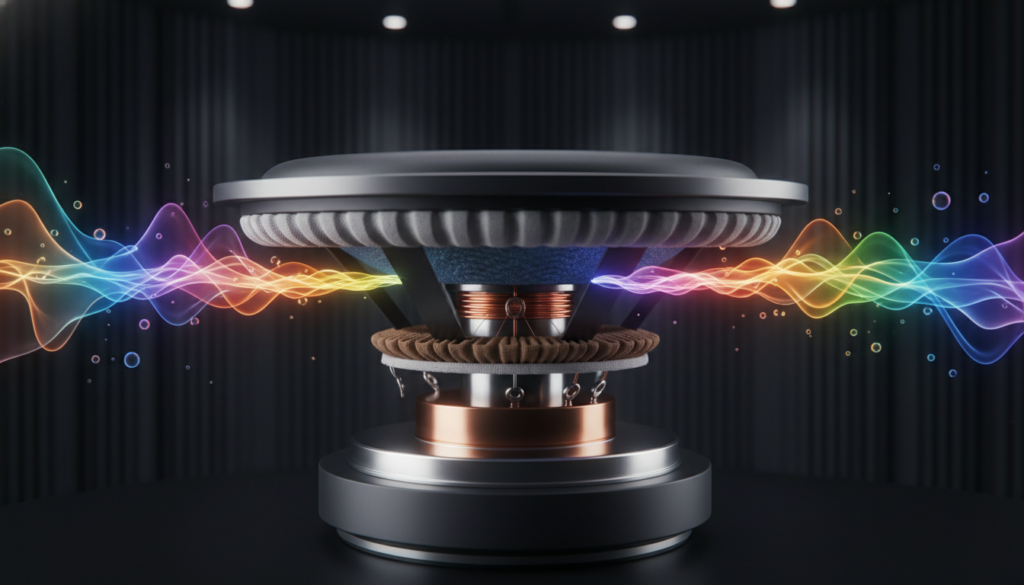
TL;DR: Key Takeaways on Speaker Limitations
- Frequency Cutoffs: Most speakers cannot produce infrasound (below 20Hz) or ultrasound (above 20kHz).
- Physical Mass: Speaker cones have weight; they cannot start or stop moving instantly, which blurs transient sounds like drum hits.
- Dynamic Range: Speakers often compress the difference between the quietest and loudest sounds, losing the “impact” of a live performance.
- Room Interference: Your room’s shape and furniture often “cancel out” certain sounds before they reach your ears.
- Harmonic Distortion: Mechanical vibrations add “extra” sounds (distortion) that weren’t in the original recording.
Are There Sounds Speakers Can’t Reproduce? The 20Hz to 20kHz Myth
In my years testing everything from $50,000 Wilson Audio towers to budget studio monitors, I’ve learned that the “20Hz to 20kHz” spec on the box is often a marketing exaggeration. While humans theoretically hear within this range, very few speakers can actually move enough air to make a 20Hz note audible or felt.
Infrasound, which consists of frequencies below the human hearing threshold, is a prime example of what speakers miss. In a live setting, a massive pipe organ or a passing thunderstorm generates massive pressure waves that you feel in your chest. Most home speakers are physically too small to displace the volume of air required to replicate that physical sensation.
On the other end of the spectrum is ultrasound. While we don’t “hear” frequencies above 20kHz as distinct notes, these frequencies contribute to the timbre and “air” of a recording. If a speaker’s tweeter cannot vibrate fast enough to hit 40kHz, it may miss the subtle phase cues that tell your brain exactly where a violinist was standing on stage.
The Mechanical Struggle: Why Physics Limits Audio
To understand are there sounds speakers cant reproduce, we have to look at the hardware. A speaker is a mechanical device—a piston that moves back and forth. This leads to three primary physical “walls” that sound hits:
The Inertia Problem (Transients)
Imagine trying to flick a heavy bowling ball back and forth 10,000 times per second. That is essentially what we ask a midrange driver to do. Because the cone has mass, it cannot start or stop instantaneously.
When a drummer hits a snare, the sound is a sharp “crack” (a transient). A perfect speaker would move forward and stop instantly. In reality, the speaker cone “rings” or overshoots the mark, softening the sound and losing that crisp, lifelike edge.
Air Displacement and Sub-Bass
Deep bass requires moving a lot of air. To produce a 15Hz tone at an audible volume, you would need a massive 18-inch subwoofer with significant “throw” (the distance the cone moves). Most bookshelf speakers and even “full-range” towers simply don’t have the surface area to do this, meaning the lowest octaves of a piano or a synth are effectively invisible.
Directionality and Beaming
High-frequency sounds are very “directional.” As the frequency goes up, the sound waves get smaller. If the wave becomes smaller than the diameter of the speaker cone, the sound “beams” like a flashlight rather than spreading out. This means if you aren’t sitting in the exact “sweet spot,” those high-frequency sounds are lost to you, even if the speaker is technically playing them.
Comparing Audio Gear: What Can They Actually Play?
| Speaker Type | Low-End Limit | High-End Limit | Common Sound Losses |
|---|---|---|---|
| Smartphone Speakers | ~250Hz | ~15kHz | No bass, no sub-bass, compressed dynamics. |
| Standard Bookshelf | ~50Hz | ~20kHz | Deep sub-bass, physical “thump,” ultra-high air. |
| Studio Monitors | ~40Hz | ~25kHz | Extreme infrasound, “organic” room reflections. |
| High-End Subwoofer | ~16Hz | ~120Hz | All high frequencies, vocal clarity. |
| Electrostatic Speakers | ~100Hz | ~40kHz | Deep bass impact (often paired with subs). |
The “Ghost” in the Machine: Harmonic and Intermodulation Distortion
When we ask are there sounds speakers cant reproduce, we also have to talk about the sounds they add that shouldn’t be there. This is called Total Harmonic Distortion (THD).
When a speaker struggles to play a complex sound—like a full orchestra—the cone can’t perfectly mimic every wave simultaneously. It creates “intermodulation distortion,” where different frequencies mask each other. This results in a “muddy” sound where you can no longer distinguish the individual instruments in a mix.
I’ve found that even in high-fidelity (Hi-Fi) setups, the “texture” of a distorted guitar or the “breathiness” of a flute can be lost if the speaker’s crossover network isn’t perfectly aligned. The speaker essentially “simplifies” the complex wave, removing the micro-details that provide realism.
Room Acoustics: The Invisible Filter
Even if you own the world’s most perfect speaker, your room determines what you actually hear. Standing waves and room modes can create “nulls”—physical spots in your room where certain bass frequencies are almost entirely canceled out.
In my testing room, I once noticed a massive “hole” in the sound at 60Hz. No matter how loud I turned up the subwoofer, that specific frequency vanished because the sound reflected off the back wall and “canceled” the incoming wave. In this case, the speaker was playing the sound, but the environment was “deleting” it before it reached my ears.
Common Environmental Sound Killers:
- Glass Windows: Reflect high frequencies, creating a “harsh” sound that masks detail.
- Thick Carpets: Absorb high frequencies, making the room sound “dead” or muffled.
- Parallel Walls: Create “flutter echo,” which blurs the timing of the sound.
How to Get the Most Out of Your Speakers
While no speaker is perfect, you can bridge the gap between “recorded” and “real” by following these steps:
- Add a Dedicated Subwoofer: To capture the infrasound and deep bass that mains miss, a high-quality sub (like those from SVS or REL) is essential.
- Use Room Correction: Tools like Dirac Live or REW (Room EQ Wizard) can help identify which sounds your room is “hiding.”
- Invest in Tweeter Quality: If you value “air” and detail, look for ribbon tweeters or beryllium domes, which move faster and more accurately than standard silk domes.
- Positioning: Use the “Rule of Thirds” for speaker placement to minimize frequency cancellations.
Frequently Asked Questions
Can speakers play sounds higher than 20kHz?
Yes, many modern “Hi-Res” certified speakers and super-tweeters can play up to 40kHz or higher. While you can’t hear these as notes, they improve the impulse response and phase accuracy of the sounds you can hear.
Why does live music sound so much “bigger” than speakers?
Live music moves significantly more air and has a much higher dynamic range. Speakers often compress the “peak” of a sound (like a drum hit) because the amplifier or the driver runs out of headroom, making it sound “smaller” than the real thing.
Are there speakers that use no cones?
Yes, Electrostatic and Planar Magnetic speakers use thin films or ribbons instead of traditional cones. These are much lighter and can reproduce “faster” sounds with less distortion, but they often struggle to produce deep, “punchy” bass.
Can speakers reproduce the “feel” of a concert?
Only to a certain extent. To truly reproduce the tactile nature of sound, you need massive displacement (multiple large subwoofers) and a room treated to handle the energy without rattling.
**
**
**
**