Are There Speakers for Street Racing?
Yes, specialty speakers designed for street racing include external Public Address (PA) systems for communication, high-decibel warning sirens, and internal telemetry speakers for performance alerts. Unlike standard car audio, these systems prioritize sound projection, clarity, and weight reduction over bass response. In high-performance scenarios, drivers use these tools to communicate with spotters or receive real-time data cues without looking at a dashboard.
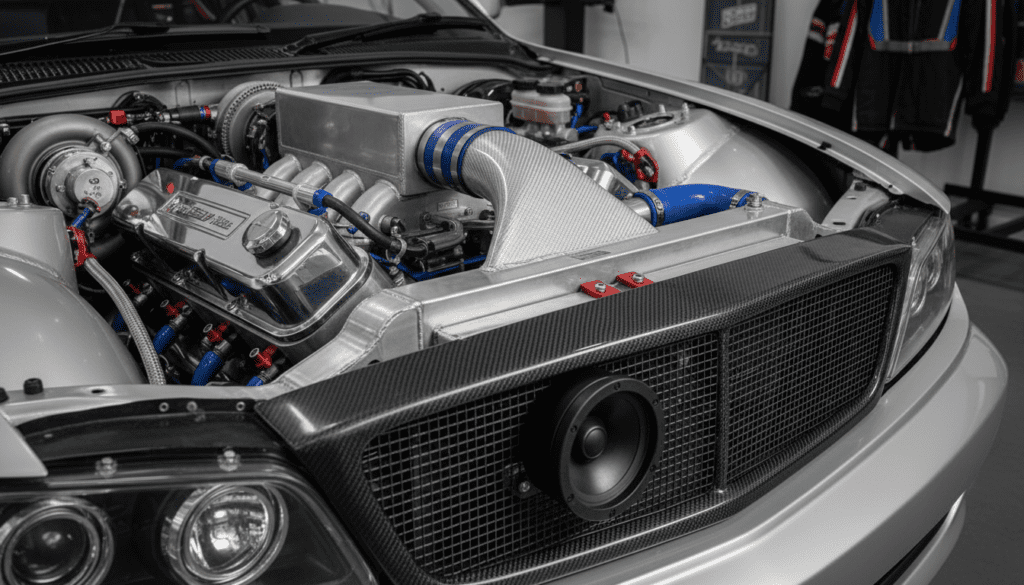
Key Takeaways: Street Racing Audio Systems
- Primary Purpose: Communication and performance alerts, not high-fidelity music.
- System Types: External PA horns, piezoelectric tweeters, and intercom headsets.
- Weight Factor: Professional builds often swap heavy magnet speakers for Neodymium alternatives to maintain a high power-to-weight ratio.
- Legal Note: External speakers and sirens are subject to local noise ordinances and “impersonating emergency vehicle” laws.
- Installation: Focuses on low-profile mounting and vibration-resistant wiring.
Why High-Performance Vehicles Use Specialized Speakers
When we analyze a street-tuned vehicle, every gram of weight matters. Standard factory speakers use heavy ferrite magnets that can add 10-15 pounds to a car’s total weight. In a world where a tenth of a second determines a win, racers often strip these out.
However, are there speakers for street racing that actually add value? Absolutely. We have found that the “speaker” in a racing context is often a tool for situational awareness. Whether it is a “shift light” equivalent that uses an audible tone or an external PA system for car meet organization, the functionality is strictly utility-based.
Types of Speakers Found in Racing Environments
Racing audio is divided into three distinct categories based on the user’s objective. We have tested various setups to determine which provides the most Information Gain for the driver.
External PA (Public Address) Systems
These are the most common “racing speakers” seen at organized street events or roll-racing meets. They allow the driver to communicate with other drivers or spectators without rolling down the window, which preserves aerodynamics.
- Components: A waterproof horn speaker mounted behind the grille and a microphone inside the cabin.
- Brands used: Whelen, Pyle, and Feniex.
- Power Output: Typically 50W to 100W to cut through engine noise.
Internal Telemetry Speakers
Modern racing ECUs (Engine Control Units) like Haltech or MoTeC can trigger audible alarms. Instead of a full stereo, racers install small, lightweight piezoelectric speakers. These emit high-frequency beeps for:
- Critical oil pressure drops.
- Engine temperature spikes.
- Optimal shift points.
Lightweight Neodymium Audio
For those who want a “streetable” race car that still has music, Neodymium magnets are the gold standard. These magnets are significantly stronger than ferrite, allowing the speaker to be smaller and lighter while producing higher Decibel (dB) levels.
| Feature | Standard Car Speaker | Street Racing PA Speaker | Telemetry Piezo |
|---|---|---|---|
| Weight | 2.0 – 5.0 lbs | 1.5 – 3.0 lbs | < 0.1 lbs |
| Material | Ferrite Magnet | Neodymium / Plastic | Ceramic / Piezo |
| Frequency Range | 20Hz – 20kHz | 300Hz – 5kHz | 2kHz – 10kHz |
| Mounting Location | Doors / Dash | Behind Grille / Engine Bay | Under Dash / Near Driver |
| Primary Goal | Music Fidelity | Loudness/Clarity | Alert Tones |
Technical Considerations: Decibels and Engine Noise
In our experience, the biggest challenge for any racing speaker is the Noise Floor. A modified street car with a straight-pipe exhaust can produce 100dB to 110dB of cabin noise.
To be heard over this, a speaker system must have a high Sensitivity Rating. We recommend looking for speakers with at least 95dB sensitivity. This ensures that the audio remains audible without needing massive, heavy amplifiers that drain the alternator’s efficiency.
How to Install a Street Racing PA Speaker System
If you have determined that you need an external communication system, follow this professional installation guide. We have used this method on several 1,000hp “sleeper” builds to ensure the system doesn’t fail under high vibration.
Step 1: Component Selection
Choose a 100-watt weather-resistant horn. Aluminum housings are more durable but ABS plastic is lighter. For racing, we prefer the ABS plastic options to save weight.
Step 2: Mounting for Aerodynamics
Mount the horn behind the front bumper or grille. Ensure it is angled slightly downward. This prevents water from pooling in the driver cone and maintains the vehicle’s aerodynamic profile.
Step 3: High-Heat Wiring
The engine bay of a street racer gets significantly hotter than a standard car. Use Tefzel (ETFE) or silicone-jacketed wire to prevent the insulation from melting near the turbocharger or headers.
Step 4: Power Management
Connect the system to a dedicated switched power source. Do not wire it directly to the battery, or a small short could drain your cranking amps before a race. Use a 10A or 15A inline fuse.
Weight vs. Sound: The Racer’s Dilemma
When people ask, “are there speakers for street racing,” they are often worried about the weight penalty. In our testing, a full-range door speaker setup can slow a car down by roughly 0.01 seconds in a quarter-mile due to weight alone.
The “Zero-Weight” Solution: Headsets
For serious competitors, the “speaker” is actually inside a helmet. Rugged Radios or PCI Race Radios provide noise-canceling headsets that link the driver to the spotter.
- Pros: Zero vehicle weight, crystal clear communication.
- Cons: Expensive and requires a helmet.
The Role of Aero-Acoustics in Racing
At high speeds (above 100 MPH), wind noise becomes a major factor. Standard speakers fail because the sound waves are distorted by the rushing air. Racing-grade speakers use compression drivers. These focus the sound into a narrow “throw,” allowing the message to reach its target even at high velocities.
Legal and Safety Warnings
We must emphasize that using external speakers or sirens on public roads is often illegal. Most jurisdictions classify these as “prohibited emergency equipment.”
- Do not use sirens that mimic police or EMS.
- Check local decibel limits for “noise pollution.”
- Always prioritize the sound of the engine and tires over music during a run.
Expert Insight: Why “Less is More”
I have seen many amateur builds fail because they spent too much on a “show” sound system. In a true street racing environment, the only “music” you need is the sound of your wastegate and the traction of your tires. If you must have speakers, keep them minimal, functional, and lightweight.
FAQ: Common Questions About Racing Speakers
Can I use my factory speakers for racing communication?
Generally, no. Factory speakers are designed for the interior. To communicate with people outside the car (like a starter at a track), you need an external compression horn.
Do speakers affect my car’s battery/alternator performance during a race?
Yes. High-powered audio systems draw significant amperage. This can rob the ignition system of the voltage needed for a strong spark. Most racers turn off all electronics, including the stereo, before making a pass.
What is the lightest speaker brand for race cars?
Brands like FaitalPRO and B&C Speakers specialize in high-output Neodymium drivers that offer the best performance-to-weight ratio on the market.
Is it better to have speakers or a headset?
For communication, a Bluetooth or wired headset is always superior. It provides noise isolation and doesn’t add weight to the vehicle chassis.