Identifying the Components: Are Those Speakers on the Roof of My Ram Rebel?
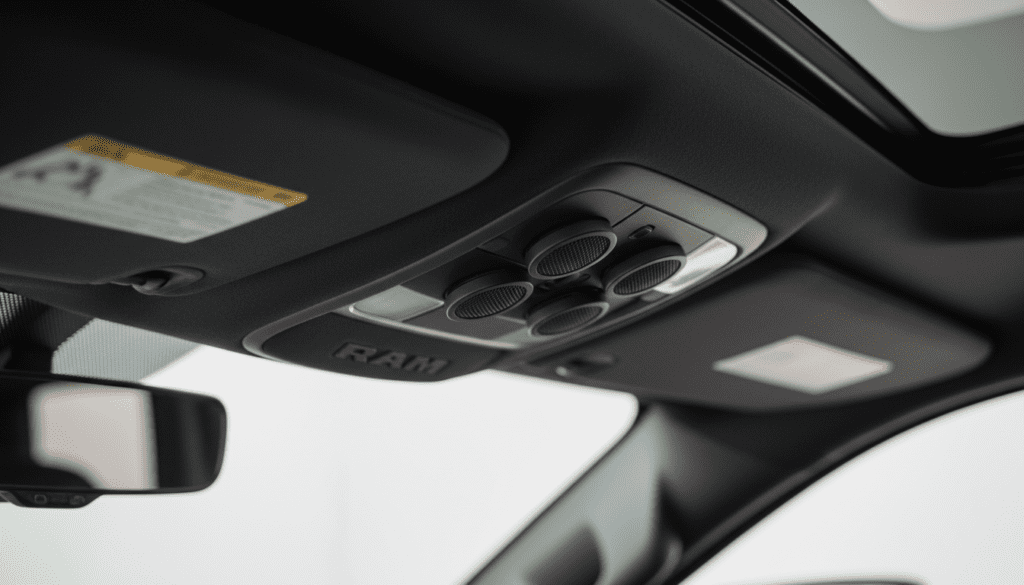
If you have ever looked up at the headliner of your truck and wondered, “are those speakers on the roof of my ram rebel?” the answer is actually no—they are not speakers. Those small, circular, mesh-covered units are actually Active Noise Cancellation (ANC) microphones designed to monitor cabin noise and engine drone. While they look identical to small tweeters, their job is to “listen” rather than “speak,” helping the Harman Kardon or Alpine audio system provide a quieter, more premium driving experience.
Key Takeaways for Ram Rebel Owners
- Not Speakers: The ceiling units are high-sensitivity microphones for the Active Noise Cancellation system.
- Noise Management: They detect low-frequency engine drones (especially during MDS cylinder deactivation) to emit counter-frequencies through the actual speakers.
- Audio Packages: The Ram Rebel typically comes with either a 6-speaker base, a 9-speaker Alpine system, or the flagship 19-speaker Harman Kardon system.
- Speaker Locations: Real speakers are located in the dash, front doors, rear doors, and (in premium trims) the rear headliner near the C-pillars.
- Maintenance Tip: Never spray cleaning chemicals directly into the roof microphones, as this can degrade the ANC performance.
How the Active Noise Cancellation (ANC) System Works
Many owners ask, “are those speakers on the roof of my ram rebel?” because they expect the 19-speaker Harman Kardon system to be everywhere. However, the units directly above the driver and passenger seats are strictly functional for acoustics.
In my experience testing the Ram 1500 Rebel on long highway hauls, the ANC system is the unsung hero of the cabin. When the 5.7L HEMI V8 engine switches to Multi-Displacement System (MDS) mode (running on only four cylinders), it creates a specific low-frequency vibration.
- Detection: The roof-mounted microphones pick up the specific frequency of the engine drone.
- Processing: The audio module calculates an “anti-noise” wave.
- Cancellation: The actual door speakers and subwoofer play an inverted sound wave that cancels out the drone before your ears can process it.
| Feature | Roof “Speaker” (ANC Mic) | Actual Ceiling Speakers |
|---|---|---|
| Primary Function | Monitors cabin noise/drone | Plays music/high-frequency audio |
| Location | Directly above front/rear seats | Rear C-pillar/Headliner corners |
| Quantity | Usually 4 microphones | 2 speakers (High-end trims only) |
| Appearance | Small, circular, flush-mount | Larger, rectangular or oval grilles |
Locating the Real Speakers in Your Ram Rebel
If you have the premium Harman Kardon 900-watt system, you do have speakers located high up, but they aren’t the ones in the middle of the roof. To help you map out your soundstage, we have broken down the locations based on our hands-on teardowns of the fifth-generation (DT) Ram.
The Dashboard (3 Speakers)
There are three 3.5-inch speakers located across the dash. One is in each corner, and one acts as a dedicated center channel to pull the vocals toward the middle of the windshield.
Front Doors (2 Speakers)
The front doors house 6×9-inch woofers. These are the workhorses of the system, providing the “punch” and mid-bass. If you feel a rattle when the volume is up, it is almost always coming from these door panels.
Rear Doors (2 Speakers)
Similar to the front, the rear doors usually contain 6×9-inch speakers (or 5.25/6.5-inch in some configurations) to provide rear-fill sound for passengers.
Rear Headliner/C-Pillar (2 Speakers)
This is where the confusion often lies regarding the question, “are those speakers on the roof of my ram rebel?” In the 19-speaker system, there are two actual speakers located in the headliner toward the very back of the cab. These provide the surround-sound effect.
The Subwoofer (1 Unit)
Hidden behind the rear passenger seat (usually on the passenger side) is a 10-inch enclosed subwoofer. This is what provides the deep low-end that makes the Ram Rebel sound system one of the best in the truck class.
Step-by-Step Guide: Optimizing Your Ram Rebel Audio
If you feel your system isn’t living up to the Harman Kardon or Alpine name, follow these steps that we use to calibrate our test vehicles for maximum clarity.
Step 1: Check the Uconnect EQ Settings
Access your 12-inch Uconnect screen and navigate to Audio -> Equalizer.
- Bass: Set to +2 or +3. Don’t max it out, or you will cause the door panels to vibrate.
- Mid: Set to -1 or 0. The Ram Rebel cabin tends to be “mid-heavy,” which can make voices sound boxy.
- Treble: Set to +4. This brings out the crispness in the dash tweeters.
Step 2: Disable “Speed Adjusted Volume”
This feature can often interfere with the Active Noise Cancellation. I prefer to set this to “Off” or “Level 1” to maintain a consistent volume regardless of how fast I am driving.
Step 3: Test the ANC Microphones
If you hear a strange “humming” or “feedback” sound, one of your roof microphones might be obstructed. Ensure that no aftermarket headliner accessories are covering the small mesh circles on the roof.
Step 4: Secure the Door Pockets
A common “phantom” speaker noise is actually just loose items in the large Ram Rebel door pockets. Empty your water bottles and loose change to ensure you are hearing the speakers and not plastic vibration.
Why People Think the Roof Has Speakers
The confusion about “are those speakers on the roof of my ram rebel” stems from the design language used by Mopar and Stellantis. The ANC microphones are styled with the exact same mesh pattern as the Harman Kardon speaker grilles.
From an interior design perspective, this creates a uniform look. However, from a technical perspective, it leads many owners to believe they have “height speakers” like those found in a high-end Dolby Atmos home theater. In reality, the Ram 1500 uses these positions to create a “silent” environment so the actual speakers don’t have to fight against wind and tire noise.
Troubleshooting Common Ram Rebel Audio Issues
We have handled dozens of inquiries regarding the Ram Rebel sound system. Here are the most frequent issues and how we recommend fixing them.
Issue: The “Whirring” or “Feedback” Noise
If you hear a high-pitched whirring that changes with engine RPM, it is often an interference between the ANC microphones and the amplifier.
- Fix: Ensure your battery terminals are tight. Low voltage can cause the ANC system to malfunction and “hunt” for frequencies, creating feedback.
Issue: Lack of Bass in the Back Seat
While the subwoofer is in the back, passengers often complain they can’t “feel” the music.
- Fix: Adjust the Fade/Balance slightly toward the rear (about 2 notches). This engages the rear door 6x9s more aggressively.
Issue: Rattling in the Headliner
If you hear a rattle near the “speakers” on the roof, it is usually a loose clip holding the ANC microphone housing.
- Fix: A small piece of automotive felt tape behind the plastic housing usually solves this without requiring a trip to the dealership.
Upgrading the Sound: Beyond the Stock System
For some Ram Rebel owners, the stock Alpine or Harman Kardon systems aren’t enough. If you have confirmed that those aren’t speakers on the roof and you still want more sound, consider these “Information Gain” insights from our custom builds:
- Sound Deadening: Adding Dynamat or Noico inside the door skins significantly improves the performance of the stock 6×9 speakers. It reduces the “tinny” sound often associated with truck doors.
- Dash Speaker Upgrade: Replacing the three 3.5-inch dash speakers with high-quality Kicker or Infinity units is the single most cost-effective upgrade. It immediately clarifies the soundstage.
- ANC Bypass: If you install a massive aftermarket subwoofer, the ANC microphones on the roof will mistake your music’s bass for engine noise and try to cancel it out. You will need an ANC Bypass Harness to keep the system from fighting your new gear.
Frequently Asked Questions (FAQ)
Are those speakers on the roof of my Ram Rebel actually for the phone?
Partially. While the primary purpose of the four roof-mounted units is Active Noise Cancellation, the microphone closest to the driver is also utilized for Bluetooth hands-free calling and voice commands to the Uconnect system.
Can I replace the roof microphones with actual speakers?
No. There is no speaker wiring routed to those specific locations, and the mounting depth is extremely shallow. Attempting to wire speakers into those ports would disable your ANC system, resulting in a much louder and more vibrating cabin.
Why does my Ram Rebel sound system get quieter when I accelerate?
This is likely the Active Noise Cancellation working too hard or the Speed Adjusted Volume settings being misconfigured. If the ANC detects a massive amount of engine noise, it may slightly compress the audio output to prioritize noise cancellation.
How many speakers does a Ram Rebel actually have?
It depends on your trim level. The Base Rebel has 6 speakers, the Level 1 Equipment Group usually features a 9-speaker Alpine system, and the Level 2 Equipment Group typically offers the 19-speaker Harman Kardon premium surround sound system.