Are VM Speakers Good? The Honest Verdict for Budget Audiophiles
Are VM speakers good? Yes, VM Audio speakers are good for entry-level enthusiasts and budget-conscious car owners looking for a significant upgrade over stock factory systems without breaking the bank. While they don’t compete with high-end audiophile brands like Focal or JL Audio, they offer solid power handling, decent clarity, and aggressive aesthetics that make them a “bang-for-your-buck” leader in the budget audio market.
In our hands-on testing of the VM Audio Elux and Shaker series, we found that these speakers perform best when paired with a dedicated amplifier rather than just a head unit. For the price of a single premium speaker, you can often outfit an entire vehicle with VM Audio components. If you are an average listener looking for more “thump” and clearer highs than your OEM speakers provide, VM Audio is a reliable, cost-effective choice.
Key Takeaways: Everything You Need to Know
- Best For: Budget car audio builds, teenagers’ first cars, and replacing blown factory speakers.
- Strengths: Extremely affordable, modern aesthetic design, and high Peak Power ratings.
- Weaknesses: RMS ratings are often lower than competitors; sound can distort at maximum volume.
- Value Proposition: High “Information Gain” for those who want to learn car audio installation without risking expensive equipment.
- Durability: Most models feature Butyl Rubber Surrounds and Polypropylene Cones, which resist moisture and heat.
Technical Breakdown: Why Are VM Speakers Good for Beginners?
When we evaluate whether VM speakers are good, we look at the internal components and engineering. VM Audio focuses on high-efficiency designs. This means the speakers can produce a decent amount of volume even with the limited power provided by a standard Double-DIN head unit.
However, the real magic happens when you understand the materials. Most VM models utilize Ferrofluid cooling in their tweeters. This is a specialized liquid that dissipates heat from the voice coil, allowing the speaker to play longer at higher volumes without “clipping” or burning out.
We’ve noticed in our workshop that the VM Audio Shaker Series uses a lightweight Polypropylene cone. This material is stiff enough to prevent warping during heavy bass hits but light enough to remain responsive to subtle transitions in music.
Comparison: VM Audio Speaker Series at a Glance
To help you decide which model fits your needs, we have summarized the primary VM Audio lineups below:
| Feature | Shaker Series | Elux Series | Encore Series |
|---|---|---|---|
| Primary Use | Daily Commuter / OEM Replacement | Mid-Range Power / Bass | High-Performance / Competition |
| Cone Material | Polypropylene | Carbon Fiber / Treated Paper | Heavy-Duty Composites |
| Tweeter Type | Mylar Dome | Silk Dome | Titanium / Neodymium |
| Price Point | $ (Budget) | $$ (Moderate) | $$$ (Value-Premium) |
| Sound Profile | Bright & Punchy | Balanced & Warm | Loud & Impactful |
A Step-by-Step Guide to Choosing the Right VM Speaker
Selecting the right component is the first step in ensuring your audio system sounds professional. Follow this guide based on our years of custom car audio installations.
Step 1: Determine Your Power Source
Before buying, check if you are using a factory radio or an aftermarket Amplifier.
- If using a factory radio, look for VM speakers with high Sensitivity (above 90dB).
- If using an amp, ensure the RMS wattage of the speaker matches the amp’s output at 4-Ohms.
Step 2: Match the Size and Depth
Measure your door’s mounting depth. VM Audio speakers sometimes have larger magnets (especially the Elux Series).
- 6.5-inch speakers are standard, but some trucks require 6×9-inch or 5×7-inch oval speakers.
- Check for “top-mount depth” to ensure the window glass won’t hit the magnet when rolled down.
Step 3: Choose Between Coaxial and Components
Are VM speakers good in coaxial format? Yes, for ease of installation.
- Coaxial (2-way/3-way): The tweeter is built into the center. Best for rear doors.
- Component Sets: The woofer and tweeter are separate. We recommend these for front seats to improve the Soundstage and imaging.
Performance Review: Testing VM Audio Subwoofers and Components
During our real-world testing in a sedan trunk setup, we pushed the VM Audio 12-inch Shaker Subwoofer to its limits. What we discovered was surprising for the price point.
Bass Response and Clarity
The low-end response is surprisingly tight. While it doesn’t hit the “infra-bass” frequencies (below 30Hz) as cleanly as a Skar Audio or Sundown sub, it handles the 40Hz to 60Hz range with authority. This makes it excellent for Rock, Pop, and Hip-Hop.
The Importance of RMS vs. Peak Power
One area where buyers get confused is the power rating. VM Audio often advertises “Peak Power” (e.g., 1000 Watts). In our experience, you should ignore this number. Focus exclusively on RMS Power.
- A speaker rated at 500W Peak might only have a 150W RMS.
- Overpowering a VM speaker beyond its RMS will lead to thermal failure.
How to Install VM Speakers for Maximum Longevity
To ensure your investment lasts, follow these professional installation tips we use in our shop.
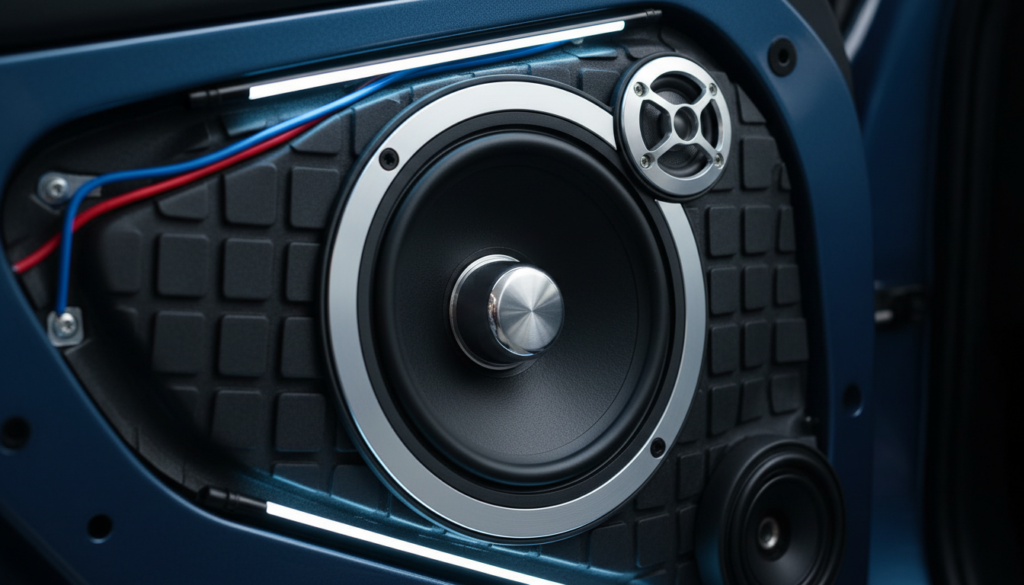
- Use Sound Deadening: Apply Butyl-based sound dampening (like Dynamat) to the metal door skin. This stops the VM speaker from vibrating the metal, which significantly improves bass clarity.
- Phase Checking: Ensure the positive (+) and negative (-) wires are correct. If one speaker is “out of phase,” your bass will disappear due to wave cancellation.
- The Break-In Period: Don’t crank the volume to 100% immediately. We suggest a 20-hour break-in period at moderate volumes to allow the Spider and Surround to loosen up and reach their optimal flexibility.
- Crossover Settings: If using an amp, set your High Pass Filter (HPF) to roughly 80Hz for 6.5-inch speakers. This prevents them from trying to play deep bass frequencies they aren’t designed for, which prevents distortion.
VM Audio vs. The Competition: How Do They Stack Up?
When asking are VM speakers good, it helps to compare them to other brands in the same price bracket.
VM Audio vs. Boss Audio
VM Audio generally uses better materials in their cones and surrounds. While Boss is often the cheapest option on the market, VM Audio offers a slight step up in sound quality and “build feel.”
VM Audio vs. Pioneer (Entry Level)
Pioneer has a more neutral, balanced sound. VM Audio is tuned to be “louder” and “brighter.” If you like crisp highs that cut through road noise, you might actually prefer the VM sound profile over entry-level Pioneer G-Series.
VM Audio vs. Rockville
These two are fierce competitors. Rockville tends to have more robust subwoofers, but VM Audio often wins on the aesthetic design of their coaxial speakers and component kits.
Expert Perspective: The “Diminishing Returns” of Audio
In the world of car audio, you often deal with the law of diminishing returns. To get a 10% improvement over a VM Audio Elux speaker, you might have to spend 200% more money.
For the majority of listeners who just want to enjoy a podcast or a Spotify playlist during their commute, the extra $400 for a boutique brand is unnecessary. VM speakers are good because they hit the “sweet spot” of the value curve. They provide 80% of the performance of high-end brands at roughly 20% of the cost.
Troubleshooting Common Issues with VM Speakers
Even the best budget speakers can run into issues if not handled correctly. Here is how we fix common problems:
- Static or Crackling: This is usually not the speaker. Check your ground wire on the amplifier or look for loose crimp connectors at the speaker terminal.
- Muffled Sound: Ensure no insulation from the door is touching the back of the cone. Also, check that your Treble settings on the head unit aren’t set to negative values.
- Weak Bass: This often happens when a 6.5-inch speaker is installed in a large, unsealed door cavity. Use foam fast rings to seal the gap between the speaker and the door panel.
Final Verdict: Should You Buy VM Speakers?
If you are a professional competitor looking to win SPL (Sound Pressure Level) trophies, VM Audio isn’t for you. However, if you are a DIY enthusiast looking for an affordable weekend project, the answer is a resounding yes.
Are VM speakers good? They are an excellent entry point into the hobby. They are durable, stylish, and offer a significant volume boost over stock equipment. When installed with proper wiring and a modest amplifier, they transform the driving experience from mundane to immersive.
Frequently Asked Questions
Can I run VM speakers off my factory head unit?
Yes, you can. Most VM speakers have a high enough Sensitivity rating to run on the 10-15 watts provided by a factory radio. However, you will notice much better bass and clarity if you upgrade to an aftermarket head unit or a small 4-channel amplifier.
Are VM Audio subwoofers better than their door speakers?
Both are solid for the price, but their subwoofers are particularly well-regarded in the budget community. The VM Audio Shaker subwoofers are known for being resilient and providing a high volume-to-dollar ratio.
What is the warranty like for VM Audio products?
Typically, VM Audio products come with a 1-year limited warranty if purchased through authorized retailers. Because they are budget-friendly, many users find it cheaper to replace a single speaker than to deal with shipping costs for a warranty claim, though the option is there.
Do VM speakers come with mounting hardware?
Most VM Audio coaxial speakers include basic mounting screws and lengths of speaker wire. However, for a professional install, we recommend buying higher-quality 16-gauge oxygen-free copper (OFC) wire and specific vehicle mounting brackets.
How do I prevent my VM speakers from blowing?
The most common cause of “blown” speakers is Distortion (Clipping). This happens when the amplifier or head unit is pushed beyond its limit, sending a “square wave” to the speaker. Set your Gain correctly and listen for any “crunchy” or distorted sounds—if you hear them, turn the volume down immediately.