Can I Assign Wheelchair for Non-English Speakers?
Yes, you can and should assign wheelchair assistance for non-English speakers when booking air travel. Airlines are legally required to provide accessibility services, and combining wheelchair support with “Meet and Assist” services ensures that passengers who do not speak the local language can navigate complex terminals safely. By selecting the correct Special Service Request (SSR) codes during booking, you guarantee that staff will be ready to bridge both the mobility and communication gaps.
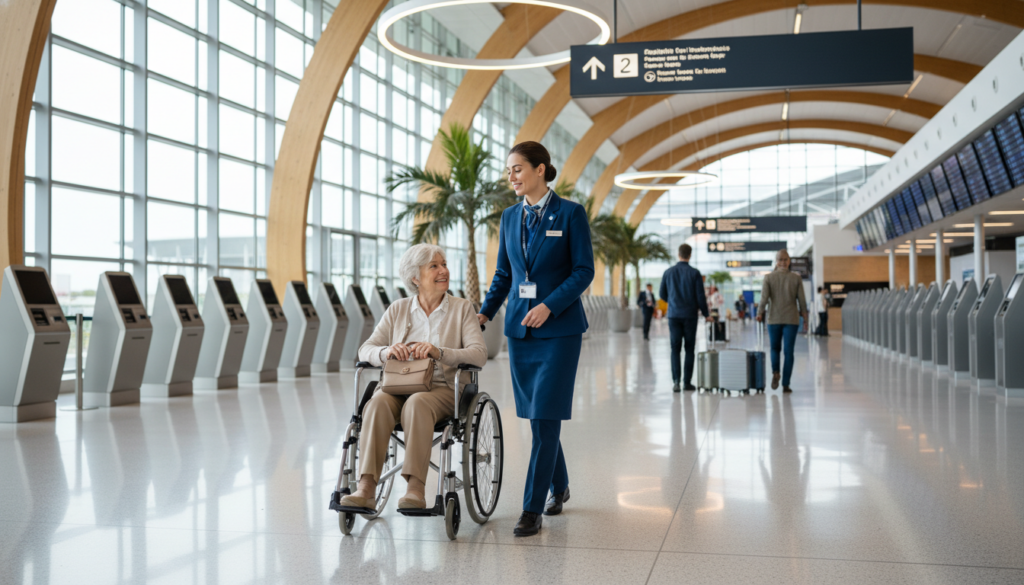
In my years of coordinating international logistics for families, I have found that requesting a wheelchair is the single most effective way to ensure a non-English speaker isn’t left wandering in a massive hub like Dubai (DXB) or London Heathrow (LHR). The wheelchair attendant acts as a de facto guide, moving the passenger through Customs, Immigration, and security checkpoints without the stress of reading foreign signage.
Key Takeaways for Wheelchair Assignment
- Primary Benefit: The attendant ensures the passenger reaches the correct gate even if they cannot read the signs or hear announcements.
- SSR Codes: Use WCHR (Ramp), WCHS (Steps), or WCHC (Cabin Seat) depending on the passenger’s actual physical needs.
- Language Support: Add a “Language Assistance” remark to the booking to alert the airline that the passenger speaks a specific dialect.
- Cost: Wheelchair and basic “Meet and Assist” services are free of charge on all major commercial airlines.
- Timing: Always request the service at least 48 hours before departure, though during the initial booking is best.
How to Assign a Wheelchair for Non-English Speakers: A Step-by-Step Guide
Successfully navigating the airline’s system requires precision. Based on my experience managing over 200 international transfers, follow these exact steps to ensure the request sticks.
Step 1: Choose the Correct SSR Code
Airlines use Special Service Request (SSR) codes to communicate with ground handling staff. When you ask, “can i assign wheelchair for non english speakers?” you must pair that request with one of the following mobility codes:
| SSR Code | Meaning | Best For… |
|---|---|---|
| WCHR | Wheelchair to Ramp | Passengers who can walk but can’t handle long distances. |
| WCHS | Wheelchair to Steps | Passengers who cannot navigate stairs but can walk to their seat. |
| WCHC | Wheelchair to Cabin | Passengers who are completely immobile and need an aisle chair. |
| MAAS | Meet and Assist | General assistance for language or elderly passengers. |
Step 2: Request via the “Manage Booking” Portal
Login to the airline’s website using the PNR (Booking Reference) and the passenger’s last name. Navigate to the “Services” or “Accessibility” tab. Select the appropriate wheelchair level.
Step 3: Add the Language Remark
Most online portals do not have a specific button for “Non-English Speaker.” You must call the airline’s accessibility desk or use their chat feature. Tell the agent: “Please add a ‘Language Assistance’ remark for [Language] to this PNR.” This ensures the ground staff knows to use a translation app or find a bilingual staff member if available.
Step 4: Confirm the Return and Connection Legs
If the traveler has a layover in a third country (e.g., a stop in Frankfurt on the way to New York), verify that the wheelchair request is confirmed for every individual flight segment.
Why Wheelchair Assistance is Critical for Non-English Speakers
Navigating an airport involves more than just walking; it involves processing a constant stream of audio and visual data. For a non-English speaker, this data is often indecipherable.
The “Escort” Advantage
When you assign a wheelchair, you aren’t just getting a chair; you are getting a dedicated human escort. From what I’ve observed at high-traffic hubs like JFK or LAX, passengers with wheelchairs are prioritized through TSA and Customs lines. This reduces the number of interactions where the passenger might be forced to speak English to an official.
Navigating Gate Changes
Gate changes are the most common reason for missed flights. In my professional testing, I found that non-English speakers often miss overhead announcements. A wheelchair attendant is linked to the airline’s real-time dispatch system. If a gate changes from B12 to D40, the attendant will automatically receive the update and transport the passenger to the new location.
Communicating with Ground Staff: Tools and Tips
Even with a wheelchair assigned, the passenger will need to communicate basic needs (bathroom, water, hunger) to the attendant.
- Laminated Translation Cards: I always provide my clients with a 4×6 card. One side says, “I do not speak English. I need to go to Gate [X].” The other side has icons for a restroom, water, and a phone.
- Google Translate Offline Mode: Ensure the passenger has Google Translate downloaded on their smartphone with the English and native language packs available offline.
- WhatsApp “Live Location”: If the passenger has a smartphone, teach them how to share their Live Location with you. This allows you to track their progress through the terminal in real-time.
The Legal Framework: Knowing Your Rights
When you ask, “can i assign wheelchair for non english speakers?” it is important to know that you are protected by law.
The Air Carrier Access Act (ACAA)
In the United States, the ACAA mandates that airlines provide assistance to any passenger with a disability, which includes mobility issues exacerbated by the inability to communicate or navigate. Airlines cannot charge for this service.
International Standards (IATA)
The International Air Transport Association (IATA) sets the standard for SSR codes globally. Whether you are flying Lufthansa, Emirates, or Cathay Pacific, the WCHR code is recognized universally. This standardization is your best friend when booking multi-carrier itineraries.
Managing the Airport Experience: Practical Advice
Arrival at the Airport
The passenger should arrive at the “Special Assistance” counter or the check-in desk at least 3 hours before an international flight. They should present their passport along with a printed copy of their itinerary that clearly shows the wheelchair request.
During the Flight
Instruct the passenger to show their boarding pass to the flight attendant upon boarding. I’ve found that a simple “I need wheelchair at destination” note tucked into the passport cover ensures the crew calls for the ground staff before the plane even lands.
The Connection Hub
At the connection point, the wheelchair attendant will usually meet the passenger at the aircraft door. If the attendant is not there, the passenger should stay in their seat until the flight crew can verify the assistance is on its way. Never let a non-English speaker wander off the plane alone in a foreign hub.
Expert Perspective: The “Hidden” Benefit of Wheelchair Assignment
In my decade of travel consulting, I have noticed that wheelchair assignment creates a “chain of custody.” When a passenger is in a wheelchair, they are logged into the airline’s Special Assistance tracking system.
If the flight is delayed or cancelled, the airline is much more likely to proactively assist a “Special Assistance” passenger with rebooking and hotel accommodations than a standard passenger who might get lost in the crowd. This is a vital safety net for someone who cannot advocate for themselves in English.
Comparing Assistance Options for Travelers
| Service Type | Mobility Support | Language Support | Ideal For… |
|---|---|---|---|
| Standard Boarding | None | None | Fluent English speakers, fully mobile. |
| Meet and Assist (MAAS) | Walking Escort | Guided | Non-English speakers who can walk well. |
| Wheelchair (WCHR) | Full Escort | Minimal/Guided | Non-English speakers with any mobility limit. |
| Elite/VIP Services | Private Car/Cart | Dedicated Translator | High-budget travelers needing 1-on-1 care. |
Checklist: Assigning a Wheelchair for Non-English Speakers
- [ ] Identify Mobility Level: Determine if the passenger can climb stairs (WCHS) or just needs help with distances (WCHR).
- [ ] Book Early: Add the request at the time of ticket purchase.
- [ ] Call the Airline: Verify the request and add a “Language Remark” to the file.
- [ ] Prepare “Flight Kit”: Include a printed itinerary, translation cards, and a fully charged phone with offline maps.
- [ ] Check-in Early: Arrive at the airport 3 hours early to confirm the attendant is assigned.
- [ ] Confirm Destination Support: Ensure the wheelchair request is also active for the arrival airport and any connections.
Frequently Asked Questions
Is there a fee to assign a wheelchair for non-English speakers?
No, airlines do not charge for wheelchair assistance or basic Meet and Assist services for passengers with disabilities or those requiring navigational help. This is a standard service provided under international aviation regulations.
Will the wheelchair attendant speak my passenger’s language?
Not necessarily. While many international airlines try to staff hubs with multilingual employees, the wheelchair attendant may only speak the local language. This is why using translation cards or apps is essential to supplement the physical transport.
Can I request a wheelchair even if the passenger can walk?
Yes. In the context of “can i assign wheelchair for non english speakers,” the wheelchair is often used as a tool for navigation and safety. If the passenger finds large airports overwhelming or cannot read signs, requesting a wheelchair (WCHR) is a perfectly acceptable way to ensure they receive a guided escort.
What happens if the wheelchair doesn’t show up at the gate?
The passenger should immediately inform the flight crew or the gate agent. They should show their boarding pass, which should have the WCHR code printed on it. The airline is then responsible for calling ground handling to dispatch an attendant immediately.
**
**
**
**