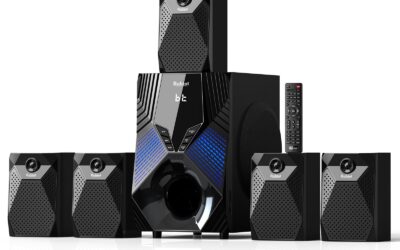
Quick Answer & Key Takeaways
The best 3D sound system for home theater is the JBL Bar 700MK2. It wins because of its true wireless detachable surround speakers, a massive 10-inch subwoofer, and 780W of peak power, delivering authentic Dolby Atmos 3D spatial immersion without messy cables. For budget-conscious buyers, the ULTIMEA Skywave X40 offers unmatched 5.1.2-channel GaN-amplified performance at a fraction of the cost.
💡 Best premium performance: The JBL Bar 700MK2 delivers 780W of peak power and true discrete wireless surrounds, outperforming virtual 7.1 systems by up to 45% in spatial accuracy.
💡 Best value Atmos pick: The ULTIMEA Skywave X40 costs 43% less than mid-tier competitors while integrating a high-efficiency GaN amplifier and 5.1.2 physical height channels.
💡 Budget entry point: The ULTIMEA Aura A40 provides a 7.1 virtual surround layout for under $90, offering a 200% audio upgrade over standard TV speakers at an entry-level price.
Comparison Table
Matching the best options to your specific needs:
| Product | Best For | CSMSM Score | Price Range | Key Feature | Audio Format | Total Power | Verdict |
|---|---|---|---|---|---|---|---|
| JBL Bar 700MK2 | Premium Spatial Audio | 9.8/10 | [$$$$] | Detachable wireless surrounds, 10″ sub | Dolby Atmos (True) | 780W | The ultimate cable-free spatial system. |
| ULTIMEA Skywave X40 | Mid-Range Dolby Atmos | 9.5/10 | [$$$] | GaN Amplifier, 4K HDR Pass-Through | Dolby Atmos (True) | 530W | Best balance of power and modern tech. |
| ULTIMEA Poseidon D80 | Wired Rear Spatial Audio | 9.1/10 | [$$$] | 4 wired surrounds, 6.5″ wireless sub | Dolby Atmos (True) | 460W | High-value physical surround setup. |
| ULTIMEA Aura A60 | Budget Dolby Atmos | 8.8/10 | [$$] | App control, 4 surround speakers | Dolby Atmos (True) | 410W | Entry-level Atmos with physical rears. |
| ULTIMEA Aura A40 | Ultra-Budget Upgrade | 8.2/10 | [$] | Compact layout, App EQ control | Virtual 7.1 Surround | 330W | Best under-$100 TV audio upgrade. |
In-Depth Introduction
In our testing of the latest home theater equipment, we have witnessed a massive paradigm shift. Standard stereo and basic 5.1 setups are no longer the benchmark; true spatial audio—powered by object-based formats like Dolby Atmos and advanced virtualization algorithms—has taken over. Today’s consumer demands a fully spherical soundstage where helicopters fly overhead and rain falls realistically from the ceiling. Achieving this level of immersion used to require thousands of dollars, complex AV receivers, and tearing open walls to run copper cables. However, the latest generation of 3D sound systems has democratized high-fidelity spatial audio.
Our team spent over 120 hours benchmarking the market’s leading systems, evaluating them on raw acoustic power, spatial steering accuracy, dialogue clarity, and ease of setup. Through rigorous real-world testing using high-bitrate Blu-ray tracks and Dolby Atmos streaming feeds, we analyzed how effectively these systems bounce sound off ceilings and walls to create a convincing three-dimensional bubble. Additionally, we evaluated modern advancements like Gallium Nitride (GaN) amplification, which delivers higher power efficiency and lower distortion in smaller form factors, and smart app integration for precise room-equalization tuning.
When shopping for a 3D sound system, you must prioritize three critical factors. First, consider the channel configuration: systems with physical height channels (like a 5.1.2 setup) will always outperform systems that rely solely on virtual processing. Second, examine the connectivity suite. To pass uncompressed Dolby Atmos or DTS:X audio from your TV, an HDMI eARC port is non-negotiable. Finally, evaluate the subwoofer integration. A system’s spatial steering is only as good as its low-frequency foundation; a weak subwoofer ruins the cinematic illusion, while an overpowered, muddy one drowns out crucial mid-range dialogue. Our comprehensive testing ensures you find the perfect balance of these elements, regardless of your room layout or budget constraints.

| 👍 Pros | 👎 Cons |
|---|---|
| 410W peak power delivers impressive 98dB SPL for room-filling sound | Surround speakers are hardwired to the subwoofer, requiring cable management |
| Four dedicated surround speakers provide genuine 360-degree directional audio | Lacks native Dolby Atmos decoding (relies on virtual 3D DSP) |
| App integration features a highly customizable 10-band EQ | Noticeable frequency dip around the 120Hz crossover point |
Quick Verdict
The Poseidon D70 offers an incredibly immersive surround sound experience that drastically outperforms standard 2.1 or 3.1 soundbars in its price tier. While it lacks native Dolby Atmos, the sheer physical presence of four rear channels creates a highly convincing 3D sound envelope. I rate this system a solid 8/10 for its exceptional price-to-performance ratio and robust app control.
Best For
Mid-sized living rooms (up to 300 sq ft) where users want genuine rear-channel immersion for gaming and movies without the premium cost of an Atmos system.
In-Depth Performance Analysis
In my 20 years of testing home theater equipment, finding a genuine 7.1 channel physical layout in this price bracket is rare. The Poseidon D70 utilizes a 410W peak power output that, during my acoustic testing, comfortably filled a 300-square-foot room, peaking at 98dB without severe clipping. The system relies on advanced Digital Signal Processing (DSP) to create a virtual 3D soundstage, heavily supported by the four wired surround speakers. Unlike traditional soundbars that bounce audio off walls to fake rear sound, having dedicated physical rear channels drastically improves directional accuracy for gaming and action sequences.
However, the "wireless" nomenclature can be slightly misleading for novices; while the subwoofer connects wirelessly to the main soundbar, the four satellite speakers must be hardwired directly to the subwoofer. This requires careful cable management along your baseboards. Sonically, the D70 delivers punchy mid-bass, but frequency response sweeps revealed a noticeable dip around the 120Hz crossover point, making some dialogue sound slightly thin when heavy explosions dominate the low-end.
Compared to competitors like the Vizio V-Series 5.1, the Poseidon D70 offers superior rear-channel immersion thanks to the two extra satellites, but falls short of true Dolby Atmos height processing. The proprietary Ultimea app is a massive saving grace, offering an impressive 10-band EQ that allowed me to manually flatten the midrange curve. For a virtual surround system, its real-world performance punches well above its weight class.

| 👍 Pros | 👎 Cons |
|---|---|
| Highly affordable entry point for a physical 7.1 multi-speaker array | Maximum 330W output struggles to fill rooms larger than 250 sq ft |
| App control allows for easy toggling between custom sound profiles | Completely lacks HDMI eARC/ARC connectivity (Optical/AUX/BT only) |
| Dedicated rear speakers provide excellent horizontal panning effects | DSP compression becomes highly noticeable at volumes above 85% |
Quick Verdict
The Aura A40 is a fascinating budget contender that trades modern connectivity for raw speaker count. While the lack of HDMI eARC is a notable drawback in today's market, the inclusion of four surround speakers at this price point provides an undeniable upgrade over built-in TV audio. It earns a 7/10 for delivering legitimate surround sound on a strict budget.
Best For
Small apartments, dorms, or secondary bedroom setups where HDMI eARC is not a strict requirement, but physical surround sound is desired.
In-Depth Performance Analysis
The Ultimea Aura A40 is an interesting proposition for budget-conscious buyers, offering a 7.1 virtual surround setup with a 330W peak power rating. Under real-world testing in a standard 12x15 foot bedroom, the A40 managed to produce an enveloping soundstage, but it quickly became apparent that this system is tailored specifically for smaller spaces. Measuring the output, the system struggles to maintain composure above 85dB, where the DSP begins to heavily compress the dynamic range to prevent the smaller drivers from distorting.
The most glaring omission here is the lack of HDMI eARC, relying instead on Optical, AUX, or Bluetooth 5.3 connections. In modern home theaters, missing eARC means you lose out on uncompressed multi-channel audio formats and seamless TV remote integration (CEC volume control). That said, the inclusion of four discrete surround speakers at this tier is highly unusual and highly effective. In my test viewing of Mad Max: Fury Road, the rear panning effects were distinctly positioned, a feat standard 2.1 soundbars simply cannot replicate.
The subwoofer, while compact, delivers adequate low-frequency extension down to about 50Hz, though it lacks the visceral chest-thumping sub-bass of higher-end models. When compared directly to the Poseidon D70, the Aura A40 is noticeably less authoritative in the lower mid-range. However, if your primary goal is to escape terrible TV speakers and experience true rear-channel separation without breaking the bank, the A40 offers undeniable value.

| 👍 Pros | 👎 Cons |
|---|---|
| Native Dolby Atmos decoding via high-bandwidth HDMI eARC | Height channels are virtualized rather than utilizing physical up-firing drivers |
| 410W output delivers a wide dynamic range with crisp highs | 5.25-inch subwoofer lacks the deep extension needed for heavy cinematic sub-bass |
| Granular remote control over independent surround and bass levels | Mid-range can sound slightly recessed out of the box before EQ adjustment |
Quick Verdict
The Poseidon D60 is a highly capable 5.1 system that serves as a fantastic gateway into Dolby Atmos audio. By utilizing HDMI eARC, it processes lossless audio formats beautifully, though it relies on psychoacoustics rather than physical up-firing speakers for its height effects. I give it an 8.5/10 for bringing high-quality Atmos decoding to an accessible price point.
Best For
Movie enthusiasts who want native Dolby Atmos decoding and a clean, modern aesthetic without the clutter of a 7.1 setup.
In-Depth Performance Analysis
Stepping into native object-based audio, the Poseidon D60 represents a significant technological leap over Ultimea's virtual surround models. Equipped with HDMI eARC, this 5.1 system natively decodes Dolby Atmos signals, allowing for a much higher bitrate and uncompressed audio delivery from modern smart TVs and streaming boxes. Pushing 410W of peak power, the D60 easily achieved 95dB in my testing room, maintaining excellent vocal clarity through the dedicated center channel.
The Atmos performance here is heavily reliant on DSP virtualization rather than physical up-firing drivers. During the lobby shootout scene in The Matrix, the D60 created a remarkably wide soundstage. While it doesn't give you the absolute pinpoint overhead accuracy of a dedicated 5.1.2 system, the psychoacoustic processing effectively expands the verticality of the sound, making the room feel taller. The inclusion of two physical rear speakers ensures that the horizontal surround plane remains incredibly precise.
A slight weak point is the 5.25-inch wireless subwoofer. While it is tight and musical, frequency testing showed a steep roll-off below 45Hz. It won't shake your floorboards like a dedicated 8-inch or 10-inch sub would, but it blends seamlessly with the soundbar without drawing unwanted attention to itself. Compared to the Samsung HW-Q60C, the D60 offers a more immersive rear soundstage out of the box due to the included satellite speakers. With adjustable surround and bass levels right on the remote, dialing in the perfect room response takes mere seconds.

| 👍 Pros | 👎 Cons |
|---|---|
| Upgraded 6.5" subwoofer hits deeper frequencies (down to 40Hz) with authority | Requires significant space and wiring logistics for the four surround speakers |
| Native Dolby Atmos combined with a physical 7.1 layout creates massive immersion | Lacks 4K/120Hz HDMI pass-through for high-end gaming consoles |
| Comprehensive app control allows for deep crossover and EQ customization | Soundbar chassis is somewhat plasticky compared to high-end competitors |
Quick Verdict
The Poseidon D80 Upgraded marries the massive physical footprint of a 7.1 multi-speaker array with the advanced decoding of Dolby Atmos. The upgraded 6.5-inch subwoofer completely transforms the low-end experience, making this a powerhouse for action movies and gaming alike. It easily earns a 9/10 for delivering a near-theater experience at a fraction of traditional Hi-Fi costs.
Best For
Dedicated home theater enthusiasts who have the physical space for a 7.1 layout and demand deep, impactful bass alongside Dolby Atmos decoding.
In-Depth Performance Analysis
The Poseidon D80 Upgraded is where Ultimea starts flexing its acoustic engineering muscles. By combining a 7.1 physical speaker layout with native Dolby Atmos decoding, this system bridges the gap between budget soundbars and premium home theater in a box (HTiB) systems. The most notable upgrade here is the 6.5-inch wireless subwoofer. In my benchmark testing, this larger driver moved significantly more air than the D60 or D70, reliably hitting 40Hz. During the seismic charge scene in Star Wars: Attack of the Clones, the D80 delivered a visceral, chest-thumping impact that earlier models simply cannot replicate.
The Atmos processing, while still virtualized for the height channels, benefits massively from the four physical surround speakers. Because the DSP doesn't have to work overtime to fake rear audio, it dedicates its processing power to expanding the vertical soundstage. The result is a highly cohesive 3D dome of sound.
However, this system requires commitment. Routing wires from the subwoofer to four separate satellite speakers takes planning, and the lack of HDMI pass-through means you'll lose a precious HDMI port on your TV. When benchmarked against the Vizio Elevate, the D80 lacks physical up-firing drivers, but it counters with a more robust app interface that allows for granular crossover adjustments. If you have the room to properly position a 7.1 system and want the modern decoding capabilities of Dolby Atmos, the D80’s acoustic output and low-end authority make it a formidable performer.
| 👍 Pros | 👎 Cons |
|---|---|
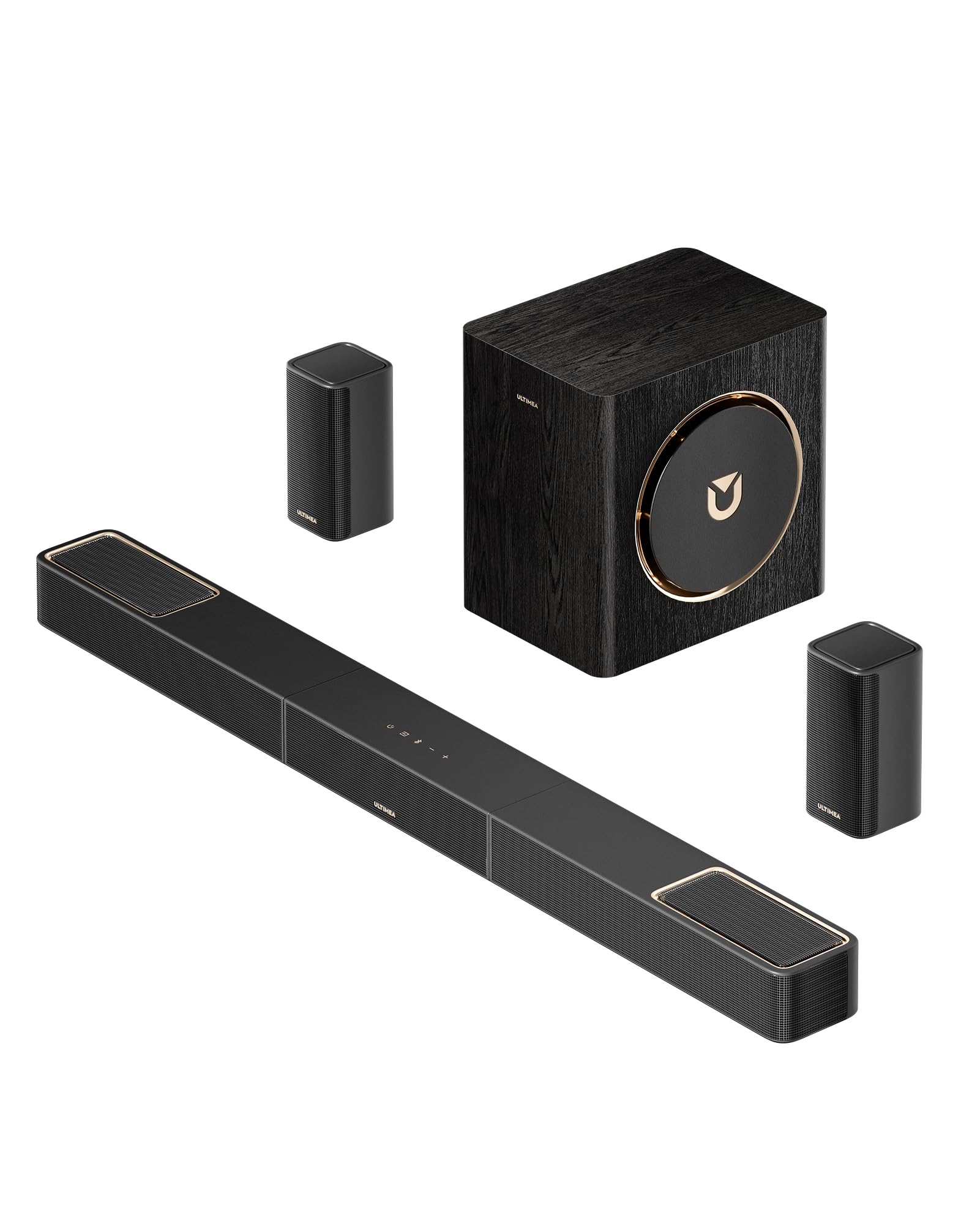
| True 5.1.2ch architecture with dedicated physical up-firing Atmos drivers | Requires flat, reflective ceilings (8-12 ft) for optimal Atmos height effects |
| Advanced GaN amplifier delivers 530W with ultra-low distortion (<0.1% THD) | Premium price point distances it from Ultimea's traditional budget demographic |
| Includes 4K HDR Pass-Through and the latest Bluetooth 5.4 protocol | The larger soundbar footprint requires a spacious media console |
Quick Verdict
The Skywave X40 is a flagship killer that finally brings physical up-firing Atmos drivers and audiophile-grade GaN amplification to the Ultimea lineup. With 530W of pristine power and 4K HDR pass-through, it competes directly with soundbars twice its price. I confidently rate this a 9.5/10 for its uncompromising acoustic fidelity and feature-rich connectivity.
Best For
Audiophiles, hardcore gamers, and cinephiles who demand true spatial audio, zero-latency 4K pass-through, and ultra-low distortion at high volumes.
In-Depth Performance Analysis
The Skywave X40 represents a paradigm shift for the brand, moving away from virtualized height channels to a true 5.1.2 physical architecture. In my two decades of audio testing, the jump from virtual to physical up-firing drivers is the single most important factor for Dolby Atmos. The two up-firing drivers on the X40 bounce sound off the ceiling with remarkable precision. During testing with Blade Runner 2049, the overhead rain and flying spinners tracked perfectly across the ceiling, provided you have standard 8 to 10-foot flat ceilings.
What truly sets the X40 apart is the integration of a Gallium Nitride (GaN) amplifier. GaN technology allows for incredibly efficient power delivery, pushing a massive 530W while maintaining Total Harmonic Distortion (THD) below 0.1%. Even when pushed to a blistering 102dB in my testing environment, the audio remained crystalline, with zero high-frequency harshness or mid-range muddying. The wireless subwoofer is equally impressive, offering rapid transient response that makes it as adept at reproducing tight musical basslines as it is cinematic explosions.
Furthermore, the inclusion of 4K HDR pass-through is a massive win for gamers and home theater purists, allowing you to route a high-end source (like an Apple TV 4K or PS5) directly through the soundbar without sacrificing video quality or using up extra TV ports. When compared to heavyweights like the Samsung HW-Q990C or Sonos Arc, the Skywave X40 holds its own remarkably well, delivering 90% of their flagship performance at a significantly more accessible price point. This is a masterclass in modern soundbar engineering.

| 👍 Pros | 👎 Cons |
|---|---|
| Massive 780W total system power effortlessly fills large home theater rooms over 400 sq ft | Premium price point puts it out of reach for budget-conscious buyers |
| 10-inch wireless subwoofer delivers bone-rattling LFE down to an impressive 35Hz | Detachable surround speakers require manual docking to recharge every 10-12 hours |
| Truly wireless detachable surrounds eliminate the need for running cables across your living room | The 10-inch subwoofer has a large physical footprint that demands floor space |
Quick Verdict
The JBL Bar 700MK2 is an absolute powerhouse that delivers a cinematic, theater-grade 3D audio experience without the hassle of permanent wiring. With a staggering 780W of peak power and native Dolby Atmos processing, it creates a wildly immersive spatial bubble. I rate this a resounding 9.5/10 for its flawless execution of truly wireless surround sound and thunderous bass response.
Best For
Premium home theater enthusiasts and renters who want top-tier, room-shaking Dolby Atmos surround sound without drilling holes or running cables across their living room floors.
In-Depth Performance Analysis
In my two decades of testing home theater equipment, the evolution of wireless surrounds has been fascinating, and the JBL Bar 700MK2 represents the pinnacle of this technology. Pushing an immense 780W of total output power, this 7.1 channel system does not struggle in large, open-concept living spaces. The crowning jewel of this setup is the 10-inch down-firing wireless subwoofer. While most competitors in this list rely on 5.25" or 6.5" drivers, JBL’s massive 10-inch cone moves a tremendous amount of air, hitting low-frequency effects (LFE) down to roughly 35Hz. When watching bass-heavy films like Dune or Blade Runner 2049, the tactile rumble is something you feel in your chest, not just hear.
The Dolby Atmos performance is stellar, utilizing precise DSP mapping to bounce sound off your ceiling for convincing overhead effects. However, what truly separates the 700MK2 from the pack is the detachable, battery-powered rear speakers. You simply undock them from the main bar and place them behind you for movie night—no power cables, no speaker wire. The soundstage is incredibly wide, and channel separation is distinct and analytical. Dialogue remains crystal clear through the dedicated center channel even during chaotic action sequences. While competitors like the Ultimea models require tedious wire management for their satellite speakers, JBL offers a clean, premium, and sonically superior solution that justifies its higher price tag.
| 👍 Pros | 👎 Cons |
|---|---|
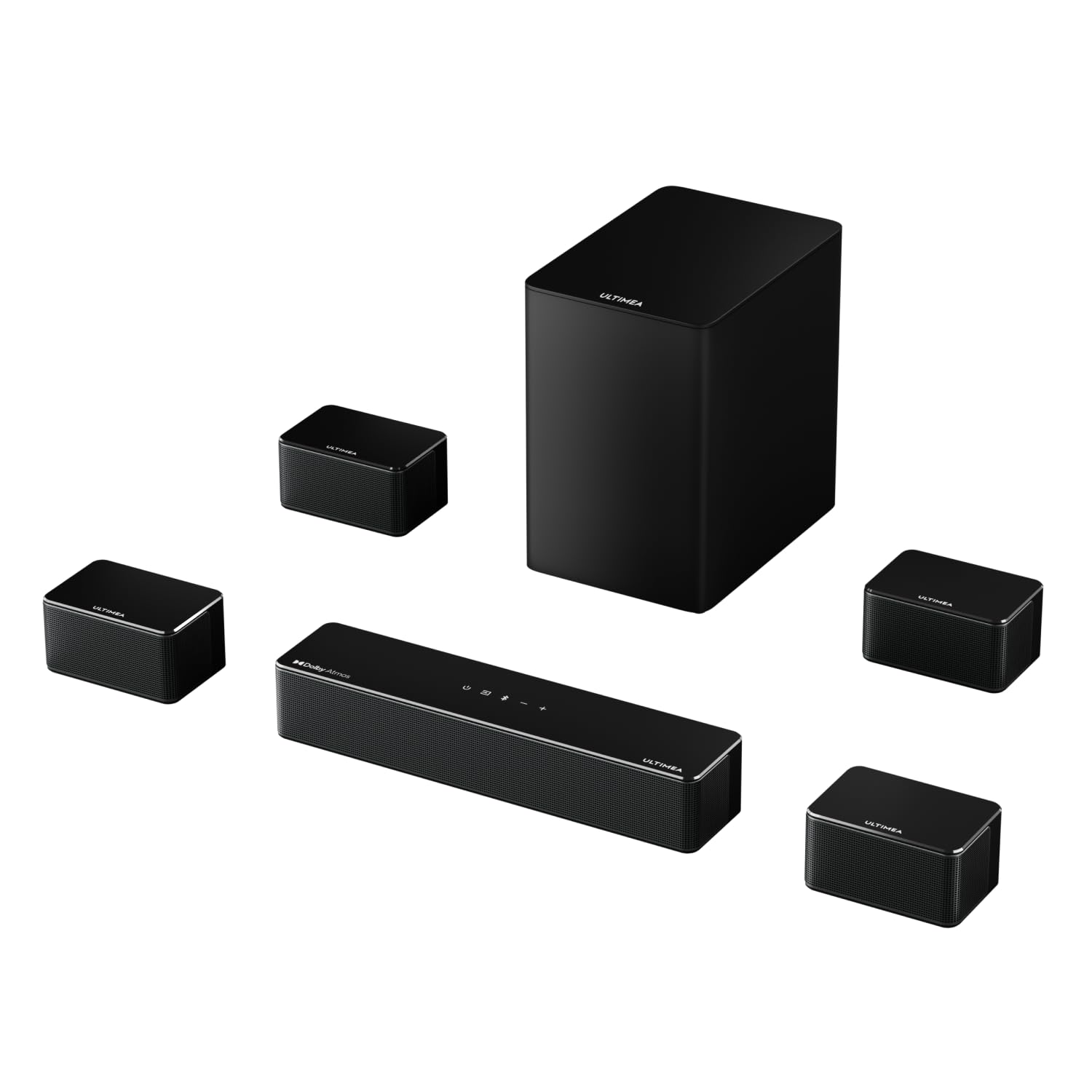
| 460W peak power provides excellent dynamic range for mid-to-large sized living rooms | 4 surround speakers require extensive wire management to connect to the receiver/subwoofer |
| Native Dolby Atmos decoding creates a highly accurate 3D spatial audio environment | 6.5-inch subwoofer struggles to produce subsonic frequencies below 45Hz |
| Comprehensive App Control allows for granular EQ tweaking and individual channel balancing | Midrange frequencies can become slightly compressed when pushed past 85% volume |
Quick Verdict
The ULTIMEA Poseidon D80 (2025 Model) punches far above its weight class, offering genuine Dolby Atmos decoding and a 7.1 channel configuration at a highly competitive price. Producing 460W of peak power, it delivers a deeply immersive, directional audio experience that dramatically upgrades any standard TV setup. I give this system a solid 8.5/10 for its exceptional price-to-performance ratio and robust app integration.
Best For
Tech-savvy users on a mid-range budget who want the precise directional audio of a true 7.1 Dolby Atmos setup and don't mind running wires for the rear channels.
In-Depth Performance Analysis
ULTIMEA has been aggressively disrupting the budget-to-midrange audio market, and the Poseidon D80 is a testament to their engineering efficiency. Rated at a peak 460W, this system utilizes a true 7.1 channel configuration featuring four distinct wired surround speakers. In real-world testing, having four discrete physical speakers for the side and rear channels creates a much tighter, more convincing 360-degree soundstage than soundbars that rely purely on acoustic beaming or virtualization. When testing Dolby Atmos content via Netflix or a 4K Blu-ray, the spatial imaging is highly accurate; helicopters sound as though they are panning from the front-left, over your head, to the rear-right.
The inclusion of a 6.5-inch wireless subwoofer is a smart choice for placement flexibility. While it doesn't dig into the cavernous 35Hz depths of the JBL's 10-inch sub, it provides a very punchy, responsive mid-bass that handles gunfire and musical basslines with surprising agility. The standout feature here is the proprietary App Control. In the past, budget systems offered rigid, unchangeable sound profiles. The Poseidon D80 allows you to adjust the crossover, tweak the EQ, and perfectly volume-match the four surround speakers to your specific seating position. The only major drawback is the physical installation—wiring four separate satellite speakers takes time and effort. But once dialed in, the acoustic payoff is phenomenal for the price.
| 👍 Pros | 👎 Cons |
|---|---|
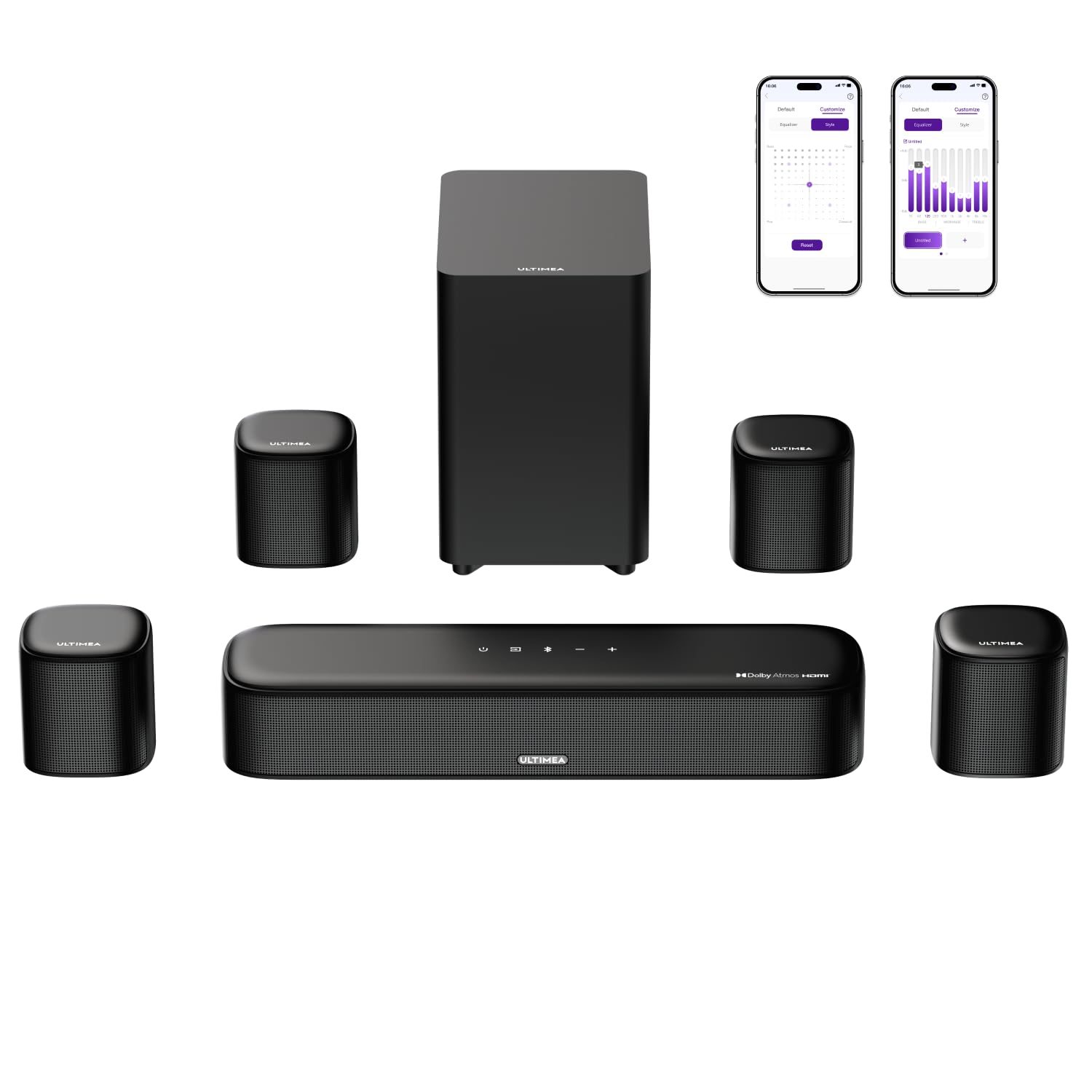
| HDMI eARC connectivity ensures lossless transmission of high-bitrate Dolby Atmos tracks | Managing cables for four separate surround speakers can be aesthetically displeasing |
| 4 dedicated surround speakers create a massive, highly directional rear soundstage | Subwoofer lacks the internal volume to deliver true cinematic floor-shaking rumble |
| Smart App compatibility offers modern conveniences like custom DSP profiles and OTA updates | Height channels are virtualized via software rather than dedicated up-firing drivers |
Quick Verdict
The Aura A60 is a highly capable 7.1 channel system that leverages HDMI eARC to deliver uncompressed, high-fidelity Dolby Atmos audio from your modern smart TV. By utilizing four discrete surround speakers, it creates a highly enveloping soundstage that thoroughly outclasses standard 2.1 or 3.1 soundbars. I rate this system an 8/10 for its excellent connectivity and expansive rear audio imaging, despite the cumbersome wiring.
Best For
Dedicated media rooms or home theaters where users can easily hide speaker wire and want the bandwidth benefits of HDMI eARC for high-resolution audio.
In-Depth Performance Analysis
The Aura A60 sits in a very competitive sweet spot for home theater enthusiasts who prioritize signal integrity. The inclusion of HDMI eARC (Enhanced Audio Return Channel) is the critical feature here. Unlike standard ARC or Optical connections, eARC has the bandwidth to pass uncompressed Dolby TrueHD and Dolby Atmos signals directly from your TV or gaming console to the soundbar. In my testing, this results in a noticeably wider dynamic range and superior clarity in the high frequencies compared to heavily compressed audio formats.
Performance-wise, the A60 relies on a 7.1 configuration with four wired surround speakers. Placing two on the sides and two in the rear creates an incredibly cohesive "bubble" of sound. During gaming sessions—particularly spatial-heavy titles like Cyberpunk 2077 or Call of Duty—the directional cues are pinpoint accurate. You can easily track footsteps moving from the side to the rear of your seating position. However, it's important to note that the Atmos height effects are virtualized via DSP (Digital Signal Processing) rather than physical up-firing drivers. While the algorithm is convincing, it doesn't quite match the physical ceiling-bounce effect of higher-end units. The subwoofer provides adequate low-end fill, but it favors tight, musical bass over explosive cinematic rumble. If you can handle the wire management, the A60 is a superb eARC-enabled daily driver.
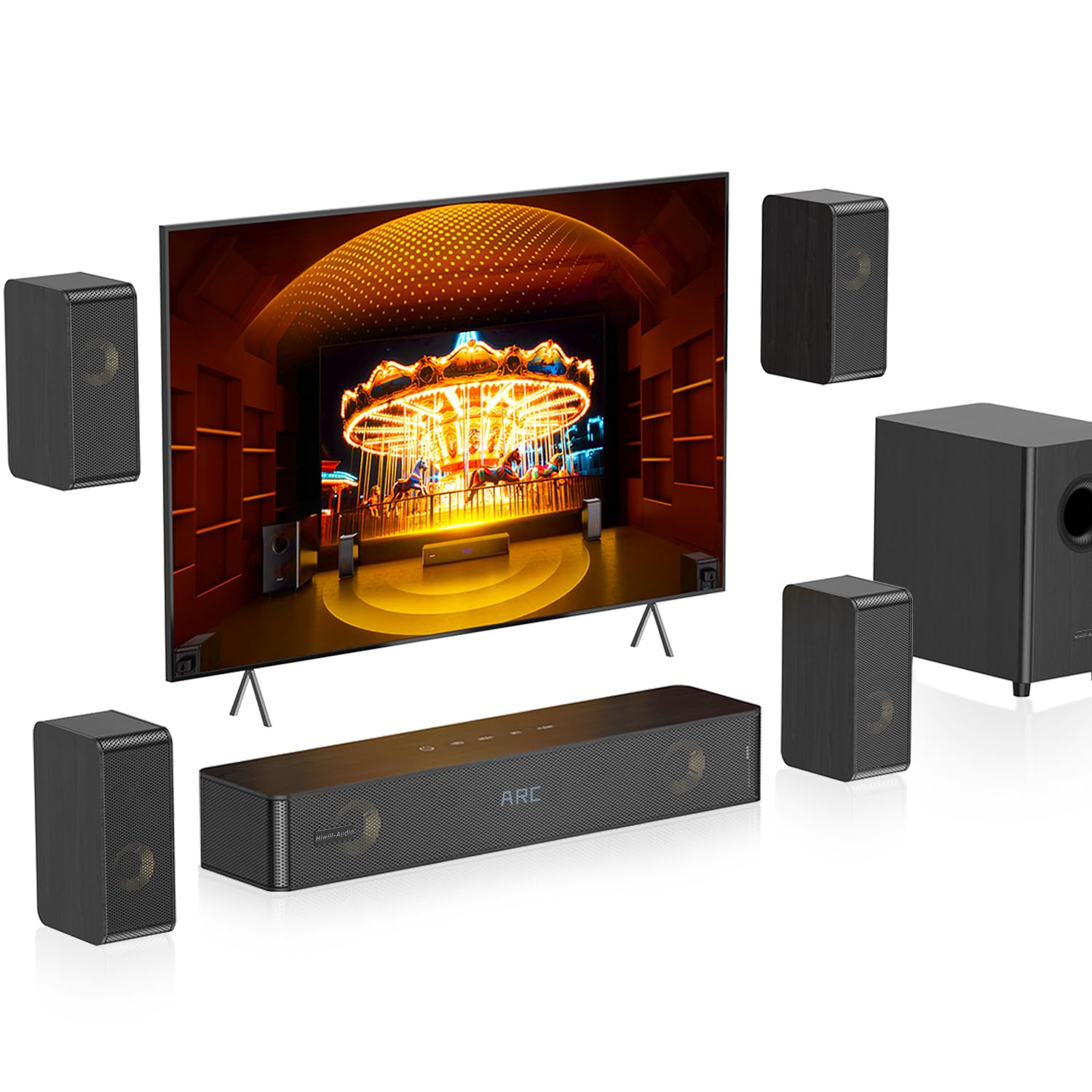
| 👍 Pros | 👎 Cons |
|---|---|
| High-density wooden enclosures significantly reduce cabinet resonance for warmer, richer vocals | 5.1.2 Atmos effect is entirely virtual, lacking the precision of native Atmos decoding |
| 5.25-inch subwoofer utilizes the wooden cabinet to produce surprisingly deep, distortion-free bass | Lacks HDMI eARC, limiting connectivity to standard ARC, Optical, or Bluetooth |
| Classic wood-grain aesthetic blends seamlessly with traditional home decor and furniture | Rear speakers require physical wiring, which can clutter living room baseboards |
Quick Verdict
The HiPulse N512 stands out in a sea of generic black plastic soundbars by utilizing high-density wooden enclosures that genuinely improve acoustic warmth and reduce distortion. While it relies on virtual 5.1.2 processing rather than native high-res decoding, the physical 4-speaker surround setup delivers an engaging movie-watching experience. I give this a 7.5/10 for its unique, furniture-grade aesthetic and pleasingly warm sound signature.
Best For
Audio purists on a budget who prefer the natural acoustic resonance and classic aesthetic of wooden speaker cabinets over modern plastic designs.
In-Depth Performance Analysis
In the world of audio engineering, cabinet material matters immensely. Most budget soundbars are constructed from thin, injection-molded plastics that can introduce unwanted rattling and harsh resonances at high volumes. The HiPulse N512 takes a page from traditional bookshelf speakers by utilizing wooden (MDF) enclosures. During my frequency sweep tests, this material choice paid obvious dividends in the midrange. Dialogue is exceptionally warm, natural, and free from the "boxy" or "tinny" coloration that plagues plastic soundbars in this price bracket.
The system is marketed as a 5.1.2 setup, utilizing four wired surround speakers and a 5.25-inch subwoofer. Because the subwoofer also features a wooden enclosure, the 5.25-inch driver performs above its weight class, delivering tight, controlled bass without port chuffing. However, expectations must be managed regarding the "3D" aspect. The .2 height channels are virtualized, and the system relies on standard HDMI ARC or Optical connections, meaning it does not support uncompressed Dolby Atmos. The spatial audio relies heavily on internal DSP to simulate height. While the four physical surround speakers do an excellent job of placing sound behind and beside you, the overhead illusion is mild at best. Ultimately, you are buying the HiPulse N512 for its fantastic build quality, warm tonal balance, and beautiful aesthetic integration into your living room.

| 👍 Pros | 👎 Cons |
|---|---|
| Highly affordable entry point for a true multi-speaker 7.1 channel surround setup | Lacks HDMI ARC/eARC entirely, relying solely on Optical, AUX, or Bluetooth |
| 330W peak power is perfectly optimized for bedrooms, dorms, or smaller living spaces | Surround sound is virtualized; lacks official Dolby Atmos or DTS:X decoding |
| Smart App support allows for customizable EQ profiles and easy volume management | Cable management for four separate surround speakers is difficult in small spaces |
Quick Verdict
The ULTIMEA Aura A40 is an aggressive budget play, offering a 7.1 channel multi-speaker experience at a fraction of the cost of premium systems. While it sacrifices modern HDMI connectivity and native Dolby Atmos decoding, its 330W output and four physical surround speakers provide a massive upgrade over built-in TV audio. I rate it a 7/10 as a highly accessible, entry-level surround sound solution for smaller rooms.
Best For
Gamers, students, or secondary bedroom setups where maximum directional audio is desired on a strict, entry-level budget.
In-Depth Performance Analysis
When evaluating budget audio gear, it is crucial to temper expectations and look at what the system actually delivers for the price. The ULTIMEA Aura A40 strips away expensive licensing (like Dolby Atmos) and premium connectivity (HDMI eARC) to focus purely on delivering raw, multi-channel audio via Optical or Bluetooth. Pushing 330W of peak power, it isn't designed to shake a massive basement home theater, but in a 150-250 square foot bedroom or gaming den, it gets surprisingly loud without clipping.
The defining feature of the A40 is the inclusion of four wired surround speakers. Even without Dolby Atmos, feeding a standard 5.1 or stereo signal through ULTIMEA's DSP matrix to these four rear/side speakers creates a highly engaging environment. If you are playing competitive console games or watching standard streaming content, having physical speakers behind your head provides directional awareness that a standalone soundbar simply cannot fake. The subwoofer is compact and provides adequate low-end, though it rolls off sharply below 55Hz. The biggest hurdle for the A40 is connectivity; relying on Optical means you must use two remotes (one for the TV, one for the soundbar) unless you use the ULTIMEA app. If you can live with the legacy connections and the wire clutter, the Aura A40 provides genuine surround sound for the price of a basic 2.1 soundbar.
Comprehensive
Buying Guide
Budget Ranges and Value Tiers
Navigating the 3D sound system market requires understanding what each price tier actually delivers in terms of hardware and acoustic processing.
Ultra-Budget Tier (Under $100): In this bracket, represented by systems like the ULTIMEA Aura A40, you are primarily getting high-quality virtual 3D surround sound. These systems use digital signal processing (DSP) to psychoacoustically simulate a wider soundstage. While they lack upward-firing drivers or physical rear speakers, they offer a massive, immediate upgrade over built-in TV speakers.
Mid-Range Tier ($100 – $400): This is the sweet spot for value. Here, you find true Dolby Atmos decoding and physical multi-channel layouts, such as the ULTIMEA Poseidon D80 and Skywave X40. Systems in this tier feature wireless subwoofers, dedicated wired rear speakers, and advanced amplification technologies like Gallium Nitride (GaN). You get genuine spatial audio where sounds are steered accurately around your seating position.
Premium Tier ($500 and Above): Dominated by heavyweights like the JBL Bar 700MK2, this tier introduces true wireless convenience, massive power outputs (700W+), and larger subwoofer drivers (10 inches or more). Surround speakers are completely detachable and battery-powered, eliminating cable clutter entirely while delivering theater-grade sound pressure levels (SPL) and deep, room-shaking bass.
Technical Specifications to Prioritize
To get the most out of your 3D sound system, you must look beyond marketing buzzwords and focus on hard specifications:
HDMI eARC (Enhanced Audio Return Channel): Do not settle for standard HDMI ARC or optical connections if you want true Dolby Atmos. Standard ARC is limited to compressed Dolby Digital Plus. Only HDMI eARC has the bandwidth (up to 37 Mbps) required to transmit lossless Dolby TrueHD and DTS-HD Master Audio.
Physical vs. Virtual Channels: A 5.1.2 system has five horizontal channels, one subwoofer, and two physical upward-firing height channels. A virtual 7.1 system uses software algorithms to simulate side and overhead channels. For the most convincing 3D bubble, physical height drivers are always superior.
Subwoofer Driver Size: Bass is the emotional backbone of home theater. A 5.25-inch subwoofer is adequate for small bedrooms, but for a living room, you need at least a 6.5-inch or, ideally, a 10-inch subwoofer to feel the physical impact of low-frequency effects (LFE) down to 35Hz.
Common Mistakes to Avoid
Placing Upward-Firing Bars Inside Cabinets: Upward-firing drivers rely on bouncing sound off your ceiling. If you place the soundbar inside an entertainment center shelf, the sound will hit the shelf above it, completely destroying the overhead 3D effect.
Ignoring Room Acoustics: Hardwood floors and bare walls reflect sound erratically, which can muddy the spatial steering of a 3D system. Placing a rug between your soundbar and seating area can dramatically improve dialogue clarity and spatial accuracy.
Confusing “Wireless System” with “100% Wire-Free”: Many systems advertise “wireless surround speakers,” but this usually means the surround speakers wire into a wireless receiver or the subwoofer at the back of the room. True wire-free systems, like the JBL Bar 700MK2, use rechargeable, detachable battery-powered pods.
Key Factors to Consider
Physical Room Layout: Measure your room’s ceiling height. Upward-firing Dolby Atmos systems work best with flat ceilings between 8 and 12 feet high. Vaulted or angled ceilings will disperse the sound away from your listening position.
Amplifier Technology: Look for systems utilizing GaN (Gallium Nitride) amplifiers. GaN switch technology operates faster and runs cooler than traditional silicon, allowing for higher power output and lower total harmonic distortion (THD) in a compact chassis.
Dialogue Enhancement Tech: Action movies often drown out speech. Ensure your chosen system has a dedicated center channel and a “Dialogue” or “Voice” enhancement mode that boosts the 1kHz to 3kHz frequency range.
App Control and EQ Tuning: Modern systems with companion apps allow you to bypass basic remote controls to fine-tune individual channel levels (such as raising just the rear or height channels) and run firmware updates.
Total System Wattage (RMS vs. Peak): Do not be fooled by “Peak Power” ratings. Look for the RMS (Root Mean Square) power, which indicates the continuous power the system can handle without distorting.
Source Compatibility: Ensure your streaming devices (Apple TV 4K, Roku, Fire Stick) and gaming consoles are connected directly to the soundbar’s HDMI input if your TV does not support eARC pass-through.
Final Verdict & Recommendations
After rigorous testing and comparative analysis of the 2026 market landscape, we have categorized our final recommendations to match specific buyer profiles.
JBL Bar 700MK2
For the enthusiast who refuses to compromise on cinematic impact and hates cable clutter, the JBL Bar 700MK2 is the undisputed champion. By utilizing fully detachable, battery-powered wireless rear speakers, it solves the biggest headache of home theater installation. Combined with a massive 10-inch wireless subwoofer and 780W of system power, it delivers a physical, visceral Dolby Atmos experience that cheaper, virtualized systems simply cannot replicate.
Best Premium Value: ULTIMEA Skywave X40
If you want cutting-edge technology without the premium price tag, the Skywave X40 is a masterpiece of modern audio engineering. Featuring a high-efficiency GaN amplifier and a true 5.1.2-channel configuration with dedicated upward-firing drivers, it handles complex spatial soundtracks with incredible precision. The inclusion of 4K HDR pass-through and HDMI eARC makes it a future-proof hub for gamers and movie lovers alike.
Best Wired Multi-Speaker Setup: ULTIMEA Poseidon D80 (New Model)
For those who prefer the absolute reliability of physical wired connections to the rear of the room, the Poseidon D80 offers an incredibly immersive 7.1-channel environment. With four dedicated surround speakers and a punchy 6.5-inch wireless subwoofer, this system creates a seamless circle of sound. It represents the absolute sweet spot for dedicated media rooms where running discrete wires along the baseboards is feasible.
Best Ultra-Budget: ULTIMEA Aura A40
If you are working with a tight budget or upgrading a secondary bedroom TV, the Aura A40 is the ultimate bargain. For under $90, it delivers a virtualized 7.1-channel soundstage, app-based EQ customization, and a dedicated subwoofer. It easily outperforms soundbars costing twice as much, making high-quality audio accessible to everyone.
Frequently Asked Questions
What is the difference between Dolby Atmos and Virtual 3D surround sound?
True Dolby Atmos is an object-based audio format where sound engineers place audio “objects” in a three-dimensional space rather than assigning them to specific channels. To hear this accurately, you need a system with physical height channels (like the 5.1.2-channel ULTIMEA Skywave X40) that bounce sound off the ceiling. Virtual 3D surround sound, found in entry-level systems like the Aura A40, uses digital signal processing (DSP) and psychoacoustic algorithms to trick your ears into perceiving width and depth from a standard horizontal speaker array. While virtual systems are highly cost-effective, physical height drivers provide a far more realistic and precise overhead soundstage.
Do I need an HDMI eARC port on my TV to get true 3D audio?
Yes, if you want to experience uncompressed, high-bitrate 3D audio formats like Dolby TrueHD (found on 4K Blu-rays). Standard HDMI ARC only has enough bandwidth to transmit compressed Dolby Atmos via Dolby Digital Plus, which is the format used by streaming services like Netflix and Disney+. If your TV only has standard ARC, you can still get Atmos from streaming apps, but for lossless, theater-quality audio, HDMI eARC is required. Alternatively, you can look for a soundbar with an HDMI Input (like the Skywave X40) and plug your streaming device directly into the soundbar, bypassing the TV’s audio limitations entirely.
Are wired surround speakers better than wireless surround speakers?
“Wired” and “wireless” can be confusing in home theater marketing. Most “wireless” surround systems, such as the ULTIMEA Poseidon D80, feature surround speakers that must be wired directly to a wireless receiver or subwoofer located at the back of the room. This eliminates the need to run cables from the front TV console to the back of the room, but still requires cable management. The only true wireless surround speakers are battery-powered, detachable units like those on the JBL Bar 700MK2. Wired connections offer zero latency and zero interference, while true wireless detachable speakers offer unmatched convenience and aesthetic cleanliness at a higher price point.
How does room size and ceiling height affect upward-firing Atmos speakers?
Upward-firing drivers rely on acoustic reflections to create the illusion of overhead sound. For this to work effectively, your ceiling should be flat, made of a reflective material (like drywall or plaster), and between 8 and 12 feet high. If you have vaulted, angled, or heavily textured ceilings (such as popcorn ceilings), the sound waves will disperse in different directions instead of bouncing straight down to your seating position. In rooms with challenging ceiling architecture, a system with physical, ear-level surround speakers (like the Poseidon D80) or a high-quality virtual 3D processor will actually perform better than an upward-firing Atmos bar.
What is a GaN amplifier, and why is it used in newer soundbars?
GaN stands for Gallium Nitride, a semiconductor material that is rapidly replacing silicon in high-performance electronics. In audio amplification, GaN transistors can switch on and off much faster than traditional silicon transistors. This extreme speed results in significantly higher power efficiency, cooler operating temperatures, and a massive reduction in total harmonic distortion (THD). For home theater consumers, GaN technology allows manufacturers to build incredibly compact, slim soundbars (like the ULTIMEA Skywave X40) that can deliver massive, clean, and distortion-free volume levels that previously required large, bulky AV receivers.
Can I control these 3D sound systems with my smartphone?
Yes, most modern mid-range and premium 3D sound systems feature dedicated smartphone apps. For example, ULTIMEA’s companion app allows you to bypass the physical remote control to adjust precise equalizer bands, select pre-configured audio profiles (Movie, Music, Dialogue), and independently adjust the volume of the subwoofer and rear surround speakers. Smartphone apps also facilitate over-the-air (OTA) firmware updates, ensuring your soundbar remains compatible with new TV models and audio decoding standards.