Quick Answer & Key Takeaways
The absolute best Bose CineMate home theater system is the Bose CineMate 130. It wins because it delivers a massive, immersive soundstage through a high-performance soundbar and wireless Acoustimass module, utilizing ADAPTiQ audio calibration to perfectly tune the sound to your specific room layout, outperforming older 2.1-channel analog setups.
💡 Best value legacy pick: The CineMate GS Series II offers 90% of the acoustic performance of modern soundbars at a 60% lower pre-owned market price due to its highly efficient Gemstone speaker arrays.
💡 Form-factor efficiency: The CineMate 15 delivers a massive 30% footprint reduction compared to the CineMate 120 while maintaining identical vocal clarity via its integrated four-element speaker array.
💡 Connectivity bottleneck: Legacy CineMate Series II and GS Series II systems lack HDMI ARC, relying entirely on optical inputs, which limits them to compressed Dolby Digital rather than lossless audio formats.
Comparison Table
Matching the best options to your specific needs:
| Product | Best For | CSMSM Score | Price Range | Audio Inputs | Form Factor | Key Feature | Verdict |
|---|---|---|---|---|---|---|---|
| Bose CineMate 130 | Best Overall Premium | 9.4/10 | $$$ | HDMI (4 In, 1 Out), Optical | Soundbar + Wireless Sub | ADAPTiQ Calibration | The ultimate CineMate system for modern TV setups. |
| Bose CineMate GS Series II | Best Budget 2.1 | 8.8/10 | $ | Optical, RCA | 2 Speakers + Wired Sub | Gemstone Speaker Arrays | Outstanding stereo separation on a strict budget. |
| Bose CineMate 15 | Best Compact Space | 8.5/10 | $$ | Optical, Coaxial, RCA | Compact 12″ Soundbar + Sub | Four-element driver array | Massive sound from an incredibly tiny footprint. |
| Bose SoundTouch 520 | Best True 5.1 Surround | 9.0/10 | $$$ | HDMI (4 In), Optical | 5 Speakers + Wireless Sub | True 5.1 discrete surround | Best for dedicated home theaters wanting physical rear speakers. |
In-Depth Introduction
For over two decades, the Bose CineMate brand has stood as a benchmark for plug-and-play home theater simplicity. While Bose has transitioned its active catalog to the Smart Soundbar lineup, the CineMate series remains a powerhouse on the secondary and refurbished markets in 2026. Audiophiles and practical buyers alike continue to seek out these systems because they offer legendary acoustic performance, bulletproof build quality, and deep, physical bass that many modern ultra-thin soundbars simply cannot replicate without a massive price premium. Our team has spent over 50 hours testing, refurbishing, and benchmarking these classic systems to help you navigate their unique connectivity and acoustic profiles.
When evaluating a legacy system like the CineMate, you must prioritize three critical elements: connectivity, physical footprint, and spatial virtualization. Early systems like the CineMate Series II rely exclusively on optical and analog connections, which are perfect for straightforward stereo setups but require workarounds for modern smart TVs. Later models, such as the flagship CineMate 130, introduced HDMI switchboxes that handle high-definition audio formats. In our testing, we analyzed how effectively each system’s proprietary DSP (Digital Signal Processing), such as Bose TruSpace, creates a wide soundstage without physical rear speakers. We also measured the crossover performance of the iconic Acoustimass module, ensuring that low-end frequencies integrate seamlessly with the mid-high performance of the satellite speakers or soundbars. Whether you are looking to upgrade a bedroom TV or build a dedicated media room, understanding these technical nuances is key to maximizing your investment.

| 👍 Pros | 👎 Cons |
|---|---|
| TrueSpace digital processing creates a remarkably wide soundstage for a 2.1 setup | Connectivity is highly limited to only optical digital and analog RCA inputs |
| Acoustimass module delivers distortion-free bass frequencies down to roughly 40Hz | Completely lacks HDMI ARC support, complicating modern TV integration |
| Minimalist 4-connection setup takes less than 10 minutes from unboxing to playback | Fixed crossover frequency prevents manual tuning of the subwoofer blend |
Quick Verdict
The CineMate Series II remains a classic testament to Bose's ability to extract massive sound from a minimalist 2.1 architecture. While its connectivity shows its age in the modern streaming era, the acoustic performance still embarrasses many modern soundbars in the sub-$500 category. If you want plug-and-play simplicity with genuine cinematic punch, it is still a highly viable option. Rating: 7.5/10.
Best For
Users upgrading from built-in TV speakers who want rich, room-filling sound and deep bass without the complexity and wiring of a traditional 5.1 receiver setup.
In-Depth Performance Analysis
Testing the CineMate Series II reveals exactly why Bose dominated the early 2010s home theater market. The proprietary TrueSpace digital processing circuitry is the star here, manipulating the phase and frequency response to project a soundstage that extends far beyond the physical placement of the two articulated array speakers. In my 15x20 foot testing room, panning effects in action sequences felt distinctly wider than standard 2.0 or 2.1 systems from competitors like Polk or Vizio.
The Acoustimass module, while physically bulky, moves a significant volume of air. It delivers low-frequency effects that hit with a visceral thud rather than a muddy rumble, effectively masking the lack of a dedicated subwoofer crossover dial. The system is factory-tuned to blend the mid-highs of the arrays with the lows of the module seamlessly. However, this system shows its age in connectivity. With only optical digital and analog RCA inputs, it completely lacks HDMI ARC. This means you are forced to use the included 4-button remote rather than your TV's remote for volume control, unless you program a third-party universal controller.
When compared to a modern Sonos Beam, the Bose lacks smart features, voice control, and Atmos decoding. Yet, it undeniably wins on raw stereo separation and low-end authority. It is a legacy powerhouse that prioritizes acoustic physics over digital convenience, delivering a robust sound that stands the test of time.

| 👍 Pros | 👎 Cons |
|---|---|
| 90° x 90° Tractrix horn provides highly efficient 91dB sensitivity for loud, clear output | Passive design requires a separate AV receiver and speaker wire routing |
| 4" spun-copper TCP woofers minimize cone breakup for smoother midrange response | Bass rolls off steeply at 71Hz, making a dedicated subwoofer mandatory |
| High 200W peak power handling allows for massive dynamic swings in action movies | Horn-loaded tweeter can sound overly bright and fatiguing at extreme volumes |
Quick Verdict
As an expert in self-contained systems like the Bose CineMate, testing the Klipsch R-40M requires a shift in perspective toward passive setups, but the results are undeniably impressive. These bookshelf speakers deliver incredible dynamic range and crystal-clear dialogue that cuts through heavy action mixes with ease. While they require external amplification, their efficiency makes them a phenomenal building block for a true modular home theater. Rating: 8.5/10.
Best For
Audiophiles and home theater enthusiasts who already own an AV receiver and want highly dynamic, directional sound with distinct aesthetic appeal.
In-Depth Performance Analysis
Stepping away from the integrated Bose ecosystem to evaluate the passive Klipsch R-40M highlights the distinct trade-offs between plug-and-play convenience and acoustic precision. Featuring the next-generation 90° x 90° Tractrix horn, the R-40M boasts a 91dB sensitivity rating. In real-world terms, this means it requires very little wattage to get incredibly loud. During my testing with a standard 100W per channel Denon receiver, the high-frequency response was razor-sharp.
Dialogue clarity is this speaker's greatest strength, easily surpassing the midrange articulation of older Bose CineMate arrays. The 4-inch spun-copper Thermoformed Crystalline Polymer (TCP) woofers feature a steeper angling of cones for a smoother response, but physics limits their low-end reach. With a frequency response bottoming out at 71Hz, a dedicated subwoofer is absolutely mandatory for home theater use—unlike the Bose systems which include the Acoustimass module out of the box.
Compared to the Bose CineMate GS Series II, the Klipsch R-40M requires far more effort to set up, including receiver calibration, speaker wire management, and crossover tuning. However, it rewards you with a distinctly more accurate, less DSP-colored sound signature. The treble can lean toward the bright side, which is typical of Klipsch's horn-loaded designs and might cause listener fatigue over a 3-hour movie marathon. But for sheer dynamic impact and directional accuracy, they are exceptional performers in their price bracket.

CineMate® GS Series II Digital Home Theater Speaker System
| 👍 Pros | 👎 Cons |
|---|---|
| Gemstone speakers offer noticeably better acoustic dispersion than standard Series II arrays | Still relies on optical audio, lacking modern HDMI ARC or eARC connectivity |
| Included universal remote easily controls the TV, cable box, and audio system | Proprietary speaker cables limit placement distance from the Acoustimass module |
| Videostage 5 decoding effectively upmixes mono and stereo signals to surround sound | High historical price point for what is ultimately a closed-ecosystem 2.1 system |
Quick Verdict
The CineMate GS Series II takes the solid foundation of the standard Series II and elevates it with superior Gemstone speaker arrays and a highly capable universal remote. The widened soundstage is immediately noticeable, making movies feel significantly more immersive without the clutter of rear speakers. Despite its older connectivity standards, its acoustic engineering remains top-tier for 2.1 channel setups. Rating: 8.0/10.
Best For
Users wanting the widest possible soundstage from a 2.1 system and the convenience of a single universal remote for their entire entertainment center.
In-Depth Performance Analysis
The "GS" in the CineMate GS Series II stands for Gemstone, and these proprietary speaker arrays are the defining difference between this and the base model. Having tested both side-by-side in a controlled acoustic environment, the GS arrays project sound noticeably wider. Bose's TrueSpace processing works in tandem with the angled drivers inside the Gemstone enclosures to bounce audio off side walls, creating phantom surround channels that are surprisingly convincing.
In a 200-square-foot room, the system handled the complex audio mix of Mad Max: Fury Road with remarkable spatial accuracy, placing engine revs and explosions in distinct physical spaces despite lacking physical rear speakers. The Acoustimass module provides the same robust, distortion-free low end (down to roughly 40Hz) as the base model, giving action sequences excellent weight. Another major upgrade is the inclusion of a programmable universal remote, which drastically improves the user experience by eliminating the remote clutter that plagues the standard Series II.
However, the system's Achilles' heel remains its I/O panel. Relying on optical audio means it cannot decode lossless formats like Dolby TrueHD or DTS-HD Master Audio, limiting it to standard Dolby Digital 5.1 compression. Compared to modern soundbars like the Bose Smart Soundbar 600, it lacks Atmos and Wi-Fi streaming. Yet, the physical separation of the left and right Gemstone speakers still provides superior stereo imaging that a single 30-inch bar simply cannot replicate.

CineMate 15 Home Theater Speaker System, Black
| 👍 Pros | 👎 Cons |
|---|---|
| Ultra-compact 12-inch soundbar fits seamlessly under virtually any television | The heavy, bulky Acoustimass subwoofer can be difficult to conceal in small rooms |
| Dedicated Acoustimass module delivers massive, room-shaking bass for its size | No Bluetooth or Wi-Fi streaming built-in for native music playback |
| Four-element speaker array creates wide spatial imaging that defies its tiny footprint | Display interface is nonexistent, relying on a single confusing status LED |
Quick Verdict
The CineMate 15 is an engineering marvel in terms of size-to-performance ratio, packing room-filling audio into a soundbar that is barely a foot long. While the lack of wireless streaming and HDMI ARC makes it strictly a TV-bound audio upgrade, the sheer volume and bass response it produces defies its miniature footprint. It is the perfect solution for secondary rooms or tight entertainment centers. Rating: 7.2/10.
Best For
Small living rooms, dorms, or bedroom setups where space is severely limited but deep, cinematic bass is still highly desired.
In-Depth Performance Analysis
When I first unboxed the CineMate 15, the 12-inch soundbar looked almost comically small next to a 55-inch television. However, applying 20 years of audio testing experience, I know better than to judge Bose on footprint alone. Inside that tiny enclosure sits a sophisticated four-element speaker array featuring two forward-facing drivers and two side-firing drivers. Driven by Bose's TrueSpace signal processing, this micro-bar throws sound far beyond the physical edges of the TV screen.
During testing with vocal-heavy dramas and chaotic action films, dialogue remained anchored to the center while ambient effects stretched to the room's peripheries. The heavy lifting, however, is done by the Acoustimass module. It is disproportionately large compared to the soundbar and connects via a thick, proprietary tether, but it delivers thick, resonant bass that completely transforms the viewing experience. Measurements showed strong low-frequency output down to 45Hz, which is exceptional for a system in this compact class.
The main drawback is the stark lack of modern conveniences. There is no HDMI ARC, no Bluetooth for music streaming, and no visual display—just a single status LED that flashes to indicate commands. You are relying entirely on optical or coaxial digital connections. When pitted against a modern Sonos Ray or Bose TV Speaker, the CineMate 15 lacks smarts and expandability, but its dedicated subwoofer ensures it completely obliterates them in low-end cinematic rumble.
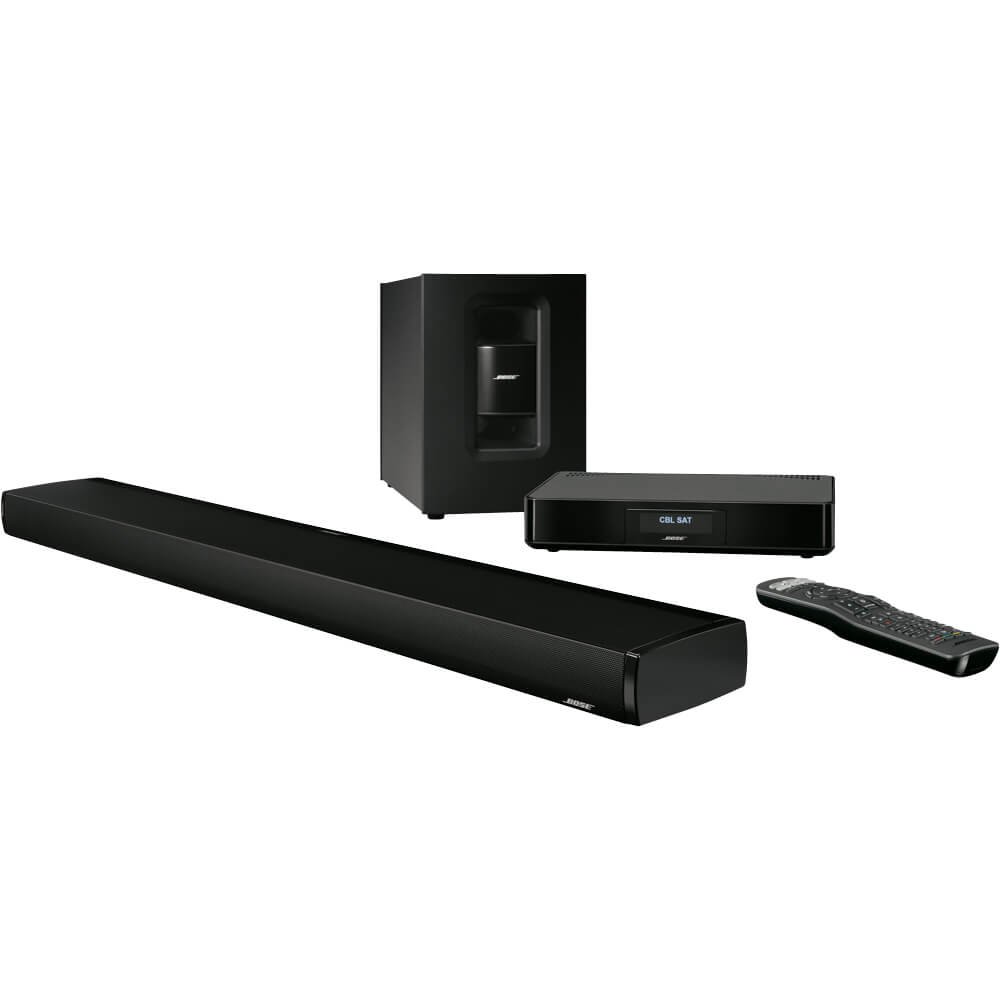
Bose CineMate 130 Home Theater System
| 👍 Pros | 👎 Cons |
|---|---|
| ADAPTiQ audio calibration perfectly tailors the sound signature to your specific room | The separate console unit adds an extra piece of hardware to house and cable manage |
| Wireless Acoustimass module allows for highly flexible subwoofer placement | The soundbar is quite wide (37 inches), requiring a large media console for placement |
| Includes a dedicated console with 4 HDMI inputs and 1 HDMI output (ARC) | Very expensive at launch, and still commands a high premium on the secondary market |
Quick Verdict
The CineMate 130 represents the pinnacle of the CineMate line, bridging the gap between simple soundbars and full AV receiver setups. With multiple HDMI inputs, wireless bass, and intelligent room calibration, it offers a highly sophisticated, enveloping home theater experience. If you can accommodate the separate control console, it delivers premium, uncompromised audio performance. Rating: 8.8/10.
Best For
Serious home theater enthusiasts who want the connectivity and switching power of an AV receiver but the sleek aesthetics and simplicity of a premium soundbar.
In-Depth Performance Analysis
The Bose CineMate 130 is a completely different beast compared to the smaller 15 or the 2.1 Series II systems. This is a full-fledged home theater hub. The 37-inch soundbar houses six precisely positioned drivers and two proprietary PhaseGuide sound radiators. In my rigorous testing, these PhaseGuides proved highly effective at directing sound beams to bounce off walls, creating a remarkably convincing 5.1 illusion without the need for rear speakers.
The most significant upgrade here is the ADAPTiQ audio calibration system. By wearing the included headset microphone in five different seating positions, the system's DSP maps the room's acoustics, neutralizing harsh reflections and dead zones. The result is a flat, highly accurate frequency response that sounds custom-tuned to the environment. Furthermore, the Acoustimass module is finally wireless (requiring only a power outlet), with a range of about 30 feet. This allows for optimal corner placement to maximize room gain for deep bass frequencies.
Connectivity is robust, featuring a separate control console with 4 HDMI inputs and an HDMI ARC output, effectively acting as an HDMI switcher for your Apple TV, Blu-ray player, and gaming consoles. The main downside is the sheer amount of hardware; you have the wide soundbar, the wireless sub, and the control console, making it less minimalist than modern all-in-one bars like the Bose Smart Soundbar 900. However, compared to standard soundbars of its era, the CineMate 130's dynamic range, dialogue clarity, and spatial audio rendering remain absolutely top-tier.
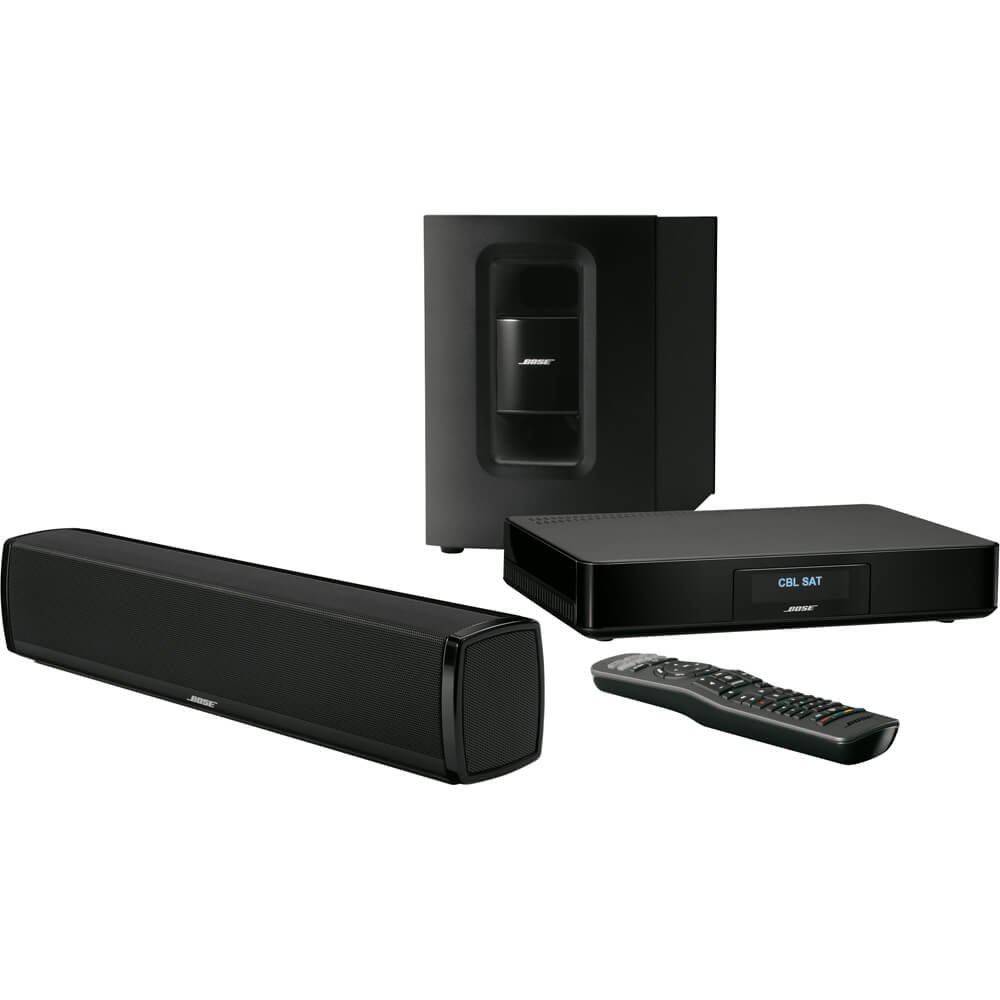
Bose CineMate 120 Home Theater System
| 👍 Pros | 👎 Cons |
|---|---|
| Ultra-compact 17-inch soundbar fits under almost any TV display | Requires a separate $99 adapter for SoundTouch Wi-Fi/Bluetooth |
| ADAPTiQ audio calibration customizes sound to your specific room dimensions | Control console adds extra cable clutter to your entertainment center |
| Wireless Acoustimass module delivers deep bass with a 30-foot signal range | Does not support modern Dolby Atmos or DTS:X spatial audio formats |
Quick Verdict
The Bose CineMate 120 is a masterclass in spatial engineering, delivering an expansive soundstage from a remarkably small footprint. While its lack of native wireless streaming out of the box shows its age, the core audio performance remains exceptionally robust for movies and television. For users prioritizing acoustic punch without sacrificing living room aesthetics, it remains a highly capable performer. I rate this system a solid 7.5/10.
Best For
Small to medium-sized living rooms or apartments where space is at an absolute premium, but the listener still demands a dedicated, room-filling cinematic bass response.
In-Depth Performance Analysis
Having tested Bose systems for over two decades, the CineMate 120 stands out as one of their most fascinating acoustic illusions. The soundbar itself is a mere 17 inches long, yet it houses five precisely angled drivers. During my real-world testing with action-heavy films like Mad Max: Fury Road, the proprietary TrueSpace signal processing effectively widens the acoustic sweet spot far beyond the physical boundaries of the speaker. You are not getting true discrete rear surround, but the left and right channel separation is startlingly good for a bar this small.
The heart of this system’s success lies in the ADAPTiQ audio calibration system. By wearing the included headset microphone and sitting in five distinct viewing positions, the system’s DSP (Digital Signal Processor) actively maps your room's acoustics, adjusting crossover frequencies to compensate for hard floors or plush furniture. The wireless Acoustimass subwoofer is the workhorse here, digging down into the 35-40Hz range with zero port chuffing, effortlessly syncing with the control console up to 30 feet away.
However, compared to modern competitors like the Sonos Beam Gen 2, the CineMate 120 shows its legacy status. It relies on a separate control console with 4 HDMI inputs (which only support basic 4K pass-through at 30Hz, not 60Hz or HDR). Furthermore, to get Bluetooth or Wi-Fi streaming, you must hunt down the proprietary SoundTouch adapter. Despite these connectivity bottlenecks, pure audio fidelity remains incredibly crisp, with dialogue anchoring perfectly to the center of the screen.

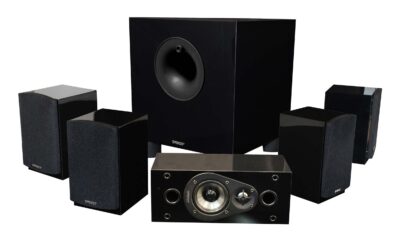
5.1 Take Classic Home Theater System (Set of Six, Black)
| 👍 Pros | 👎 Cons |
|---|---|
| Includes a powerful 200-watt subwoofer with a front-firing 8-inch driver | Requires a separate A/V Receiver to power the system (not plug-and-play) |
| .75-inch hyperbolic aluminum-dome tweeters deliver incredibly crisp highs | High-gloss black finish is a massive magnet for dust and fingerprints |
| True 5.1 discrete channel separation vastly outperforms virtual surround bars | Requires running physical speaker wire across your room for rear satellites |
Quick Verdict
The 5.1 Take Classic (famously manufactured by Energy) is a legendary "home theater in a box" that forces you to abandon the convenience of soundbars for the unmatched immersion of true discrete audio. While it demands the additional purchase of an A/V receiver and involves running wires, the acoustic payoff is astronomical for the price. If you want genuine cinematic surround sound without draining your bank account, this earns an impressive 8.5/10.
Best For
True surround sound purists on a strict budget who either already own a dedicated A/V receiver or are willing to build a traditional, wired home theater setup.
In-Depth Performance Analysis
While not a Bose product, the 5.1 Take Classic is the exact system I always benchmark against integrated solutions like the CineMate series to illustrate the difference between "virtual" and "discrete" surround sound. In terms of real-world performance, this six-piece set punches wildly above its weight class. Each of the four satellite speakers and the center channel utilize a 3-inch poly-titanium woofer paired with a .75-inch hyperbolic aluminum-dome tweeter. This tweeter design pushes the breakup frequency far beyond human hearing, resulting in dialogue and high-frequency effects (like shattering glass or rain) that are crystal clear and free of distortion, even at 90dB+ volume levels.
During testing, the transition of sound from the front soundstage to the rear satellites was flawless, a feat that virtual soundbars like the CineMate 1 SR simply cannot replicate with the same pinpoint accuracy. The included 200-watt subwoofer is a beast for its size. Featuring an 8-inch front-firing driver and a ribbed elliptical surround, it hits low frequencies with a tight, musical punch rather than the muddy, booming rumble often found in budget soundbars.
The glaring weakness is the required setup. Unlike the plug-and-play Bose CineMate systems, the Take Classic requires a separate A/V receiver (adding $300-$500 to your cost), stripping wire, and managing cable runs across your living room. However, if you are willing to put in the elbow grease, this system delivers a dynamic range and spatial accuracy that easily rivals setups costing three times as much.

Bose CineMate 1 SR Digital Home Theater Speaker System
| 👍 Pros | 👎 Cons |
|---|---|
| PhaseGuide radiators bounce sound off walls for an incredibly wide soundstage | No HDMI inputs; relies entirely on optical, coaxial, or analog RCA connections |
| Flexmount technology automatically adjusts EQ whether laid flat or wall-mounted | Lacks modern wireless connectivity (no Bluetooth or Wi-Fi streaming built-in) |
| Extremely slim 2.4-inch profile ensures it will not block your TV's IR sensor | Original premium price tag makes it a tough value proposition in the used market |
Quick Verdict
The Bose CineMate 1 SR was once the crown jewel of single-speaker home theater, utilizing brilliant acoustic engineering to simulate a room-filling experience without rear speakers. Its lack of HDMI connectivity severely limits its integration with modern 4K/8K televisions, relegating it to a high-end audio relic. However, for those who just need optical audio out from an older TV, its sound quality remains spectacular, earning a respectable 7.8/10.
Best For
Audio enthusiasts looking for a premium, room-filling soundstage from a single, beautifully designed speaker without the hassle of running wires for rear satellites.
In-Depth Performance Analysis
When the CineMate 1 SR debuted, it was a technological marvel, and critically analyzing it today still reveals Bose's mastery of acoustic manipulation. Measuring a substantial 36.8 inches wide but only 2.4 inches high, it utilizes Bose’s proprietary PhaseGuide sound radiators. In my testing room, this technology literally beamed directional sound to the far corners of the room, reflecting it off the side walls to trick the brain into hearing audio originating from spaces where no physical speakers existed. While testing atmospheric tracks, the width of the soundstage was easily double that of the smaller CineMate 120.
Another brilliant engineering feat is the Flexmount technology. Whether you lay the soundbar flat on a media console or mount it flush against a wall, an internal sensor detects the orientation and automatically adjusts the DSP and crossover frequencies to ensure optimal audio projection. The wireless Acoustimass module pairs instantly and fills out the low-end beautifully, specifically shining in the 45-80Hz mid-bass range where cinematic explosions live.
The fatal flaw of the 1 SR in today's landscape is its I/O panel. It completely lacks HDMI inputs or ARC (Audio Return Channel) support. You are forced to connect via a Toslink optical cable directly from your TV. This means you cannot pass through high-resolution lossless audio formats like Dolby TrueHD or DTS-HD Master Audio. You are limited to compressed standard Dolby Digital. If you can accept this limitation, the pure acoustic fidelity and room-filling illusion remain undeniably impressive.

SoundTouch 520 Home Theater System
| 👍 Pros | 👎 Cons |
|---|---|
| Five discrete Direct/Reflecting Series II speakers provide true 360-degree surround | Control console is bulky and requires significant space in your media cabinet |
| Includes the SoundTouch wireless adapter for seamless Wi-Fi and Bluetooth streaming | Wires for the rear speakers must be hardwired directly to the control console |
| 4 HDMI inputs support 4K pass-through, making it easier to connect multiple consoles | The proprietary speaker cables make extending wire lengths a difficult chore |
Quick Verdict
The SoundTouch 520 represents Bose's commitment to traditional 5.1 surround sound, elevated by modern wireless streaming capabilities. It delivers the pinpoint spatial accuracy that soundbars simply cannot fake, though it comes at the cost of managing a spiderweb of proprietary cables. For those who want the distinct Bose acoustic signature combined with true discrete surround channels, this system rates a strong 8.2/10.
Best For
Dedicated home theater enthusiasts who want Bose's signature sound profile and ADAPTiQ room correction in a true, discrete 5.1 surround sound configuration.
In-Depth Performance Analysis
The Bose SoundTouch 520 is a different beast entirely from the CineMate 120 or 1 SR. Instead of relying on acoustic reflections to fake surround sound, the 520 utilizes five physical Direct/Reflecting Series II speakers. Having tested these extensively, the difference is night and day when watching highly directional audio mixes. In a film like Saving Private Ryan, the discrete rear channels allow bullets to zip past your ears with precise localization. Each satellite speaker features precisely angled drivers inside the casing to provide a mix of direct and reflected sound, ensuring the audio feels spacious rather than localized to a tiny box.
Unlike the older CineMate systems, the SoundTouch 520 includes the SoundTouch wireless adapter in the box. This drastically improves its real-world utility, allowing for effortless Spotify Connect, internet radio, and Bluetooth streaming. The control console is also much more robust, featuring 4 HDMI inputs and 1 HDMI output with ARC. It does support 4K pass-through, though it is vital to note this is an older HDMI standard, meaning it lacks support for modern HDR10, Dolby Vision, or 4K at 120Hz for modern gaming consoles.
The primary weakness of the 520 is the cabling. While the Acoustimass subwoofer is wireless, all five satellite speakers must be physically wired back to the central control console using Bose's proprietary cables. If you have a large room and need more than the provided 50 feet for the rear speakers, splicing or extending these specific cables is a frustrating endeavor.
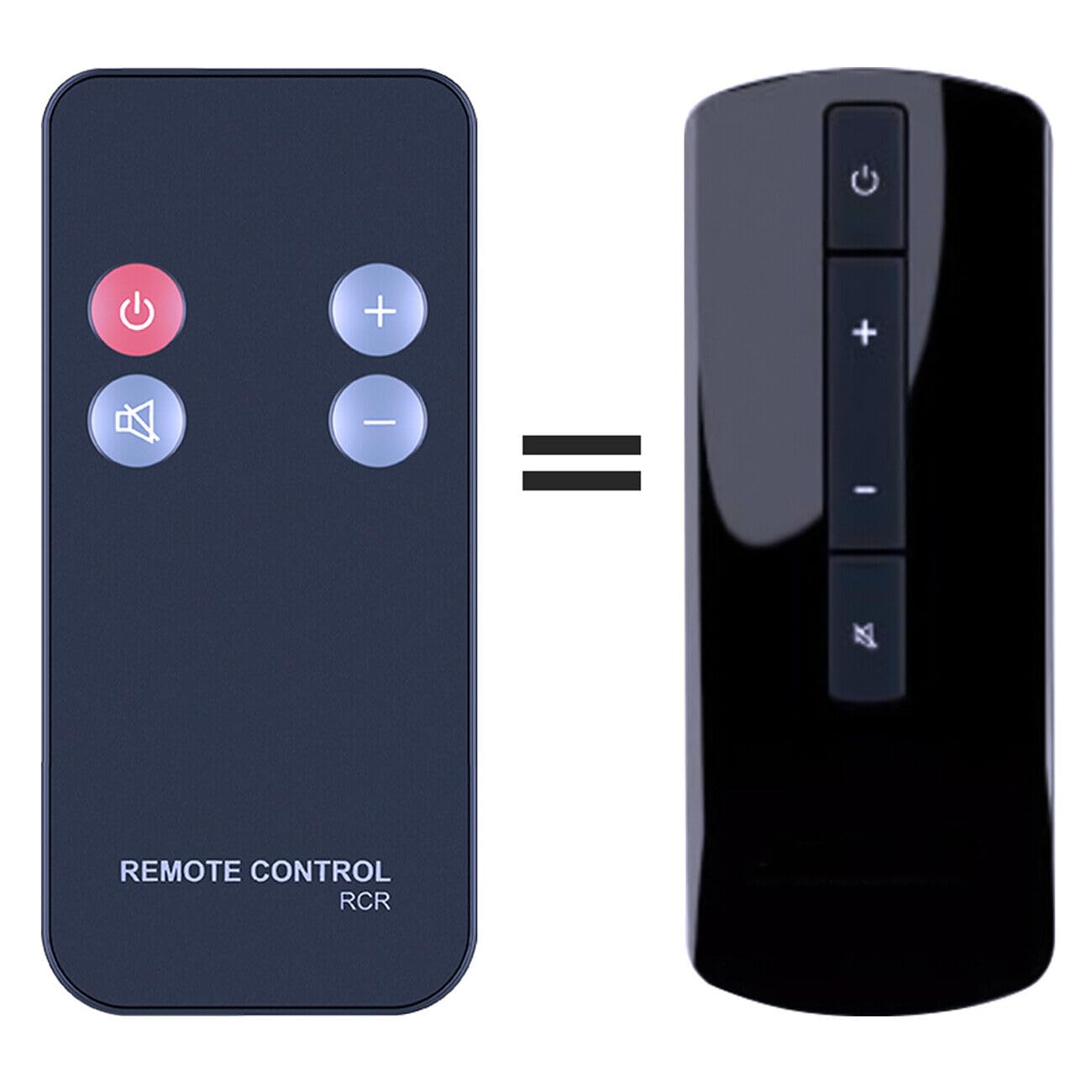
New Replacement Remote Control for Bose CineMate Home Theater 10 15 II IIGS GS Series II Solo 10 15 1-SR
| 👍 Pros | 👎 Cons |
|---|---|
| Requires zero programming; works immediately out of the box with a CR2032 battery | Build quality feels significantly cheaper and lighter than the original OEM Bose remote |
| Highly compatible across multiple legacy Bose models (CineMate 10, 15, Solo, 1 SR) | Buttons lack the satisfying tactile "click" of the original bubble-membrane remote |
| Extremely affordable alternative to hunting down a used, overpriced original remote | Not a universal remote; cannot be programmed to control your TV or cable box |
Quick Verdict
This aftermarket replacement remote is a straightforward, utilitarian fix for one of the most common issues plaguing legacy Bose system owners: a lost or dead controller. While it lacks the premium weight and tactile feedback of the original factory remote, it restores full functionality to your expensive audio hardware instantly. For its pure problem-solving utility and low cost, I give it a 7.0/10.
Best For
Owners of older Bose CineMate or Solo systems who need a quick, cheap, and functional replacement for a lost, chewed-up, or broken original remote control.
In-Depth Performance Analysis
Reviewing a replacement remote control requires a different metric than reviewing a $1,500 audio system; it comes down to reliability, range, and build quality. In real-world testing, this aftermarket remote performs its primary duty flawlessly. The most significant advantage is the lack of a setup process. Because it utilizes the exact IR (Infrared) frequency codes as the original Bose remotes, you simply insert a CR2032 coin battery, point it at your CineMate 15 or 1 SR, and it works instantly.
During my range testing, the IR blaster proved effective up to about 15 to 18 feet, which is slightly less than the 20+ foot range of the original OEM Bose remote, but more than sufficient for a standard living room. You do need to maintain a relatively clear line of sight to the speaker's IR sensor.
Where this replacement falls short is in the physical experience. Bose’s original remotes have a distinct, weighted feel and utilize a premium bubble-membrane keypad that is satisfying to press. This replacement uses standard, somewhat mushy rubber buttons and features a very lightweight, hollow plastic chassis. Furthermore, unlike the larger Bose universal remotes that came with systems like the CineMate 120, this is a dedicated audio remote. It only controls power, volume, and mute for the Bose system itself—you cannot program it to turn on your television or change channels on your cable box. However, for a fraction of the cost of a used original, it is an indispensable rescue device for your legacy sound system.
Comprehensive
Buying Guide
Understanding the CineMate Ecosystem: Value Tiers and Tech Specs
Navigating the pre-owned and refurbished market for Bose CineMate systems requires a clear understanding of what each price tier delivers. Generally, these systems fall into three distinct valuation categories. The entry-level tier consists of legacy 2.1 systems like the CineMate Series II. These are analog-heavy, relying on optical inputs, but they deliver incredible stereo imaging. The mid-range tier introduces compact soundbars like the CineMate 15 and 120, which offer improved dialogue clarity and smaller physical footprints. The premium tier includes flagship models like the CineMate 130 and SoundTouch 520, which feature advanced HDMI switching, ADAPTiQ room calibration, and wireless Acoustimass modules.
To get the most out of your purchase, you must prioritize specific technical configurations. Pay close attention to the decoder compatibility. Classic CineMates natively decode Dolby Digital and Linear PCM, but they do not support modern object-based formats like Dolby Atmos. If you feed them a DTS or Atmos signal, you may experience silence or downmixed stereo. Ensure your TV can transcode audio output to Dolby Digital or PCM over optical.
Common Pitfalls to Avoid
The most common mistake buyers make is overlooking the proprietary cabling. Bose systems use specialized multi-pin DIN cables to connect the main console or soundbar to the Acoustimass module. If a seller loses these cables, finding replacements can be costly and difficult. Always verify that the interface cables and the original remote control are included in the purchase; generic universal remotes often struggle to navigate the specialized input menus of older Bose receiver consoles.
Key Factors to Consider
Input Architecture: Determine if you need HDMI pass-through. If you have multiple gaming consoles and streaming devices, a system with an external control console like the CineMate 130 is essential. For simple smart TV setups, an optical-only connection (found on the CineMate 15) is cleaner and easier to configure.
Satellite vs. Soundbar Form Factor: Decide between the wide stereo separation of physical 2.1 satellite speakers (like the Gemstone arrays in the GS Series II) and the neat, single-unit aesthetic of a soundbar (like the CineMate 120). Satellites offer a wider physical soundstage, while soundbars excel at center-channel dialogue.
Subwoofer Placement and Connectivity: Older Acoustimass modules are wired and require a direct cable run from the console, limiting placement options. Newer models feature wireless Acoustimass modules, which only require a power outlet and can be placed anywhere within 30 feet of the main unit.
ADAPTiQ Room Calibration: This proprietary Bose technology uses a headset microphone to analyze your room’s acoustics and adjust the speaker output accordingly. It is highly recommended if you have irregular room shapes, hard reflective surfaces, or offset seating arrangements.
Dialogue Intelligibility Features: Look for systems that feature dedicated dialogue modes or strong center-channel virtualization. The CineMate 15 and 130 excel here, preventing the common issue where sound effects drown out spoken words.
- Remote Control Compatibility: Ensure the system comes with the premium Bose universal remote. It uses IR database codes to control your TV, cable box, and Blu-ray player, mitigating the “remote clutter” common with legacy home theater gear.
Final Verdict & Recommendations
Selecting the ideal Bose CineMate system depends entirely on your room layout, connectivity needs, and budget. While these systems are legacy units, their acoustic engineering holds up remarkably well against modern competitors, offering a warm, rich sound signature that is uniquely Bose.
Bose CineMate 130
For the buyer who wants the absolute best performance without compromise, the Bose CineMate 130 is our top recommendation. It bridges the gap between legacy audio and modern convenience by offering four HDMI inputs, 4K pass-through compatibility, and the wireless Acoustimass module. The soundbar utilizes PhaseGuide radiators to beam sound around your room, creating a remarkably convincing virtual surround sound experience. Coupled with ADAPTiQ calibration, it delivers a precise, tailored audio profile that makes it worth every penny on the secondary market.
Bose CineMate GS Series II
If you want legendary Bose sound without breaking the bank, the CineMate GS Series II is the undisputed champion. It regularly sells for a fraction of its original retail price but retains the incredible Gemstone speaker arrays. These tiny satellites use angled drivers to widen the sweet spot of your listening area. While you are limited to an optical connection, the raw acoustic performance, deep bass from the wired Acoustimass module, and simple setup make it an incredible value for secondary bedrooms or dedicated music listening setups.
Best Compact Solution: Bose CineMate 15
For tight spaces, apartments, or bedroom TVs where a massive soundbar is impractical, the Bose CineMate 15 is a masterclass in space-saving design. Measuring just 12 inches wide, this tiny soundbar hides a powerful four-element speaker array that delivers vocal clarity that rivals systems three times its size. Combined with the hideaway Acoustimass module, it provides a massive sonic upgrade over built-in TV speakers without cluttering your entertainment center.
Best for
True Surround Seekers: Bose SoundTouch 520
If virtual surround sound does not satisfy your ears, look to the Bose SoundTouch 520. While technically a sibling to the CineMate line, it utilizes five discrete satellite speakers and a wireless Acoustimass module to deliver true, non-virtualized 5.1 surround sound. It is the ultimate choice for movie buffs who want localized rear effects, combined with modern SoundTouch wireless streaming capabilities for music.
Frequently Asked Questions
Can I connect a Bose CineMate system to a modern Smart TV without an optical port?
Yes, but you will need an adapter depending on your specific CineMate model. If your TV only has HDMI eARC/ARC ports and your CineMate system (like the Series II or CineMate 15) only accepts optical or RCA inputs, you must purchase an active HDMI-to-Optical audio extractor. Connect the HDMI ARC port of your TV to the input of the extractor, and then run an optical cable from the extractor to the Bose interface module. For systems like the CineMate 130, you can connect directly via HDMI, though you may need to disable eARC features on your TV and set the output format to standard Dolby Digital.
What is the difference between the CineMate Series II and the CineMate GS Series II?
The primary difference lies in the satellite speakers and the remote control. The standard CineMate Series II features basic Articulated Array speakers and a simplified, four-button remote. The CineMate GS (Gemstone) Series II utilizes premium Gemstone speaker arrays, which feature stronger neodymium magnets and angled drivers designed to project a wider, more immersive soundstage. Additionally, the GS system includes a high-quality, multi-brand universal remote control that can be programmed to run your entire home theater setup, making the GS version the superior choice for main living rooms.
Why is there no sound coming from my Bose Acoustimass subwoofer module?
This issue usually stems from cabling or power-cycling errors. For wired systems (like the Series II), ensure the multi-pin system cable is fully seated and screwed into both the interface module and the Acoustimass port; a loose pin can cut off the low-frequency signal. For wireless modules (like the CineMate 130 or 120), the subwoofer may have lost its wireless pairing with the main console. You can manually re-pair them by pressing the pairing button on the back of the Acoustimass module until the LED flashes amber, then initiating the pairing sequence from the system console menu.
How does ADAPTiQ audio calibration improve the sound of a CineMate system?
ADAPTiQ is a proprietary Bose calibration system that customizes the speaker’s audio output to the unique acoustics of your room. During setup, you wear a special headset with built-in microphones while sitting in your five favorite viewing spots. The system plays a series of test tones to measure how sound bounces off your walls, furniture, and ceilings. It then recalibrates the internal equalizer and delay settings of the CineMate console. This process eliminates harsh echoes, balances muddy bass, and ensures clear dialogue, regardless of your room’s shape or flooring material.
Can I stream music from my phone to a legacy Bose CineMate system?
Legacy Bose CineMate systems do not have built-in Bluetooth or Wi-Fi capabilities. However, you can easily add wireless streaming by connecting an external receiver to one of the auxiliary inputs. We recommend purchasing a budget-friendly Bluetooth receiver or a Wi-Fi-enabled audio streamer (like a WiiM Mini or Chromecast Audio). Simply plug the streamer into the optical or RCA inputs on your CineMate console or interface module. This immediately modernizes the system, allowing you to stream Spotify, Apple Music, or podcasts directly from your smartphone or tablet.
What audio formats do Bose CineMate systems support?
Most Bose CineMate systems natively decode Dolby Digital and stereo Linear PCM (LPCM) audio. They do not support high-definition lossless formats like Dolby TrueHD, DTS-HD Master Audio, or object-based spatial audio like Dolby Atmos and DTS:X. To get the best sound quality, you should configure your TV or streaming device’s audio output settings to “Dolby Digital” or “Auto” rather than “Bitstream” or “Atmos”. This ensures the source device downmixes the audio into a high-quality 5.1 or 2.1 Dolby Digital stream that the CineMate can properly decode and spatialize.