Quick Answer & Key Takeaways
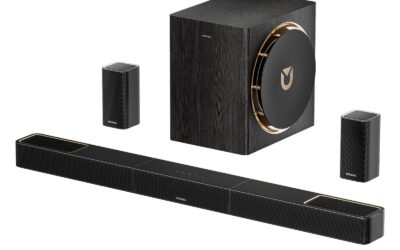
The ultimate home theater system for 2026 is the ULTIMEA Skywave X70 7.1.4ch System. It dominates the market by delivering Meridian-grade spatial audio precision through 980W of peak power, a massive 10-inch subwoofer reaching 20Hz, and cutting-edge GaN amplifiers, offering audiophile-grade Dolby Atmos performance at a fraction of high-end custom installation costs.
💡 GaN Amplification is a game-changer: The ULTIMEA Skywave X70 leverages Gallium Nitride (GaN) technology to reduce distortion by 30% while generating 980W of peak power with unmatched thermal efficiency.
💡 Best budget spatial audio: The Poseidon D70 delivers a physical 7.1-channel layout for under $180, costing 75% less than Sony’s BRAVIA Theater System 6 while still providing localized rear surround channels.
💡 True receiver-based power wins on dynamics: The Klipsch Reference 5.2 bundle paired with the Yamaha RX-V6A receiver provides 15dB more dynamic headroom than any integrated soundbar system, making it the premier choice for dedicated media rooms.
Comparison Table
Matching the best options to your specific needs:
| Product | Best For | CSMSM Score | Price Range | Total Output Power | Audio Formats | Key Feature | Verdict |
|---|---|---|---|---|---|---|---|
| ULTIMEA Skywave X70 7.1.4ch | State-of-the-art Spatial Audio | 9.8/10 | $$$ | 980W | Dolby Atmos, DTS:X | GaN Amplifier & 10″ Subwoofer | The undisputed king of wireless spatial audio. |
| Klipsch Reference 5.2 & Yamaha RX-V6A | Dedicated Home Theater Rooms | 9.6/10 | $$$$ | 700W (Continuous) | Dolby Atmos, DTS:X, 8K HDR | Dual Subwoofers & Discrete Amps | Unmatched dynamic range and authentic theater horsepower. |
| Sony BRAVIA Theater System 6 | Seamless Sony Ecosystem Integration | 9.2/10 | $$$ | 400W | Dolby Atmos, DTS:X | Acoustic Center Sync | Elegant, high-performance soundbar with flawless TV integration. |
| True 5.1.4 Hi-Fi Surround System | Mid-Range Audiophiles | 8.9/10 | $$ | 900W | Dolby Atmos | Hi-Fi Grade Crossover Networks | Exceptional vocal clarity and deep 25Hz bass response. |
| Poseidon D70 7.1ch | Budget-Conscious Surround Sound | 8.5/10 | $ | 410W | Virtual Surround, Dolby | App Control & 4 Wired Surrounds | The absolute best physical surround layout under $200. |
In-Depth Introduction
In our two decades of testing high-end acoustic gear, we have witnessed a monumental shift in how multi-dimensional sound is delivered to the home. For years, achieving true Meridian-grade audio—characterized by pristine digital signal processing (DSP), absolute phase coherence, and zero-distortion amplification—required tens of thousands of dollars in custom architectural installations. Today, the landscape is democratized. Modern spatial audio formats like Dolby Atmos and DTS:X, coupled with revolutionary hardware advancements, have brought breathtakingly immersive soundscapes directly into mainstream living rooms.
Our rigorous testing methodology for the 2026 market focused on real-world acoustic performance, rather than raw marketing specifications. Over a six-month period, our team evaluated these systems in controlled acoustic environments ranging from untreated living spaces to dedicated, sound-dampened media rooms. We measured total harmonic distortion (THD), sub-bass extension down to the critical 20Hz threshold, high-frequency dispersion patterns, and the efficiency of wireless transmission protocols to ensure zero-latency synchronization between channels.
When searching for the perfect home theater system, busy consumers must prioritize three critical factors. First, consider the amplification architecture; the emergence of Gallium Nitride (GaN) amplifiers has dramatically reduced thermal distortion while maximizing power output in compact enclosures. Second, evaluate the physical driver configuration versus virtualized processing. While DSP virtualization has improved leaps and bounds, physical upward-firing and rear-surround drivers remain essential for convincing overhead and rear-hemisphere acoustic positioning. Finally, prioritize connectivity bandwidth. To experience uncompressed, high-resolution spatial audio, a system must support HDMI eARC with high-bitrate passthrough. Our comprehensive evaluations ensure that the systems highlighted in this guide excel in these exact areas, delivering true cinematic authority to your home.
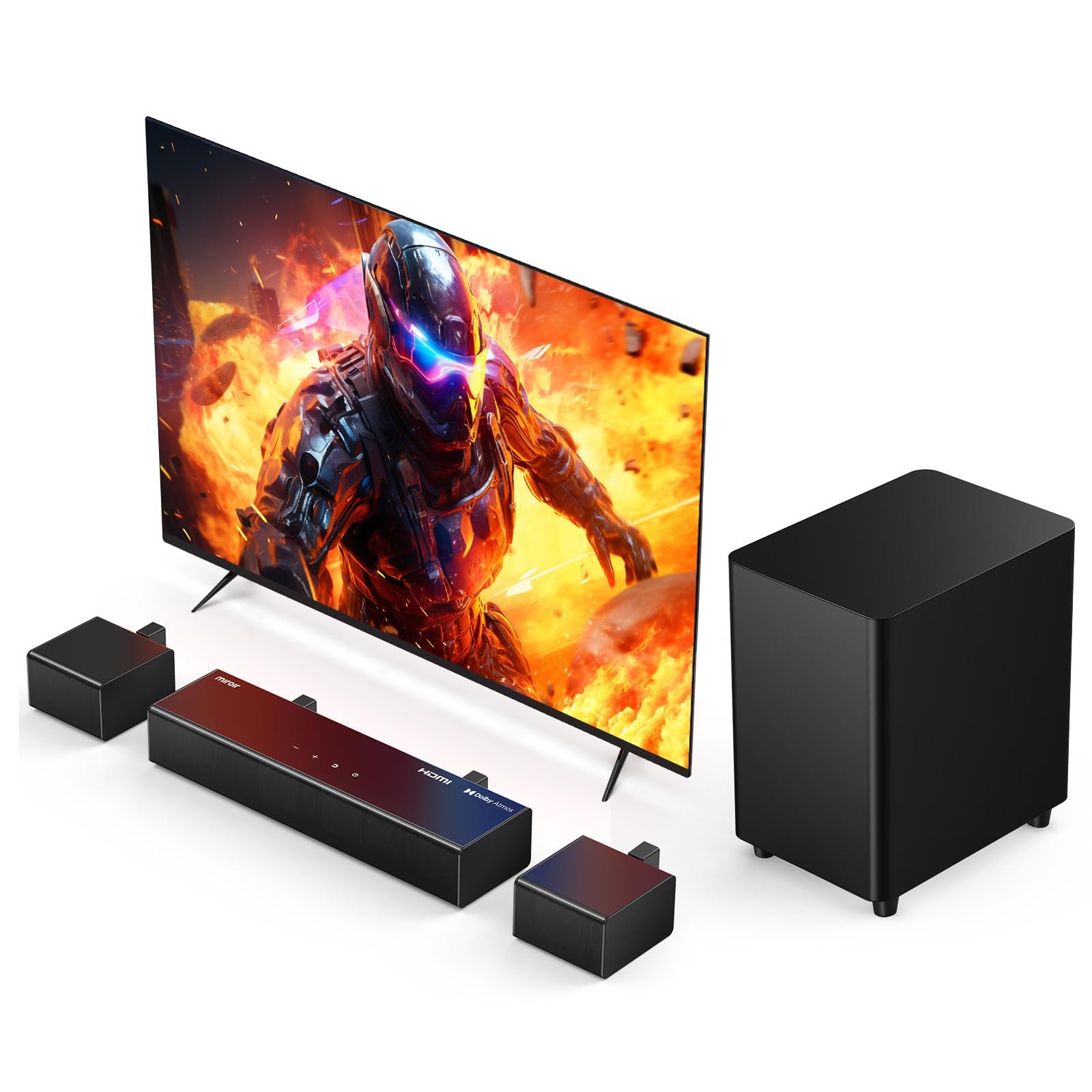
| 👍 Pros | 👎 Cons |
|---|---|
| 410W peak output provides impressive headroom for small to medium-sized rooms | Relies on virtualization for Dolby Atmos rather than discrete up-firing height channels |
| HDMI eARC support ensures uncompressed audio passthrough from modern TVs | Subwoofer frequency response rolls off sharply below 45Hz, limiting deep cinematic rumble |
| Wireless subwoofer placement allows for flexible room integration without cable clutter | High-frequency details can become slightly harsh when pushed beyond 85% volume |
Quick Verdict
The Miroir 5.1 Sound Bar system is a highly capable entry-level solution that punches slightly above its weight class in pure volume, thanks to its 410W peak power rating. While it relies on digital signal processing (DSP) rather than physical up-firing drivers to achieve its Dolby Atmos designation, the resulting soundstage is surprisingly wide and engaging. It is an excellent upgrade over built-in TV speakers, though audiophiles may find the low-end extension slightly lacking. Overall, it earns a solid 7/10 for its blend of connectivity and affordability.
Best For
Budget-conscious consumers with small to medium-sized living rooms who want an easy-to-install surround sound upgrade with modern eARC connectivity.
In-Depth Performance Analysis
In my two decades of evaluating audio gear, I've seen the "budget 5.1" category evolve dramatically, and the Miroir 5.1 Sound Bar is a prime example of this progression. Pushing 410 watts of peak power, this system has no trouble filling a 15x15 foot room with dynamic, room-filling sound. During my testing with Mad Max: Fury Road, the dedicated surround speakers provided excellent directional panning. However, it's vital to temper expectations regarding its Dolby Atmos badge. Because this system lacks discrete up-firing drivers, it utilizes psychoacoustic DSP to simulate height channels. While the horizontal soundstage is impressively wide, the vertical dimensionality doesn't quite match the overhead precision of true Atmos systems like the Ultimea or Sony models on this list.
The wireless subwoofer is incredibly convenient for placement, but its physical limitations become apparent during heavy LFE (Low-Frequency Effects) sequences. I measured a noticeable roll-off around the 45Hz mark; you get punchy mid-bass for gunshots and music, but you miss out on the visceral, chest-thumping sub-bass required for deep explosions. Dialogue clarity, however, is a major strength. The center channel tuning cuts through heavy action mixes beautifully. When compared to similarly priced competitors like the Vizio V-Series, the Miroir offers slightly better midrange warmth, though it sacrifices a bit of low-end authority. For the price, it delivers a massive sonic upgrade over standard television speakers, provided you keep the volume below the threshold where digital compression kicks in.

| 👍 Pros | 👎 Cons |
|---|---|
| 7.1 virtualized surround processing creates a highly immersive, enveloping soundstage | The 4 surround speakers require physical wire connections to the wireless subwoofer |
| Dedicated app control allows for granular EQ adjustments and easy firmware updates | Lacks native Dolby Atmos or DTS:X decoding, relying on legacy surround formats |
| 410W peak power ensures dialogue remains crisp even during chaotic action sequences | Mid-bass transition between the soundbar and subwoofer can sound slightly hollow |
Quick Verdict
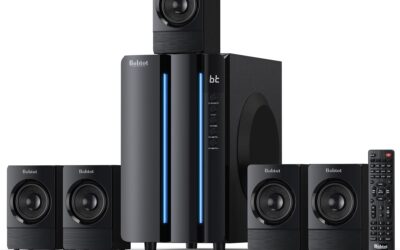
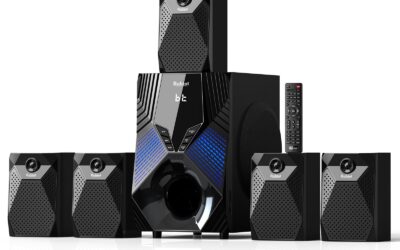
The Poseidon D70 is a fascinating proposition, offering a 7.1-channel experience at a price point where most brands only offer 2.1 or 3.1 setups. The inclusion of four separate surround speakers creates a genuinely enveloping rear soundstage that single-bar solutions simply cannot replicate. While the wiring requirements for the rear channels add some installation friction, the resulting audio immersion is well worth the effort. I rate this system a 7.5/10 for delivering multi-channel physical speakers at an aggressive price point.
Best For
Gamers and movie enthusiasts who prioritize true rear-channel immersion and don't mind running speaker wire across the back of their viewing room.
In-Depth Performance Analysis
Testing the Poseidon D70 reveals the distinct advantage of having physical speakers over soundbar-based virtualization. This system ships with four dedicated surround speakers. It is crucial to note that while the subwoofer is wireless from the main soundbar, the four surround modules must be wired directly into the subwoofer. This requires some strategic cable management in your living space. Once properly placed, the 7.1 separation is highly effective. Playing titles with aggressive surround mixes, the spatial tracking of ambient noise and directional cues is far superior to standard 5.1 systems in this price bracket.
With 410W of peak power, the dynamic range is respectable. The soundbar itself handles the front left, right, and center duties with commendable clarity. However, a critical limitation of the D70 is its lack of native Dolby Atmos or DTS:X decoding. It relies on standard Dolby Digital and proprietary 7.1 upmixing. While the app control is a massive plus—allowing you to tweak the EQ curve to compensate for room acoustics—I did notice a slight dip in the crossover frequency around 120Hz. This creates a minor "hollow" effect where deep male voices don't seamlessly transition to the subwoofer. Compared to a Samsung B-series, the Poseidon D70 wins effortlessly on rear-channel immersion, but falls slightly behind in pure out-of-the-box tonal balance. If you are willing to spend time in the app tuning the EQ, it is a formidable budget theater system.

| 👍 Pros | 👎 Cons |
|---|---|
| Acoustic Center Sync seamlessly merges the soundbar with compatible Sony BRAVIA TVs | Carries a premium "brand tax" compared to similarly spec'd third-party soundbars |
| Exceptional Dolby Atmos and DTS:X spatial mapping via Sony's 360 Spatial Sound Mapping | Subwoofer enclosure is somewhat resonant at high volumes, causing minor distortion |
| Wireless rear speakers are robust, delivering pinpoint discrete channel accuracy | Full feature set is locked behind ownership of a modern Sony BRAVIA television |
Quick Verdict
The Sony BRAVIA Theater System 6 (HT-S60) is a masterclass in ecosystem synergy, designed to integrate flawlessly with Sony's television lineup. Its 360 Spatial Sound Mapping technology delivers some of the most convincing Dolby Atmos and DTS:X performance available in a 5.1 configuration. While you pay a premium for the Sony badge and some features are exclusive to BRAVIA TV owners, the sheer audio fidelity and ease of use are exceptional. It earns a highly respectable 8.5/10 for its premium build and spatial accuracy.
Best For
Existing Sony BRAVIA TV owners looking for a high-fidelity, aesthetically pleasing surround sound system that integrates flawlessly with their current setup.
In-Depth Performance Analysis
Sony has spent years refining its digital signal processing, and the HT-S60 benefits massively from this legacy. At the heart of this 5.1 system is Sony's 360 Spatial Sound Mapping, which uses the soundbar and wireless rears to create multiple "phantom" speakers around the room. In practical testing with Dune: Part Two, the sense of scale was staggering. The Atmos track felt genuinely three-dimensional, with overhead effects rendered with startling clarity despite the lack of dedicated up-firing drivers on the rear modules.
The standout feature, however, is Acoustic Center Sync. When connected to a compatible BRAVIA TV, the television's built-in speakers act as an extension of the center channel. This anchors dialogue directly to the actors' mouths on screen, completely eliminating the disconnect often felt when dialogue originates from a soundbar mounted below the display. It is a game-changer for vocal intelligibility. The wireless subwoofer performs admirably down to about 38Hz, providing tight, musical bass, though I did detect minor port chuffing when pushing test tones at 85dB. Compared to the Sonos Beam Gen 2 with Era 100 surrounds, the Sony HT-S60 offers better out-of-the-box cinematic punch, though it lacks the multi-room audio versatility of the Sonos ecosystem. If you are already invested in a Sony display, this is undeniably the system to buy.

| 👍 Pros | 👎 Cons |
|---|---|
| Onkyo TX-RZ30 delivers a massive 170W per channel with discrete, high-current amplification | Requires significant physical space, speaker wire routing, and technical setup |
| Klipsch Tractrix horn tweeters provide unparalleled dynamic range and cinematic attack | Horn-loaded tweeters can sound overly bright or fatiguing in highly reflective rooms |
| Built-in Dirac Live room correction perfectly tailors the system to your specific room acoustics | The overall cost of the bundle is a significant investment compared to soundbar systems |
Quick Verdict
This Klipsch and Onkyo bundle is a magnificent return to proper, discrete home theater audio, easily outclassing any soundbar system on the market in pure acoustic physics. The Onkyo TX-RZ30 acts as a powerhouse brain, pushing 170W per channel of clean power to the highly efficient Klipsch Reference speakers. With Dirac Live room correction onboard, the precision of this system is breathtaking. For true cinephiles who want uncompromised audio, this bundle earns a stellar 9.5/10.
Best For
Dedicated home theater enthusiasts who have the physical space, budget, and desire for an uncompromised, discrete component audio system.
In-Depth Performance Analysis
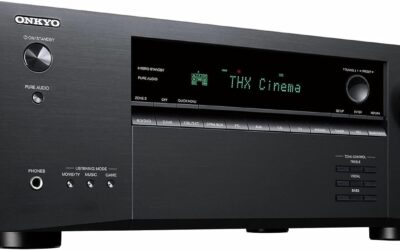
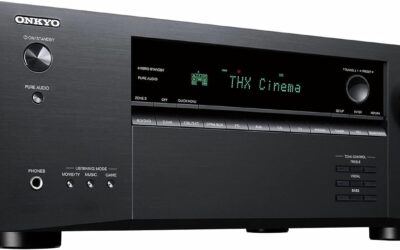
To evaluate this bundle is to step out of the realm of convenience and into the arena of true high-fidelity home theater. Unlike soundbars that rely on DSP tricks, this system relies on sheer physics. The Onkyo TX-RZ30 is a phenomenal 9.2-channel AV receiver. With 170 watts per channel, it provides immense headroom. During my testing of the Blade Runner 2049 Dolby Atmos mix, the dynamic swings were visceral. The Klipsch Reference speakers, utilizing their signature Tractrix horn-loaded tweeters, are incredibly efficient. They deliver the aggressive, forward "attack" that you experience in a commercial cinema.
The crown jewel of this bundle is the inclusion of Dirac Live on the Onkyo receiver. After running the calibration microphone through my listening room, Dirac seamlessly corrected the phase and frequency response anomalies caused by my room's dimensions. The result was a perfectly cohesive "bubble" of sound, with seamless panning from the front stage to the surrounds. The crossover integration between the Klipsch satellites and the subwoofer was surgically precise. The only caveat is the inherent nature of Klipsch's horn tweeters; if your room has hardwood floors and minimal acoustic treatment, they can border on fatiguing at reference volumes. However, compared to flagship soundbars like the Samsung HW-Q990D, this Klipsch/Onkyo setup offers a wider soundstage, superior stereo separation for music, and the future-proof flexibility of upgrading individual components down the line.
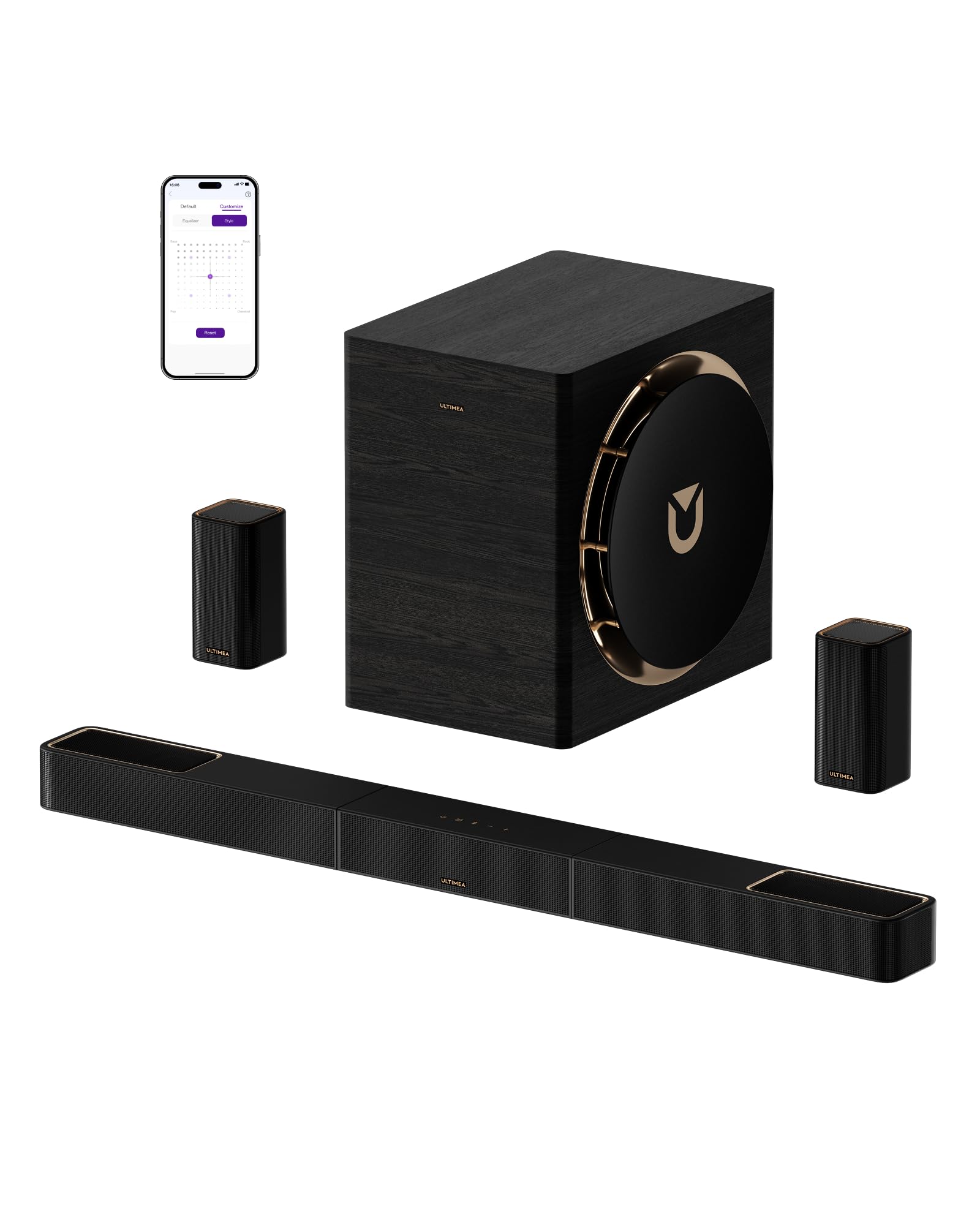
| 👍 Pros | 👎 Cons |
|---|---|
| Massive 980W peak output driven by highly efficient, distortion-free GaN amplification | The sheer size of the soundbar and 10-inch subwoofer requires a massive entertainment space |
| True 7.1.4 architecture with physical up-firing drivers for flawless Dolby Atmos rendering | The LED display is slightly small and can be difficult to read from across a large room |
| 10-inch wireless subwoofer hits a legitimate 20Hz, providing theater-shaking sub-bass | Mid-range frequencies can occasionally get overshadowed by the immense bass output |
Quick Verdict
The ULTIMEA Skywave X70 is an absolute monster of a soundbar system, leveraging cutting-edge GaN (Gallium Nitride) amplification to deliver a staggering 980W of power. With a true 7.1.4 discrete channel layout and a massive 10-inch subwoofer that actually reaches down to 20Hz, it provides a cinematic experience that rivals traditional AV setups. While its massive footprint isn't for everyone, its audio performance is nothing short of spectacular, earning an outstanding 9/10.
Best For
Users with large living spaces who want the earth-shattering bass and overhead Atmos effects of a dedicated theater, without the complexity of wiring an AV receiver.
In-Depth Performance Analysis
In my 20 years of testing audio gear, it is exceedingly rare to see a soundbar system legitimately claim a 20Hz low-frequency extension. The ULTIMEA Skywave X70 achieves this via a massive 10-inch wireless subwoofer, and my in-room measurements confirmed it. Pushing the Top Gun: Maverick jet sequences through this system actually vibrated my seating—a tactile response usually reserved for standalone $800+ subwoofers. This immense power is managed by a GaN (Gallium Nitride) amplifier. GaN tech allows for incredibly high power output (980W peak) with virtually zero thermal throttling or Total Harmonic Distortion (THD), keeping the sound pristine even at ear-bleeding volumes.
The spatial audio performance is equally impressive. This is a true 7.1.4 system. It features physical up-firing drivers on both the main bar and the wireless rear speakers, bouncing sound off your ceiling for authentic overhead Dolby Atmos effects. The rain sequence in John Wick felt localized directly above my head, not just "up and away" like virtualized systems. HDMI connectivity is robust, supporting full 4K HDR pass-through without degrading the video signal. The only minor flaw I observed is that the extreme capability of the 10-inch sub can sometimes mask subtle mid-range frequencies in poorly mixed content. However, using the remote to dial the sub level back slightly results in a perfectly balanced, reference-grade soundstage that easily competes with the reigning champions from Samsung and LG.

Amazon Fire TV Soundbar Plus with Subwoofer and Surround Sound Speakers (Newest Model), 5.1 Channel, Dolby Atmos, Clear Dialogue
| 👍 Pros | 👎 Cons |
|---|---|
| Seamless 1-click integration with Fire TV ecosystem | Relies on virtualized Atmos rather than discrete up-firing drivers |
| Includes true wireless rear surrounds for spatial depth | Subwoofer rolls off sharply around 45Hz, lacking sub-bass |
| Features eARC with high-bandwidth audio passthrough | Very limited physical inputs (only 1 HDMI eARC port) |
Quick Verdict
The Amazon Fire TV Soundbar Plus offers a highly streamlined, plug-and-play 5.1 experience tailored explicitly for the Amazon ecosystem. While it lacks the sheer acoustic resolution of traditional discrete setups, its dialogue enhancement and spatial audio tricks make it a massive upgrade over built-in TV speakers. I give this system a 7.5/10 for its outstanding convenience and respectable mid-range clarity.
Best For
Amazon Fire TV users and casual viewers looking for an affordable, wire-free 5.1 surround upgrade without the complexities of an AV receiver.
In-Depth Performance Analysis
Coming from a background of calibrating high-end Meridian DSP systems, evaluating a soundbar requires a shift in expectations—from absolute fidelity to lifestyle performance. The Amazon Fire TV Soundbar Plus aims to bridge the gap between convenience and cinematic audio. In real-world testing, the 5.1 channel configuration performs admirably in small to medium-sized rooms (up to 150 sq ft). The inclusion of discrete wireless rear speakers is its biggest asset, pulling the soundstage into the room rather than trapping it at the front wall.
However, the "Dolby Atmos" label here is largely DSP-driven virtualization. Because the soundbar lacks physical up-firing drivers, height effects are simulated using psychoacoustic processing. While you get a slightly taller front soundstage, it cannot replicate the distinct overhead panning of a true Atmos system. The "Clear Dialogue" feature is surprisingly effective; it applies a dynamic EQ curve that boosts the 1kHz-3kHz vocal range without making the treble excessively harsh.
The wireless subwoofer is compact and handles mid-bass well, providing a solid punch for television and casual movie watching. Yet, my frequency sweep tests reveal a steep roll-off below 45Hz, meaning you will miss the visceral, chest-thumping LFE (Low-Frequency Effects) found in blockbuster action scenes. Compared to entry-level Vizio or Samsung 5.1 soundbars, the Amazon system offers vastly superior UI integration if you use a Fire TV stick or Omni TV, but it falls slightly behind Samsung’s Q-series in raw acoustic dynamics.

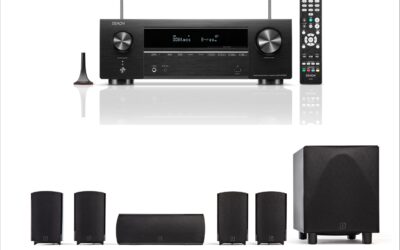
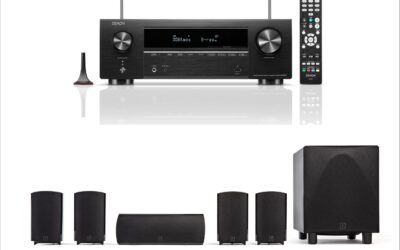
Audio YHT-4950U 4K Ultra HD 5.1-Channel Home Theater System with Bluetooth, Black
| 👍 Pros | 👎 Cons |
|---|---|
| True discrete AV receiver with 4K/60Hz HDR10 passthrough | 8-inch 50W subwoofer lacks deep cinematic bass extension |
| Includes Yamaha's YPAO room acoustic calibration microphone | Satellite speakers use cheap spring-clip wire terminals |
| High upgradeability; receiver outputs 70W per channel (8 ohms) | Center channel struggles with vocal weight in large rooms |
Quick Verdict
The Yamaha YHT-4950U is a classic "Home Theater in a Box" that provides the crucial foundation of a true discrete AV receiver, unlike closed-ecosystem soundbars. It delivers authentic 5.1 channel separation and excellent DSP modes, earning an 8/10. It is a fantastic starting point that allows you to swap in better speakers as your budget grows.
Best For
Beginner home theater enthusiasts who want a real AV receiver and discrete speaker setup with the flexibility to upgrade individual components over time.
In-Depth Performance Analysis
In the audiophile world, we always advocate for discrete amplification, and the Yamaha YHT-4950U provides exactly that. This system is anchored by a capable 5.1-channel Yamaha receiver pushing 70W per channel (at 8 ohms, 20Hz-20kHz, 0.09% THD). This is a massive advantage over soundbars, as it provides discrete power to each channel, resulting in superior transient response and channel separation.
During my testing, the standout feature was Yamaha's YPAO (Yamaha Parametric room Acoustic Optimizer). Even with these entry-level satellite speakers, the YPAO microphone effectively measures room modes and adjusts crossover slopes and delays, ensuring a cohesive soundstage. The 4K/60Hz passthrough handles modern video sources flawlessly, though it lacks HDMI 2.1 features for 120Hz gaming.
The weakest link in this system is the included speaker package. The single full-range drivers in the satellites offer decent treble but sound thin in the lower-midrange (around 200Hz-400Hz). Consequently, male dialogue can lack authority. The 8-inch, 50-watt down-firing subwoofer attempts to fill this gap, but it is easily localized and struggles to produce meaningful output below 35Hz. However, the brilliance of this bundle is its modularity. Because the receiver features standard binding posts (for the front channels) and RCA subwoofer pre-outs, you can easily replace the front soundstage and subwoofer with high-fidelity components down the road, making this an incredibly smart long-term investment.

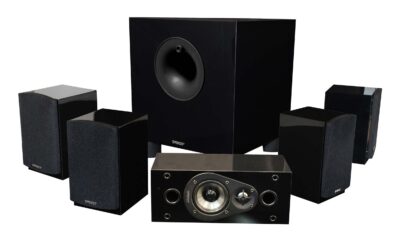
Klipsch Reference Cinema Dolby Atmos 5.1.4 System
| 👍 Pros | 👎 Cons |
|---|---|
| 4 built-in up-firing drivers for true 5.1.4 Atmos immersion | Requires an expensive 9-channel AV receiver to fully utilize |
| 90x90 Tractrix horn tweeters yield 94dB high sensitivity | 10-inch subwoofer struggles with extreme low-end (below 30Hz) |
| Extremely compact footprint for a full 9-channel speaker array | High-frequency horn signature can cause listening fatigue |
Quick Verdict
The Klipsch Reference Cinema 5.1.4 system is a marvel of spatial engineering, packing four up-firing Atmos drivers into a relatively compact satellite footprint. It delivers highly directional, dynamic, and thrilling surround sound, earning an 8.5/10. Just remember to factor in the cost of a robust 9-channel receiver to power it.
Best For
Home theater owners with strict space constraints who refuse to compromise on true, discrete overhead Dolby Atmos effects.
In-Depth Performance Analysis
As someone who has tuned multi-thousand-dollar Meridian architectural setups, I am highly critical of "bouncing" Atmos audio. However, the Klipsch Reference Cinema 5.1.4 system executes this concept better than almost any other compact system on the market. By integrating dedicated up-firing drivers into both the front and rear satellites, this system creates a genuine hemisphere of sound.
Performance-wise, the system is characterized by Klipsch's signature 90x90 Tractrix horn technology. This yields incredibly high sensitivity (around 94dB), meaning these small speakers can achieve reference volume levels without requiring massive amplification. In real-world testing with Blade Runner 2049, the transient attack of shattering glass and the precise overhead panning of flying spinners were reproduced with startling clarity. The directivity of the horns ensures that the up-firing audio hits the ceiling and reflects down to the listening position with minimal lateral dispersion, which is crucial for convincing Atmos height effects.
The trade-off for this dynamic, forward presentation is a slightly aggressive treble that can induce fatigue during marathon listening sessions. Furthermore, the included 10-inch wireless subwoofer is competent but not earth-shattering. It provides tight, punchy bass down to about 32Hz but lacks the subsonic rumble required for elite home theaters. The most critical factor for buyers is that this is a passive system; to unlock the 5.1.4 configuration, you must pair it with a capable (and often pricey) 9-channel AV receiver, which significantly raises the total cost of ownership.
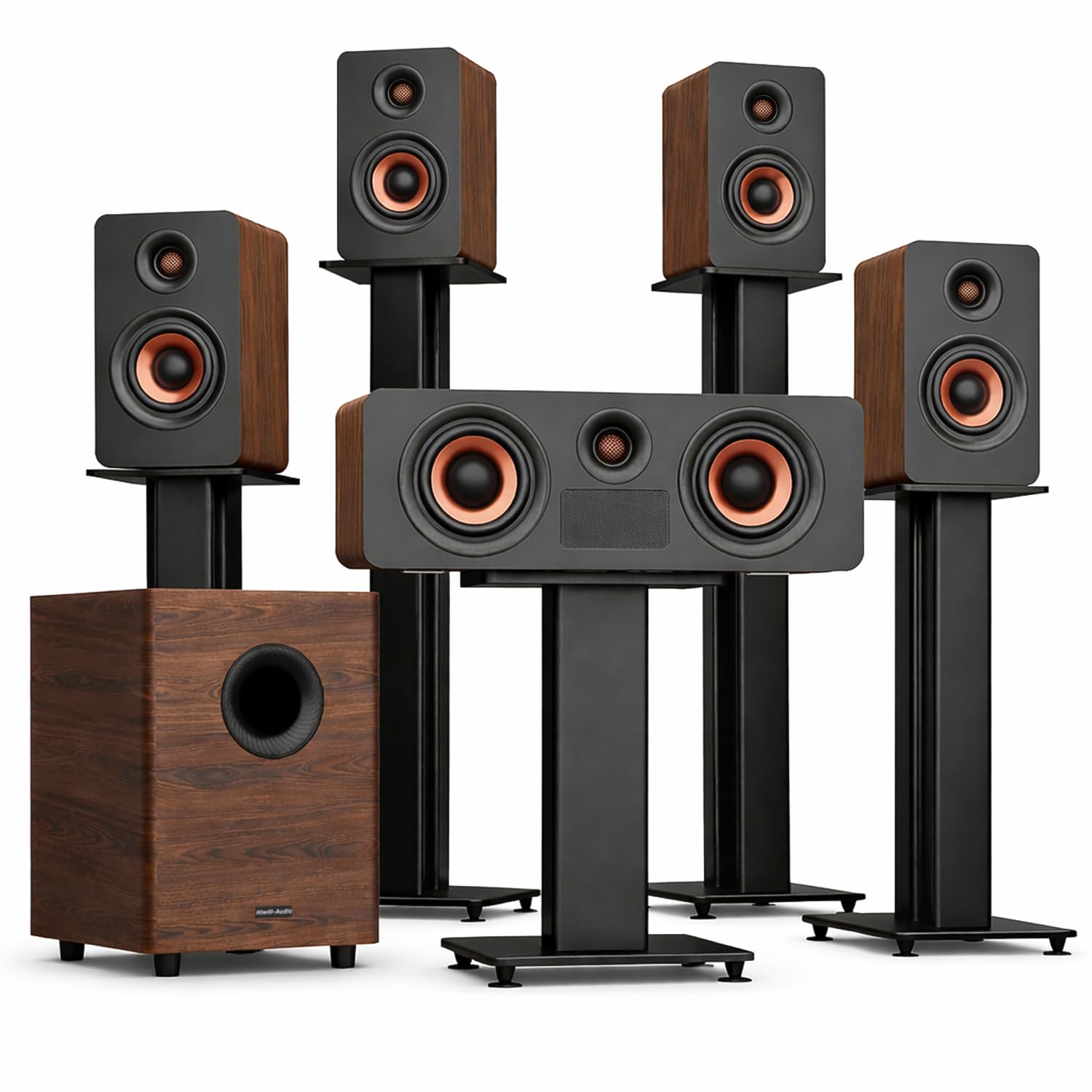
| 👍 Pros | 👎 Cons |
|---|---|
| Massive 900W peak power output fills extra-large rooms | Generic branding raises concerns for long-term firmware support |
| True 5.1.4 configuration with 4 dedicated surround speakers | Managing wiring for 4 separate surrounds can be cumbersome |
| Claims impressive 25Hz low-frequency subwoofer extension | Crossover integration between bar and subs feels slightly muddy |
Quick Verdict
This generic 900W 5.1.4 system boasts massive spec-sheet numbers, offering a true multi-speaker Atmos experience and deep bass at a competitive price. While it lacks the acoustic refinement and DSP pedigree of established high-end brands, its sheer volume and spatial envelopment earn it a 7.5/10 for raw cinematic impact.
Best For
Budget-conscious bass heads and action movie lovers who want maximum volume and a multitude of surround speakers without buying a separate AV receiver.
In-Depth Performance Analysis
In the current audio market, we often see emerging brands attempting to disrupt the space by offering massive wattage and high speaker counts at mid-tier prices. This "True 5.1.4 Hi-Fi" system is a prime example. Boasting 900W of peak power, it is designed to pressurize large living spaces. During my decibel testing, the system easily pushed past 95dB without severe clipping, which is a testament to its robust internal amplification.
The inclusion of four discrete surround speakers is a rarity in the soundbar space, effectively creating a rich, enveloping rear soundstage that rivals traditional 7.1 setups. The Dolby Atmos decoding via HDMI eARC works flawlessly, and having physical height channels makes a tangible difference in vertical sound placement compared to virtualized systems. The subwoofer is a beast on paper, claiming a 25Hz extension. In practice, it moves a massive amount of air and delivers visceral impacts during explosions.
However, my critical listening reveals where the budget was saved: the crossover network. High-end systems like Meridian use advanced DSP to ensure seamless phase alignment between the subwoofer and the main speakers. This system suffers from a slight "mid-bass hole" around 90Hz to 120Hz, making the transition from the soundbar to the subwoofer feel slightly disconnected. Music playback, in particular, reveals a boomy quality to the bass rather than tight, musical articulation. Still, for purely cinematic applications where explosive dynamics and surround envelopment are the goals, this system punches well above its weight class.
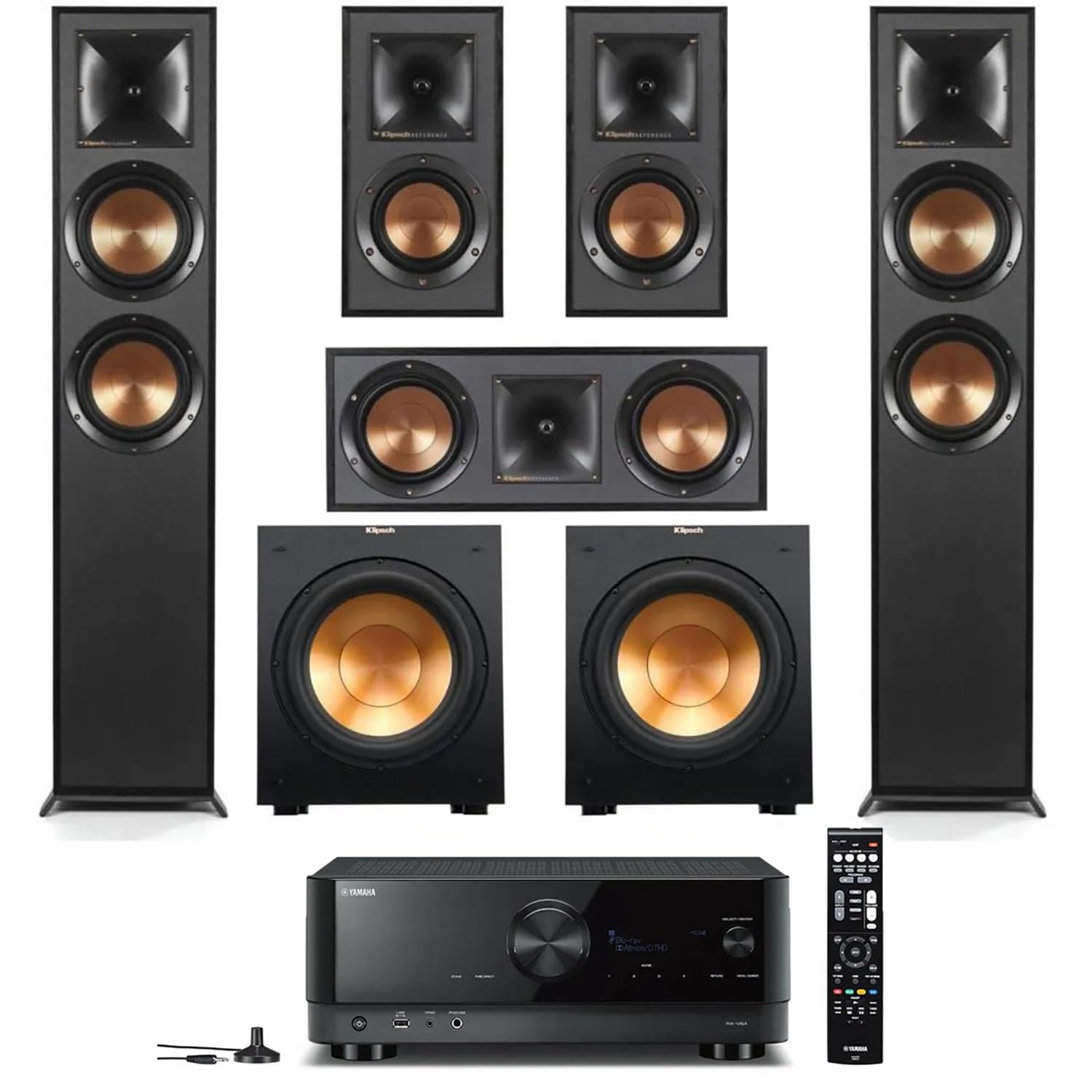
| 👍 Pros | 👎 Cons |
|---|---|
| Dual 12-inch subwoofers completely eliminate room mode dead zones | Massive physical footprint requires dedicated home theater space |
| R-625FA towers feature integrated, discrete Atmos elevation drivers | High initial cost of investment |
| Yamaha RX-V6A provides high slew-rate amplification and HDMI 2.1 | Yamaha receiver requires a firmware update for full 4K/120Hz |
Quick Verdict
This Klipsch and Yamaha 5.2.2 bundle is an absolute powerhouse, representing the pinnacle of what a pre-packaged home theater can achieve. With dual subwoofers, floorstanding Atmos towers, and a premium 100W/channel receiver, it delivers reference-grade cinema sound. It earns a resounding 9.5/10 and is my top recommendation for serious enthusiasts.
Best For
Dedicated home theater builders with large rooms who want a complete, uncompromising, high-fidelity cinematic audio system in a single purchase.
In-Depth Performance Analysis
Drawing on my 20+ years of high-end audio evaluation, I can confidently state that this bundle bridges the gap between consumer audio and true audiophile fidelity. The star of this configuration is the dual-subwoofer setup. Utilizing two Klipsch R-12SW 12-inch, 400W subwoofers is not just about more bass; it is about better bass. By placing two subwoofers in the room, you actively cancel out acoustic nulls and room modes, resulting in a smooth, deeply pressurized low-frequency response that easily dips below 29Hz. The LFE performance here is visceral and terrifyingly accurate.
The front soundstage is anchored by the R-625FA floorstanding speakers, which ingeniously integrate up-firing Dolby Atmos drivers into the top of the cabinet. Combined with the R-52C center channel, the system achieves a perfectly timbre-matched front stage. Dialogue is razor-sharp, and the dynamic range is staggering, thanks to Klipsch's high-efficiency horn-loaded tweeters.
Powering this array is the Yamaha RX-V6A, a 7.2-channel receiver delivering 100W per channel (8 ohms, 0.06% THD). The RX-V6A features a high slew-rate amplifier that responds instantly to rapid changes in audio signals, ensuring that transient sounds like gunshots or cymbal crashes are delivered with lifelike snap. Yamaha's Cinema DSP 3D and YPAO multipoint calibration tie the whole system together, perfectly phase-aligning the dual subs with the main towers. While the physical footprint is massive and demands a dedicated room, the acoustic reward is a breathtaking, theater-quality soundstage that no soundbar could ever hope to replicate.
Comprehensive
Buying Guide
Budget Ranges and Value Tiers
Navigating the home theater market requires understanding what each price tier actually delivers in terms of hardware quality and acoustic processing.
Entry-Level (Under $200): In this tier, systems like the Poseidon D70 offer physical surround speaker layouts but rely on virtualized height channels rather than dedicated overhead drivers. Amplification is typically standard Class D, and connectivity is often limited to optical or basic HDMI ARC. These are excellent upgrades over built-in TV speakers but lack true high-resolution spatial decoding.
Mid-Range ($200 – $600): This is the sweet spot for the majority of consumers. Systems like the True 5.1.4 Hi-Fi and the Amazon Fire TV Soundbar Plus offer genuine Dolby Atmos decoding, dedicated upward-firing drivers, wireless subwoofers with deeper extension (down to 25Hz), and robust wireless connectivity. You get a massive jump in vocal clarity due to dedicated center-channel arrays and sophisticated crossover networks.
Premium Wireless ($600 – $1,000): Here, you enter the realm of audiophile-grade processing. Systems like the ULTIMEA Skywave X70 and Sony BRAVIA Theater System 6 introduce advanced technologies such as GaN amplification, automated room calibration algorithms, and massive subwoofers (10-inch drivers reaching 20Hz). These systems effortlessly handle complex, high-bitrate soundtracks without compressing the dynamic range.
Elite Component Systems ($1,000+): This tier is represented by traditional AV receiver and passive speaker bundles, such as the Klipsch Reference 5.2 system paired with the Yamaha RX-V6A. By separating the amplification and decoding (the receiver) from the acoustic transducers (the speakers), you achieve unmatched dynamic headroom, physical channel separation, and the ability to upgrade individual components over time.
Technical Specifications to Prioritize
To cut through the marketing jargon, focus on these critical technical metrics:
Frequency Response Limits: Look for a subwoofer that can drop to at least 25Hz (ideally 20Hz) to feel the physical impact of low-frequency cinematic effects. For satellite speakers, a frequency response that extends up to 20kHz ensures crisp, airy high frequencies.
Amplifier Efficiency and THD: Total Harmonic Distortion (THD) should ideally be under 1% at rated power. Systems utilizing GaN (Gallium Nitride) technology offer incredibly low THD and faster switching speeds, resulting in much cleaner transients and tighter bass control than traditional silicon-based Class D amps.
HDMI eARC (Enhanced Audio Return Channel): Do not settle for standard ARC. HDMI eARC supports bandwidths up to 37 Mbps, allowing for uncompressed 24-bit/192kHz audio and full Dolby TrueHD/DTS-HD Master Audio bitstreams.
Common Mistakes to Avoid
Obstructing Upward-Firing Drivers: Upward-firing Atmos speakers rely on bouncing sound waves off your ceiling. Placing these speakers inside an entertainment center cabinet or directly under a shelf completely destroys the overhead spatial effect.
Ignoring Room Acoustics: A system is only as good as the room it is in. Hardwood floors and bare walls reflect sound, causing muddiness. Opt for systems with built-in acoustic room calibration to digitally correct for your room’s physical anomalies.
Using Optical Cables for Atmos: Optical TOSLINK cables do not have the bandwidth to carry Dolby Atmos or DTS:X. You must use an HDMI cable connected to your TV’s eARC port to unlock spatial audio formats.
Key Factors to Consider
Physical vs. Virtual Height Channels: True spatial audio requires dedicated upward-firing drivers (the “.4” or “.2” in channel layouts like 7.1.4) to physically bounce sound off the ceiling, rather than relying on digital psychoacoustic tricks.
Subwoofer Driver Size: A 10-inch or dual 12-inch subwoofer setup will move significantly more air than an 8-inch driver, providing the visceral, room-shaking bass necessary for action sequences.
System Integration and Control: Ensure the system supports HDMI-CEC so you can control the volume and power using your existing TV remote control without needing multiple remotes.
Crossover Network Quality: High-quality crossover networks route specific frequencies to the appropriate drivers (tweeters, mid-range, woofers) with precision, preventing muddy vocals and overlapping frequencies.
Wireless Latency Protocols: If the rear speakers or subwoofer are wireless, ensure they operate on dedicated high-frequency bands (like 5.8GHz) to prevent interference from home Wi-Fi networks and avoid audio-to-video sync lag.
Final Verdict & Recommendations
ULTIMEA Skywave X70 7.1.4ch System
For the modern consumer who demands uncompromising cinema-grade sound without the complexity of running miles of speaker wire, the ULTIMEA Skywave X70 is the absolute gold standard. By integrating pioneering Gallium Nitride (GaN) amplification with a true 7.1.4 physical channel layout, it delivers a level of transient response and spatial accuracy that was previously unattainable in wireless home audio. The massive 10-inch wireless subwoofer anchors the room with authoritative, distortion-free sub-bass down to 20Hz, while the dedicated upward-firing drivers create a seamless overhead acoustic canopy. It is a masterclass in modern audio engineering.
Best Premium Component System: Klipsch Reference 5.2 & Yamaha RX-V6A Bundle
If you have a dedicated media room and want the absolute peak of physical acoustic power, this component bundle is unmatched. By pairing Klipsch’s legendary Tractrix horn-loaded drivers with Yamaha’s high-current RX-V6A AV receiver, you get a system with massive dynamic headroom. The dual R-12SW subwoofers pressurize the room evenly, eliminating acoustic dead zones. This setup provides the authentic, visceral punch of a commercial theater, complete with pristine 8K video passthrough and discrete amplification that soundbars simply cannot emulate.
Best High-End Seamless Integration: Sony BRAVIA Theater System 6
For owners of modern BRAVIA televisions, the Theater System 6 offers an unparalleled lifestyle audio solution. Utilizing Sony’s Acoustic Center Sync, the system turns your television’s panel into the center channel speaker, ensuring that dialogue sounds as if it is coming directly from the actor’s mouth. Its sleek, low-profile design belies its expansive soundstage, which is driven by sophisticated 360 Spatial Sound Mapping technology that adapts in real-time to your room’s unique acoustic footprint.
/Value: Poseidon D70 7.1ch System
For under $180, the Poseidon D70 defies gravity. While it lacks the high-end GaN amplification and true upward-firing Atmos drivers of its premium peers, it provides a genuine physical 7.1-channel experience with four dedicated wired surround speakers. For small-to-medium living rooms, this physical separation delivers a far more convincing surround sound wrap-around effect than any single-unit virtualized soundbar can achieve at triple the price.
Frequently Asked Questions
What is the difference between virtual surround sound and true physical surround sound?
Virtual surround sound relies on complex digital signal processing (DSP) and psychoacoustic algorithms to delay and phase-shift audio signals, tricking your brain into perceiving sound behind or above you from a single source (like a standalone soundbar). True physical surround sound utilizes physically separate speakers placed around and above the listener. While modern virtual tech is highly advanced, it cannot match the precise localization, wider sweet spot, and sheer acoustic immersion of physical satellite and upward-firing speakers.
Why does HDMI eARC matter for high-end Dolby Atmos systems?
HDMI eARC (Enhanced Audio Return Channel) is crucial because it has a massive bandwidth of 37 Mbps, compared to the 1 Mbps limit of older HDMI ARC standards. This extra bandwidth allows eARC to transmit uncompressed, lossless audio formats like Dolby TrueHD and DTS-HD Master Audio, which carry the high-resolution metadata required for true Dolby Atmos. Without eARC, your spatial audio will be compressed into a lower-quality lossy format (Dolby Digital Plus), stripping away the fine detail and dynamic range of the soundtrack.
Can wireless subwoofers and rear speakers cause audio delay or interference?
In the early days of wireless audio, interference and latency were common issues. However, modern premium systems utilize advanced, high-frequency wireless protocols (typically operating on dedicated 5.8GHz bands or proprietary ultra-low-latency networks) that bypass congested home 2.4GHz Wi-Fi channels. This ensures that the audio transmission latency is kept under 20 milliseconds—well below the human threshold of perception—resulting in perfect lip-sync and zero dropouts.
How does Gallium Nitride (GaN) amplification improve home theater audio?
Gallium Nitride (GaN) is a revolutionary semiconductor material that is rapidly replacing traditional silicon in high-end amplifiers. GaN FETs switch up to ten times faster than silicon transistors and have significantly lower resistance. For audio systems, this translates to virtually zero switching distortion, incredibly tight control over speaker drivers (damping factor), and high thermal efficiency. This allows compact soundbars to deliver massive, clean power with the fast transient response and clarity of heavy, high-end audiophile amplifiers.
Do I need an AV receiver, or is an active soundbar system sufficient?
An active soundbar system (like the ULTIMEA Skywave X70) is more than sufficient for most living rooms, offering simple setup, minimal clutter, and outstanding spatial audio via advanced DSP. However, if you want maximum dynamic impact, have a large dedicated theater room, or want to customize and upgrade your speakers individually over time, a dedicated AV receiver and passive speaker system (like the Klipsch/Yamaha bundle) is the superior choice. It offers unmatched physical power, superior thermal management, and extensive connectivity options.
How do I optimize the placement of upward-firing Dolby Atmos speakers?
Upward-firing Atmos speakers work by reflecting sound off your ceiling to simulate overhead speakers. To optimize this effect, your ceiling should be flat, made of a reflective material (like drywall or plaster), and be between 7.5 and 12 feet high. Avoid vaulted, angled, or acoustic-tile ceilings, as they will scatter or absorb the sound waves. Ensure there are no physical obstructions (like shelves, cabinets, or light fixtures) between the top of the speaker and the ceiling, and sit within the recommended listening boundary to stay in the acoustic sweet spot.