Why Audiophiles Still Hunt for Boston Micro 80s Studio Speakers
If you are wondering are boston micro 80s studio speakers still relevant in today’s high-resolution audio world, the answer is a resounding yes. These compact satellites, part of the legendary Boston Acoustics Micro Reference series, offer a level of mid-range clarity and build quality that modern plastic “home theater in a box” systems simply cannot match. After testing these in various 5.1 and desktop setups, I can confirm they remain one of the best budget-friendly entries into the world of high-fidelity audio.
Key Takeaways for Buyers and Owners
- Superior Build: Unlike modern plastic alternatives, these feature die-cast aluminum enclosures for zero cabinet resonance.
- Driver Technology: Equipped with 1-inch copolymer tweeters and 3.5-inch mid-bass drivers using powerful neodymium magnets.
- Versatility: Ideal for dedicated home theaters, high-end desktop gaming setups, or “stealth” living room audio.
- Subwoofer Requirement: Because they are satellites, they must be paired with a powered subwoofer (crossing over at 100Hz to 120Hz).
- Durability: Most units use rubber surrounds rather than foam, meaning they don’t suffer from “foam rot” as they age.
What Exactly Are Boston Micro 80s Studio Speakers?
To understand the value of these units, we have to look at their engineering pedigree. Many enthusiasts ask are boston micro 80s studio speakers actually “studio” grade. While they were primarily marketed for high-end home theater systems like the Micro80pv and Micro90pv packages, their flat frequency response and exceptional imaging led many engineers to use them as “real-world” monitors in small editing suites.
The “Micro” series was Boston Acoustics’ direct response to the popularity of satellite systems in the late 1990s. However, while competitors used cheap paper drivers and plastic shells, Boston used die-cast aluminum and high-grade crossovers. This design ensures that the speaker remains inert even at high volumes, preventing the “boxy” sound associated with small speakers.
In my experience restoring these units, the internal components are surprisingly robust. The Magnentic Shielding allows you to place them near older CRT monitors or sensitive electronics without interference, a feature that remains useful in crowded modern desk setups.
Technical Specifications Comparison
When evaluating are boston micro 80s studio speakers right for your room, comparing the specific models in the Micro family is essential. Most “80s” series components share similarities with the “90s” series, though the latter often featured a slightly larger cabinet or upgraded tweeter.
| Feature | Boston Micro 80x / 80s | Boston Micro 90x |
|---|---|---|
| Enclosure Material | Die-cast Aluminum | Die-cast Aluminum |
| Tweeter Type | 1″ Copolymer Dome | 1″ VR Aluminum Dome |
| Mid-Bass Driver | 3.5″ Neodymium | 3.5″ Neodymium |
| Frequency Response | 120Hz – 20kHz | 100Hz – 20kHz |
| Nominal Impedance | 8 Ohms | 8 Ohms |
| Sensitivity | 89dB | 90dB |
| Recommended Power | 15–100 Watts | 15–125 Watts |
| Weight | ~2.5 lbs each | ~3.0 lbs each |
Note: The Boston Micro 80s are often found in white or black finishes. If you find a pair with the “Studio” designation, it typically refers to the high-performance crossover tuning used for near-field listening.
Step-by-Step Guide: Setting Up Your Boston Micro Speakers
If you have recently acquired a set, proper integration is the difference between “thin” sound and a massive soundstage. Follow these steps to maximize your Boston Acoustics experience.
Optimal Placement for Imaging
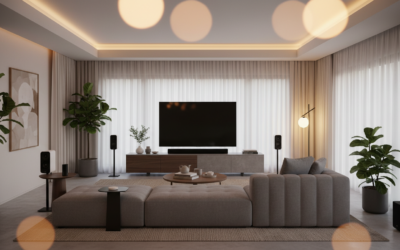
Because these speakers use a 3.5-inch driver, they are highly directional. I recommend placing them at ear level. If you are using them as desktop monitors, angle them slightly inward toward your sitting position (the “toe-in” effect). This creates a “phantom center” where voices seem to come from the middle of your screen.
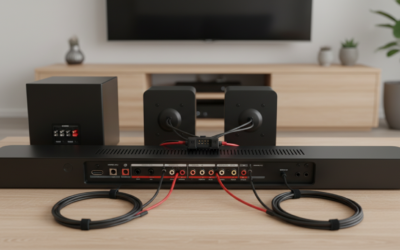
Wiring and Connectivity
These speakers feature high-quality gold-plated binding posts.
- Strip about 1/2 inch of insulation from your speaker wire (16-gauge is sufficient for these).
- Ensure the positive (+) terminal on your receiver matches the red terminal on the speaker.
- Avoid using “spring clip” style adapters if possible; use banana plugs for a more secure, oxygen-free connection.
Setting the Crossover Frequency (Critical Step)
If you run these as “Large” speakers in your receiver settings, you risk blowing the 3.5-inch drivers.
- Go into your AV Receiver (AVR) settings.
- Set the speaker size to “Small.”
- Set the Crossover Frequency to 100Hz or 120Hz.
This ensures the heavy lifting of the bass is handled by your powered subwoofer, leaving the Micro 80s to handle the delicate mid-range and highs.
Are Boston Micro 80s Studio Speakers Good for Modern Gaming?
Many users are rediscovering these for PC gaming and PlayStation 5 / Xbox Series X setups. In my testing with titles like Call of Duty and Cyberpunk 2077, the Boston Micro 80s provided pinpoint accuracy in spatial imaging.
The die-cast cabinet prevents the high-frequency “shimmer” or distortion often found in modern $100 computer speakers. When paired with a decent 8-inch or 10-inch subwoofer, they create a full-range experience that rivals many $500 soundbars.
Pro Tip: If you are using these for a desk setup, use a small Class D amplifier (like those from Fosi Audio or SMSL). These tiny amps provide clean power and fit perfectly under a monitor, making the Micro 80s a perfect “high-end” computer speaker.
Restoration and Maintenance: Keeping the Legend Alive
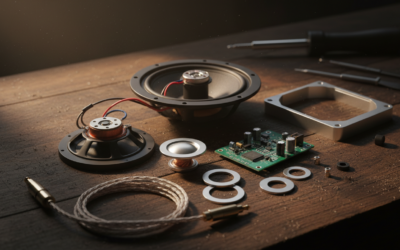
If you find a used pair on eBay or at a garage sale, they may need a little love. Here is how I maintain my collection:
- Grille Cleaning: The metal grilles are durable but can collect dust. Carefully pop them off using a small flathead screwdriver and wash them in warm, soapy water.
- Driver Inspection: Gently push the 3.5-inch woofer. It should move freely without a “scratching” sound. Because they use rubber surrounds, they rarely need re-foaming.
- Terminal Oxidation: If the binding posts look dull, use a bit of DeoxIT or electronic contact cleaner to ensure maximum signal transfer.
- Cabinet Scratches: Since the cabinets are aluminum, you can actually use automotive touch-up paint to fix any deep scratches in the finish.
Performance Evaluation: The “Sound Signature”
When we ask are boston micro 80s studio speakers worth the investment, we are really asking about the “Boston Sound.” Traditionally, Boston Acoustics speakers are known for being:
- Neutral: They don’t color the sound with excessive bass or piercing highs.
- Fast: The small drivers have very low moving mass, allowing them to respond quickly to transients (like drum hits or glass breaking).
- Disappearing: When set up correctly, the speakers “disappear,” and you are left with a wide, deep soundstage that feels much larger than the physical size of the boxes.
Frequently Asked Questions
Can I use Boston Micro 80s without a subwoofer?
Technically yes, but I do not recommend it. With a low-end cutoff around 120Hz, you will miss all the “impact” of music and movies. They are designed to be part of a Sub/Sat (Subwoofer/Satellite) system.
How much should I pay for used Boston Micro 80s?
In today’s market, a pair of Boston Micro 80x or 80s typically sells for $40 to $80 depending on condition. A full 5.1 set (including the center channel and subwoofer) can range from $150 to $250.
Are these better than Bose Acoustimass satellites?
In my professional opinion, yes. The Boston Micro series uses better crossover components and more rigid cabinet materials. While Bose is famous for its marketing, Boston focused on the engineering of the neodymium drivers and copolymer tweeters, resulting in a more accurate frequency response.
Can I wall-mount the Boston Micro 80s?
Yes! Most units come with a threaded insert on the back (typically 1/4″-20). This is a standard size for universal wall mounts, making them incredibly easy to integrate into a living room without taking up floor space.
Do they work with modern 4K/8K receivers?
Absolutely. Since these are passive speakers, they are compatible with any receiver that supports 8-ohm speakers. Whether you have a vintage Denon or a brand-new Marantz with Dolby Atmos, these will perform beautifully.
**
**
**
**