Can I Bypass the Amp for the Two Dash Speakers?
Yes, you can bypass the amp for the two dash speakers by locating the factory amplifier and rerouting the speaker wires directly to your aftermarket head unit or a new power source. This process involves identifying the input and output wires at the factory amp harness and bridging them, ensuring the small dash speakers receive a clean, full-range or high-passed signal.
Bypassing the factory amplifier is often the best solution when installing a modern aftermarket head unit that provides more power or cleaner signal processing than the aging stock system. In my experience, many “premium” factory systems (like JBL, Bose, or Alpine) use proprietary crossovers in the amp that actually limit the performance of high-quality aftermarket dash speakers. By bypassing this, you regain control over the soundstage and frequency response.
Key Takeaways: AMP Bypass Essentials
- Direct Answer: Yes, bypassing is possible and often recommended for aftermarket head unit installs.
- Difficulty: Moderate (Requires basic wiring knowledge and a multimeter).
- Main Benefit: Removes factory EQ “bottlenecks” and allows for higher volume without distortion.
- Critical Part: You must use bass blockers (capacitors) to prevent low frequencies from blowing the small dash speakers.
- Compatibility: Works best on older “premium” systems where the amp is a separate module from the radio.
Why Bypassing the Factory Amp is Necessary for Better Audio
Many car owners ask, “can i bypass the amp for the two dash speakers,” because they find their new speakers sound muddy or quiet. This happens because factory amplifiers often have hard-coded crossovers. These internal filters prevent certain frequencies from reaching specific speakers.
In a factory setup, the amp might only send high frequencies to the dash and mid-frequencies to the doors. If you replace those dash speakers with high-end coaxial speakers, the factory amp will still cut off the mid-range, making your upgrade feel like a waste of money.
By bypassing the amp, you allow your aftermarket head unit to send a “pure” signal. Most modern radios from brands like Sony, Pioneer, or Kenwood have built-in Digital Signal Processing (DSP). This allows you to tune the dash speakers precisely to your liking rather than relying on a 10-year-old factory tune.
Tools and Materials Required for the Project
Before you start tearing apart your interior, you need the right gear. I’ve found that having a wiring diagram specific to your vehicle’s make, model, and trim level is the most important “tool” you can have.
| Tool/Material | Purpose | Expert Recommendation |
|---|---|---|
| Multimeter | To test for continuity and identify speaker polarities. | Fluke or Klein Tools |
| Bypass Harness | Simplifies the process without cutting factory wires. | Metra or PAC Audio |
| Bass Blockers | Protects dash speakers from low-bass damage. | 600Hz to 1kHz cut-off |
| Wire Strippers | For clean connections. | Self-adjusting strippers |
| Heat Shrink | To insulate connections against shorts. | Marine-grade (adhesive lined) |
| Panel Poppers | To remove dash and trim pieces without scratching. | Nylon/Plastic kits |
Step 1: Locate the Factory Amplifier
To answer the question, “can i bypass the amp for the two dash speakers,” you first have to find the hardware. Factory amplifiers are rarely in the same place across different car brands.
In most Toyotas, you’ll find the amp under the passenger seat or behind the glovebox. In Jeeps and Chryslers, look under the steering column or in the rear cargo area side panels. If you have a Ford with a Sony system, the amp is often behind the rear seats or in the center console.
Once you find it, you will see two or three large plugs. One plug is the Input (signal coming from the radio), and the others are the Outputs (wires going to the speakers). Your goal is to connect the “Radio Input” wires directly to the “Dash Speaker Output” wires.
Step 2: Identify the Dash Speaker Wiring
This is the most technical part of the job. You must identify which wires in the harness lead specifically to the left and right dash speakers.
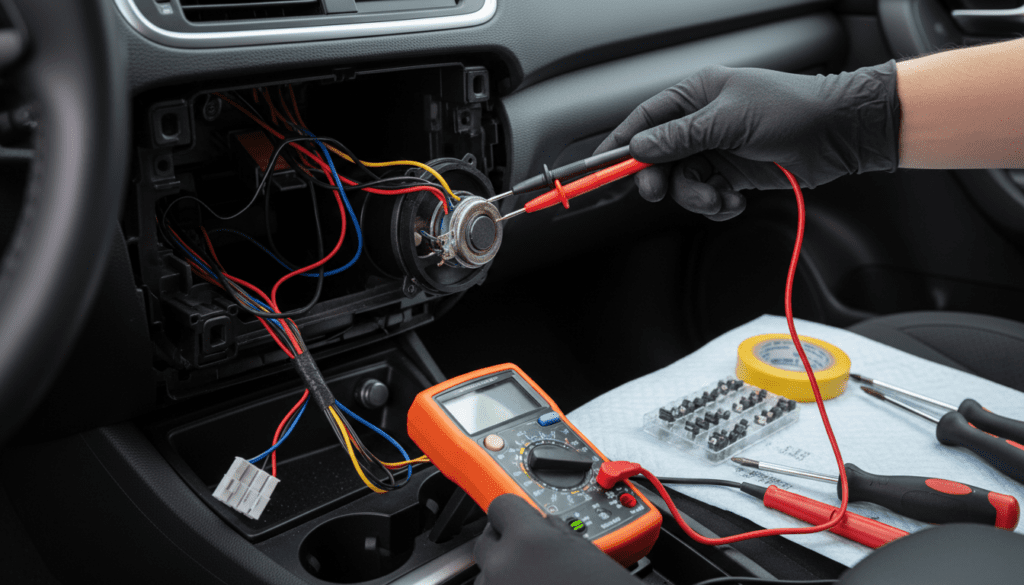
I recommend using a 9V battery pop test. If you touch the battery terminals to a pair of speaker wires in the output harness, you will hear a faint “pop” or “crackle” from the corresponding speaker. This confirms you have the right wires.
Common Dash Speaker Wire Colors (Examples):
- Toyota (JBL): Often Pink/Violet or Light Green/Blue.
- Jeep (Alpine): Often Gray/Yellow or Gray/Orange.
- GM (Bose): Often Light Blue/Dark Blue or Yellow/Brown.
Pro Tip: Always verify with a multimeter. Set it to Ohms (Ω). A standard dash speaker should read between 2.0 and 4.0 Ohms. If you see a “0” or “Infinity,” you have a short or an open circuit.
Step 3: Connecting the Bypass
Once you’ve identified the wires, you have two choices: use a bypass harness or perform a hardwire bypass.
Option A: The Bypass Harness (Recommended)
If a harness exists for your car (like the Metra 70-8113 for older Toyotas), use it. It plugs directly into the factory input and output plugs, effectively looping the signal around the amp. This is “Plug and Play” and requires zero cutting.
Option B: The Hardwire Bypass
If no harness is available, you will need to cut the input and output wires at the amp.
- Cut the Front Left (+) and (-) wires from the input harness.
- Cut the Front Left Dash (+) and (-) wires from the output harness.
- Solder or crimp the input wires directly to the output wires.
- Repeat for the Front Right side.
Warning: When you bypass the amp for the two dash speakers, you are now sending the head unit’s full power to those speakers. If your head unit is 22W RMS and your dash speakers are only rated for 15W, be careful with the volume.
Protecting Your Speakers: The Role of Bass Blockers
The biggest mistake I see DIYers make when bypassing an amp is forgetting passive crossovers. Factory amps have “active” crossovers that stop deep bass from reaching the 2.5-inch or 3.5-inch dash speakers.
If you bypass the amp and send 50Hz bass notes to a tiny dash speaker, it will distort and eventually blow. To fix this, install Bass Blockers (non-polarized capacitors) in-line on the positive wire of each dash speaker.
- For 3.5″ Speakers: Use a 600Hz bass blocker.
- For 1″ Tweeters: Use a 3.5kHz to 5kHz bass blocker.
This ensures that only the high-frequency “sparkle” reaches the dash, while your door speakers or subwoofers handle the heavy lifting.
Specific Challenges with Modern Infotainment Systems
Can I bypass the amp for the two dash speakers in a car made after 2020? This is where it gets tricky. In many modern vehicles, the amplifier is part of a CAN-bus or MOST (fiber optic) network.
If you simply unplug the amp, you might lose:
- Chimes: Door ajar, seatbelt, and parking sensor sounds.
- Hands-free Calling: Often routed through the dash speakers.
- Navigation Voice: The prompts might disappear.
In these cases, you cannot do a “hard bypass.” Instead, you must use an Integration Module (like the iDatalink Maestro or PAC AmpPRO). These modules allow you to add aftermarket power while keeping the factory computer happy.
Comparison: Amp Bypass vs. Factory Integration
| Feature | Hard Bypass (Cutting Wires) | Integration Module (Maestro/PAC) |
|---|---|---|
| Cost | Almost Free ($5 for tape/solder) | $150 – $300 |
| Sound Quality | Raw, uncompressed | High-fidelity, clean signal |
| Installation Time | 2-4 Hours | 30 Minutes |
| Reversibility | Difficult | Easy (Plug & Play) |
| Retains Chimes? | Usually No | Yes |
Expert Advice for a Successful Installation
When I’m performing an amp bypass, I always follow the “Solder and Shrink” rule. Vehicle interiors experience extreme temperature swings and constant vibration. Crimping can fail over time, leading to annoying intermittent audio.
Always solder your connections and use heat shrink tubing. Avoid using electrical tape alone, as the adhesive will melt in the summer heat, leaving a sticky mess and potential short circuits.
Another tip: Label everything. Use a fine-tip Sharpie and some masking tape to label “Input Left” and “Output Left” before you start cutting. It saves hours of troubleshooting if you get distracted mid-project.
FAQs: Bypassing Dash Speaker Amps
Will bypassing the amp make my speakers quieter?
It depends on the impedance (Ohms). If your factory speakers are 2-Ohm and your head unit is rated for 4-Ohms, the head unit might run hot or shut down. If you use 4-Ohm aftermarket speakers, they will likely sound much clearer, even if the absolute volume is slightly lower than the boosted factory amp.
Can I bypass the amp for just the dash speakers and leave the others?
Technically, yes, but it is complicated. You would have to split the signal coming out of the head unit. It is generally better to bypass the entire amp for all speakers to ensure phase consistency and a balanced soundstage.
Do I need to run new speaker wire from the dash to the radio?
Not necessarily. You can use the existing factory wiring. You just need to find where that wire meets the amp and “jump” it to the wire coming from the radio. Running new wire is only necessary if the factory wire is damaged or of extremely poor gauge (thinner than 22 AWG).
What happens if I don’t use a bass blocker?
Without a bass blocker, your dash speakers will try to reproduce low frequencies they aren’t designed for. You will hear a “thumping” or “crackling” sound at higher volumes, and the voice coil will eventually overheat and fail.
Is it better to bypass the amp or just replace it?
If you want the absolute best sound, replacing the factory amp with a high-quality 4-channel aftermarket amplifier is the superior choice. However, if you are on a budget, bypassing the amp to let the head unit drive the speakers is a significant upgrade over a bloated factory “premium” system.