Understanding the Fit: Can 4 Speakers Fit in 3.5 Inch Openings?
Technically, no, four full-sized speakers cannot physically fit into a single 3.5-inch factory opening due to the extreme spatial constraints of the mounting diameter and depth. However, you can achieve a “four-speaker effect” by using high-end 3.5-inch coaxial drivers (which contain two drivers per speaker) or by utilizing custom A-pillar pods and kick panels to house multiple drivers in the front stage.
In my years of custom car audio fabrication, I’ve seen many enthusiasts try to cram excessive hardware into small dash corners. While you can’t defy physics, you can strategically use component sets or parallel wiring to expand your system’s output while respecting the 3.5-inch footprint.
Key Takeaways for Speaker Upgrades
- Physical Limit: A standard 3.5-inch hole is only large enough for one 3.5-inch driver.
- The Coaxial Solution: Most 3.5-inch speakers are 2-way coaxials, meaning a pair of them gives you four total drivers (two woofers, two tweeters).
- Impedance Matters: Wiring four separate speakers to a single channel requires careful Ohm’s Law calculations to avoid frying your head unit.
- Custom Fabrication: If you truly need four distinct speakers in the dash area, fiberglass pods are the only professional solution.
- Sound Quality: Overcrowding a small space often leads to phase cancellation and poor imaging.
The Reality of 3.5-Inch Speaker Mounting
When people ask, “can 4 speakers fit in 3.5” locations, they are usually looking to maximize the “front stage” of their vehicle. In many modern trucks and sedans (like Jeep Gladiators, Ram 1500s, or Toyota Camrys), the dash corners house these small speakers.
I recently worked on a 2023 Ram 1500 where the owner wanted “more” from the dash. We explored the possibility of adding multiple drivers. The diameter of a 3.5-inch speaker is roughly 89mm. If you attempt to place four separate 1-inch tweeters in that space, you might succeed with a custom plate, but you would lose the essential mid-range frequencies that a dedicated 3.5-inch driver provides.
Space Constraints Table
| Feature | Standard 3.5″ Spec | 4-Speaker Cluster Requirement |
|---|---|---|
| Mounting Diameter | ~3.1 Inches | ~6.5 – 8 Inches |
| Mounting Depth | 1.5 – 1.8 Inches | Varies (Deep) |
| Air Volume | Minimal (Infinite Baffle) | Controlled Enclosure Needed |
| Wiring | 2-Lead (Pos/Neg) | Complex Serial/Parallel Looping |
How to Maximize a 3.5-Inch Location (Step-by-Step)
If your goal is high-volume and high-clarity sound, but you are limited to that 3.5-inch factory spot, follow this professional installation guide to get the most “gain” from your setup.
Step 1: Evaluate Your Mounting Depth
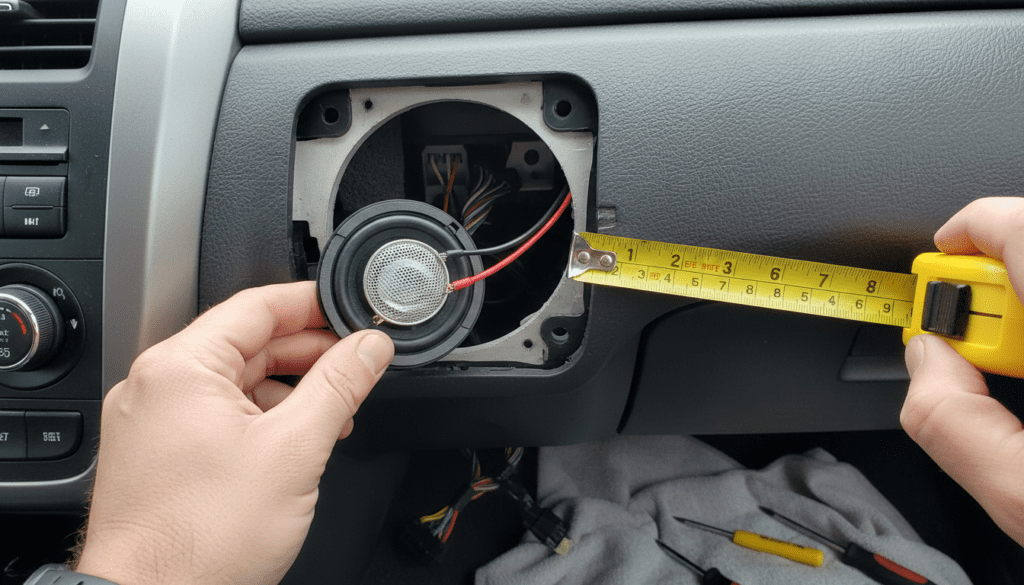
Before buying hardware, measure the distance from the mounting flange to the nearest obstruction (usually a defrost duct). Many high-output 3.5-inch speakers have oversized magnets that won’t fit without a spacer ring.
Step 2: Choose High-Sensitivity Drivers
Since you can’t fit four speakers, you need the one speaker you can fit to be extremely efficient. Look for speakers with a Sensitivity Rating of 89dB or higher. I recommend the Kicker KS-Series or Hertz Dieci for these tight spots.
Step 3: Address the Wiring (The “Four Speaker” Logic)
If you are trying to wire four speakers into the front outputs of your car, you must understand Impedance.
- Parallel Wiring: Two 4-ohm speakers wired in parallel create a 2-ohm load. Most factory head units will overheat and shut down at 2 ohms.
- Series Wiring: Two 4-ohm speakers wired in series create an 8-ohm load. This is safe but will significantly reduce your volume (output).
Step 4: Use Bass Blockers (Passive Crossovers)
A 3.5-inch speaker cannot handle low frequencies. If you try to push 60Hz to them, they will distort and blow. Install 300Hz or 600Hz Bass Blockers on the positive lead to ensure they only play the frequencies they were designed for.
Why You Might Think You Need 4 Speakers in the Dash
Often, the desire to fit more speakers stems from a lack of volume or detail. In our shop, we frequently see customers confused by “driver count” versus “sound quality.”
Can 4 speakers fit in 3.5 inch holes if they are tiny tweeters? Yes. Should you do it? Likely no. Using four tweeters in one spot creates a “harsh” sound environment known as comb filtering. This happens when the same sound waves from multiple sources hit your ears at slightly different times, causing some frequencies to cancel out.
Comparison: Single 3.5″ vs. Multi-Tweeter Array
- Single 3.5″ Coaxial: Balanced sound, covers 500Hz to 20kHz, easy installation.
- Four 1″ Tweeters: Extremely loud high-end, zero mid-range, requires custom mounting plates, complex wiring.
Expert Tips for “Infinite Baffle” 3.5-Inch Installs
To make a single pair of speakers sound as powerful as four, you must optimize the environment. We use these “pro-secrets” on every high-end build:
- Sound Deadening: Apply a small square of Butyl-based deadener (like Dynamat or SoundSkins) inside the speaker cavity. This stops the thin plastic dash from vibrating.
- Fast Rings: Use foam acoustic rings to seal the speaker against the factory grille. This prevents sound from leaking under the dash and “canceling” itself out.
- Phase Checking: Always use a 9V battery to check that your speakers are “popping” outward. If one is inward and one is outward, they will cancel each other’s bass.
Alternatives to Fitting 4 Speakers in a 3.5-Inch Spot
If you are determined to have four sound sources in your front stage, don’t try to cram them into the 3.5-inch holes. Instead, consider these GEO-optimized layout strategies:
The 3-Way Component Setup
Install a high-quality 3.5-inch midrange in the dash and a 1-inch tweeter on the A-pillar (the plastic pillar between the windshield and side window). Combined with a 6.5-inch woofer in the door, you have a massive, clear soundstage that uses the 3.5-inch hole effectively.
Custom Kick Panels
Kick panels are located in the footwell. You can purchase or build pods that house two speakers per side. This is how we achieve that “wall of sound” without hacking up the dashboard.
Surface Mount Pods
Companies like Valicar or Custom Speaker Pods create housings that sit on top of your dash. These can hold a 3.5-inch driver and an additional tweeter, effectively doubling your speaker count while utilizing the 3.5-inch mounting point for the wires.
Common Vehicle Compatibility for 3.5-Inch Upgrades
While the question “can 4 speakers fit in 3.5” is universal, certain vehicles are notorious for this specific upgrade path.
- Chrysler/Dodge/Jeep: Almost all “Alpine” or “Harman Kardon” premium systems use three 3.5-inch speakers across the dash.
- Toyota: Many Tundras and Camrys use a 3.5-inch “squawker” in the corner that benefits immensely from a high-quality coaxial replacement.
- General Motors: Older GMC and Chevy trucks often have 4×6 plates that can be adapted to hold a 3.5-inch speaker and a tweeter.
FAQ: Solving the “4 Speakers in 3.5” Dilemma
Can I put a 4-inch speaker in a 3.5-inch hole?
Usually, no. While 0.5 inches seems small, the bolt pattern of a 4-inch speaker is wider, and the basket is usually too large to sit flush in a 3.5-inch cutout. You would need a 1/2-inch spacer ring, which might prevent your factory grille from snapping back into place.
Is there a “dual voice coil” 3.5-inch speaker?
Yes, some specialty manufacturers like RetroSound make dual voice coil (DVC) 3.5-inch speakers. These have four terminals (two positive, two negative), allowing you to connect two separate channels of audio to one speaker. This is the closest you can get to “fitting more” into the same space.
Why do some 3.5-inch speakers come in sets of four?
Some retailers sell value packs for vehicles that have four 3.5-inch locations (two in the dash, two in the rear pillars or headliner). These are meant for four separate factory locations, not for cramming all four into the front dash.
Will adding more speakers make my system louder?
Not necessarily. Adding more speakers without adding amplification (wattage) actually splits the existing power. If your head unit puts out 20 watts and you wire two speakers to one channel, each speaker only gets 10 watts. This often results in a quieter, distorted sound.