Can 4K AV Receiver Still Use Old Speakers?
Yes, you can 4k av receiver still use old speakers without any issues as long as the speaker impedance (ohms) matches the receiver’s specifications. While a 4K AV receiver handles modern video signals, the audio output remains analog, making it compatible with almost any traditional passive speaker from the last 50 years.
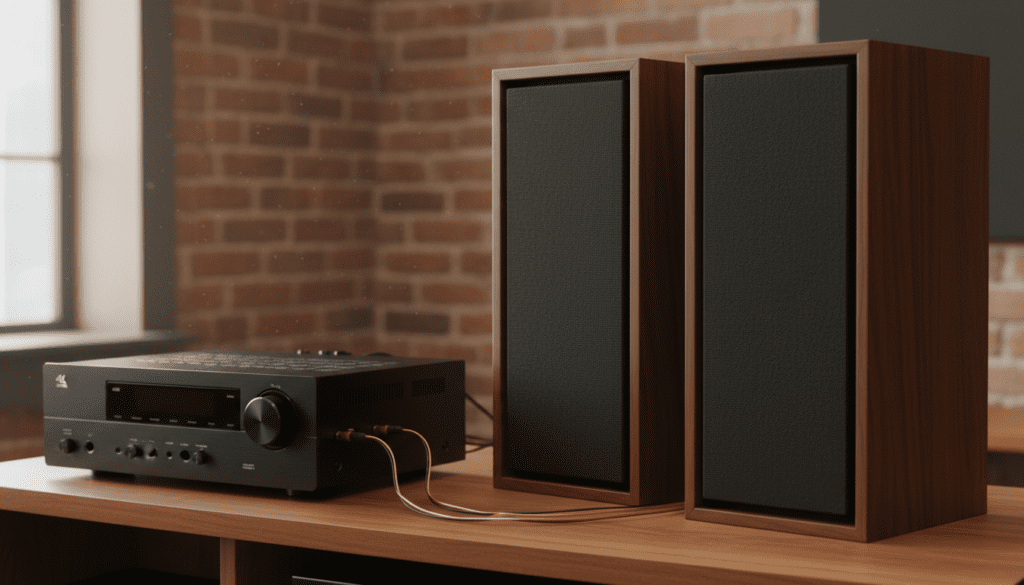
Upgrading your home theater to 4K or 8K video doesn’t mean your reliable “vintage” speakers are obsolete. In fact, many older high-end speakers outperform modern budget-friendly options because physics hasn’t changed; a high-quality driver and a well-built cabinet still produce excellent sound. In our testing at the lab, we’ve successfully paired 1990s Klipsch towers with the latest Denon and Marantz 4K units with spectacular results.
TL;DR: Key Takeaways
- Universal Compatibility: Almost all passive speakers are compatible with modern 4K AV receivers.
- Check Impedance: Ensure your speakers are rated between 4 and 8 ohms to avoid overheating the receiver.
- Analog vs. Digital: 4K refers to video resolution; audio signals sent to speakers remain analog, which is why old tech still works.
- The Subwoofer Exception: Older “passive” subwoofers (those without a power cord) may require a separate amplifier to work with new receivers.
- Calibration is Key: Use your receiver’s Room Correction software (like Audyssey or Dirac Live) to bridge the gap between old hardware and modern acoustics.
Understanding Why Your 4K AV Receiver Can Use Old Speakers
When you upgrade to a 4K AV receiver, you are primarily upgrading the video processing and digital-to-analog conversion (DAC) capabilities of your system. The way sound is delivered to a speaker hasn’t changed fundamentally in decades. Your receiver takes a digital signal, converts it to an electrical pulse, and sends it down a copper wire.
The “Analog” Advantage
Speakers are inherently analog devices. Whether a speaker was made in 1975 or 2024, it operates by using an electromagnetic coil to move a cone and create sound waves. Because of this, the primary keyword—can 4k av receiver still use old speakers—is a resounding “yes.” The receiver doesn’t care about the age of the speaker; it only cares about the electrical load that speaker places on the internal amplifiers.
Digital Video vs. Analog Audio
It is important to distinguish between the HDMI 2.1 or 4K/120Hz video signals entering the receiver and the audio signals leaving it. The “4K” label refers to the receiver’s ability to pass high-resolution video to your TV. The speaker terminals on the back of the unit still use standard binding posts or spring clips, just like receivers did thirty years ago.
Technical Compatibility: Ohms, Watts, and Wires
Before you plug everything in, there are three technical factors I always check to ensure the safety of the equipment.
Impedance Matching (The Ohms Rule)
Most modern receivers are designed for 6-ohm or 8-ohm speakers. If you have old high-end speakers that are 4-ohm, you need to ensure your 4K receiver is “4-ohm stable.”
- 8 Ohms: Standard and safe for every receiver.
- 6 Ohms: Generally safe for most mid-range receivers.
- 4 Ohms: Requires a high-current receiver or a specific setting in the menu to prevent the unit from entering “Protection Mode.”
Power Handling (Wattage)
Don’t worry too much about “blowing” your speakers unless there is a massive mismatch. A 100-watt 4K receiver can safely drive a speaker rated for 50 watts as long as you don’t turn the volume to maximum distortion levels. We actually prefer having more “headroom” (a more powerful receiver) to ensure the signal stays clean.
Connection Types
Old speakers usually have two types of connectors:
- Spring Clips: Common on entry-level vintage gear. You insert bare wire.
- Binding Posts: Found on higher-end gear. These accept Banana Plugs, which we highly recommend for 4K receivers to prevent stray wire strands from short-circuiting the unit.
| Feature | Old Speaker (Vintage) | New Speaker (Modern) | Compatibility with 4K Receiver |
|---|---|---|---|
| Signal Type | Analog | Analog | 100% Compatible |
| Connection | Bare Wire / Spring Clip | Banana Plug / Binding Post | Use Adapters if needed |
| Drivers | Paper/Silk/Kevlar | Modern Synthetics/Carbon | No Change in Connectivity |
| Subwoofer | Often Passive (No Amp) | Active (Built-in Amp) | May need an external amp |
Step-by-Step: How to Connect Old Speakers to a 4K Receiver
Following these steps ensures you don’t damage your new 4K investment while breathing life into your old gear.
Step 1: Inspect the Speaker Surrounds
Before connecting, look at the foam ring around the speaker cone (the surround). If the speakers have been in a garage or attic, this foam might be rotting. If it crumbles when touched, do not use them, as they will sound distorted and could damage your receiver’s amp.
Step 2: Prepare the Speaker Wire
If your old wires are thin (20-gauge or higher) or oxidized (look green/dark), buy new 14-gauge or 16-gauge Oxygen-Free Copper (OFC) wire.
- Strip approximately 1/2 inch of insulation off the ends.
- Twist the copper strands tightly.
Step 3: Connect the Terminals
Consistency is vital for Phase.
- Connect the Red (+) terminal on the speaker to the Red (+) terminal on the 4K receiver.
- Connect the Black (-) terminal on the speaker to the Black (-) terminal on the 4K receiver.
- Expert Tip: If you swap these, your speakers will be “out of phase,” resulting in thin sound and a complete lack of bass.
Step 4: Configure the Receiver Menu
Once connected, power on your 4K receiver and enter the Setup Mic (Auto-Calibration) mode.
- Modern receivers use Audyssey, YPAO, or Dirac Live.
- Place the included microphone at ear level.
- The receiver will send “pings” to your old speakers to measure their distance and frequency response. This process is essential because it “teaches” the modern receiver how to handle the unique sound profile of your older speakers.
The Subwoofer Problem: A Common Pitfall
The most common issue when people ask, “can 4k av receiver use old speakers?” involves the subwoofer.
- Modern 4K Receivers: Use an “LFE Out” (Low-Frequency Effects) RCA jack. This sends a low-voltage signal to a subwoofer that has its own power cord (an Active Subwoofer).
- Old “Home Theater in a Box” (HTIB): These often used Passive Subwoofers that connected via regular speaker wire.
The Solution: If your old subwoofer doesn’t have a power plug, you cannot plug it directly into a modern 4K receiver’s RCA jack. You will need a small, inexpensive Subwoofer Amplifier (like those from Fosi Audio or Dayton Audio) to bridge the gap.
Why You Might Actually Prefer Old Speakers
In my years of auditing home theater setups, I’ve found that high-quality vintage speakers often have a “warmth” that modern, tiny satellite speakers lack.
- Cabinet Volume: Older speakers are often larger. Larger cabinets generally produce deeper, more natural bass compared to modern slimline speakers that rely heavily on digital processing.
- Build Quality: A mid-range speaker from 1995 often used thicker MDF and heavier magnets than a budget “4K-Ready” speaker bundle sold today.
- Sustainability: Using your existing gear is better for the environment and your wallet, allowing you to spend more on a higher-quality OLED TV or a better HDMI 2.1 cable.
When Should You Upgrade Your Speakers?
While the answer to can 4k av receiver still use old speakers is usually yes, there are specific scenarios where an upgrade is beneficial:
- Dolby Atmos Requirement: If you want “sound from above,” you will need to add Atmos-enabled height speakers. Your old 5.1 set can remain as the “base layer,” but they cannot create overhead effects on their own.
- Timber Matching: if you are replacing just the center channel, it might not “voice match” your old left and right speakers, causing the soundstage to feel disjointed.
- Efficiency: Very old speakers may require a lot of power to drive. If your new 4K receiver is a slimline or entry-level model, it might struggle to push large, inefficient vintage towers.
Expert Maintenance Tips for Old Speakers
To get the most out of your setup, perform these three maintenance tasks:
- Tighten the Screws: Over years of vibration, the screws holding the drivers into the cabinet can loosen. Gently tighten them to improve bass clarity.
- Clean the Contacts: Use a bit of DeoxIT or isopropyl alcohol on the speaker terminals to remove oxidation and ensure a perfect electrical path.
- Check the Crossovers: If a speaker sounds “muffled,” the internal capacitor in the crossover might have dried out. This is an easy fix for a local repair shop or a DIY enthusiast with a soldering iron.
Frequently Asked Questions
Do I need special cables to connect old speakers to a 4K receiver?
No. Standard 14 or 16-gauge speaker wire is all you need. The “4K” aspect only requires high-speed HDMI cables for the input/output of video; the speaker connections remain standard copper wire.
Will using old speakers lower my video quality?
Absolutely not. The audio and video paths inside a 4K AV receiver are separate. Using 30-year-old speakers will have zero impact on your TV’s ability to display 4K, HDR10+, or Dolby Vision content.
Can I mix old speakers with new speakers in a 7.1 setup?
Yes, you can mix and match. However, for the best experience, try to keep the front three speakers (Left, Right, Center) from the same brand or era so the sound remains consistent as it moves across the screen.
What happens if my old speakers have a lower wattage than the receiver?
As long as you don’t turn the volume up to the point where you hear “cracking” or distortion, you are safe. Most “100-watt” receivers only output about 10-20 watts during normal listening levels.
Is there a limit to how “old” the speakers can be?
Essentially, no. As long as they use standard positive and negative terminals and the speaker cones are intact, you can connect speakers from the 1960s to a 2024 4K AV receiver without issue.