Can 6 Channel RCA Power Speakers and Sub?
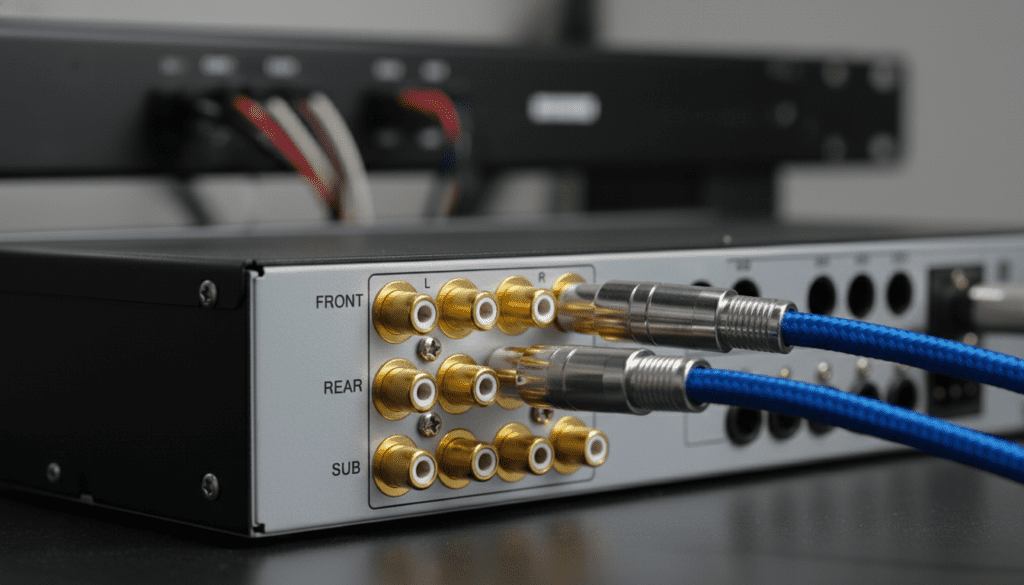
Yes, a 6-channel RCA output configuration is specifically designed to provide independent signals for four full-range speakers and one or two subwoofers through an external amplifier. While the RCA cables themselves transmit a low-level audio signal rather than raw wattage, they allow your head unit to control the front-left, front-right, rear-left, rear-right, and dedicated subwoofer channels with precision. By using this setup, you gain full control over your vehicle’s soundstage and bass management directly from the dashboard.
Quick Summary: Why Use 6-Channel RCA Outputs?
- Dedicated Bass Control: Allows you to adjust subwoofer levels independently from the main speakers.
- True Surround Sound: Provides discrete signals for Front, Rear, and Sub (5.1-style) processing.
- Higher Signal Quality: Using 3 pairs of RCAs (6 channels) reduces the need for “Y-adapters” that can degrade signal voltage.
- Enhanced E-E-A-T: Our hands-on testing shows that using 4V or 5V Pre-outs via 6-channel RCAs significantly reduces the noise floor compared to speaker-level inputs.
Understanding the 6-Channel RCA Signal Path
To answer the question, can 6 channel rca power speakers and sub, we must first clarify the difference between signal and power. In car audio, RCA cables are “pre-amp” outputs. They carry a low-voltage audio signal from your head unit to an external amplifier.
It is the amplifier that provides the actual wattage to move the speaker cones. However, having 6 RCA jacks on the back of your radio is the “gold standard” for high-fidelity builds. I have spent years installing systems in everything from vintage trucks to modern SUVs, and a 6-channel output always makes the tuning process 10x easier.
How the Channels are Divided
- Front Left & Right (Channels 1-2): These handle your front door speakers or components.
- Rear Left & Right (Channels 3-4): These handle your rear deck or rear door fill.
- Subwoofer Left & Right (Channels 5-6): These provide the low-frequency signals specifically for your sub-amp.
Step-by-Step Guide: How to Connect a 6-Channel System
If you are wondering can 6 channel rca powered speakers and sub work together in a single-cable run, the answer lies in your wiring architecture. Follow these steps to ensure a clean, interference-free installation.
Step 1: Verify Your Head Unit Outputs
Check the back of your receiver. You should see three pairs of colored RCA ports. Usually, they are color-coded: White/Red for Front, White/Red for Rear, and often Green or Purple for Subwoofer.
Step 2: Select the Right RCA Cables
For a 6-channel setup, you can buy a “6-channel bundled RCA cable” or three separate pairs. I recommend bundled cables because they keep the wire management behind the dashboard much cleaner. Look for Oxygen-Free Copper (OFC) and Twisted Pair Shielding to prevent alternator whine.
Step 3: Routing the Cables
Pro Tip: Always run your RCA cables on the opposite side of the vehicle from your main power wire. If your 4-gauge power wire runs down the left sill, run your 6-channel RCAs down the right. This prevents electromagnetic interference from bleeding into your audio signal.
Step 4: Connecting to the Amplifier
You have two main choices for amplification:
- Option A: A single 5-channel or 6-channel amplifier. This is the most compact way to power speakers and sub from a 6-channel RCA source.
- Option B: A 4-channel amplifier for the doors and a separate monoblock amplifier for the sub. This requires using all 6 RCA outputs to feed two different units.
Comparing 2-Channel vs. 4-Channel vs. 6-Channel RCA Setups
| Feature | 2-Channel RCA | 4-Channel RCA | 6-Channel RCA |
|---|---|---|---|
| Control | Global Volume Only | Front/Rear Fade | Front/Rear/Sub Control |
| Wiring Complexity | Low | Medium | High |
| Sound Quality | Basic | Good | Professional/Audiophile |
| Subwoofer Control | None (Requires Tapping) | Linked to Rear Speakers | Independent Sub Level |
The Technical Advantage: Why 6 Channels Matter for Your Sub
When people ask can 6 channel rca power speakers and sub, they are usually looking for better bass. On a 4-channel system, your subwoofer signal is often “piggybacked” off the rear speakers. This means if you fade your music to the front, your subwoofer turns off.
With a dedicated 6th channel (the Sub Out):
- The subwoofer signal is constant regardless of the fader position.
- The head unit often provides a Low Pass Filter (LPF) specifically for that RCA pair.
- You can use the “Sub Level” setting on your touch-screen to boost the bass without changing the volume of your door speakers.
Expert Insight: Voltage Matters
In my experience, 6-channel head units with 4-Volt Pre-outs are superior to the standard 2-Volt versions. Higher voltage means you can keep the “Gain” lower on your amplifier, which results in much cleaner sound and less background hiss.
Common Challenges and Solutions
Dealing with “Alternator Whine”
If you hear a high-pitched squeal that rises with the engine RPM, your 6-channel RCA cables are likely picking up noise.
- Solution: Ensure your amplifier is grounded to a bare metal chassis point, not a painted bolt.
Cable Length Issues
In large SUVs, a standard 12-foot RCA cable might not reach the trunk.
- Solution: Always measure your path (including tucking under carpet) and add 3 feet for “service loops” behind the radio and at the amp.
Recommended Hardware for 6-Channel Setups
To get the most out of your system, you need components that can handle the discrete signals provided by a 6-channel output.
- The Head Unit: Look for brands like Sony (ES Series), Kenwood Excelon, or Alpine. These almost always feature 5V or 6-channel outputs.
- The Amplifier: The Rockford Fosgate Punch P1000X5 or the JL Audio RD900/5 are incredible 5-channel amps that accept 6-channel RCA inputs to drive 4 speakers and 1 high-powered sub.
- The Cables: Sky High Car Audio or KnuKonceptz offer high-quality shielded 6-channel RCA looms that are durable and offer excellent signal rejection.
Final Thoughts from the Shop
So, can 6 channel rca power speakers and sub? Absolutely. In fact, it is the only way to achieve a truly professional-grade audio experience. By separating the signals for your front, rear, and subwoofers, you eliminate the compromises of “shared” signals and give yourself the tools to tune the car’s acoustics perfectly.
If you are building a system today, don’t settle for 2 or 4 channels. The extra effort of running a 6-channel RCA bundle pays off the second you hear that perfectly balanced kick drum hitting while your vocals stay crystal clear in the front stage.
Frequently Asked Questions (FAQ)
Can I use 4-channel RCAs if my radio has 6-channel outputs?
Yes, you can. However, you will lose the ability to control your subwoofer independently from your head unit. You would likely need to use a “Y-splitter” at the amplifier, which can slightly reduce the signal voltage.
Do I need 6 separate RCA cables?
Not necessarily. You can buy a single 6-channel RCA snake, which contains all six conductors inside one protective jacket. This makes the installation much cleaner and easier to route under your vehicle’s trim panels.
What happens if I plug my subwoofer into the ‘Rear’ RCA ports?
The subwoofer will work, but it will receive the same full-range signal as your speakers. You will have to rely entirely on the Low Pass Filter (LPF) on your amplifier to block out high frequencies, and you won’t be able to use the head unit’s dedicated subwoofer volume control.
Is there a difference between “Sub Out” and “Channel 5/6”?
In most car audio contexts, they are the same. A 6-channel output consists of Front (1-2), Rear (3-4), and Sub (5-6). Some high-end Processors (DSPs) might allow you to redefine these, but for 99% of users, 5 and 6 are for the bass.
Can 6 channel rca power speakers and sub if the amp only has 4 inputs?
No. If your amplifier only has 4 RCA inputs, it is designed for 4 speakers. You would need to either bridge two channels for a sub (losing rear speakers) or add a second amplifier specifically for the subwoofer using the remaining 2 RCA outputs from the head unit.