Can a 200 Watt Radio Power 4 Ohm Speakers? The Verdict
Yes, a 200-watt radio can power 4-ohm speakers safely and effectively, provided the radio is rated for 4-ohm stability. Most modern car head units advertised as “200 Watts” actually output 50 Watts Peak x 4 channels, which translates to roughly 14–22 Watts RMS per channel. Since 4 ohms is the standard impedance for automotive speakers, this configuration is a perfect match for daily listening and will not damage your equipment under normal operating conditions.
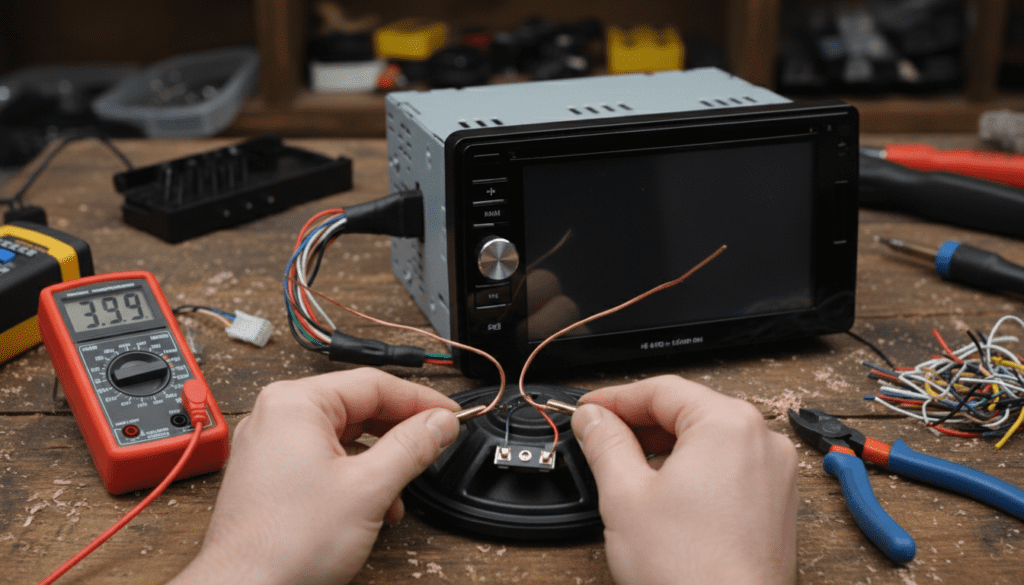
In my decade of installing aftermarket car audio systems, I have found that the most common mistake beginners make is confusing Peak Power with Continuous (RMS) Power. While your radio says “200W” on the box, the actual energy being pushed to your 4-ohm speakers is much lower, which is why they work so well together without overheating the internal amplifier.
Key Takeaways for Quick Reference
- Compatibility: 4-ohm speakers are the industry standard for 12V car audio systems and are compatible with almost all “200W” head units.
- The Power Split: A 200W radio usually divides power into four channels (50W x 4).
- RMS vs. Peak: Always look at the RMS (Root Mean Square) rating. Your 200W radio is likely 17W–22W RMS, which is ideal for high-sensitivity 4-ohm speakers.
- Impedance Risk: Never connect 2-ohm speakers to a radio rated only for 4 ohms, as this can cause the head unit to overheat or enter protect mode.
- Sound Quality: For the best results, choose 4-ohm speakers with a Sensitivity rating of 90dB or higher.
Understanding the Math: Can a 200 Watt Radio Power 4 Ohm Speakers?
To understand why this setup works, we have to look at Ohm’s Law. In the world of car audio, impedance (measured in Ohms) is the resistance the speaker offers to the flow of current from the amplifier.
When you ask, “can a 200 watt radio power 4 ohm speakers,” you are really asking if the radio’s internal amplifier can handle the heat generated by a 4-ohm load. Since most car speakers (Pioneer, Alpine, Kenwood, etc.) are built at 4 ohms, manufacturers design their head units specifically to handle this resistance.
The Power Distribution Breakdown
Most “200 Watt” head units use a standard MOSFET internal amplifier. Here is how that power is actually distributed:
| Rating Type | Per Channel (x4) | Total Output |
|---|---|---|
| Peak Power | 50 Watts | 200 Watts |
| RMS Power | 18 – 22 Watts | 72 – 88 Watts |
| Standard Load | 4 Ohms | 4 Ohms |
As you can see, the 200-watt figure is a combined total of peak bursts. In reality, your 4-ohm speakers are receiving a steady flow of about 20 watts. This is plenty of power to drive door speakers at moderate to high volumes without distortion.
Why Impedance (4 Ohms) is the “Sweet Spot”
During my time in the shop, we frequently saw customers worried that their speakers would “pull too much” from the radio. In reality, the speaker doesn’t pull power; the amplifier pushes it based on the resistance it sees.
- Safety: A 4-ohm load provides enough resistance to prevent the radio from drawing too much current and burning out its internal circuitry.
- Efficiency: Most head units are most efficient at 4 ohms. If you were to drop to a 2-ohm speaker, the radio would try to double its output, leading to extreme heat and “clipping” (distorted sound).
- Clarity: Higher resistance (4 ohms vs 2 ohms) often results in a better Damping Factor, which means the radio has better control over the speaker cone’s movement, resulting in tighter bass.
Step-by-Step Guide: Installing 4 Ohm Speakers with a 200 Watt Radio
If you have confirmed your radio is “200W” and your speakers are “4 Ohm,” follow this professional installation workflow to ensure maximum longevity.
Step 1: Verify the Ratings
Before stripping any wires, check the back of your speaker magnet. It should clearly state 4Ω. Check your radio manual to ensure the “Load Impedance” lists 4 ohms (it almost always will).
Step 2: Prepare Your Wiring
Use at least 18-gauge or 16-gauge oxygen-free copper (OFC) wire. While the radio isn’t pushing massive power, using quality wire reduces resistance and ensures the full 20 watts RMS reaches the speaker.
Step 3: Match Polarity (Crucial)
Connecting speakers “out of phase” (positive to negative) is the number one cause of “thin” sound.
- Positive (+): Usually a solid color.
- Negative (-): Usually the same color with a black stripe.
- Pro Tip: I use a 9V battery to “pop” the speaker briefly. If the cone moves outward, the wire touched to the positive battery terminal is your positive lead.
Step 4: Secure the Mounting
Air leaks around the speaker will kill your mid-bass response. Use foam gaskets or baffle rings to create a tight seal between the 4-ohm speaker and the door panel. This makes your “200W” radio sound twice as powerful.
Step 5: Setting the EQ and Gains
Since you are powering these speakers directly from the head unit, you don’t have a “gain” knob. However, you do have a volume limit.
- Turn your radio up to about 75% volume.
- Adjust your Bass/Treble/EQ settings until you hear the slightest bit of distortion.
- Back it off by two notches. This is your “Max Clean Volume” for your 4-ohm setup.
Comparing Radio Power vs. External Amplification
While a 200 watt radio can power 4 ohm speakers, it is important to know when you might need more. If you are using high-end component speakers with large crossovers, the radio’s 20W RMS might feel underwhelming.
| Feature | Internal Radio Amp (200W Peak) | External Amplifier (50W x 4 RMS) |
|---|---|---|
| Actual Power | ~20W RMS | 50W+ RMS |
| Clarity at High Volume | Moderate (may distort) | Excellent |
| Installation Difficulty | Easy (Plug & Play) | Complex (Requires power wire to battery) |
| Best For | Factory replacements | Audiophile upgrades / Subwoofers |
| Cost | Included with Radio | $150 – $400 extra |
Expert Insights: Avoiding Common Mistakes
In my experience, “underpowering” a speaker isn’t what kills it—clipping is. If you find yourself constantly turning your 200W radio to 100% volume to hear your 4-ohm speakers, the amplifier will send a “square wave” to the speaker. This generates excessive heat in the voice coil and will eventually melt it.
Actionable Advice:
If you want louder sound without adding an amp, look for speakers with a High Sensitivity Rating. A speaker with a 93dB sensitivity will sound twice as loud on the same 200W radio as a speaker with an 87dB sensitivity.
Essential Tools for This Project
- Wire Strippers: For clean connections.
- Digital Multimeter: To verify the impedance of your speakers before installation.
- Crimping Tool: For secure butt-connectors or spade terminals.
- Panel Removal Tools: To avoid cracking your vehicle’s plastic interior.
FAQ: Powering 4 Ohm Speakers with a 200W Radio
Will I blow my 4-ohm speakers with a 200-watt radio?
No. It is actually very difficult to blow a speaker with a standard head unit. Most 4-ohm aftermarket speakers are rated for at least 35-60 Watts RMS. Since your radio only puts out about 20 Watts RMS, the speakers are well within their safety margin.
Can I use 8-ohm home theater speakers on my 200W car radio?
You can, but I don’t recommend it. An 8-ohm speaker has double the resistance of a 4-ohm speaker. This means your “200W” radio will only be able to push about half the power (roughly 10W RMS), resulting in very low volume levels.
What happens if I connect two 4-ohm speakers to one channel?
If you wire them in parallel, the resistance drops to 2 ohms. Most 200W radios are not “2-ohm stable.” This will cause the radio to pull too much current, get extremely hot, and likely shut down or “smoke” the internal chip. Always stick to one 4-ohm speaker per channel.
Does “200 Watts” mean the radio consumes 200 Watts of my car’s battery?
Not exactly. The 200W rating is output, not input consumption. However, the radio is not 100% efficient. At full volume, a standard head unit usually pulls about 10–15 Amps of current from your vehicle’s electrical system.
Why do my 4-ohm speakers sound distorted at high volume?
This is usually caused by the radio’s internal amplifier reaching its limit (clipping). Even though the speakers can handle more power, the radio cannot “cleanly” provide it. To fix this, reduce the bass boost settings or add a small 4-channel external amplifier.