Understanding Why a Line Output Converter Can Mute Your Speakers
Yes, can a line output converter mute speakers? The answer is a definitive yes, though it usually happens as a protective measure or due to a wiring error. A Line Output Converter (LOC) can mute your speakers if the installation causes a short circuit, triggers a factory radio’s impedance-sensing protection, or if the unit itself is defective. In modern vehicles, OEM integration is sensitive; if the head unit detects a load change it doesn’t like, it will often shut down the internal amplifier to prevent damage, resulting in total silence.
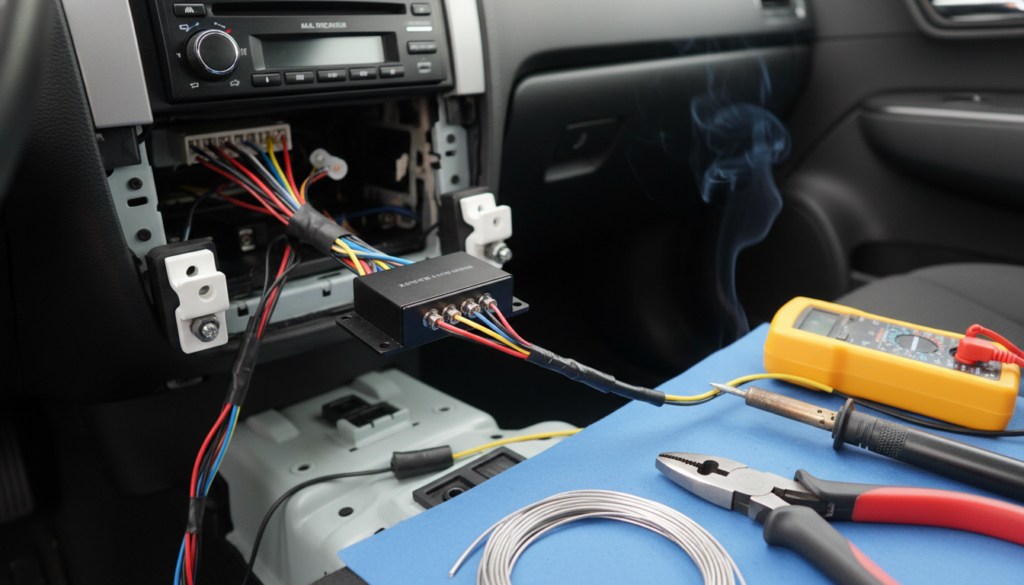
During my 15 years in car audio installation, I have seen countless DIY enthusiasts panic when their factory speakers go dead after tapping into the lines for a new subwoofer. Most often, this isn’t a “blown” radio, but rather the car’s Load Sensing system reacting to the high-impedance input of a low-quality passive LOC. By understanding how these devices interact with your vehicle’s electrical ecosystem, you can restore your sound and ensure a high-fidelity signal.
Key Takeaways: LOC Basics and Troubleshooting
- Safety Shutdown: Modern factory head units (like those in Dodge, Chrysler, and Ford) use DC Offset or Load Detection and may mute if they don’t “see” a speaker.
- Wiring Faults: A single stray wire strand touching the vehicle chassis can trigger “Protect Mode,” muting all output.
- Passive vs. Active: Active LOCs (like the AudioControl LC2i) are less likely to cause muting because they can provide a simulated load to the factory system.
- Signal Summing: If you tap into the wrong wires, you might experience phase cancellation, which makes the speakers sound extremely quiet or “muted.”
What is a Line Output Converter and How Does It Work?
A Line Output Converter (LOC) is a transformer-based or electronic device that steps down a high-level speaker signal to a low-level RCA signal. This is essential when you want to add an aftermarket amplifier or subwoofer to a factory radio that lacks RCA outputs.
I’ve found that many users treat an LOC as a simple “plug and play” adapter, but it is a critical bridge in your signal chain. It must handle the voltage produced by your factory head unit and convert it into a voltage that your aftermarket amplifier can process without distortion (clipping).
How the Conversion Process Affects Your Sound
- Voltage Reduction: The LOC takes the 10V–40V signal from your speaker wires and drops it to roughly 2V–8V for the RCAs.
- Impedance Matching: It acts as a middleman between the low impedance of a speaker (typically 4-Ohms) and the high impedance of an amplifier’s input.
- Isolation: High-quality LOCs use isolation transformers to prevent ground loops, which cause that annoying engine whine.
Can a Line Output Converter Mute Speakers? The Technical Reasons
When someone asks, can a line output converter mute speakers, they are usually experiencing one of three specific technical failures.
The “Open Circuit” Protection (Load Sensing)
Modern vehicles with Class D factory amplifiers monitor the resistance on the speaker lines. When you cut a speaker wire to install an LOC, the radio no longer “sees” the 4-Ohm load of the speaker. It assumes the speaker is blown or disconnected and mutes the channel to prevent the internal circuitry from overheating.
Short to Ground
During a DIY install, it is incredibly easy to accidentally ground one side of the speaker wire. Most factory radios are Bridge-Tied Load (BTL), meaning neither the positive nor the negative wire is a ground. If either touches the metal frame of the car, the radio will immediately enter Protect Mode and mute all audio output.
Signal Phase Cancellation
If you wire the left channel correctly but swap the positive and negative on the right channel, the two signals will “fight” each other. This is known as being out of phase. While not technically “muted,” the bass and mid-range frequencies will cancel each other out, making the system sound incredibly thin and quiet.
Active vs. Passive Line Output Converters: Which Is Better?
Choosing the right type of LOC is the best way to ensure your speakers don’t mute. In my experience, spending the extra $50 on an Active LOC saves hours of troubleshooting.
| Feature | Passive LOC | Active LOC |
|---|---|---|
| Power Requirement | None (Self-powered) | Requires 12V Power & Ground |
| Signal Quality | Can be low; prone to roll-off | High-fidelity; wide frequency range |
| Load Simulation | Usually none; may mute factory radios | Often includes Load Resistors |
| Output Voltage | Low (usually < 2V) | High (up to 9V or more) |
| Best For | Budget-friendly basic sub adds | Premium systems/Modern vehicles |
Expert Insight: If you drive a vehicle made after 2015, I strongly recommend using an Active LOC with built-in load generating resistors. This tricks the factory computer into thinking the speakers are still connected, preventing the system from muting.
Step-by-Step Guide: Installing an LOC Without Muting Your Speakers
To avoid the dreaded silent speakers, follow this professional-grade installation process. We will assume you are tapping into the rear speakers to add a subwoofer amplifier.
Step 1: Identify Your Wiring
Use a vehicle-specific wiring diagram to identify the color codes for your left and right rear speakers. Do not guess. Using a AA battery to “pop” the speakers is a classic trick, but in modern cars with digital amps, this can actually damage the factory equipment.
Step 2: Access the Speaker Wires
You can usually find these wires in the B-pillars, under the doorsills, or directly behind the head unit.
- Pro Tip: I prefer tapping in at the doorsills because it provides more room to work and keeps the RCA cables away from power wires, reducing noise.
Step 3: Use High-Quality Connectors
Avoid “T-Taps” if possible. While convenient, they often cut through wire strands, increasing resistance and potentially triggering a mute condition. I recommend a Military Splice or high-quality soldered joints protected by heat shrink tubing.
Step 4: Connect the LOC
- Connect the Left (+) and Left (-) wires of the LOC to the corresponding factory wires.
- Repeat for the Right channel.
- If using an Active LOC, connect the 12V Constant, Ground, and Remote Turn-on leads.
- Important: Ensure no bare wires are touching the vehicle’s metal body.
Step 5: Test for “Mute” Conditions
Turn on the ignition. If the factory speakers are silent, your radio has likely detected the change in impedance. You may need to add Load Resistors (usually 33-Ohm or 47-Ohm) across the speaker leads to satisfy the factory head unit.
Troubleshooting: What to Do If Your Speakers Muted After Install
If you just finished your install and are met with silence, don’t panic. Follow this diagnostic checklist I’ve developed over years of shop work.
Check the Factory Fuses
Check the fuses labeled RADIO, AMP, or INFO. A momentary short during installation is all it takes to pop a small 10A fuse.
Isolate the LOC
Disconnect the LOC from the factory wires. If the sound returns to the speakers, the issue is either:
- The LOC has a shorted internal transformer.
- The LOC’s impedance is too high for the radio’s protection circuit.
Verify the Grounding
If you are using an Active LOC, ensure your ground point is bare metal. Paint is an insulator. A “floating ground” can cause the LOC to send back-fed voltage into the head unit, triggering a mute.
Adjust the Gain Settings
If the LOC has gain dials, ensure they aren’t turned all the way down. Conversely, if they are turned all the way up, you might be sending a clipped signal to your amp, which might be entering its own “Protect Mode.”
Advanced Tech: Dealing with Factory Bass Roll-off
Even if your speakers aren’t muted, you might feel like they are “dying” as you turn the volume up. This is Bass Roll-off, a feature manufacturers use to protect cheap factory speakers.
When you add a subwoofer via an LOC, this roll-off makes the sub sound weak at high volumes. To fix this, look for an LOC with AccuBASS or similar signal restoration technology. This circuitry monitors the incoming signal and injects the missing low-end frequencies back into the RCA output, keeping your system loud and clear.
Safety and Best Practices for OEM Integration
- Disconnect the Battery: Always pull the negative terminal before cutting any factory wires. This prevents accidental shorts that could fry the Body Control Module (BCM).
- Use a Multimeter: Before connecting your LOC, use a Digital Multimeter (DMM) to check for continuity to ground on your speaker leads. There should be none.
- Secure the Unit: Use industrial-strength Velcro or zip ties to secure the LOC. If it bounces around, the wires can fatigue and break, eventually leading to a short and a muted system.
FAQ: Can a Line Output Converter Mute Speakers?
Why did my factory radio stop playing music after I installed an LOC?
Most likely, your car has a load-detection system. When the radio detects the high impedance of the LOC instead of the 4-Ohm speaker, it shuts down the output to protect itself. You may need an Active LOC with a Load Selection switch or external load resistors.
Can a bad ground on an LOC cause speakers to mute?
Yes. On Active LOCs, a poor ground can cause the device to malfunction and send “DC offset” back into the factory radio’s output stage. This will cause the radio to enter protect mode and mute the audio.
Will an LOC work with a Bose or Sony factory amplified system?
Yes, but it’s trickier. You must tap into the signal after the factory amplifier for a full-range signal, or before the amp if you are using a specialized DSP or high-voltage LOC. Tapping in the wrong spot can definitely result in muted or highly distorted sound.
How do I know if my LOC is blown?
Use a Multimeter to check the resistance across the input wires of the LOC. If you see “OL” (Open Loop) or 0 Ohms (Direct Short), the internal transformer or circuit board is likely damaged.
Does the “Gain” on an LOC control speaker volume?
No, the gain on an LOC controls the pre-amp voltage being sent to your aftermarket amplifier. If it is set too low, your subwoofer will be very quiet. If set too high, the signal will clip, potentially damaging your equipment.