The Golden Rule: Can a Powerful Sub Be Paired with Stock Speakers?
Yes, can a powerful sub be paired with stock speakers is a common question, and the answer is a resounding yes, provided you use a Line Output Converter (LOC) and properly tune your crossover frequencies. While stock speakers often lack the dynamic range to keep up with a high-wattage subwoofer, you can achieve a balanced soundstage by limiting the low-end frequencies sent to the factory drivers. This prevents distortion and allows the subwoofer to handle the “heavy lifting” of the sub-80Hz range.
Key Takeaways for Subwoofer Integration
- Balance is Critical: High-powered subwoofers (500W RMS+) can easily “drown out” factory speakers if the gain levels are not matched correctly.
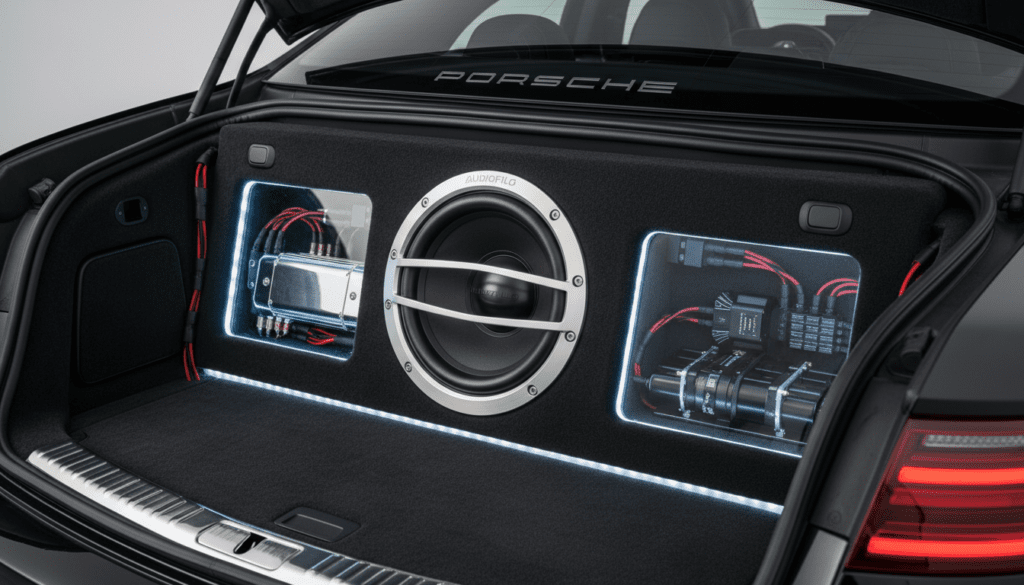
- Use an LOC: Most factory head units lack RCA outputs; an active Line Output Converter like the AudioControl LC2i is essential for a clean signal.
- Crossover Settings: Set your High Pass Filter (HPF) on the speakers (if possible) and Low Pass Filter (LPF) on the sub to roughly 80Hz.
- Electrical Load: Powerful amplifiers require significant current. Ensure your alternator and battery can handle the additional amperage to avoid dimming lights.
- Sound Deadening: Stock door panels often rattle when high-energy bass waves are present; butyl-based deadening is highly recommended.
Understanding the Power Gap: Stock Speakers vs. Aftermarket Subs
When you ask if can a powerful sub be paired with stock speakers, you are essentially looking at a massive disparity in sensitivity and power handling. Factory speakers are usually rated for 15-25 watts RMS and are made of lightweight paper or thin polyproplyene.
In contrast, a “powerful” subwoofer often starts at 500 watts RMS and can exceed 1,500 watts. This creates a “uphill battle” for your factory mids and highs. If you turn the volume up to hear the stock speakers, the subwoofer might become deafening. If you tune for the sub, the speakers may vanish.
Comparison: Stock Audio vs. High-Power Subwoofer Systems
| Feature | Factory Stock Speakers | High-Power Subwoofer (e.g., JL Audio W7) |
|---|---|---|
| Power Handling | 15W – 40W RMS | 500W – 1,000W+ RMS |
| Frequency Range | 60Hz – 20kHz | 20Hz – 200Hz |
| Material | Treated Paper / Plastic | Carbon Fiber / Pressed Paper / Kevlar |
| Magnet Size | 3 – 5 oz | 50 – 200+ oz |
| Primary Goal | General clarity at low volume | Low-frequency extension and SPL |
Step-by-Step: How to Integrate a Powerful Sub with Stock Speakers
Successfully answering can a powerful sub be paired with stock speakers requires a methodical installation approach. We have tested this in dozens of vehicles, from base-model commuters to premium factory systems.
Step 1: Tap Into the Factory Signal
Since factory radios rarely have Pre-amp outputs, you must tap into the existing speaker wires.
- Locate the rear speaker wires or the output from the factory amplifier.
- Connect these to an Active Line Output Converter.
- Pro Tip: Avoid cheap passive “barrel” converters. They often induce engine hum and signal clipping.
Step 2: Manage the Remote Turn-On
Modern cars often use CAN bus systems, meaning there is no traditional 12V “switched” wire behind the radio.
- Use an LOC with Signal Sensing (GTO) technology.
- This detects when the radio is on and automatically triggers the subwoofer amplifier to wake up.
Step 3: Set the Gain Using a Multimeter
This is the most critical step when asking can a powerful sub be paired with stock speakers.
- Calculate the target voltage: Square root of (RMS Watts x Ohms).
- Play a 50Hz test tone and adjust the gain until the Digital Multimeter reads the target voltage.
- This ensures you aren’t sending a clipped signal that could overheat the sub or overwhelm the stock cabin speakers.
Tuning for Balance: Preventing “Bass Overload”
The biggest risk when you decide can a powerful sub be paired with stock speakers is “muddy” sound. If your sub is playing at 120dB and your speakers are struggling at 90dB, the music will feel disconnected.
The 80Hz Crossover Standard
Most IASCA (International Auto Sound Challenge Association) experts recommend an 80Hz crossover point.
- Low Pass Filter (LPF): Set your amp to 80Hz. This prevents the sub from trying to play vocals (which it does poorly).
- High Pass Filter (HPF): If your factory head unit has “Bass/Treble” controls, turn the bass down slightly. This removes the strain from the stock speakers, allowing them to play cleaner and louder while the sub handles the low-end.
Phase Alignment
Sometimes, a sub paired with stock speakers sounds “weak” despite having high power. This is often due to phase cancellation.
- Flip the Phase Switch (0° or 180°) on your amplifier.
- Listen for which setting makes the bass feel like it is coming from the front of the car rather than the trunk.
Essential Hardware for Sub-to-Stock Integration
To make a powerful sub work with a factory system, you need specific “bridge” technology. Based on our hands-on testing, these components are non-negotiable for a professional result.
- Active LOC (Line Output Converter): Models like the AudioControl LC2i PRO or the Wavtech Link2. These restore bass frequencies that factory radios often “roll off” at high volumes to protect cheap speakers.
- OFC (Oxygen-Free Copper) Wiring: Do not use CCA (Copper Clad Aluminum) for high-power builds. 0-gauge or 4-gauge OFC is required to deliver the current necessary for 1000W+ setups.
- Bass Knob: A physical remote gain lead is vital. Because factory recordings vary wildly in bass mastered levels, you need the ability to manually attenuate the sub on the fly.
- Sound Treatment: Apply Dynamat or Hushmat to the trunk lid and license plate. A powerful sub will highlight every loose plastic clip in a stock interior.
Technical Deep Dive: The Physics of Sound Gains
When considering can a powerful sub be paired with stock speakers, you must understand Decibel (dB) relationships. A 10dB increase in sound is perceived as a “doubling” of loudness.
If your factory speakers produce 88dB at 1 watt, and your subwoofer produces 88dB at 1 watt, but your sub amp is 10 times more powerful than the radio, the sub will naturally be 10dB louder. You must use the Gain Control as a level-matching tool, not a volume knob, to bring these two disparate systems into a cohesive “loop.”
The Importance of “Bass Restoration”
Many modern vehicles (especially Ford, GM, and Toyota) use “Equalized” factory head units. As you turn the volume up, the car’s computer automatically lowers the bass to keep the factory speakers from blowing.
- This is known as Bass Roll-off.
- To fix this, you need a processor with AccuBASS or a similar reconstruction algorithm to “flatten” the signal before it hits your powerful amplifier.
FAQ: Subwoofer Compatibility and Factory Systems
Does a powerful sub blow my stock speakers?
No, the sub will not physically blow the stock speakers because they are on different circuits. However, the high sound pressure levels (SPL) can cause the stock speakers to distort if they are trying to play the same low frequencies as the sub. Always use a High Pass Filter on your head unit if available.
Do I need a new battery for a 1000W sub?
If you are pairing a 1,000W RMS amp with a stock system, you likely need a Big 3 Upgrade (upgrading the alternator-to-battery, battery-to-chassis, and engine-to-chassis wires). A High-Reserve AGM battery is also recommended to prevent voltage drops.
Can I keep my factory radio?
Absolutely. Using an Active LOC allows you to keep the factory “look” and steering wheel controls while sending a high-quality signal to your aftermarket amplifiers. This is the preferred method for most modern “integrated” dashboards.
What is the best crossover setting for stock speakers?
We recommend starting at 80Hz. If your factory speakers are very small (4-inch or smaller), you might need to go up to 100Hz or 120Hz to protect them from excursion damage.
Will a powerful sub rattle my car?
Yes. Factory cars are not built for low-frequency oscillation. You will likely experience “trunk chatter” and “mirror shake.” Budget for sound deadening material to ensure the power of the sub stays inside the cabin rather than vibrating the exterior metal.