Understanding How a Storm Can Blow Your Speakers Even if They’re Off
Yes, a storm can blow your speakers if they’re off because the physical “off” switch on modern electronics rarely disconnects the internal circuitry from the power source completely. A high-voltage lightning strike or a power surge can travel through electrical lines, HDMI cables, or even speaker wire, bypassing the power button and frying delicate components like voice coils and integrated amplifiers.
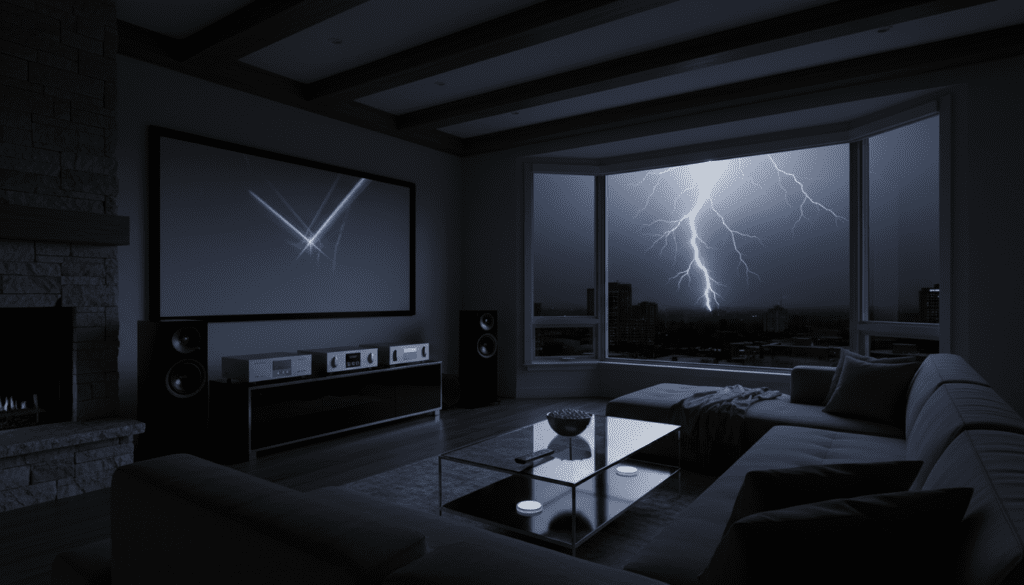
During my years as a professional AV technician, I’ve seen countless “dead” home theaters where the owners were baffled because everything was powered down. The reality is that “off” is usually just a standby mode, leaving a path open for thousands of volts to enter your equipment.
Key Takeaways for Storm Protection
- Total Isolation: The only 100% guarantee against storm damage is physically unplugging the power and data cables from the wall.
- Surge Vulnerability: Even if your speakers aren’t “on,” an electrical surge can jump the gap in a standard power switch (a process known as arcing).
- Signal Path Risks: Power doesn’t just come from the wall; surges can travel through Ethernet cables, coaxial lines, and subwoofer interconnects.
- Component Failure: The most common failure points are the power supply units (PSU) in active speakers and the crossovers in passive ones.
The Science: Can a Storm Blow Your Speakers if They’re Off?
To understand why your gear is at risk, we have to look at how electricity behaves during a meteorological event. When people ask, “can a storm blow your speakers if they’re off,” they are usually thinking of the power button as a physical gate. In the past, this was true, but today’s electronics are much more complex.
The “Standby” Trap
Most modern speakers, especially Bluetooth speakers, smart speakers like Sonos, and active studio monitors, never actually turn off. They enter a low-power standby mode so they can respond to remote commands or wake up instantly. This means the transformers and capacitors inside are still connected to the grid, making them “sitting ducks” for a voltage spike.
Electrical Arcing and Induction
Lightning carries millions of volts. If a strike hits a nearby power pole, the resulting surge is so powerful that it can “arc” or jump across the small gap inside a standard power switch. Furthermore, electromagnetic induction can occur. If lightning strikes near your house, the massive electromagnetic field can induce a current directly into your speaker wires, even if they aren’t plugged into a wall outlet at all.
Active vs. Passive Speakers: Which is More at Risk?
Not all speakers react to storms the same way. We categorize them into two main types: Active (Powered) and Passive (Non-powered).
| Speaker Type | Power Source | Primary Risk Factor | Vulnerability Level |
|---|---|---|---|
| Active Speakers | Internal Amp (Plugged into wall) | Power supply failure, PCB frying | High |
| Passive Speakers | External Amp (Connected via wire) | Voice coil burnout via induced current | Medium |
| Subwoofers | Internal Amp (Plugged into wall) | Plate amp failure, fuse blowout | Very High |
| Smart Speakers | USB/DC Adapter | Logic board corruption | High |
Why Active Speakers Are Targets
Active speakers, such as Bose SoundTouch or JBL LSR series, contain their own amplification. These have complex Printed Circuit Boards (PCBs) and sensitive Integrated Circuits (ICs). A surge doesn’t just “blow” the speaker cone; it destroys the brain of the unit. I have frequently opened these units after storms to find charred components and melted solder joints.
The Danger to Passive Speakers
You might think your passive bookshelf speakers are safe because they aren’t plugged into the wall. However, they are connected to an AV Receiver. If the receiver gets hit by a surge, it can send a massive “thump” of DC voltage down the speaker lines. This excess energy causes the voice coil to overheat instantly, melting the adhesive and causing the speaker to “seize” or sound scratchy.
Signs Your Speakers Were Damaged by a Storm
If a storm recently passed through and you’re worried about your setup, look for these specific red flags.
- The “Dead” Unit: The most obvious sign. If the status light won’t turn on, the internal fuse or power supply has likely failed.
- Acrid Smell: Electrical components release a very distinct, metallic burning smell when they “pop.” If your speaker smells like burnt plastic, it’s a bad sign.
- Visible Distortion: If the speaker plays but sounds “fuzzy” or “crunchy,” the voice coil may have been partially melted or deformed by a surge.
- The “Popping” Sound: If you hear a loud pop when you finally turn the unit on, it could be a failing capacitor that was damaged during the storm.
- Humming or Buzzing: A constant low-frequency hum (even when no music is playing) often indicates that the grounding circuit or filter capacitors in the amplifier were fried.
How to Protect Your Audio Gear: A Step-by-Step Guide
Prevention is significantly cheaper than replacement. Here is the protocol we use in professional recording studios to ensure storm effects don’t ruin six-figure equipment.
Step 1: Invest in a High-Quality Surge Protector
Don’t rely on a $10 power strip from a grocery store. You need a device with a high Joule rating (at least 2000 Joules or higher). Look for brands like APC, Tripp Lite, or Panamax.
- Pro Tip: Check the “Protected” LED. If it’s out, the protector has already sacrificed itself in a previous minor surge and is no longer offering protection.
Step 2: Use a Power Conditioner
For high-end audiophile gear, a Power Conditioner is superior to a surge protector. It filters out “dirty” electricity and provides a much more robust defense against voltage fluctuations. Furman is the industry standard for protecting sensitive audio racks.
Step 3: Address Data Lines
Surges don’t just travel through power outlets. I’ve seen lightning enter a home through a satellite dish, travel down the coaxial cable to the cable box, go through the HDMI cable to the receiver, and finally blow the speakers.
- Ensure your surge protector has ports for Ethernet and Coaxial cables.
Step 4: The Physical Disconnect
If the forecast calls for a severe electrical storm, the only certain protection is the physical air gap.
- Turn off the equipment.
- Unplug the main power cord from the wall.
- Disconnect the subwoofer LFE cable (these are notorious for carrying surges).
- Wait until the storm has completely passed before reconnecting.
The Role of Insurance and Warranties
When a storm blows your speakers if they’re off, you might wonder if you’re covered.
Manufacturer Warranties: Generally, these do not cover “Acts of God” or weather-related damage. If the technician finds evidence of a power surge (charred boards), they will likely deny the claim.
Homeowners/Renters Insurance: This is your best bet. Most policies cover lightning strikes. However, keep in mind your deductible. If you have $5,000 worth of Kef or Klipsch speakers, it’s worth the claim. If it’s a $200 soundbar, you might be better off paying out of pocket to avoid a premium hike.
Surge Protector Guarantees: Many high-end surge protectors come with a Connected Equipment Warranty. If your gear is plugged into an APC unit and it gets fried, the company may reimburse you. Always register your product and keep your receipts!
Frequently Asked Questions
Can lightning damage speakers not plugged in?
Surprisingly, yes. If lightning strikes very close to your home, it creates a massive Electromagnetic Pulse (EMP). This can induce a current in any long metal wire, including speaker cables running through your walls. While rare, this can “pop” a speaker driver even if it’s disconnected from the amplifier.
Does turning off the power strip protect my speakers?
Not necessarily. Most power strips only have a single-pole switch. A massive surge can still jump across the open contact. To be safe, you must unplug the strip from the wall outlet entirely.
Is it safe to play music during a thunderstorm?
It is generally safe for your ears, but not for the equipment. If you are using a wired system, a sudden surge could cause a massive voltage spike to hit the speakers, potentially creating a sound loud enough to cause hearing damage or simply destroying the gear while you’re using it.
Do “Whole House” surge protectors work for audio gear?
They are an excellent first line of defense, but they aren’t perfect. A whole-house protector stops surges from the outside grid, but it won’t stop surges generated inside the house (like when your A/C compressor kicks off). For the best protection, use a layered approach: a whole-house protector plus point-of-use surge strips for your sensitive AV gear.