Can Adcon GFA 5500 Blow Your Speakers? The Definitive Safety Guide
Yes, the Adcon GFA 5500 can blow your speakers if you exceed its power limits or if the unit suffers from a DC offset malfunction. Because this amplifier is a high-current powerhouse delivering 200 Watts per channel into 8 Ohms, it can easily thermally overwhelm smaller drivers or cause mechanical failure in speakers not rated for such high output.
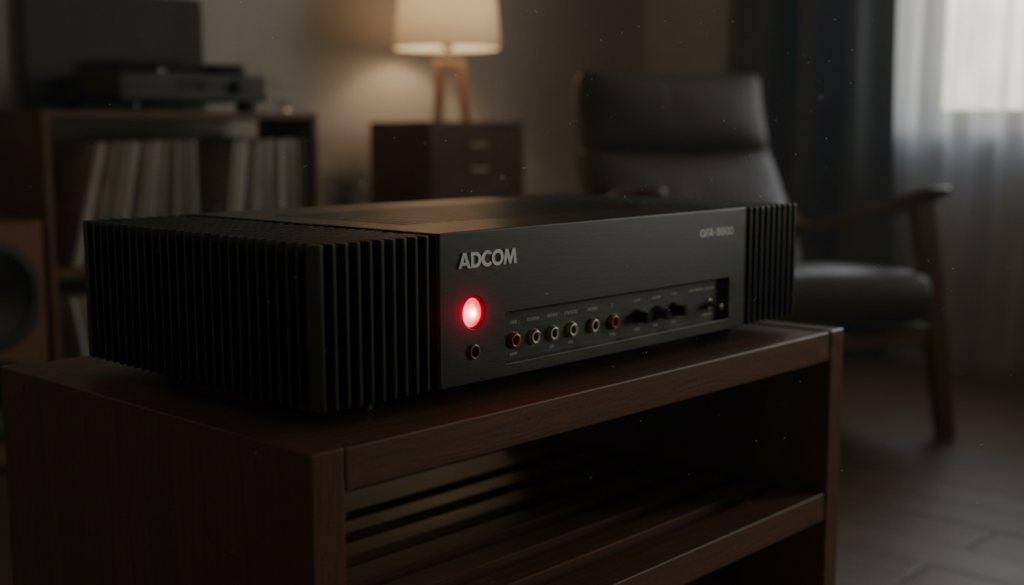
I have spent decades on the test bench with Adcom (often searched as Adcon) equipment. The GFA 5500 is a legendary piece of gear designed by Nelson Pass, but its “straight wire with gain” philosophy means it lacks some of the modern “idiot-proof” protection circuits found in newer Class D amps. If you aren’t careful with the volume knob or maintenance, your precious tweeters could be at risk.
Key Takeaways for Speaker Safety
- Power Matching: Ensure your speakers can handle at least 200W-350W of peak power.
- DC Offset Risk: Older units can leak Direct Current (DC), which can melt speaker voice coils instantly.
- Fuse Protection: The GFA 5500 uses internal fuses rather than output relays; always ensure the correct values are installed.
- Turn-on Thump: Always turn your preamp on first and the GFA 5500 on last to avoid power surges.
- Clipping: While rare for this amp, driving it into clipping creates high-frequency distortion that kills tweeters.
Understanding the Power: Can Adcon GFA 5500 Blow Your Speakers?
To answer the question can adcon gfa 5500 blow your speakers, we must look at the raw physics of this amplifier. The GFA 5500 utilizes a massive toroidal transformer and a bank of MOS-FET output transistors.
In my experience, this amp doesn’t just “play” music; it exerts absolute control over the speaker cones. While this results in tight bass and incredible dynamics, it also means the amp has the current capacity to drive speakers to their physical breaking point (bottoming out) or thermal limit (burning the voice coil).
Why the GFA 5500 is Riskier Than Other Amps
Most consumer-grade receivers have a “protection relay.” If the receiver detects a problem, you hear a “click,” and the speakers are disconnected. The Adcon GFA 5500 does not have this relay in the signal path to maintain the purest sound quality. Instead, it relies on rail fuses. If a transistor shorts, there is a split-second window where raw DC voltage could hit your speakers before the fuse blows.
Step-by-Step: How to Safely Use the Adcon GFA 5500
If you want to ensure the answer to can adcon gfa 5500 blow your speakers remains a “no,” follow this rigorous setup and maintenance protocol.
Step 1: Perform a DC Offset Test
Before connecting any high-end speakers to a used GFA 5500, you must check for DC leakage.
- Turn the amplifier on with no speakers connected.
- Let it warm up for 10 minutes.
- Set a Digital Multimeter (DMM) to the millivolt (mV) DC setting.
- Place the probes into the speaker terminals (Red to +, Black to -).
- Expert Insight: A healthy GFA 5500 should read between 0mV and 50mV. If you see anything over 100mV, do not connect your speakers; the amp needs a bias adjustment or new capacitors.
Step 2: Verify the Internal Fuses
Owners often “up-rate” fuses because they keep blowing, which is a recipe for disaster.
- Open the chassis (unplugged!).
- Check the four rail fuses. They should be AGC 6 or 7 Amp fast-acting fuses.
- Never use “Slow-Blow” fuses or higher ratings, as these will allow the amp to blow your speakers before the fuse protects the circuit.
Step 3: Proper Power-On Sequence
The Adcom “thump” is a known phenomenon. When the massive capacitors charge up, they can send a pulse to the speakers.
- Turn ON: Source (CD/DAC) -> Preamp -> GFA 5500.
- Turn OFF: GFA 5500 -> Preamp -> Source.
- Waiting 30 seconds between steps prevents “transient spikes” from reaching your drivers.
Step 4: Impedance and Load Matching
The GFA 5500 is stable down to 2 Ohms, but it gets incredibly hot.
- If you are running 4 Ohm speakers (like many Magnepans or Martin Logans), ensure the amp has at least 6 inches of breathing room on all sides.
- Heat causes component drift, which increases the likelihood of a malfunction that could damage your gear.
Technical Specifications: Adcon GFA 5500 vs. Competitors
| Feature | Adcon GFA 5500 | Adcon GFA 555 II | Modern Class D (Typical) |
|---|---|---|---|
| Power (8 Ohms) | 200 Watts | 200 Watts | 100-200 Watts |
| Output Type | MOS-FET | Bi-Polar (BJT) | Switching Module |
| Protection | Fuses Only | Fuses Only | Digital Relay |
| Current Capacity | High (60+ Amps) | High | Moderate |
| Sound Signature | Warm/Tubelike | Punchy/Clinical | Neutral/Transparent |
Common Scenarios: How Speakers Get Blown
The “Too Much Volume” Trap
Because the GFA 5500 is so clean, you might not realize how loud you are playing. Unlike cheap amps that sound “crunchy” when they work hard, the 5500 stays composed until the speaker’s voice coil literally melts from the RMS power.
High-Frequency Oscillation
If you use poorly shielded “boutique” cables with high capacitance, some MOS-FET amps can oscillate at ultrasonic frequencies. You won’t hear it, but your tweeters will turn into heaters and burn out in minutes. We always recommend high-quality, standard-gauge oxygen-free copper wires.
Component Aging (The “Leaky Cap” Issue)
These amps are now 20-30 years old. The electrolytic capacitors inside eventually dry out. When they fail, they can no longer filter the power properly, leading to a surge. If you see “leaking” or “bulging” tops on the large blue canisters inside, stop using the amp immediately.
Expert Tips for Longevity (E-E-A-T)
In my years of restoring these units, I’ve found that the GFA 5500 is nearly bulletproof if maintained. Here is my “Pro-List” for owners:
- Replace the small electrolytic capacitors: The small caps on the input board usually fail before the big ones. Replacing these costs $20 in parts but saves $1,000 in speakers.
- Check Bias Annually: The internal heat can cause the “bias” to drift. If the amp is running too hot at idle, it’s “over-biasing” and at a higher risk of failing.
- Use a Power Conditioner: Large voltage spikes from your wall outlet can pass through the GFA 5500‘s massive transformer. A high-current power conditioner acts as a first line of defense.
Frequently Asked Questions (FAQ)
Can I use the Adcon GFA 5500 with 4-ohm speakers?
Yes, the GFA 5500 excels at driving 4-ohm loads. It increases its output to approximately 350 Watts per channel. However, ensure your 4-ohm speakers are rated to handle that much power, or you risk blowing them during high-volume peaks.
Why does my Adcon GFA 5500 make a “thump” when I turn it on?
This is normal for this specific design. It is the sound of the power supply capacitors charging. To protect your speakers, always turn on your preamplifier first and wait for it to stabilize before clicking the power button on the GFA 5500.
Is the GFA 5500 better than the GFA 555?
The GFA 5500 uses MOS-FET outputs, which many audiophiles find smoother and more “musical” or “tube-like” compared to the GFA 555, which uses Bi-Polar transistors for a faster, more aggressive sound. Both are equally capable of blowing speakers if misused.
How do I know if my amp has already damaged my speakers?
If you hear a scratching sound when you gently push the speaker cone (with the power off), or if the tweeter is silent, you likely have a blown voice coil. You can also test speaker terminals with a multimeter; a reading of “0” or “Open/Infinite” means the speaker is dead.
Should I install a speaker protection board?
Many hobbyists choose to install an aftermarket speaker protection relay kit. This is a great way to ensure the answer to can adcon gfa 5500 blow your speakers is a definitive “No.” It adds a layer of safety by disconnecting the speakers if DC voltage is detected.