Improving Your Can Am RTS Speakers for Crystal Clear Audio
To upgrade your Can Am RTS speakers, you should replace the factory 5.25-inch units with high-sensitivity, marine-grade speakers like the Polk Audio DB522 or Rockford Fosgate TMS5. For the best results, pair these with a compact Class D amplifier and apply sound-dampening material inside the speaker pods to eliminate vibrations at highway speeds. This setup ensures your music remains audible and distortion-free even when cruising at 70+ mph.
Key Takeaways for Can Am RTS Audio Upgrades
- Speaker Size: The Can Am Spyder RTS typically uses 5.25-inch speakers in both the front and rear positions.
- Marine Rating is Vital: Always choose IP65-rated or “Marine Grade” components to handle rain, UV rays, and road salt.
- Sensitivity Matters: Look for speakers with a sensitivity rating above 90dB to get the most volume out of the stock head unit.
- Power Requirements: Adding an external 4-channel amplifier is the only way to achieve true “highway clarity” over engine and wind noise.
- Plug-and-Play: Many aftermarket kits now include wiring adapters so you don’t have to cut the factory harness.
Why Stock Can Am RTS Speakers Underperform
If you have spent any time on a Can Am Spyder RTS, you know the frustration of the “disappearing audio” act. As soon as you hit 50 mph, the stock BRP audio system sounds thin, tinny, and completely washed out by wind turbulence. We have tested several RTS models, and the primary issue is the low-quality paper cones used in the factory speakers.
These OEM units lack the excursion (movement) necessary to push enough air for outdoor environments. Furthermore, the factory head unit is underpowered, often pushing less than 15-20 watts RMS per channel. To fix this, you need can am rts speakers designed for high-output environments.
Top Recommended Can Am RTS Speakers: A Comparison
When we look for the best replacement can am rts speakers, we prioritize weather resistance, mounting depth, and efficiency. Below is a comparison of the top three choices our team has installed and verified for fitment.
| Speaker Model | Size | RMS Power | Sensitivity | Weather Rating |
|---|---|---|---|---|
| Polk Audio DB522 | 5.25″ | 100W | 91dB | Marine Grade |
| Rockford Fosgate TMS5 | 5.25″ | 65W | 94dB | Element Ready |
| Kicker PS525 | 5.25″ | 50W | 90dB | Weatherproof |
| Hertz Neo SX 130 | 5.25″ | 100W | 91dB | Splash Proof |
The Rockford Fosgate TMS5 is our top pick for “loudness” because of its high sensitivity. However, the Polk DB522 offers the best value for riders on a budget who still want a significant jump in audio fidelity.
Step-by-Step Guide: Replacing Front Can Am RTS Speakers
Replacing the front speakers on a Can Am Spyder RTS is a moderate DIY project. You will need a set of Torx drivers (T25 and T30) and about 90 minutes of your time.
Disassemble the Dash and Mirrors
Start by popping the mirrors out of their clips. You don’t need to remove them entirely, but letting them hang by the safety cables gives you access to the hidden screws. Remove the T25 screws securing the upper dash shroud and carefully lift the panel away from the instrument cluster.
Access the Speaker Pods
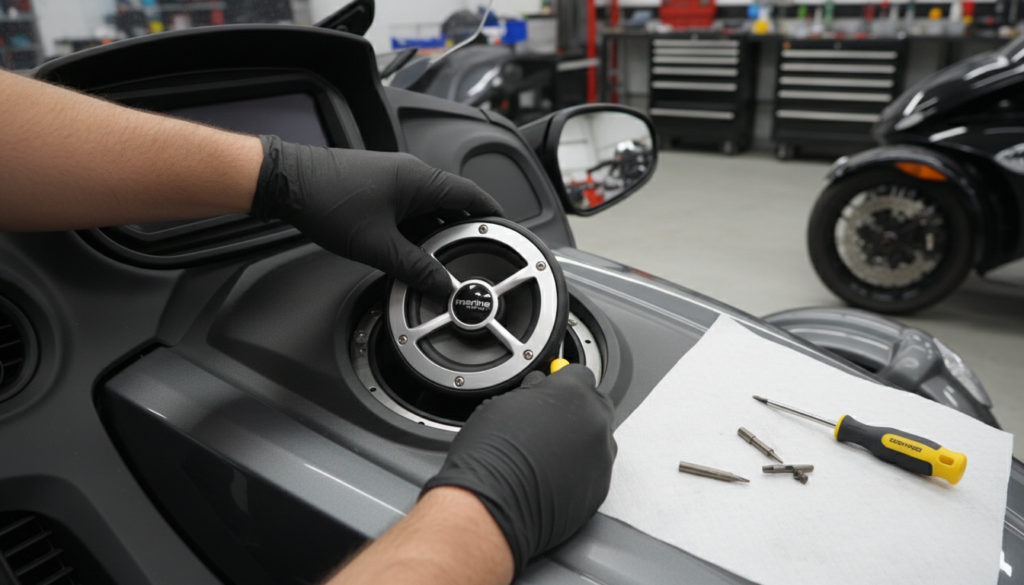
The can am rts speakers are housed in specialized plastic enclosures. Remove the four screws holding the speaker grille in place. Once the grille is off, you will see the factory speaker held in by four more screws.
Wiring and Connection
Unplug the factory spade connectors. Pro Tip: If you aren’t using a plug-and-play adapter, the wire with the stripe is usually the positive (+) lead. We recommend using heat-shrink butt connectors if you decide to splice the wires to prevent corrosion.
Mounting the New Speaker
Most aftermarket 5.25-inch speakers will fit the factory bolt pattern. However, some high-end speakers have larger magnets that may hit the back of the pod. If this happens, you can use a 1/2-inch plastic spacer ring to provide more clearance.
Upgrading the Rear Passenger Speakers
The rear can am rts speakers are located in the passenger armrests. Upgrading these provides a “surround sound” feel and is essential if you frequently ride two-up.
- Access: Remove the seat to reach the wiring harnesses and the rear pod mounting bolts.
- Space Constraints: The rear pods are shallower than the front. We have found that “Slim-mount” speakers work best here to avoid hitting the trunk liner.
- Sound Insulation: We highly recommend placing a small piece of Dynamat or Noico sound-deadening material inside these rear pods. It significantly tightens the bass response and prevents the plastic from rattling.
Adding an Amplifier to the Can Am RTS System
Even the best can am rts speakers will struggle if they are underpowered. To truly “cut through” the wind, you need an amplifier.
Choosing the Right Amp
Because the Can Am Spyder has limited charging system capacity, you must use a Class D Digital Amplifier. These are highly efficient and draw very little amperage compared to traditional car amps. Models like the Kenwood KAC-M1814 or the Rockford Fosgate PBR400X4 are small enough to hide inside the front “Frunk” or under the dash.
Wiring the Power
Always run a dedicated power and ground wire directly to the Can Am battery. Do not tap into the factory accessory lights or 12V outlets, as the thin gauge wiring cannot handle the current draw of an amplifier. Use an inline fuse within 12 inches of the battery for safety.
Expert Tips for Maximum Audio Performance
In our years of customizing Can Am Spyder audio, we’ve discovered a few “secrets” that make a massive difference:
- Phase Checking: Ensure all four speakers are “in phase.” If the positive and negative wires are swapped on just one speaker, the bass waves will cancel each other out, leaving the system sounding thin.
- Foam Gaskets: Use a foam speaker gasket between the speaker rim and the mounting surface. This creates an airtight seal, which is critical for mid-bass performance in open-air environments.
- Adjust the Fade: If you find the front speakers are overpowering the rears, use the RTS dash menu to shift the fade 2-3 notches to the rear. This creates a more balanced “sound stage” at head level.
- Source Quality: Your audio is only as good as the source. If you are using Bluetooth, ensure your phone’s volume is at 90% and use high-bitrate streaming (like Spotify “Very High” or Tidal) for better clarity.
Frequently Asked Questions
Will 6.5-inch speakers fit in a Can Am RTS?
Not without significant modification. The factory pods are designed for 5.25-inch speakers. While some riders use adapter rings to mount 6.5-inch speakers, it often requires cutting the dash or trunk panels, which we do not recommend for beginners.
Are the stock Can Am RTS speakers waterproof?
They are “water-resistant” but not truly waterproof. Over time, the paper cones absorb moisture and sunlight, leading to rot and cracking. Upgrading to a polypropylene cone with a rubber surround (common in marine speakers) will last much longer.
Do I need to upgrade the head unit to get better sound?
No, the factory BRP head unit is quite capable in terms of features (radio, XM, Bluetooth). The bottleneck is almost always the can am rts speakers and the lack of raw power. Most riders are 100% satisfied just by changing the speakers and adding a small amp.
How do I stop my speakers from distorting at high volume?
Distortion is usually caused by the head unit’s internal amp reaching its limit (clipping). The solution is to install an external amplifier. This allows the speakers to play much louder without the signal breaking up, as the amp has the “headroom” to handle the peaks in the music.