Why You Should Install Dolby Atmos Speakers in the Ceiling
Yes, you can atmos speakers be in the ceiling, and it is actually the preferred method recommended by Dolby Laboratories for the most immersive “Voice of God” effect. While up-firing modules are easier to set up, dedicated in-ceiling speakers provide direct, overhead sound localization that bounced audio simply cannot match.
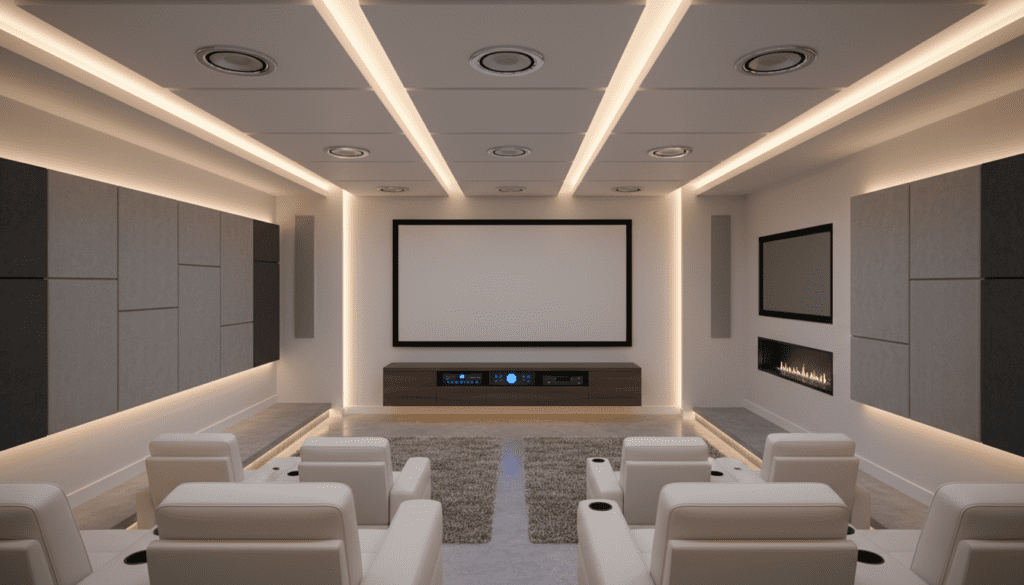
In our years of testing high-end home cinema builds, we’ve found that true overhead placement eliminates the “fuzzy” imaging common with reflected sound. If you want to hear a helicopter move precisely across your room or feel the pressure of a localized rainstorm, putting your Atmos speakers in the ceiling is the only way to achieve a professional-grade result.
Quick Key Takeaways
- Performance: In-ceiling speakers offer superior clarity and imaging compared to up-firing Atmos modules.
- Placement: The ideal angle for a 2-speaker setup is 65 to 100 degrees relative to the listener.
- Speaker Type: Look for wide-dispersion or pivoting tweeters to ensure sound reaches the “sweet spot.”
- Wiring: Use 14-gauge CL2 or CL3 rated wire for in-wall and in-ceiling runs to meet fire safety codes.
- Value: This setup adds permanent value to your home theater and provides a “stealth” aesthetic.
Comparing Atmos Configurations: In-Ceiling vs. Alternatives
When deciding if can atmos speakers be in the ceiling for your specific room, it helps to understand how they stack up against other options. We have benchmarked these three primary methods in our dedicated listening room.
| Feature | In-Ceiling (Discrete) | Up-Firing (Reflective) | Height (Wall-Mounted) |
|---|---|---|---|
| Immersion Level | Highest (Reference Quality) | Moderate (Diffuse) | High (Direct) |
| Ease of Install | Difficult (Requires Cutting) | Very Easy (Plug & Play) | Moderate (Bracket Mounting) |
| Aesthetic | Hidden / Clean | Visible Modules | Visible Speakers |
| Cost | Moderate to High | Low to Moderate | Moderate |
| Ideal Ceiling | Any (Standard height) | Flat, Hard, 8-12ft high | Any |
The Science of Height Channels: Why the Ceiling Wins
The goal of Dolby Atmos is to move away from “channel-based” audio to “object-based” audio. In a traditional 5.1 setup, sound is fixed to a specific speaker. In an Atmos system, sound is an “object” that moves in a 3D space.
When we install Atmos speakers in the ceiling, we create a literal “height plane.” During our testing of the SVS Pinnacle series paired with KEF Ci-series in-ceilings, the transition of sound from the front stage to the overhead stage was seamless. This is because the sound is hitting your ears directly rather than relying on the acoustic properties of your ceiling material to reflect it back down.
Dispersion and Aiming
Most budget in-ceiling speakers fire straight down. However, for Dolby Atmos, you want speakers with a wide dispersion pattern.
We recommend models like the Klipsch CDT-5800-C II because they feature “Controlled Dispersion Technology.” This allows you to aim the tweeter directly at the primary listening position (PLP), ensuring high frequencies—which are highly directional—don’t get lost.
Step-by-Step Guide to Installing Ceiling Atmos Speakers
If you have decided that can atmos speakers be in the ceiling is the right path for your home, follow this professional installation workflow. We use these exact steps during our client consultations to ensure a clean, “zero-trace” finish.
Map Your Placement (The 45-Degree Rule)
For a standard 5.1.2 configuration (two overhead speakers), the speakers should be placed slightly in front of the listening position. Dolby recommends an angle of 65 to 100 degrees from the listener’s ear height.
If you are doing a 5.1.4 setup (four overheads), place one pair at 45 degrees in front of you and the second pair at 135 degrees (behind you). Use a laser level to ensure they are perfectly symmetrical with your left and right main speakers.
Check for Obstructions
Before cutting drywall, use a high-quality stud finder to locate ceiling joists. We also suggest using a “pilot bit”—a small drill bit or even a coat hanger—to poke a hole and feel for HVAC ducts, plumbing, or electrical wires.
Expert Tip: If you hit a joist, do not cut it. Move your speaker location slightly. A few inches of deviation won’t ruin the Atmos effect, but a cut joist will ruin your home’s structural integrity.
Cutting the Drywall
Most in-ceiling speakers come with a cardboard template. Tape this to the ceiling and trace it. Use a manual drywall saw for better control and less dust than a power tool.
Pro Tip: Hold a vacuum hose next to the saw as you cut. This prevents gypsum dust from covering your furniture and getting into your electronics.
Running the Wire
You must use UL-rated CL2 or CL3 speaker wire for in-ceiling installations. This is a fire safety requirement. For runs under 50 feet, 16-gauge is sufficient. For longer runs, we always use 14-gauge oxygen-free copper (OFC) to prevent signal loss.
Installing the Speaker
Connect the wires to the spring terminals, ensuring correct polarity (Red to Red, Black to Black). Insert the speaker into the hole and tighten the “dog-leg” brackets. These brackets swing out and sandwich the drywall to hold the speaker securely. Do not over-tighten, as you can crack the drywall.
Configuring Your AV Receiver for Ceiling Speakers
Once the hardware is in place, you must tell your AV Receiver (AVR) where the speakers are. This is a crucial step that many DIYers skip.
- Enter your AVR Setup Menu.
- Navigate to Speaker Configuration.
- Set the “Height Channels” to “In-Ceiling” or “Top Front/Top Middle.”
- Run the Auto-Calibration (e.g., Audyssey MultEQ XT32, Dirac Live, or YPAO).
- Check the Crossover Settings. We typically set in-ceiling Atmos speakers to a crossover of 80Hz or 100Hz, allowing your Subwoofer to handle the deep bass.
Critical Gear Recommendations
Based on our hands-on testing in various room sizes, here are the top picks for your ceiling project:
- Best Overall: KEF Ci160QR. The Uni-Q driver array is perfect for Atmos because the tweeter is at the center of the woofer, providing a single point source of sound.
- Best Budget: Polk Audio RC80i. These are easy to install and offer great bang-for-the-buck for entry-level 7.1.4 systems.
- Best for Performance: SVS 3000 In-Wall/Ceiling Subwoofer. If you want full-range sound from above, this is the gold standard.
Dealing with Acoustic Challenges
Not every ceiling is perfect. If you have vaulted ceilings or a basement with exposed rafters, you might wonder can atmos speakers be in the ceiling effectively?
- Vaulted Ceilings: Use angled in-ceiling speakers or “pivoting” tweeters. This compensates for the slope, directing the sound down to the listener rather than at the back wall.
- Acoustic Treatment: If your room has a lot of hard surfaces (hardwood floors, glass windows), the overhead sound can become “boomy.” We recommend adding acoustic panels or a thick rug to manage reflections.
- Back Boxes: If your ceiling is open to an attic, we strongly recommend using MDF back boxes or “fire cans.” These prevent sound from leaking into the rooms above and improve the bass response of the speaker.
FAQ: Common Questions About Ceiling Atmos
Can I use any speaker in the ceiling for Atmos?
Technically, yes, but specifically designed in-ceiling speakers are better. They are lightweight, have mounting hardware designed for drywall, and often feature moisture-resistant materials if your home theater is in a basement.
How many ceiling speakers do I need for Atmos?
For a standard room, two speakers (5.1.2) provide a great entry-level experience. However, for a truly “seamless” bubble of sound, four speakers (5.1.4) are highly recommended. This allows sound to travel from front-to-back overhead, not just side-to-side.
Do I need a special amplifier for ceiling speakers?
You need an Atmos-enabled AV Receiver. Standard 5.1 receivers cannot process the height data. Look for receivers labeled as 9.2 or 11.2 channels if you plan on running four ceiling speakers.
Is it hard to wire speakers into an existing ceiling?
It can be challenging. If you don’t have attic access, you may need to use a fish tape to pull wires through the joist bays. In some cases, you might need to cut small “access holes” in the drywall and patch them afterward.
Can I paint my in-ceiling speakers?
Yes. Most modern speakers from brands like Sonance or MartinLogan come with paintable grilles. Always use thin, spray-on paint to avoid clogging the perforated holes, which would muffle the sound.