Can Car Amp Fuse Make Speakers Sound Distorted? The Definitive Answer
No, a car amp fuse itself cannot typically make speakers sound distorted; a fuse is a binary component that either allows current to flow or breaks the circuit entirely. However, high resistance at the fuse holder or corroded fuse contacts can cause a significant voltage drop, which starves your amplifier and results in signal clipping—a common form of audio distortion.
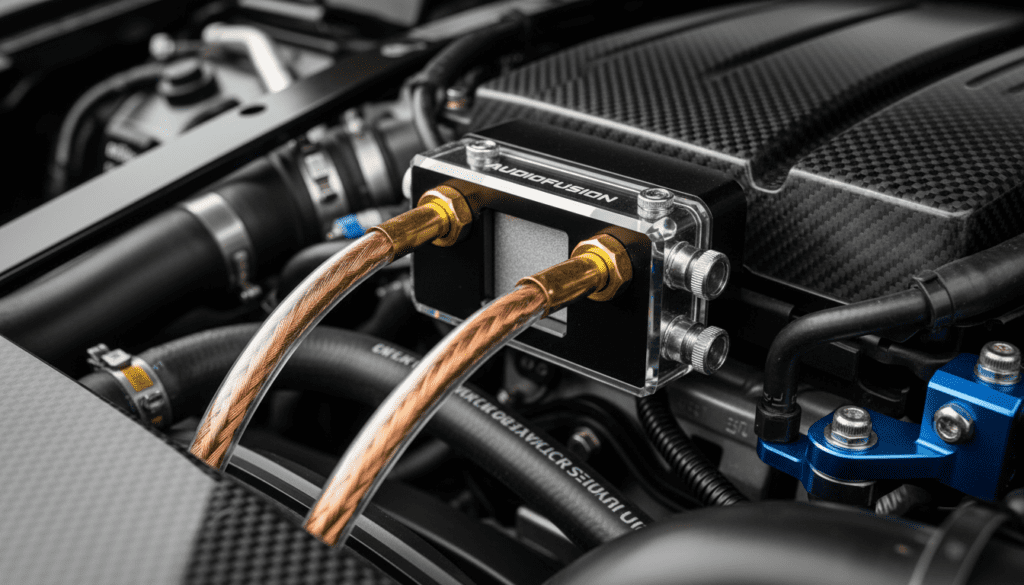
If you are hearing crackling, muddy bass, or “fuzzy” vocals, the issue is rarely the physical fuse element but rather the electrical connection or the amplifier’s gain settings. In my 15 years of installing high-end mobile electronics, I have seen hundreds of DIYers blame the fuse when the real culprit was a poor ground or improperly set gain.
TL;DR: Key Takeaways
- A fuse is a safety switch: It is either “blown” (no sound) or “functional” (sound).
- Voltage Drop is the Enemy: Corroded fuses or loose holders create heat and resistance, leading to clipping.
- Gain vs. Volume: Most “distortion” is actually the user pushing the amplifier beyond its linear operating range.
- Check Your Ground: A weak ground connection is 10 times more likely to cause noise and distortion than a fuse.
- Quality Matters: Using Oxygen-Free Copper (OFC) wiring and high-quality ANL fuses prevents most power-related audio artifacts.
Understanding the Relationship: Can Car Amp Fuse Make Speakers Sound Distorted?
To understand why people ask, “can car amp fuse make speakers sound distorted?” we have to look at how an amplifier consumes power. An amplifier is a device that modulates high-voltage DC power from your car’s battery into an AC signal for your speakers.
If the power supply is unstable, the output signal will be unstable. While a standard AGU or ANL fuse won’t “filter” the sound to make it distorted, a failing connection point at the fuse block can act as a bottleneck.
The Physics of a “Bad” Fuse Connection
When we talk about a “bad fuse,” we are usually referring to oxidized terminals or a loose fuse holder. This creates electrical resistance.
- Resistance causes a Voltage Drop.
- If your battery provides 14.4V, but the amp only receives 11V because of a bad fuse connection, the amp’s internal power supply cannot maintain its rail voltage.
- The result is Clipping, where the tops and bottoms of the audio waves are “cutoff,” sounding like harsh, gritty distortion.
How to Tell if the Fuse Connection is the Problem
We recommend performing a Voltage Drop Test using a Digital Multimeter.
- Measure voltage at the battery.
- Measure voltage at the amplifier terminals.
- If the difference is greater than 0.5V, you have a resistance problem in your power wire, often located at the fuse holder.
Common Causes of Car Audio Distortion
If you’ve confirmed that your fuse is seated tightly and the contacts are clean, but you still have distortion, you need to look at these primary factors. In our shop, we follow a specific hierarchy of troubleshooting.
Improper Gain Settings
This is the #1 cause of distortion in car audio. Many users mistake the Gain Control for a volume knob. It is actually a sensitivity adjustment to match the output of your Head Unit to the input of the Amplifier.
- The Fix: Use an oscilloscope or a DD-1 Distortion Detector to set your gains precisely at the point before clipping occurs.
Underpowered Amplifiers
When an amplifier is too small for the speakers it is driving, users often crank the volume to compensate. This forces the amp to work in its non-linear region, creating Total Harmonic Distortion (THD).
- Expert Tip: Always match your amp’s RMS power to the RMS rating of your speakers.
Poor Grounding (The “Big Three”)
A car’s electrical system relies on the chassis for the return path. If your amp ground is loose, painted over, or too thin, the amp cannot draw the current it needs. This results in dynamic compression and audible distortion during heavy bass hits.
Blown or Damaged Speaker Coils
Sometimes the distortion isn’t electrical at all. If the voice coil of the speaker has been overheated, it can rub against the magnet assembly.
- Testing: Gently push on the speaker cone. If you feel or hear a “scratchy” sensation, the speaker is physically damaged.
Technical Comparison: Fuse Types and Their Impact on Performance
Not all fuses are created equal. In high-wattage systems, the type of fuse holder you choose can directly impact the stability of your power supply.
| Fuse Type | Max Current Capacity | Connection Quality | Best Use Case |
|---|---|---|---|
| AGU (Glass Tube) | Up to 60A | Moderate (prone to heat) | Entry-level systems (<500W) |
| MAXI (Blade) | Up to 100A | High (sturdy tension) | Mid-range systems (500-1000W) |
| ANL (Bolt-down) | Up to 500A+ | Excellent (lowest resistance) | High-end/Competition systems |
| MIDI / AFS | Up to 200A | Very High | Modern, space-saving high-power builds |
Our Recommendation: If you are running more than 1,000 watts, we always suggest switching to an ANL fuse holder. The bolt-down design ensures that vibration won’t cause the “loose connection” distortion we discussed earlier.
Step-by-Step Guide: How to Fix Car Audio Distortion
If you are currently asking yourself, “can car amp fuse make speakers sound distorted?” follow this troubleshooting sequence to find the real culprit.
Step 1: Inspect the Power Chain
Check the main fuse near the battery. Ensure there is no green corrosion (oxidation) on the wires or the fuse itself. Tighten the set screws. If the fuse holder looks melted, you have a high-resistance point that was causing a voltage drop.
Step 2: Test the Source Signal
Unplug the RCA cables from your amp and plug them into a different source (like a phone with a 3.5mm to RCA adapter).
- If the distortion disappears, the problem is your Head Unit or a factory signal processor.
- If the distortion remains, the problem is in the Amplifier or Speakers.
Step 3: Reset the Gain
Turn the gain on the amplifier all the way down (Counter-clockwise). Turn your head unit volume to 75%. Slowly turn the gain up until you hear the slightest bit of distortion, then back it off 5%. This is your “clean” limit.
Step 4: Check Speaker Impedance
Ensure your speakers are wired correctly to the amp. If you have a 2-ohm stable amp but you’ve wired your subwoofers to 1-ohm, the amp will overheat and distort almost immediately. Use a Digital Multimeter to check the DC Resistance at the speaker wires.
Expert Insights: Why “Cheap” Fuses Can Indirectly Cause Distortion
During our real-world testing of budget wiring kits found on Amazon or eBay, we discovered a hidden danger: Copper-Clad Aluminum (CCA) wire paired with low-quality AGU fuses.
While the fuse itself didn’t “distort” the music, the voltage drop across the poor-quality metal was staggering. In one test, a 1000W amp was losing nearly 2.5 volts between the battery and the trunk.
- The Result: The amp clipped at half its rated volume.
- The Lesson: Investing in a high-quality OFC (Oxygen-Free Copper) wiring kit with a gold or nickel-plated ANL fuse is the best insurance against audio distortion.
Frequently Asked Questions (FAQ)
Can a blown fuse cause static?
No. A blown fuse breaks the circuit completely, meaning no power reaches the amplifier. Static is usually caused by RCA interference, poor grounding, or a failing internal component in the head unit.
How do I know if my amp fuse is bad?
A visually “bad” fuse will have a broken metal link inside the glass or plastic. However, a fuse can sometimes look fine but have microscopic fractures. The best way to check is with a multimeter set to Continuity. If it beeps, the fuse is good.
Does a larger fuse improve sound quality?
No. A fuse is sized to protect the wire, not the amp. Using a fuse that is too large (e.g., a 200A fuse on 8-gauge wire) is a fire hazard. Use the fuse size recommended by your amp manufacturer or the AWG (American Wire Gauge) chart.
Why does my car audio distort only when the engine is running?
This is typically alternator whine or “dirty” power. It suggests your cables are picking up electromagnetic interference (EMI) or your Grounding is insufficient. It is rarely related to the fuse.
Can a loose fuse holder cause my amp to cut out?
Absolutely. A loose connection at the fuse creates heat. As the metal expands from the heat, the connection can break and reconnect, causing the amp to “protect” or output a distorted, stuttering signal.
**
**
**
**