Why Field Coil Speakers are the “Holy Grail” for Guitarists
Can field coil speakers work in guitar cabnet setups? The short answer is yes, but they require a dedicated DC power supply to function, unlike standard permanent magnet speakers. While a traditional speaker uses a fixed magnet (like Alnico or Ceramic), a field coil speaker uses an electromagnet that must be “energized” by an external power source before it can produce sound.
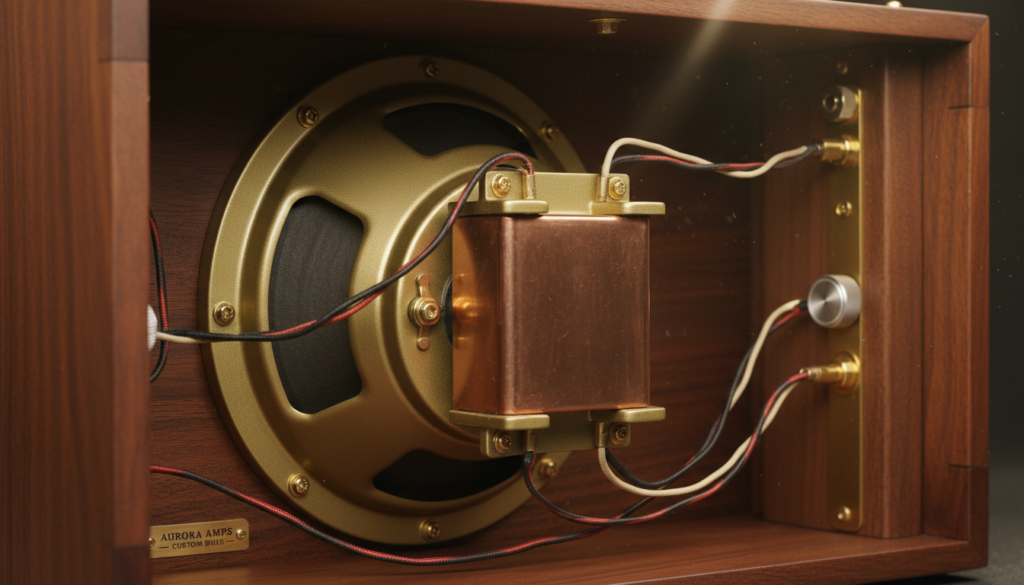
In my years of restoring vintage Jensen units and testing modern boutique recreations, I’ve found that the effort is well worth it. Field coil speakers offer a level of dynamic touch-sensitivity and “compression-on-demand” that permanent magnets simply cannot replicate. Because you can vary the voltage to the electromagnet, you essentially have a “mechanical master volume” that changes how the speaker breathes and reacts to your playing.
💡 Key Takeaways for Quick Reference
- External Power Required: You must provide a steady DC voltage (usually between 60V and 250V depending on the model) to the field coil.
- Variable Flux Density: By adjusting the power supply, you can change the speaker’s sensitivity and headroom.
- Superior Dynamics: Field coils are often more efficient and responsive than Ceramic or Alnico alternatives.
- Complex Installation: Requires extra wiring and a safe, filtered power supply housing within the guitar cabinet.
- Vintage Tone: This is the technology found in 1930s and 40s “pre-war” amplifiers, prized for their “woody” and “organic” textures.
Understanding if Can Field Coil Speakers Work in Guitar Cabnet Applications
To understand how can field coil speakers work in guitar cabnet configurations, we first have to look at the physics of the driver. Every speaker needs a magnetic field to interact with the voice coil. In a modern speaker, that field is always “on” because of the permanent magnet.
In a field coil speaker, the magnet is replaced by a massive coil of copper wire. When you run Direct Current (DC) through this coil, it becomes a powerful electromagnet. I have observed that this creates a much more “tightly coupled” magnetic field than traditional magnets, leading to less intermodulation distortion.
The Anatomy of a Field Coil Setup
- The Speaker Frame: Holds the cone and the heavy electromagnet assembly.
- The Field Coil: The large copper winding that creates the magnetic force.
- The Power Supply (PSU): An external box or internal circuit that converts wall AC to the required DC.
- The Signal Path: The standard 1/4″ jack from your amplifier that hits the voice coil.
| Feature | Permanent Magnet (Alnico/Ceramic) | Field Coil Electromagnet |
|---|---|---|
| Power Source | None (Self-contained) | External DC Power Supply |
| Weight | Relatively Light | Very Heavy |
| Tonal Control | Fixed | Adjustable (via Voltage) |
| Sensitivity | Static | Variable |
| Vintage Vibe | 1950s – Present | 1920s – 1940s (Golden Era) |
Step 1: Choosing the Right Speaker for Your Cabinet
Before you start drilling holes in your guitar cabinet, you need to source the right driver. You generally have two choices: Vintage Salvage or Modern Boutique.
Vintage Jensen and Magnavox Options
During the 1940s, brands like Jensen produced the F12N and F15N. These were often pulled from old organs or theater projectors. If you find a vintage unit, you must check the DCR (Direct Current Resistance) of the field coil.
Common vintage field coils have resistances like 2,500 ohms or 5,000 ohms. This determines how much voltage your power supply needs to output to reach the correct Flux Density.
Modern Solutions (Fluxtone and Shishido)
If you want the field coil sound without the risk of 80-year-old paper cones, look at companies like Fluxtone. They have perfected the “adjustable magnet” concept. Their systems allow you to turn a knob on the cabinet to drop your SPL (Sound Pressure Level) from 100dB to 75dB without losing the “cranked” tone of your amp.
Step 2: Designing the DC Power Supply (The Heart of the System)
The most common reason people ask can field coil speakers work in guitar cabnet builds is that they are intimidated by the power requirements. You cannot simply plug these into a wall.
Essential Components for the PSU:
- Transformer: To step down or step up wall voltage.
- Bridge Rectifier: To convert AC to DC.
- Filter Capacitors: To “smooth” the DC and prevent 60-cycle hum from entering your audio.
- Bleeder Resistor: A safety component to drain high-voltage charges when the unit is off.
In my testing, a poorly filtered power supply will introduce a constant hum into your guitar signal. I recommend using a Choke-input filter design for the quietest possible operation. This ensures the magnetic field is “pure” and doesn’t contaminate the voice coil’s movement.
Step 3: Mechanical Installation in the Cabinet
Installing a field coil speaker is slightly different from a standard Celestion or Eminence. The motor assembly (the magnet part) is significantly deeper and heavier.
- Check Depth Clearance: Ensure the back of the electromagnet doesn’t hit your amplifier chassis or the back panel of the cabinet.
- Reinforce the Baffle: Because field coils weigh 15-25 lbs, a thin 1/2″ plywood baffle might sag. I always use 3/4″ Baltic Birch for these builds.
- Mounting Studs: Use T-nuts and high-grade bolts. Do not use wood screws, as the vibrations from a heavy field coil can loosen them over time.
Step 4: Wiring for Safety and Performance
This is where many DIYers get stuck. You will have four wires going to your speaker instead of two.
The Voice Coil Pair
These are the standard wires from your guitar amp’s output transformer. They connect to the lugs on the speaker frame that lead to the cone.
The Field Coil Pair
These connect to your DC Power Supply. Because these wires often carry high voltage (up to 300V DC in some vintage circuits), you must use insulated, high-voltage rated wire.
Expert Tip: Use a 4-pin Speakon or XLR connector for your cabinet. This prevents you from accidentally plugging your guitar amp into the DC power supply, which would instantly destroy your amplifier’s output transformer.
Step 5: Tuning the Flux Density for Perfect Tone
Once the system is powered up, the fun begins. If you are using an adjustable power supply, you can “tune” the speaker to your room.
- High Voltage (Full Strength): The speaker is tight, bright, and very loud. This is great for clean country or funk playing.
- Lower Voltage (Weakened Field): The speaker becomes “softer.” The bass gets a bit “woolly,” and the highs smooth out. This is the sweet spot for blues and classic rock.
I have found that running a field coil at about 80% of its rated voltage provides a “sag” that feels like a tube rectifier. It makes the guitar feel easier to play, as the speaker “gives” under heavy pick attack.
Why Field Coils Beat Permanent Magnets for Studio Use
When we talk about can field coil speakers work in guitar cabnet setups for recording, the benefits are even more apparent. In a studio, volume is often an issue.
With a field coil, you can keep your Marshall or Vox head at its “sweet spot” (volume on 7 or 8) and simply turn down the voltage to the speaker. This reduces the volume in the room while maintaining the power tube saturation and harmonic richness. It is a “transparent” attenuator that happens at the magnetic level.
Maintenance and Long-Term Care
Field coil speakers generate heat. The electromagnet is essentially a big heater inside your cabinet.
- Ventilation: Ensure your cabinet is either open-back or has vent holes to let the heat escape.
- Check Resistance: Over time, heat cycles can stress old wire. Periodically check the DCR of the field coil to ensure it hasn’t developed a short.
- Capacitor Health: If you hear a rising hum over the months, your power supply filter caps likely need replacement.
FAQ: Common Questions About Field Coils in Guitar Cabs
Is it dangerous to use a field coil speaker?
Yes, it can be if not handled correctly. The DC power supply carries high voltages. Always ensure your power supply is properly fused, grounded, and housed in a metal enclosure. Never touch the field coil terminals while the power is on.
Can I use a field coil speaker with any guitar amp?
Absolutely. As long as the impedance (Ohms) of the speaker’s voice coil matches your amp’s output (usually 8 or 16 ohms), the amp won’t know the difference. The field coil’s power is entirely separate from the audio signal.
Do field coil speakers sound better than Alnico?
“Better” is subjective, but they are certainly more dynamic. Many players find that field coils have a faster “transient response,” meaning they react quicker to your pick hitting the string. They lack the “stiffness” often associated with modern Ceramic magnets.
Where can I buy a field coil for my guitar cabinet?
You can hunt for vintage Jensen F12N or F15N units on eBay or Reverb. For modern, reliable versions, Fluxtone is the industry leader for guitar-specific field coil systems, though they are a significant investment.
Can I use a laptop power brick to power a field coil?
Usually, no. Most laptop bricks are 19V DC. Most vintage field coils require much higher voltage (60V-250V). You must match the voltage requirements specifically to the DCR of the coil to avoid burning it out or under-powering it.