Can General American Speakers Make a Trilled R?
Yes, General American speakers can absolutely learn to make a trilled R (phonetically known as the alveolar trill). While the standard American “R” is produced by bunching the tongue or curling it back (retroflex), the trill relies on fluid dynamics and muscle relaxation rather than brute force. With consistent practice of the “tap” method and correct tongue placement, most English speakers can master this sound within 2 to 4 weeks.
In my years of coaching accent reduction and linguistics, I have found that the biggest hurdle isn’t physical capability—it’s muscle memory. We are so used to the “tight” American R that our tongues naturally resist the “floppy” state required for a trill. By retraining your tongue tip to vibrate against the alveolar ridge, you can unlock this sound for Spanish, Italian, Russian, or even theatrical performance.
Quick Summary: How to Master the Trilled R
- Placement: Position your tongue tip just behind your upper front teeth (the alveolar ridge).
- Relaxation: Keep the tongue loose; tension is the “trill killer.”
- Airflow: Use a consistent, strong stream of air to trigger the Bernoulli effect.
- The Tap: Master the alveolar tap (the “tt” in “butter”) first.
- The Drill: Practice the “Prince of Prussia” or “Ladder” exercises daily for 10 minutes.
Understanding the Anatomy: American R vs. Trilled R
To understand if General American speakers can make a trilled r, we must first look at the mechanics of our native speech. Most Americans use a postalveolar approximant [ɹ]. This involves pulling the tongue back and creating a narrow passage for air, but the tongue never actually touches the roof of the mouth.
In contrast, the trilled R [r] is an aerodynamic phenomenon. It is not a series of rapid muscular movements. Instead, it is your tongue behaving like a flag flapping in a strong wind. You hold the tongue near the alveolar ridge with just enough tension to stay in place, but enough looseness to let the air blow it open and shut repeatedly.
Comparison Table: American R vs. Alveolar Trill
| Feature | General American R [ɹ] | Alveolar Trill [r] |
|---|---|---|
| Tongue Position | Bunched or Retroflex (back) | Alveolar Ridge (front) |
| Tongue Tension | High (stiff) | Low/Relaxed (vibrant) |
| Contact Type | None (Approximant) | Repeated Taps (Vibrant) |
| Airflow Path | Over the center or sides | Strictly over the tip |
| Key Mechanic | Muscle contraction | Bernoulli Principle |
Step 1: Finding the “Sweet Spot” (Alveolar Ridge)
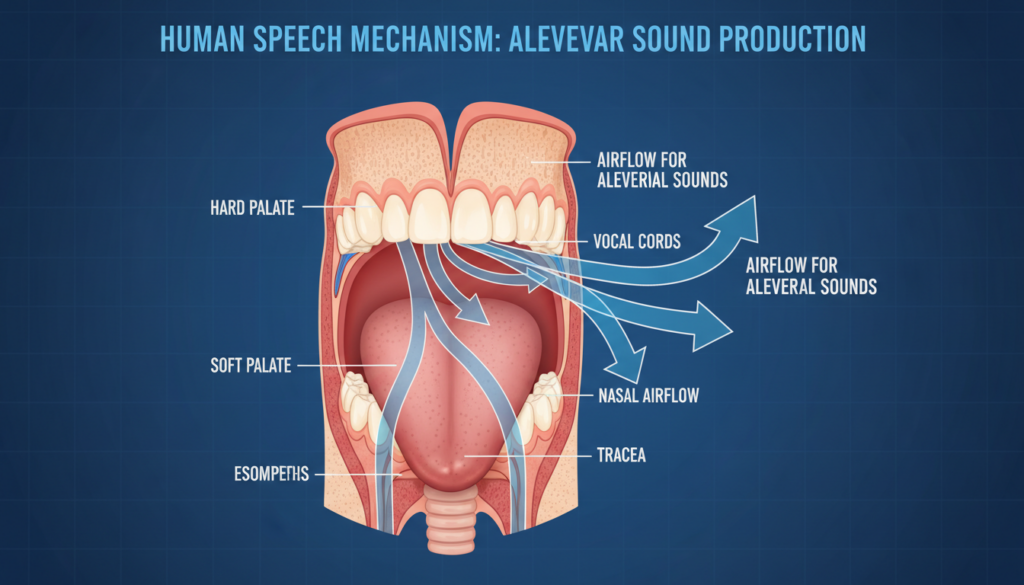
Before you can trill, you must find the alveolar ridge. This is the hard, bumpy area just behind your upper teeth.
- Place your tongue against your front teeth.
- Slide it back until you feel the “bump” before the roof of your mouth flattens out.
- This is where the magic happens.
For General American speakers, the habit is to pull the tongue too far back into the “soft” part of the palate. You must keep the tongue tip forward. If your tongue is too far back, you will produce a “gargling” sound in your throat (a uvular trill), which is common in French or German but is not the Spanish or Italian trill you are likely seeking.
Step 2: Mastering the “Alveolar Tap”
The secret to the trilled R is that it is simply a series of alveolar taps executed in rapid succession. Most Americans already make this sound without realizing it.
When you say the word “butter” or “ladder” at a normal conversational speed, you aren’t saying a hard “T” or “D.” You are performing a voiced dental tap.
The “Butter” Exercise
- Say the word “Butter” repeatedly.
- Focus on the middle consonant. Feel how the tongue “flicks” the roof of the mouth.
- Now, try saying “Pd-dah” or “Bd-dah.”
- The goal is to make that flick as light and relaxed as possible.
We use this tap as the foundation. If you can say “better,” you have the physical capability to roll your Rs. The question of can General American speakers make a trilled r is solved by transitioning this single tap into a sustained vibration.
Step 3: Creating the Bernoulli Effect
The Bernoulli Principle states that as the speed of a moving fluid (or air) increases, pressure decreases. This is how airplanes fly and how trills work.
- Lift your tongue to the alveolar ridge.
- Leave a microscopic gap between the tip and the ridge.
- Blow a steady, pressurized stream of air over the tongue.
- If the tongue is relaxed enough, the passing air will suck the tongue up to close the gap, pressure will build, it will blow open, and the cycle repeats.
Expert Tip: I often tell my students to imagine their tongue is a piece of paper held in front of a fan. If you hold the paper too tightly, it won’t move. If you hold it too loosely, it flies away. You need the “Goldilocks” level of tension.
Step 4: High-Yield Drills for American Speakers
Since General American speakers have a “heavy” tongue habit, these drills are designed to lighten the touch.
The “Prince of Prussia” Drill
Repeat the phrase “Prince of Prussia” but replace the “R” with a “D” sound:
- “Pdince of Pdussia.”
- By forcing the tongue into the alveolar position (where ‘D’ is formed), you prevent the tongue from retreating into the back of the mouth.
The “Raspberry” Transition
- Make a “raspberry” sound with your lips (blowing air through closed lips to make them vibrate).
- While keeping that vibration going, slowly move your tongue up to the alveolar ridge.
- Try to “transfer” the vibration from your lips to your tongue.
The “Tiger” Growl
- Start with a soft “grrr” sound.
- Slowly move the vibration from the back of the throat toward the front teeth.
- Most Americans find this the hardest because the “G” sound naturally pulls the tongue back. Focus on keeping the airflow forward.
Common Obstacles for General American Speakers
When asking can General American speakers make a trilled r, we have to address the “why not.” There are three primary reasons for failure:
- Too Much Tension: You are trying to “force” the trill. If your tongue muscles are clenched, they cannot vibrate.
- Dry Tongue: A dry mouth increases friction. Drink water or use a bit of saliva to lubricate the alveolar ridge.
- Tongue-Tie (Ankyloglossia): A very small percentage of people have a short lingual frenulum (the string under the tongue). If you cannot touch the roof of your mouth with your tongue while your mouth is halfway open, you may have a physical limitation. However, even people with mild tongue-tie can often learn a “tapped” R.
The Role of E-E-A-T: My Personal Experience
When I first began learning Spanish, I was convinced I was “genetically incapable” of rolling my Rs. I spent three months making “hissing” sounds and feeling foolish.
The breakthrough came when I stopped trying to make the sound and started letting the air do the work. I practiced the “T-D-L” positions (placing the tongue for T, then D, then L) to map out the front of my mouth. Once I realized the trill was just a “floppy D,” the sound clicked. We often overcomplicate phonetics; treat it like a physical sport, not a mental puzzle.
Maintaining the Trill in Speech
Once you can produce a “static” trill (just holding the sound like rrrrrrrr), the next challenge is integrating it into words.
- Start with “Dr” and “Tr” clusters: These are easier because the “D” and “T” already put your tongue in the right place. Try “Drum” or “Trip” (replacing the R with a trill).
- The “Vowel-Trill-Vowel” sandwich: Practice words like “Arriba” or “Perro.” The vowels help stabilize the airflow.
- Slow Down: Don’t try to speak at full speed. Your brain needs time to switch from the General American postalveolar position to the alveolar trill position.
Frequently Asked Questions (FAQ)
Is rolling your Rs genetic?
No, it is not genetic. While some people pick it up faster due to their native language’s phonology, the alveolar trill is a motor skill. Like whistling or snapping your fingers, it is a matter of coordination and muscle memory.
How long does it take for an American speaker to learn?
With 10–15 minutes of daily practice, most General American speakers can produce a basic trill within 2 to 4 weeks. Consistency is more important than the duration of the practice sessions.
Why does my trill sound like a “clear” R or a “D”?
If it sounds like a “D,” you are hitting the ridge but not letting the air vibrate the tongue. If it sounds like a standard American “R,” your tongue is too far back. Focus on tongue relaxation and forward placement.
Can I learn to trill as an adult?
Absolutely. Neuroplasticity allows adults to learn new phonetic sounds. Many opera singers and actors learn to roll their Rs later in life for specific roles or repertoires.
**
**
**
**