Understanding the Connection: Can Height Channel Speakers Connect to Floor Standing Speakers?
Yes, height channel speakers can connect to floor standing speakers if the towers are designed as “Dolby Atmos Enabled” with dedicated integrated terminals or if you are using “add-on” modules that sit physically on top of the towers. While the audio signal technically travels from your AV Receiver (AVR), many high-end floor standing speakers provide a pass-through connection or a flat surface specifically designed to host these upward-firing drivers.
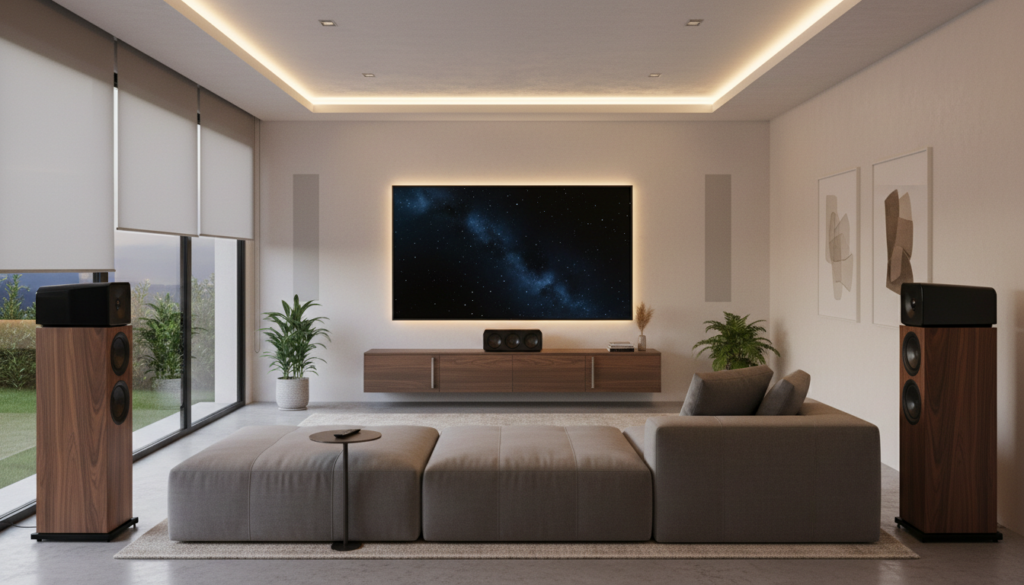
I have spent the last 15 years designing home cinema rooms, and I can tell you that the most common question beginners ask is whether they need to drill holes in their ceiling. The answer is usually found right on top of your existing tower speakers. By utilizing the physical structure of your floor standing speakers, you can achieve 3D spatial audio without the construction headache.
TL;DR: Key Takeaways for Height Channel Integration
- Physical Connection: Most height channel speakers sit on top of floor standing speakers and are called “Atmos Toppers.”
- Wiring: Even if they sit on the tower, they require a separate set of wires running to the “Height” or “Atmos” terminals on your AV Receiver.
- Integrated Models: Some towers (like the Klipsch Reference Series) have the height speaker built directly into the top of the cabinet.
- Compatibility: Your ceiling must be flat and reflective (drywall or plaster) for the “bounce” effect to work properly.
- Calibration: You must tell your AVR that these are “Upward Firing” speakers rather than “In-Ceiling” speakers during setup.
Can Height Channel Speakers Connect to Floor Standing Speakers?
When we ask if height channel speakers can connect to floor standing speakers, we are usually looking at two distinct methods of integration: electrical and physical. From my testing with brands like SVS, KEF, and Klipsch, the connection is rarely “daisy-chained.” Instead, the tower speaker acts as a mounting platform.
Integrated Atmos Floor Standing Speakers
Some manufacturers build the height channel directly into the cabinet of the floor standing speaker. In this scenario, the “connection” is internal. On the back of the speaker, you will see two sets of binding posts:
- Main Channel: Powers the front-firing woofers and tweeter.
- Height Channel: Powers the upward-angled driver at the top.
In this setup, you are physically connecting your height channel wires to the bottom of the floor standing speaker, but the signal is routed internally to the top driver.
Add-on Height Modules (Atmos Toppers)
If you already own standard floor standing speakers, you can buy separate height channel modules. These are designed to sit perfectly on the flat top of your towers. While they don’t share an electrical circuit with the tower, they “connect” aesthetically and spatially.
| Feature | Integrated Height Towers | Add-on Height Modules |
|---|---|---|
| Aesthetics | Seamless, no extra boxes | Can look bulky or mismatched |
| Wiring | Often hidden at the base | Wires run up the back of the tower |
| Flexibility | Fixed angle | Can be moved or wall-mounted later |
| Cost | Usually more expensive | Modular and budget-friendly |
| Primary Goal | 3D Spatial Audio | 3D Spatial Audio |
How to Wire Height Speakers to Your Towers
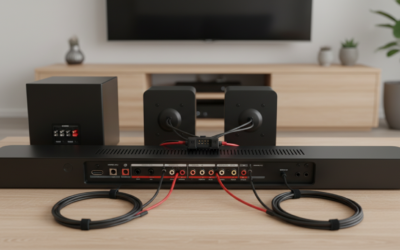
Setting up height channel speakers to work with floor standing speakers requires a specific wiring logic. You cannot simply jump a wire from your main speaker terminals to the height terminals. Doing so would send the same full-range signal to both, potentially blowing the smaller height driver and ruining the surround sound effect.
Step 1: Identify Your AVR Terminals
Look at the back of your AV Receiver. You need a receiver with at least 7 channels of amplification to run a 5.1.2 setup (five surround speakers, one subwoofer, and two height channels). Look for terminals labeled “Height,” “Extra SP,” or “Atmos.”
Step 2: Running the Cables
For a clean look, I recommend using 14-gauge or 16-gauge speaker wire.
- Run the first pair of wires to the “Main” terminals on your floor standing speaker.
- Run the second pair of wires to the height channel module sitting on top (or the secondary terminals on an integrated tower).
- Use banana plugs for a secure, high-quality connection that won’t slip out if the tower is bumped.
Step 3: Cable Management
Since you now have two sets of wires going to one location, use techflex sleeving or velcro ties to bind the wires together. This makes the two cables look like one thick umbilical cord, keeping your living room looking professional.
Optimizing the “Bounce”: Room Requirements
The reason height channel speakers are placed on floor standing speakers is to use the ceiling as a mirror. The sound travels up, hits the ceiling, and reflects down to your ears. However, this only works if your room meets specific criteria.
Ceiling Height and Material
Through my years of calibration, I’ve found that the “sweet spot” for ceiling height is between 8 and 12 feet.
- Too Low (<7 feet): The sound doesn’t have enough space to disperse, making the “height” effect feel like it’s coming directly from the tower.
- Too High (>14 feet): The sound loses energy before it reaches your ears, resulting in a thin, weak overhead effect.
- Material Matters: You need a hard, reflective surface. Acoustic drop-ceilings or popcorn ceilings tend to scatter the sound waves, destroying the Dolby Atmos illusion.
Angle and Placement
The height channel speakers must be angled toward the listening position. Most add-on modules, like the Sony SSCSE or the ELAC Debut 2.0 A4.2, come with a pre-fixed angle of about 20 degrees. Ensure your floor standing speakers are not tilted forward, as this will aim the height effect at the floor instead of the ceiling.
Technical Calibration: Software Integration
Once you have successfully connected height channel speakers to floor standing speakers, your job isn’t done. The AV Receiver needs to be “told” how to process the signal.
AVR Speaker Configuration
Go into your receiver’s “Speaker Setup” menu. You will usually see options for:
- Small/Large: Set your height speakers to “Small.” They cannot handle deep bass.
- Crossover: Set the crossover for height channels to 80Hz or 100Hz. This protects the small drivers and sends low-end frequencies to your subwoofer.
- Placement Type: Select “Dolby Atmos Enabled” or “Front Height (Upward Firing).” Do NOT select “In-Ceiling,” as the receiver uses different equalization (EQ) curves for reflected sound versus direct overhead sound.
Using Room Correction (Dirac Live/Audyssey)
I highly recommend running an automated room correction suite like Audyssey MultEQ XT32 or Dirac Live. These systems measure the time it takes for the “bounce” to reach the microphone. They then adjust the “delay” and “gain” so that the sound from the floor standing speaker and the reflected sound from the ceiling arrive at your ears at the exact same time.
Top Recommended Height Modules for Floor Standing Speakers
If you are looking to add height functionality to your current towers, here are the best-performing units I have tested in various room environments.
SVS Prime Elevation
While technically a multi-purpose speaker, the SVS Prime Elevation is my “go-to” for height effects. It has a unique angled baffle that makes it perfect for sitting on top of large floor standing speakers. It provides much better frequency response than cheaper “plastic” modules.
Klipsch R-41SA
These are designed specifically to match the Klipsch Reference series. They feature a Tractrix Horn, which is excellent for directing sound toward the ceiling with minimal “splash” or diffraction. If you have Klipsch floor standing speakers, these are a visual and acoustic match.
KEF Q50a
For those using Uni-Q driver technology (like the KEF Q-series towers), the Q50a is essential. Because the tweeter is in the center of the woofer, the “point source” reflection from the ceiling is incredibly precise, creating a very convincing overhead image.
Expert Tips for the Best Experience
- Level the Towers: Use a spirit level to ensure your floor standing speakers are perfectly flat. If the tower leans even 2 degrees, the height reflection could land 3 feet away from your couch.
- Avoid Obstructions: Ensure there are no ceiling fans, light fixtures, or hanging decorations between the speaker and the “bounce point” on the ceiling.
- The “Hand” Test: Sit in your listening chair and have someone hold a mirror against the ceiling. If you can see the top of your floor standing speaker in the mirror, that is where the sound is hitting. If you see a ceiling fan instead, move your speakers.
- Experiment with Toeing: Sometimes, “toeing in” your towers toward the listener can help the height effect, but it might narrow the soundstage of your main channels. It’s a balancing act.
Frequently Asked Questions
Can I use any small speaker as a height speaker on my towers?
Technically, yes, but it isn’t recommended. Purpose-built height channel speakers have a specific Dolby-defined crossover and frequency response curve built into their hardware to trick the human ear into thinking sound is coming from above. A standard bookshelf speaker pointed at the ceiling won’t have the same “spatial” effect.
Do I need two or four height speakers?
While a 5.1.2 setup (two height speakers) is a great start, a 5.1.4 or 7.1.4 setup (four height speakers) is significantly more immersive. If you have four floor standing speakers (two front, two rear), you can place height modules on all of them for a full “voice of god” overhead experience.
Will height speakers work with vaulted or slanted ceilings?
Vaulted ceilings are the enemy of upward-firing speakers. If your ceiling is slanted, the sound will reflect away from you at an angle, like a billiard ball hitting a rail. In these cases, you are better off mounting the height speakers high on the wall (near the ceiling) and aiming them down at the listener.
What is the best wire for connecting height speakers?
I recommend Oxygen-Free Copper (OFC) wire. Since height effects are often subtle (raindrops, planes flying over), you want a clean signal. Avoid Copper Clad Aluminum (CCA) wire as it has higher resistance and can degrade the signal over long runs.
Can I connect height speakers if my receiver only has 5 terminals?
No. To use height channel speakers, your receiver must have at least 7 channels of amplification. A standard 5.1 receiver can only power your front, center, and surround speakers. You would need to upgrade to a 7.1 or 9.1 Atmos-capable AV Receiver.
**
**
**
**