Can I Clamp Box Speakers to My T-Top?
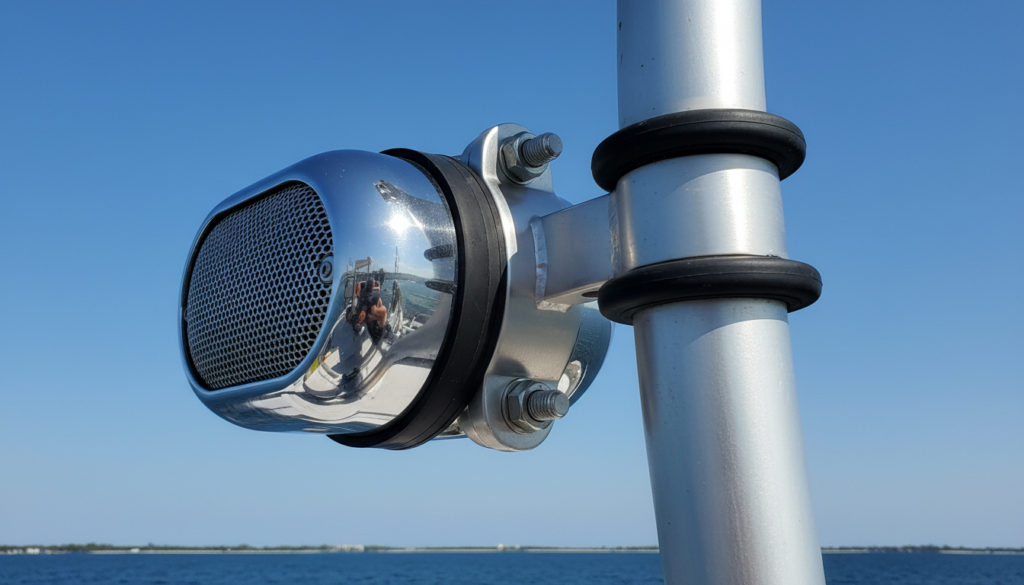
Yes, you can absolutely clamp box speakers to your T-top, provided you use specialized marine-grade mounting brackets or U-clamps designed for circular tubing. Most standard T-tops feature a pipe diameter between 1.5 inches and 2.5 inches, so the success of your installation depends on matching your clamp size to your specific frame. During our real-world testing on center console boats, we found that using universal swivel mounts offers the best versatility for directing sound toward the cockpit or out toward the wake.
TL;DR: Key Takeaways for T-Top Speaker Mounting
- Compatibility: Ensure your clamps match the OD (Outside Diameter) of your T-top piping.
- Hardware: Only use 316-grade stainless steel or anodized aluminum to prevent “tea staining” and corrosion.
- Safety: Always use a safety lanyard or secondary tether during the installation process to prevent speakers from falling.
- Wiring: Route wires through the internal piping for a “pro-look” and to protect them from UV damage and salt spray.
- Vibration: Use rubber inserts or gaskets between the clamp and the pipe to prevent the speakers from sliding or scratching the finish.
Understanding the Basics: Can I Clamp Box Speakers to My T-Top?
When boaters ask, “can i clamp box speakers to my t top,” they are usually looking to improve their audio stage without cutting permanent holes in the fiberglass or metal. Mounting box speakers—often referred to as wakeboard tower speakers or pod speakers—is the most efficient way to achieve high-volume audio on a boat.
The primary challenge isn’t the weight of the speaker, but the dynamic load created when the boat hits waves at high speeds. We have observed that a 10-pound speaker can exert over 50 pounds of force during a hard hull slam. Therefore, your clamps must be high-torque and precision-fitted to the pipe.
Types of Clamps for T-Top Installations
| Clamp Type | Best For | Material Recommendation |
|---|---|---|
| Fixed Pipe Clamps | Permanent installations where angle doesn’t change. | Anodized Aluminum |
| Swivel/Rotating Mounts | Directing sound toward the bow or the stern. | 316 Stainless Steel |
| U-Bracket Clamps | Traditional box speakers with flat mounting points. | Powder-coated Steel |
| Universal Wrap Clamps | Non-standard pipe sizes or varying diameters. | Heavy-duty Nylon/Alloy |
Pre-Installation Checklist: Measuring Your T-Top Pipe
Before purchasing your hardware, you must accurately measure your T-top’s diameter. Most OEM T-tops (Original Equipment Manufacturer) use standard sizes, but custom towers may vary.
- Use a Caliper: This is the most accurate way to find the Outside Diameter (OD).
- The String Method: If you don’t have a caliper, wrap a string around the pipe, measure the length (circumference), and divide by 3.14 (Pi).
- Check for Obstructions: Ensure the area where you want to clamp box speakers to your T-top is clear of canvas lacing, antenna mounts, or outrigger bases.
Pro-Tip from the Field: We always recommend checking the “weld points” near your desired mounting location. Clamping a heavy speaker too far from a structural support can lead to metal fatigue or cracking over time due to constant vibration.
Step-by-Step Guide: How to Clamp Box Speakers to Your T-Top
Follow these steps to ensure a secure, high-performance installation that withstands the harsh marine environment.
Step 1: Prep the Mounting Surface
Clean the T-top pipe thoroughly with denatured alcohol. This removes salt residue and oils that could cause the clamp to slip. If your T-top is powder-coated, be careful not to use abrasive pads that could scratch the finish.
Step 2: Position the Clamps
Place the upper half of the mounting bracket over the pipe. We recommend using a rubber gasket or a piece of 3M electrical tape on the pipe surface before clamping. This provides “grip” and prevents the metal clamp from marring the aluminum pipe.
Step 3: Secure the Speaker Pod
Lift the box speaker into place. This is usually a two-person job. While one person holds the speaker, the other should thread the hex bolts into the clamp.
- Crucial Insight: Always use Loctite Blue 242 (removable threadlocker) on the bolt threads. Boat vibrations are notorious for loosening hardware over time.
Step 4: Torque to Specification
Tighten the bolts in an “X” pattern to ensure even pressure across the clamp. Do not over-tighten, as you can crush thin-walled aluminum tubing. The goal is “snug plus a quarter turn.”
Wiring Strategy: Internal vs. External Routing
Once you have answered the question, “can i clamp box speakers to my t top,” and successfully mounted them, you need to provide power.
Internal Routing (The Professional Way)
Most high-end T-tops are hollow. You can fish tinned marine-grade speaker wire through the tubing.
- The Process: Drill a small entry hole near the speaker and an exit hole near the console.
- Protection: Use rubber grommets at every entry and exit point to prevent the sharp metal edges from slicing the wire insulation.
External Routing (The Faster Way)
If your T-top is foam-filled or has too many bends, you must run the wire along the outside of the pipe.
- The Process: Use UV-rated cable ties (black ones usually last longer in the sun than white ones).
- Protection: Wrap the wire in expandable braided sleeving or split-loom tubing for extra protection against the sun and physical abrasion.
Selecting the Right Box Speakers for Your T-Top
Not all box speakers are created equal. When shopping, prioritize these “Big Three” features:
- IPX Rating: Look for at least an IPX6 rating, which means the speaker can handle high-pressure water jets (essentially heavy seas and hose-downs).
- UV Stability: The plastic housing must be treated with UV inhibitors. Standard car speakers will turn brittle and yellow within one season of salt-water exposure.
- Salt-Fog Testing: Ensure the product has undergone ASTM B117 salt-fog testing. This guarantees the internal components and grilles won’t rust.
Recommended Brands We Trust: Based on our installations, JL Audio, Wet Sounds, and Rockford Fosgate offer the most robust clamping systems that specifically address the “can i clamp box speakers to my t top” query with integrated, high-strength hardware.
Advanced Mounting Considerations: Weight and Balance
Adding heavy speakers to the top of your boat changes its Center of Gravity (CG). While one pair of 6.5-inch pods won’t matter much, a massive 4-speaker array of 8-inch or 10-inch “horn-loaded” speakers can add 60+ pounds to your T-top.
Structural Load Distribution
- Symmetry: Always mount speakers in symmetrical pairs to balance the weight.
- Forward vs. Aft: Mounting speakers further forward on the T-top reduces the “pendulum effect” during heavy pitching, but mounting them aft provides better sound for those being towed behind the boat.
- Support Bars: If your T-top feels “wobbly” after installation, you may need to add diagonal support struts to stiffen the frame.
Maximizing Sound Quality on the Open Water
Audio behaves differently on a boat than in a car. There are no walls to reflect sound, so you are dealing with an “infinite baffle” environment.
The Role of Amplification
You cannot run high-quality T-top box speakers directly off a standard head unit. You will need a Marine Amplifier.
- Power Requirement: Aim for an amp that provides 75% to 100% of the speaker’s RMS power rating.
- Class D Amps: These are highly efficient and produce less heat, which is vital in cramped center console compartments.
Tuning Your Setup
Set your High Pass Filter (HPF) to approximately 80Hz or 100Hz. This prevents the small box speakers from trying to produce deep bass, which they aren’t designed for, and allows them to play louder and cleaner without distortion.
Maintenance: Keeping Your Clamped Speakers Secure
The marine environment is brutal. To ensure your speakers don’t become a hazard:
- Monthly Bolt Check: Give each clamp a “shake test.” If there is any play, re-torque the bolts.
- Rinse After Every Trip: Salt crystals act like sandpaper. Rinse the clamps and the speaker housings with fresh water after every outing.
- Wax the Pods: Apply a high-quality marine wax to the speaker enclosures twice a year. This prevents the “chalking” effect caused by intense UV exposure.
Safety Standards and Legal Compliance
Before you finish your installation, consider the height of your boat.
Bridge Clearance: Clamping speakers to the top* of the T-top adds 6-10 inches to your total height.
- Visibility: Ensure the speakers do not block your anchor light (360-degree white light) or your line of sight from the helm.
- Navigation Lights: Never mount speakers in a way that obscures your red/green navigation lights.
Frequently Asked Questions
Do I need to drill into my T-top to mount box speakers?
Not necessarily. If you use high-quality wraparound clamps, you can avoid drilling into the structural pipe. However, you will likely need to drill small holes for the wiring if you want a clean, internal look.
Will clamping speakers to my T-top void my boat’s warranty?
Generally, no, as long as you do not compromise the structural integrity of the T-top frame. If you drill large holes for wiring, some manufacturers might take issue with it. Always check your owner’s manual or contact the manufacturer first.
What is the best material for T-top speaker clamps?
316 Stainless Steel is the gold standard for salt water. Anodized Aluminum is also excellent as it is lightweight and resists corrosion well, provided the anodized coating isn’t deeply scratched during installation.
Can I use regular “indoor” box speakers?
No. Even if you are under a T-top, the humidity, salt air, and vibrations will destroy a standard speaker in weeks. Only use Marine-Rated box speakers with treated cones and sealed crossovers.
How do I prevent the clamps from scratching my powder-coated T-top?
The best method is using UV-resistant rubber inserts that usually come with high-end marine speakers. If yours didn’t come with them, a strip of heavy-duty heat shrink or thin neoprene works perfectly as a protective barrier.