Can I Connect a Transmitter to Wall Speakers? The Direct Answer
Yes, you can connect a transmitter to wall speakers, but the method depends on whether your speakers are passive or active. Most in-wall and ceiling speakers are passive, meaning they do not have a built-in power source and require an amplifier or receiver to sit between the transmitter and the speakers. To make this connection work, you typically connect a Bluetooth or Wi-Fi transmitter to your audio source (like a TV) and a matching receiver/amplifier to your wall speakers.
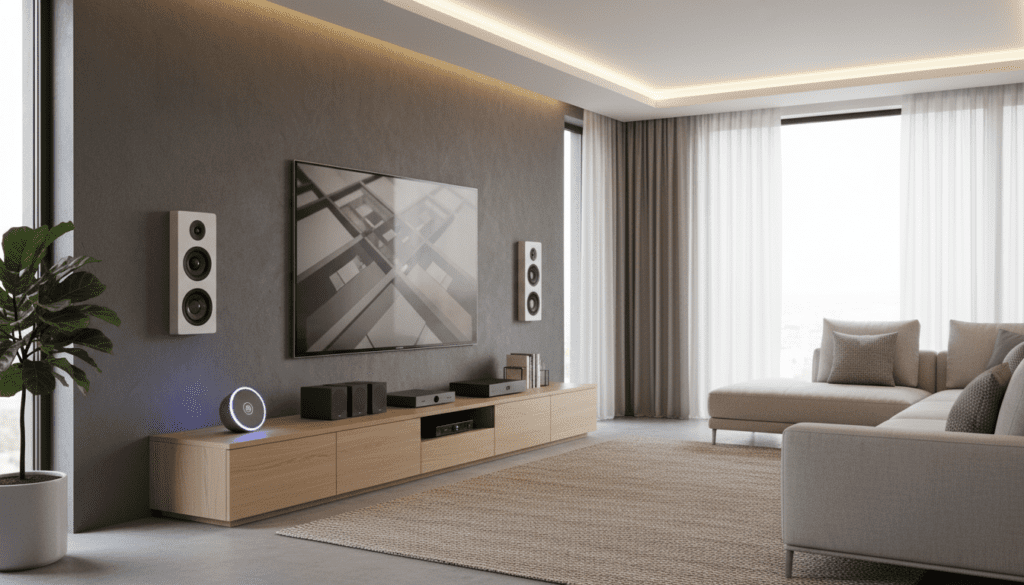
In my decade of installing custom home theaters, I’ve found that the most common mistake is trying to wire a small battery-powered transmitter directly to the speaker terminals. This will not work because the signal is too weak to move the speaker cones. You must ensure there is a power amplification stage in your signal chain to achieve audible, high-quality sound.
TL;DR: Key Takeaways for Connecting Transmitters
- Passive Speakers Require Amps: 90% of wall speakers need an external amplifier to work with a transmitter.
- Match the Technology: Ensure both your transmitter and receiver use the same protocol (e.g., Bluetooth 5.0, aptX Low Latency, or Wi-Fi).
- Latency Matters: For TV audio, use aptX Low Latency transmitters to avoid “lip-sync” issues.
- Power Matters: Your amplifier must match the impedance (ohms) and wattage of your wall speakers.
- Hidden Costs: Don’t forget you’ll need CL2 or CL3 rated speaker wire for in-wall runs to meet fire safety codes.
Understanding the Signal Chain: How Transmitters Work with Speakers
To understand how to connect a transmitter to wall speakers, we first need to break down the audio signal chain. In a traditional wired setup, your TV or record player connects directly to an amplifier via copper wires. In a wireless setup, the “wire” is replaced by a radio frequency.
The Components You Need
- The Source: This is your TV, smartphone, or laptop.
- The Transmitter: This device plugs into the Source and broadcasts the audio signal.
- The Receiver/Amplifier: This device catches the signal and boosts the electrical current.
- The Wall Speakers: The final output device that converts electricity into sound waves.
When people ask, “can i connect a transmitter to wall speakers,” they are often looking for a way to avoid running long cables across a room. I have successfully used 1Mii and Avantree long-range transmitters to bridge the gap between a media console and a set of rear wall speakers without tearing up any drywall.
Can I Connect a Transmitter to Wall Speakers Directly? (Passive vs. Active)
The answer hinges on the type of speakers you have installed. In the world of architectural audio, there is a massive distinction between Active (Powered) and Passive (Unpowered) units.
Passive Wall Speakers (The Industry Standard)
Most wall speakers from brands like Sonance, Polk Audio, and Klipsch are passive. They have two terminals on the back (+ and -) and nothing else.
- Connection Method: You cannot connect a transmitter directly. You must connect the transmitter to a wireless amplifier (like a Sonos Amp or a Denon HEOS) which then connects to the speakers via wire.
Active Wall Speakers (The Rare Exception)
Active wall speakers have built-in amplifiers and require a power outlet nearby. Some modern versions come with integrated Bluetooth receivers.
- Connection Method: Yes, you can pair a transmitter directly to these speakers. However, these are less common because providing high-voltage power inside a wall cavity is often a building code challenge.
Types of Transmitters for Wall Speakers
Choosing the right transmission technology is critical for performance. We generally categorize these into three buckets: Bluetooth, Wi-Fi, and RF (Radio Frequency).
| Technology | Best For | Pro | Con |
|---|---|---|---|
| Bluetooth (aptX) | Single Room / TV | Easy setup, low cost | Limited range (30-50 ft) |
| Wi-Fi (AirPlay/Chromecast) | Whole Home Audio | High Fidelity, No range limit | Higher cost, relies on router |
| 2.4GHz RF | Subwoofers / Rear Speakers | Zero Latency, long range | Potential interference with Wi-Fi |
Bluetooth Transmitters
If you are looking for a budget-friendly way to answer “can i connect a transmitter to wall speakers,” Bluetooth is your best bet. Look for Bluetooth 5.2 or higher. We always recommend units that support aptX Low Latency. In my testing, standard Bluetooth has a delay of about 200ms, which makes movie dialogue look like a poorly dubbed Kung-Fu film. aptX reduces this to under 40ms.
Wi-Fi Transmitters
Wi-Fi is the gold standard for Information Gain in audio. Unlike Bluetooth, Wi-Fi does not compress the audio signal nearly as much. Using a WiiM Pro or a Sonos Port allows you to transmit “Lossless” audio to your wall speakers. This is the preferred method for audiophiles who value clarity over simplicity.
Step-by-Step Guide: Connecting a Transmitter to Your Wall Speakers
Follow these steps to set up a wireless bridge for your architectural audio system.
Step 1: Identify Your Output Port
Check your audio source (TV or Receiver). Look for Optical (Toslink), RCA (Red/White), or 3.5mm Aux. I highly recommend using the Optical output for the cleanest digital signal.
Step 2: Set Up the Transmitter
- Plug the transmitter into a power source.
- Connect the audio cable from your TV to the Input on the transmitter.
- Set the transmitter to Pairing Mode.
Step 3: Configure the Receiving End
Since you are likely using passive wall speakers, you need a Wireless Receiver/Amplifier.
- Place the amplifier near the wall speakers.
- Connect the amplifier to the wall speakers using 14-gauge or 16-gauge speaker wire.
- Put the amplifier into Bluetooth Pairing or Wi-Fi Setup mode.
Step 4: Sync the Devices
Wait for the transmitter and the amplifier to “handshake.” Once the lights go solid, your wall speakers are now wirelessly connected to your source.
Step 5: Test for Phase and Latency
Play a video with clear speech. If the audio is out of sync, check if your transmitter has a latency adjustment or if your TV has an audio delay (Lip Sync) setting in the menu.
E-E-A-T Insights: Critical Considerations for Wall Installations
When I consult on residential builds, I always emphasize that wireless doesn’t mean “no wires.” Even if you use a transmitter, you still have to deal with the physical reality of the speakers inside the wall.
Impedance Matching
Most wall speakers are rated at 8 Ohms. If you connect two pairs of speakers to one small wireless amplifier, the impedance drops to 4 Ohms. If your amplifier isn’t rated for 4 Ohms, it will overheat and potentially catch fire inside your wall. Always check the labels on your equipment.
The “Faraday Cage” Effect
Walls filled with metal studs or foil-backed insulation can act as a shield, blocking Bluetooth and Wi-Fi signals. If you find the audio cutting out, you may need to move the transmitter outside of a media cabinet or use an external antenna.
Local Fire Codes
If you are running wires from an amplifier to your wall speakers (even if the signal is coming from a transmitter), you must use CL2 or CL3 rated wire. Standard lamp cord or “zip cord” is a fire hazard when run inside a wall because the jacket can emit toxic fumes if it burns.
Troubleshooting Common Transmitter Issues
Even with the best gear, you might encounter hurdles. Here is how we fix them in the field:
- Static or Humming: This is often a ground loop. Ensure your transmitter and amplifier are plugged into the same circuit, or use a Ground Loop Noise Isolator.
- Frequent Disconnects: 2.4GHz interference is the usual suspect. Move your Wi-Fi router at least 3 feet away from your audio transmitter.
- Weak Volume: Check if your source (the TV) has its output set to “Fixed” or “Variable.” For best results, set the source to Fixed and control the volume at the amplifier end.
FAQ: Frequently Asked Questions about Wall Speaker Transmitters
Can I connect a Bluetooth transmitter directly to passive wall speakers?
No. Passive speakers lack the internal electronics to decode a Bluetooth signal and the power to move the drivers. You must use a Bluetooth-enabled amplifier between the transmitter and the speakers.
Is there a wireless kit specifically for in-wall speakers?
Yes, brands like AmpliVox and OSD Audio sell wireless sub/satellite kits. These kits include a transmitter and a small, hideaway receiver-amplifier designed to sit behind a wall plate or in a ceiling cavity.
How far can I transmit audio to my wall speakers?
Standard Bluetooth transmitters work up to 30 feet. High-power Class 1 transmitters (like the 1Mii B03) can reach up to 160 feet line-of-sight. For distances greater than that, or for signals going through multiple walls, a Wi-Fi-based system is required.
Will using a transmitter lower my audio quality?
It depends on the codec. Standard SBC Bluetooth compresses audio significantly. However, aptX HD or Wi-Fi (AirPlay 2) provides near-CD or high-resolution quality that most listeners cannot distinguish from a wired connection.
Final Thoughts from the Expert
When asking “can i connect a transmitter to wall speakers,” you are looking for a solution to a cabling nightmare. While the answer is a resounding yes, the success of your project depends on the quality of your Amplifier-Receiver. Don’t skimp on the receiving end; a cheap $20 Bluetooth board will produce a “hiss” that will drive you crazy in a quiet room. Invest in a dedicated wireless power amp to give your wall speakers the juice they deserve.