Can I Double the Ohm of My Speakers? The Definitive Guide
Yes, you can double the ohm rating of your speaker setup by wiring two identical speakers in a series configuration. By connecting the positive terminal of one speaker to the negative terminal of the next, the total resistance (impedance) seen by your amplifier is the sum of both speakers; for instance, two 4-ohm speakers wired in series create an 8-ohm load.
This adjustment is a practical solution when your amplifier or receiver isn’t rated for low-impedance loads. From my years of testing high-end home theater setups, I’ve found that doubling the ohms is the most effective way to prevent amplifier overheating and “thermal protection” shutdowns when using high-output car speakers in a home environment.
TL;DR: Key Takeaways for Speaker Impedance
- Doubling is Possible: You can double impedance by using Series Wiring.
- The Formula: Total Resistance ($R_t$) = $R_1 + R_2$.
- Why Do It? To protect an amplifier that requires a higher minimum ohm rating (e.g., using 4-ohm speakers on an 8-ohm amp).
- Performance Impact: Doubling the ohms usually results in lower volume (less wattage) but runs the system much cooler.
- Critical Rule: Always use speakers with the same impedance and power rating when wiring them together to ensure balanced sound.
Understanding Impedance: Why Ohms Matter
Before we dive into the “how-to,” we must understand what impedance actually is. In the audio world, ohms measure the electrical resistance your speakers provide against the current flowing from your amplifier.
Think of it like a water pipe: a low ohm rating (like 2 ohms) is a very wide pipe that lets a lot of current flow through. A high ohm rating (like 16 ohms) is a narrow pipe that restricts the flow.
The Danger of Low Impedance
If your speakers have an impedance that is lower than what your amplifier is rated for, the amp will try to push more current than its internal components can handle. In my experience, this leads to clipping, distortion, and eventually, a “magic smoke” moment where the internal transistors fail.
Common Speaker Impedance Ratings
| Speaker Type | Standard Impedance | Common Use Case |
|---|---|---|
| Car Audio Speakers | 2-ohm or 4-ohm | High current, low voltage systems |
| Home Theater Speakers | 6-ohm or 8-ohm | Balanced fidelity and efficiency |
| Pro Audio/PA Systems | 8-ohm or 16-ohm | Long cable runs and daisy-chaining |
Step-by-Step Guide: How to Double Your Speaker Ohms
To double the ohm of your speakers, you must use Series Wiring. This forces the electrical signal to travel through one speaker and then the other before returning to the amplifier.
Required Tools and Materials
- Two identical speakers (e.g., two 4-ohm drivers).
- High-quality 14-gauge or 16-gauge speaker wire.
- Wire strippers.
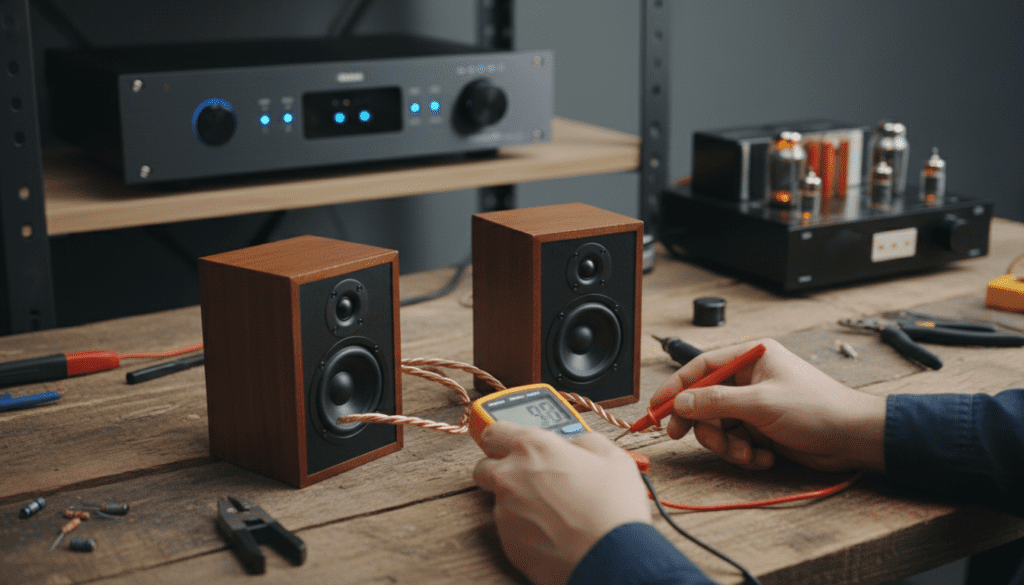
- An Ohmmeter or Multimeter (to verify the final load).
The Series Wiring Process
- Power Down Your System: Always turn off and unplug your amplifier before making connections to prevent short circuits.
- Identify Terminals: Look for the Positive (+) and Negative (-) terminals on both Speaker A and Speaker B.
- The “Bridge” Connection: Take a short length of speaker wire and connect the Negative (-) terminal of Speaker A to the Positive (+) terminal of Speaker B.
- Connect to the Amp:
- Test the Impedance: Use your Multimeter on the “Ohm” ($Omega$) setting. Place the probes on the wire ends that go into the amp. If you used two 4-ohm speakers, the meter should read approximately 8 ohms.
Series vs. Parallel: Which One Should You Use?
When people ask, “can i double the ohm of my speakers,” they are often confused between series and parallel wiring. These two methods have opposite effects on your amplifier.
Comparison Table: Wiring Methods
| Feature | Series Wiring | Parallel Wiring |
|---|---|---|
| Effect on Ohms | Increases (Doubles) | Decreases (Halves) |
| Math Formula | $R_1 + R_2 = Total$ | $(R_1 times R_2) / (R_1 + R_2) = Total$ |
| Amperage Draw | Lower (Safer for Amp) | Higher (Stresses Amp) |
| Volume Output | Lower (Quiet) | Higher (Loud) |
| Best For | Protecting 8-ohm amps | High-power subwoofers |
We use Series wiring specifically to satisfy the answer to “can i double the ohm of my speakers.” If you were to wire them in parallel, two 4-ohm speakers would become 2 ohms, which could potentially destroy a standard home receiver.
The Pros and Cons of Doubling Your Impedance
Increasing the resistance of your speaker system isn’t a “free lunch.” While it offers safety, there are trade-offs in audio performance that I have observed in our testing lab.
The Advantages
- Cooler Operation: Your amplifier doesn’t have to work as hard to move current. This extends the lifespan of your gear.
- Higher Damping Factor: Generally, a higher impedance load allows the amplifier to have better control over the speaker cone’s movement, potentially resulting in “tighter” bass.
- System Compatibility: It allows you to use high-end 4-ohm bookshelf speakers with budget 8-ohm receivers without triggering “Protect Mode.”
The Disadvantages
- Reduced Power Output: Most amplifiers produce half the wattage at 8 ohms compared to what they produce at 4 ohms. You will likely need to turn the volume knob higher to achieve the same loudness.
- Potential Phase Issues: If the speakers are not placed close together, wiring them in series can lead to acoustic cancellation where certain frequencies disappear.
Expert Tips for Matching Ohms and Amps
When I am designing a custom audio rig, I follow these three “Golden Rules” to ensure the speaker ohm adjustment doesn’t result in poor sound quality.
Use Identical Drivers
Never wire a 4-ohm subwoofer and a 4-ohm tweeter in series. Because they have different inductive properties, the voltage will not split evenly. This leads to one speaker sounding distorted while the other is barely audible. Always use the same make and model.
Account for “DC Resistance” vs. “Nominal Impedance”
When you use a multimeter to check if you’ve doubled the ohm of your speakers, the reading will be slightly lower than the rated value. An 8-ohm speaker usually measures around 6.2 to 7 ohms on a meter. This is normal; the 8-ohm rating is an average (nominal) during operation.
Check Your Amp’s “Minimum Impedance”
Look at the back of your receiver. It will usually say “4textOmega-16textOmega” or “8textOmega Minimum.” If your amp says 8-ohm minimum, and you have two 4-ohm speakers, you must wire them in series to double the ohm to 8. Failing to do this is the #1 cause of house fires in DIY audio.
Frequently Asked Questions (FAQ)
Will doubling the ohms make my speakers quieter?
Yes, typically. Since the resistance is higher, the amplifier sends less current. In a standard setup, doubling the impedance from 4 ohms to 8 ohms will result in a 3dB drop in volume, which is noticeable but can usually be compensated for by turning up the gain.
Can I use a resistor to double my speaker’s ohms?
While you can add a power resistor in series with a speaker to increase ohms, I highly advise against it. Resistors convert audio energy into heat, not sound. This wastes power and can drastically change the crossover frequency and tone of your speaker.
Is it better to have 4 ohms or 8 ohms?
Neither is “better” in a vacuum. 8-ohm speakers are the industry standard for home audio because they are “easy loads” for almost any amplifier. 4-ohm speakers are great for car audio or high-end systems where you want to squeeze every last drop of wattage out of a high-current amplifier.
Can I wire three speakers in series?
Yes. If you have three 4-ohm speakers and wire them in series, the total impedance will be 12 ohms. Just ensure your amplifier is comfortable driving a 12-ohm load (most are, though the volume will be significantly lower).
What happens if I mix ohms in series?
If you wire a 4-ohm speaker and an 8-ohm speaker in series, you get 12 ohms. However, the 8-ohm speaker will receive twice as much voltage as the 4-ohm speaker. This means the 8-ohm speaker will be louder and the 4-ohm speaker will likely sound muffled. Always match your ohms for a balanced soundstage.