Can I Get Good Bass From Door Speakers? The Definitive Guide
Yes, you can absolutely get rich, punchy bass from door speakers by transforming your car door into a sealed acoustic enclosure. While most factory setups sound thin and “tinny,” achieving high-quality low-end response requires a combination of sound deadening, proper sealing, and adequate amplification. By following a structured installation process, you can achieve mid-bass that you can actually feel in your chest without necessarily adding a bulky subwoofer box.
Key Takeaways for Elite Door Bass
- Acoustic Treatment is King: 70% of bass performance comes from the door’s environment, not just the speaker itself.
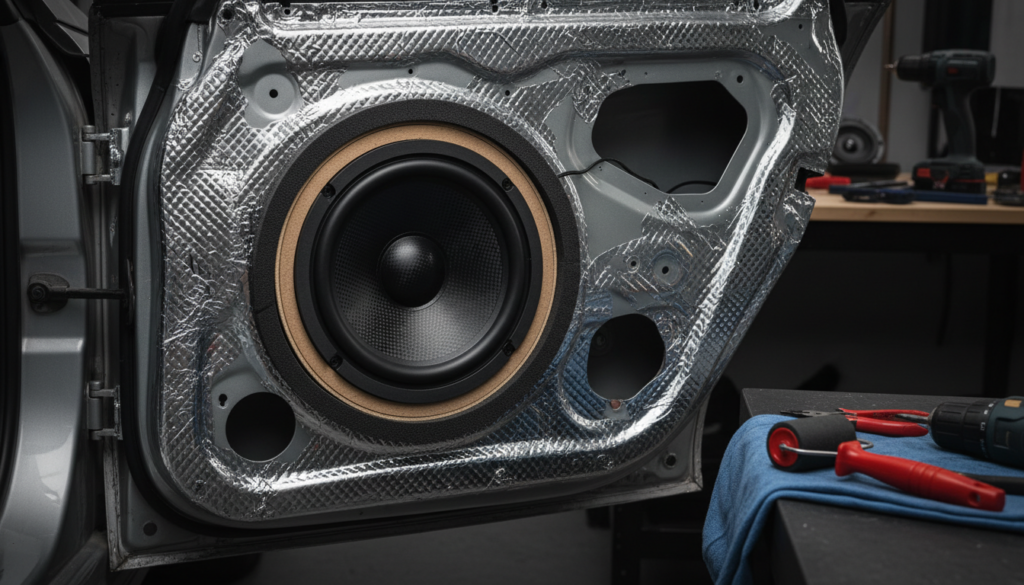
- Seal the Holes: You must cover the large access holes in the inner door skin to prevent back-wave interference.
- Decouple the Speaker: Use foam rings (Fast Rings) to tunnel sound directly through the door panel and into the cabin.
- Power Matters: Use an external amplifier; factory head units rarely provide enough current to move a woofer cone effectively for bass.
- Rigidity: Adding mass to the thin sheet metal stops “panel flex,” which otherwise eats your bass energy.
Why Factory Door Speakers Lack Bass
Before we dive into the “how-to,” we need to understand the “why.” I have spent over a decade tearing apart car doors, and the problem is almost always the same: the door is a terrible speaker box.
Car doors are made of thin, resonant sheet metal filled with holes for wires, lock rods, and drainage. When a speaker moves forward to create a sound wave, it also creates an equal and opposite wave moving backward.
In a perfect world, these waves never meet. In a factory car door, the back-wave wraps around to the front and cancels out the low frequencies. This is why you might ask, “can i get good bass from door speakers,” and the answer is only “yes” if you fix the “infinite baffle” environment.
Step 1: Add Mass with Sound Deadening (CLD)
The first step in any high-end audio build is treating the metal. When the bass hits, the thin metal of your door vibrates. This vibration creates its own sound, which is out of phase with your music, effectively “sucking” the bass out of the air.
I recommend using Constrained Layer Damper (CLD) tiles, such as Dynamat Xtreme or SoundSkin.
How to apply CLD tiles:
- Clean the Surface: Use denatured alcohol to wipe down the inside of the outer door skin.
- Apply to Outer Skin: Reach through the access holes and apply tiles directly to the metal behind the speaker.
- The 25% Rule: You don’t need to cover 100% of the metal to stop resonance, but for maximum bass, aim for at least 60-70% coverage.
- Roll it In: Use a wooden or metal roller to ensure the butyl adhesive is fully bonded to the metal. If there are air bubbles, it won’t work.
| Material Type | Purpose | Top Brands |
|---|---|---|
| Butyl Rubber (CLD) | Stops metal vibration/resonance | Dynamat, Hushmat, Noico |
| Closed Cell Foam (CCF) | Decouples panels to stop rattles | SoundShield, Second Skin |
| Mass Loaded Vinyl (MLV) | Blocks external road noise | Luxury Liner Pro |
Step 2: Create a Sealed Enclosure
This is the most “missed” step by DIYers. If you want to know how can i get good bass from door speakers, the secret is sealing the inner door skin.
Most doors have a plastic “vapor barrier” held on by messy black goo. This plastic does nothing for sound. You need to replace it with something rigid to turn the door into a true enclosure.
Professional Sealing Techniques:
- ABS Plastic Sheets: Cut pieces of 1/8″ ABS plastic to fit over the large access holes in the door frame. Screw or rivet them into place.
- Aluminum Flashing: If ABS is too difficult, use heavy-duty aluminum flashing and cover it with sound deadener.
- The Goal: Ensure that no air from the back of the speaker can easily leak through to the front of the speaker. This creates the “pressure” needed for deep bass.
Step 3: Install High-Quality Speaker Baffles
The mount for your speaker must be as rigid as possible. If the speaker is mounted to a flimsy plastic adapter, the energy that should be moving the cone is instead moving the adapter.
I always suggest swapping cheap plastic brackets for CNC-machined PVC or treated MDF rings.
Pro Tip: If you use MDF, you must paint or coat it in truck bed liner. Car doors are wet environments, and untreated wood will rot and mold within a single season.
Step 4: Use Foam Acoustic Rings (Decoupling)
Even with a great speaker and a sealed door, much of the sound gets trapped behind the plastic interior door panel. This causes “muddy” mid-bass and creates annoying rattles.
How to use Fast Rings:
- Gasket Ring: Place a thin foam ring behind the speaker to seal it to the baffle.
- Center Ring: Place a thick foam ring on the front of the speaker.
- The Compression Fit: When you put the door panel back on, this foam should compress against the back of the speaker grille.
- The Result: This creates a “tunnel” that forces every bit of bass energy through the grille and directly into your ears.
Step 5: Choose the Right Speakers for Bass
Not all 6.5-inch or 6×9 speakers are created equal. If your goal is bass, you need to look at specific technical specs.
What to look for (TS Parameters):
- Fs (Resonant Frequency): Look for a lower Fs (below 60Hz is great for door speakers).
- Xmax (Linear Excursion): This measures how far the cone can move. More Xmax generally means more bass potential.
- Sensitivity: If you aren’t using an amp, look for high sensitivity (90dB+). If you have an amp, this matters less.
Expert Recommended Bass-Heavy Door Speakers:
- Morel Virtus Nano Carbon: Incredible excursion for their size.
- Audiofrog GS60: Known for world-class mid-bass impact.
- Focal K2 Power: Exceptionally punchy, though they require a high-quality amp.
Step 6: Powering Your Progress (The Amplifier)
Can you get good bass from door speakers using just a factory head unit? Rarely.
Most factory radios put out about 10-15 watts of “dirty” power. To move a high-quality woofer cone and control it accurately, you need headroom. I recommend at least 50 to 100 watts RMS per channel.
An External Amplifier provides the “damping factor” needed to stop the speaker cone quickly after a bass hit. This results in “tight” bass rather than “boomy” or “sloppy” sound.
Step 7: Tuning and High-Pass Filters
Once everything is installed, you must tune the system. If you send 20Hz notes (ultra-low sub-bass) to a 6.5-inch door speaker, it will distort and potentially break.
- Set the High-Pass Filter (HPF): Start at 80Hz. This allows the door speaker to focus on the frequencies it handles best (80Hz to 250Hz).
- Adjusting Down: If your doors are extremely well-sealed and deadened, you can try dropping the HPF to 60Hz.
- Listen for “Popping”: If the speaker sounds like it’s “bottoming out,” your HPF is too low.
Real-World Comparison: Treated vs. Untreated Doors
In my shop, we did a frequency response test on a 2022 Toyota Tacoma.
| Feature | Factory Door (Untreated) | Fully Treated Door |
|---|---|---|
| Bass Impact (60-100Hz) | Weak, audible rattles | Solid “thump,” no rattles |
| Clarity | Muddy mid-range | Crisp vocals, distinct drums |
| Road Noise | High (65dB at 60mph) | Reduced (58dB at 60mph) |
| Speaker Life | Vulnerable to moisture | Protected by silicone baffles |
Troubleshooting Weak Bass
If you’ve done the work and the bass still feels “missing,” check these two things:
- Phase Issues: If you accidentally swapped the positive and negative wires on one speaker, the two speakers will cancel each other’s bass out.
- Polarity at the Amp: Ensure the amp inputs match the head unit outputs correctly.
Frequently Asked Questions
Will 6.5 speakers give me enough bass?
Yes, if they are high-quality component sets installed in a treated door. While they won’t hit the “sub-sonic” notes of a 12-inch subwoofer, they can provide very satisfying, punchy mid-bass that makes rock and hip-hop sound full.
Do I need a subwoofer if I fix my door speakers?
It depends on your taste. For many listeners, a perfectly treated door provides enough bass for a balanced “audiophile” experience. However, for “bass-heads” who want to feel the car shake, a subwoofer is still necessary for frequencies below 50Hz.
Is sound deadening really worth the money?
Absolutely. It is the single most cost-effective upgrade in car audio. Even cheap speakers will sound significantly better in a deadened door than expensive speakers in a factory “raw” door.
Can I get good bass from door speakers without an amp?
It is difficult. You will need to choose “high-efficiency” speakers (like those from Hertz or Blam) designed to run on low power. However, you will still hit a volume limit where the bass begins to distort because of the head unit’s limited power supply.
Summary for Success:
To answer the question, “can i get good bass from door speakers,” you must stop looking at the speaker as a standalone component. The door is the cabinet. Seal it, stiffen it, and power it properly, and you will be amazed at the low-end performance your vehicle can produce.