Can I Hook Speakers Straight to a Mixer? The Direct Answer
You can hook speakers straight to a mixer only if the speakers are “active” (powered); however, if you have passive (unpowered) speakers, you cannot connect them directly and must use an external power amplifier. Connecting passive speakers directly to a standard mixer output will result in extremely low volume or no sound at all because the mixer only outputs a low-level “line” signal.
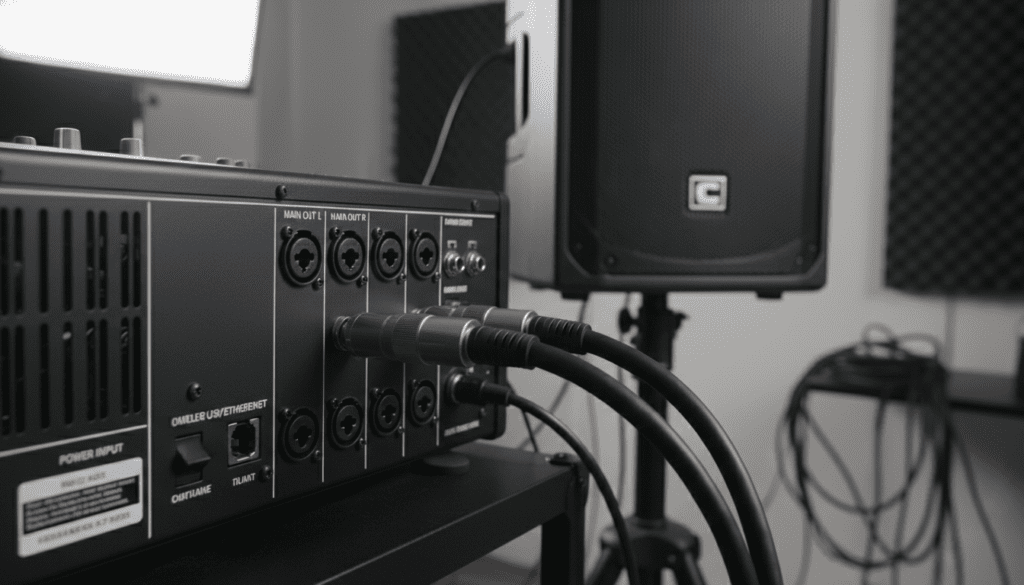
To ensure your audio system functions correctly and safely, you must first identify whether your speakers have built-in amplifiers. During my years of setting up live sound for venues, I have found that mixing up these two types is the most common cause of equipment failure for beginners.
🚀 Key Takeaways: Mixer-to-Speaker Connections
- Active Speakers: These have a built-in power cord and amplifier. You can hook these straight to a mixer.
- Passive Speakers: These do not have a power cord (only speaker wire inputs). You cannot hook these straight to a mixer without an amp.
- The “Powered Mixer” Exception: If your mixer has a built-in amplifier (a “powered mixer”), you can connect passive speakers directly to it.
- Cable Types: Use XLR or TRS (1/4″) cables for active speakers, and Speakon or Banana Plugs for passive speakers connected to an amp.
- Risk Factor: Plugging a powered output (from an amp) into a mixer’s input can fry the mixer’s circuitry.
Understanding the Signal Path: Why “Can I Hook Speakers Straight to a Mixer” is Complex
To understand why you might need extra gear, you need to understand the Signal Chain. A mixer takes multiple inputs (microphones, instruments) and blends them into a Line-Level Signal.
This signal is electrically weak—strong enough to travel through a cable, but too weak to physically move the heavy cones inside a loudspeaker. An amplifier acts as the “muscle” that boosts this weak signal into a Speaker-Level Signal.
Active vs. Passive Speakers: A Comparison
| Feature | Active (Powered) Speakers | Passive (Unpowered) Speakers |
|---|---|---|
| Internal Amp? | Yes | No |
| Power Source | Requires a wall outlet | Powered by the amplifier |
| Direct Mixer Connection? | Yes | No (Needs an Amp) |
| Common Cables | XLR, 1/4″ TRS | Speakon, 1/4″ TS, Speaker Wire |
| Best For | Mobile DJs, small bands, home studios | Permanent installs, large touring rigs |
Can I Use Direct Out from Mixer for Speakers?
Many beginners ask, “can i use direct out from mixer for speakers?” The answer depends entirely on the speaker type. A “Direct Out” on a mixer is typically a line-level tap from a specific channel, intended for recording or external processing.
If you plug an active speaker into a Direct Out, it will work, but you will only hear that specific channel, not the whole mix. If you plug a passive speaker into a Direct Out, you will hear nothing because there is no wattage behind that port to drive the speaker’s woofer.
How to Connect Active Speakers Straight to a Mixer
If you have confirmed your speakers are active (they have their own power switch and volume knob on the back), follow these steps to get sound.
- Power Down Everything: Ensure both the mixer and the speakers are turned off before connecting.
- Locate Main Outs: Find the Main Outputs (usually labeled “Main Out,” “Stereo Out,” or “L/R Out”) on the top or back of your mixer.
- Choose Your Cables: Most modern mixers use XLR (3-pin) or 1/4″ TRS cables for main outputs.
- Connect the Cables: Run the Left output to the Left speaker and the Right output to the Right speaker.
- Set Gain to Zero: Turn the volume knobs on the back of your speakers all the way down.
- Power On Sequence: Turn on the mixer first, then the speakers. This prevents a “thump” that can damage components.
- Adjust Levels: Bring your mixer faders to “0” (Unity) and slowly turn up the volume on the back of the speakers until you reach your desired level.
Can You Connect Passive Speakers Straight to a Mixer?
The short answer is: No, you cannot connect passive speakers straight to a mixer unless that mixer is specifically labeled as a Powered Mixer.
Standard mixers, like those from Mackie, Behringer, or Yamaha, only output milliwatts of power. A passive speaker usually requires between 100 and 1000 watts to produce audible sound. If you try to plug speakers straight into mixer output without an amp, you are essentially trying to power a car with a watch battery.
Step-by-Step: Connecting Passive Speakers (The Correct Way)
To use passive speakers, you must introduce an intermediary device: the Power Amplifier.
- Mixer to Amp: Use XLR or TRS cables to connect the Mixer’s Main Outputs to the Inputs of the Power Amplifier.
- Amp to Speakers: Use heavy-duty Speaker Cables (12-gauge or 14-gauge) to connect the Amplifier’s Outputs to the Passive Speakers.
- Impedance Check: Ensure your amplifier’s Ohm rating matches your speakers (usually 4 or 8 ohms). In my experience, mismatching impedance is the #1 reason for overheating amplifiers.
- The “Last On” Rule: Always turn the power amplifier on last after all other gear is powered up.
What is a Powered Mixer?
There is one major exception to the “no passive speakers” rule. A Powered Mixer (such as the Yamaha EMX series or Peavey XR series) has a built-in power amplifier inside the mixer chassis.
You can tell you have a powered mixer if:
- The unit is significantly heavier than a standard mixer.
- The back panel has large cooling fans.
- There are “Speaker Out” jacks (usually Speakon or 1/4″ TS) on the back with wattage ratings (e.g., 500W + 500W).
If you have one of these, you can hook passive speakers straight to the mixer using dedicated speaker cables.
Essential Cable Guide for Mixer Connections
Using the wrong cable can result in hum, buzz, or signal loss. Use this table to identify the correct cable for your specific “can i hook speakers straight to a mixer” scenario.
| Connection Type | Cable Recommended | Why? |
|---|---|---|
| Mixer to Active Speaker | XLR Male to Female | Balanced signal reduces noise over long distances. |
| Mixer to Power Amp | 1/4″ TRS to XLR | High-quality line-level transfer. |
| Power Amp to Passive Speaker | Speakon NL4 | Professional, locking connection that handles high voltage safely. |
| Powered Mixer to Passive Speaker | 1/4″ TS Speaker Cable | Specifically designed for high-current loads (do NOT use instrument cables). |
Expert Tip: Never use a standard guitar/instrument cable to connect an amplifier to a passive speaker. Instrument cables are shielded but have thin internal wires that can melt under the high current of an amplifier, potentially starting a fire or killing your amp.
Common Risks of Improper Connection
When people ask “can you connect passive speakers to a mixer,” they often overlook the potential for damage. Here is what can happen if you get it wrong:
The “Silence” Scenario
If you plug a passive speaker into a line-level output, you will hear a faint whisper of sound even at full volume. This won’t necessarily break anything, but it makes your gear useless for a performance.
The “Fried Mixer” Scenario
If you accidentally plug the Output of a power amplifier into the Input or Output of a mixer, the high voltage will instantly destroy the mixer’s delicate op-amps. I once saw a church volunteer do this, resulting in a $1,200 repair bill for a digital console.
Blown Drivers
If you use an active speaker but set the mixer output too high (clipping), you send a “square wave” to the speaker’s internal amp. This can overheat the voice coils and blow the speaker, even if it’s a “straight” connection.
Troubleshooting Your Setup
If you have followed the guide above and still don’t have sound, check these three common failure points:
- Phantom Power (48V): While usually meant for microphones, some older mixers can cause pops in active speakers if Phantom Power is engaged globally. Turn it off unless using condenser mics.
- The Mute Button: It sounds simple, but many mixers have “Mute” or “Alt 3-4” buttons that route sound away from the main outputs.
- Level Mismatch: Ensure your mixer is outputting a “+4dBu” (Professional) signal rather than “-10dBV” (Consumer) if your active speakers expect a hot signal.
FAQ: Can I Hook Speakers Straight to a Mixer?
Can I use a guitar cable to connect my mixer to my powered speakers?
Technically, yes, if the distance is short (under 10 feet). However, a guitar cable is unbalanced (TS) and will likely pick up radio interference or hum. For the best result, use a balanced TRS or XLR cable.
Can you connect passive speakers to a mixer if you use a “Y” cable?
No. A “Y” cable does not add power. It only splits the signal. You still require an external power amplifier to drive the passive speakers.
How do I know if my speaker is active or passive?
Check the back of the speaker. If it has a power switch, a fuse holder, or a plug for a wall outlet, it is active. If it only has a red and black terminal or a Speakon jack with no power cord, it is passive.
Is it better to use active or passive speakers with a mixer?
For most modern users, active speakers are better. They are easier to set up (you can hook them straight to the mixer), the internal amp is perfectly matched to the driver, and they include built-in limiters to prevent damage.